Editorial – The Scottish Banner Says….

March – 2022 (Vol. 45, Number 09)

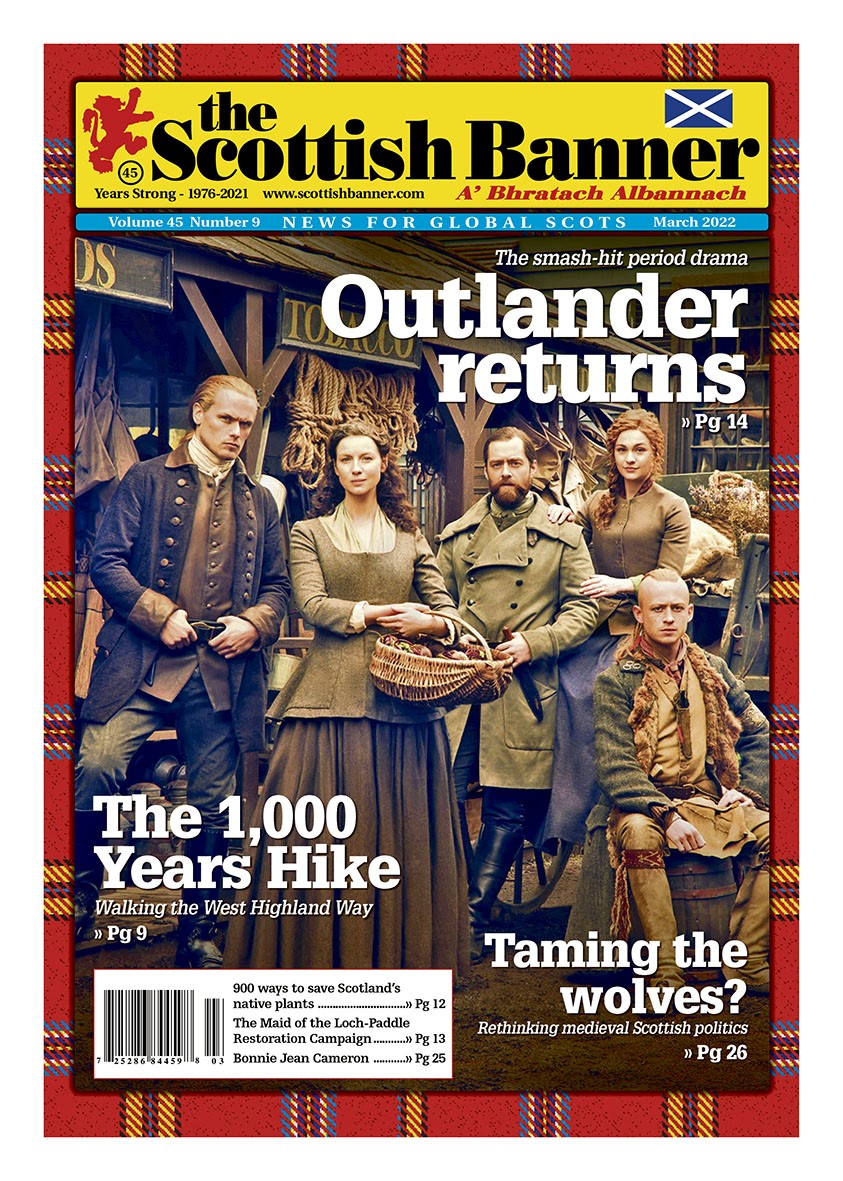
The cast of Outlander Season 6. Photo courtesy of Starz.

The Banner Says…

‘Hopping’ to stay on the Bonnie, Bonnie Banks

Just outside Glasgow sits one of Scotland’s most beautiful attractions, and the largest lake by surface area in the UK (and the second largest lake by volume after Loch Ness), Loch Lomond.

We of course all know the song about ‘The bonnie, bonnie banks of Loch Lomond’ and it boasts 22 islands and 27 islets (very small islands).

Inchconnachan

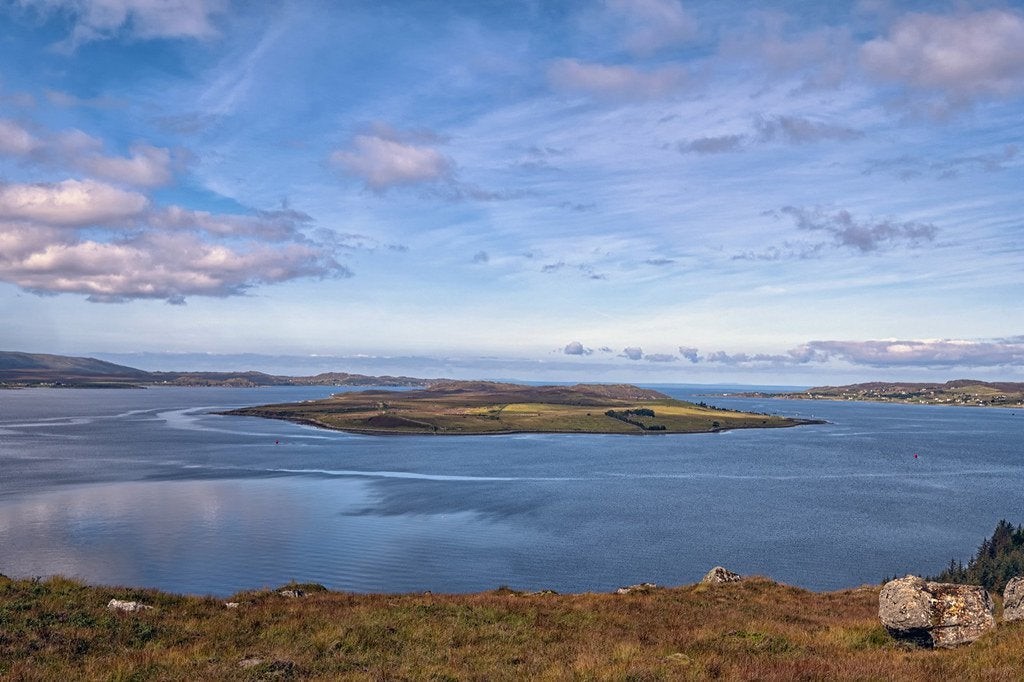
I have been fortunate to travel to Loch Lomond a few times and take in the amazing natural beauty and history of the area. On my last visit a few years ago I was on a boat and the crew were telling us about some very unique and special local residents you may not expect to find on the loch, or in Scotland for that matter. The uninhabited island of Inchconnachan, has been home to a clan of red-necked wallabies. Associated with the vast Australian landscape a Wallaby is a marsupial or pouched animal that is a member of the kangaroo family.

The name Inchconnachan comes from the Gaelic form of Innis Chonachain, meaning ‘The Colquhoun’s Island’. Interestingly most of Loch Lomond’s islands include ‘Inch’, which originates from the Gaelic word ‘innis’ for island. The 42-hectare island was owned by the Colquhoun family for more than seven centuries.

But just how did wallabies end up on a Scottish island? Fiona Bryde Colquhoun, the Countess of Arran, brought in the wallabies from her Hertfordshire home at the end of the Second World War. Lady Arran was passionate about animals, nature and Scotland and the couple she brought to the island soon became a colony of about 60 who survived on the island’s dense oak, holly, and birch. Some also may be surprised to hear that the Countess of Arran later in life was the first person to average 100 mph in an offshore boat and became known as the ‘fastest granny on water’.

Wallaby Island

In 2020 Inchconnachan, or Wallaby Island as it is also known, went up for sale and must have been considered one of Scotland’s most unique property sales at the time. It sold for over £1.5 million, and the new owners now want to turn the island into an eco-holiday let island and clear out the wallaby population, who have now resided on the island for over 80 years. The new owners are keen for the animals to be relocated, however an online petition (www.change.org/p/scottish-government-save-the-wallabies-of-loch-lomond) to protects both the wallabies and their habitat has begun in protest, at time of press the target of 75,000 signatures was about to be reached.

People from around Scotland and the world have voiced their concerns. Whilst these animals might be more expected in the Australian outback, they have adapted to Scottish life and formed a multi-generational base and become part of the Scottish ecosystem and have economic benefits as they draw tourists to the region to see the unique animal in the wild.

Some wildlife experts fear the stress of relocation could be fatal to some of the wallabies and that they now play a part in the ecosystem. While others insist, they are not native to Scotland and should be culled. There is suggestion they pose a threat to native wildlife such as grouse and capercaillie and the island should be left to them and other native species like ospreys, otters, deer, and birds. The long-term goal for the island is to have any non-native species population be zero (or as close as possible) and this includes all species of both flora and fauna. The new owners are thankfully not supportive of culling the animals.

In this issue

Across the world this month fans of the Outlander television series can breathe a sigh of relief as the hit period drama returns. Outlander has been an incredible success for Scotland and generated much interest in Scottish history, tourism and helped create many jobs in the Scottish film and production industry. I remember being at Highland Games back in the 1990’s and seeing the author Diana Gabaldon at the same events promoting her books which she could never have known would translate to a global television phenomenon, just as her books have.

This month on March 8th is International Women’s Day and we likely could have filled up a few pages with some of the amazing Scots women who have blazed a trail for those who came behind them. We do however look at Bonnie Jean Cameron, she broke just a few glass ceilings as she took men to battle and was simply ‘too much woman’ for some. This year is the 250th anniversary of her death and we are so glad to highlight this dynamic Scot.

One of Loch Lomond’s most unique residents

Could one of Lady Arran Colquhoun legacies, the 80-year residency of wallabies, soon be over on Loch Lomond? Certainly one of Loch Lomond’s most unique residents could go elsewhere, and there are in fact wallabies living across the UK, but Clan Wallaby have made home on Inchconnachan. Their future lies in the hands of local government and the new owners, and it may no longer include those bonnie, bonnie banks.

What do you think should happen to the wallabies of Inchconnachan? Share your story with us! Do you have you any comments from the content in this month’s edition? Share your story with us by email, post, social media or at: www.scottishbanner.com/contact-us

#ScottishBanner, #TheBanner

Covid-19 is having a major impact on many of our regular advertisers, with events being cancelled and businesses suffering. The Scottish Banner is more reliant than ever on our readers helping us to provide you with our unique content by buying a copy of our publication, regardless if by print or digital subscription or at a retail outlet.
We appreciate your support and hope you enjoy this edition.
Loch Lomond- A story of Culloden

By: Dr Wade King

The song Loch Lomond is well-known by Scots. Most of us learnt it as children. The lyrics are not immediately clear; it is a lament about “me and my true love” but it does not say who they were. The story behind the song is true. “Me and my true love” were Robert King and his wife Janet Kissock who lived in Renfrewshire from 1673 to 1746. They courted in 1698 – 1700 and married in 1700, to be parted by his death 46 years later.

Robert King’s baptism was recorded on 3rd January 1673 in the Old Parish Registers of the parish of Kilbarchan [ref. O.P.R. 568/1053 Kilbarchan] as “Robert son lawful to James King and Agnes Ffairy”. His parents were from the Dudwick estate at Ellon in Aberdeenshire. They had to leave Dudwick because they belonged to the Scots Episcopalian church, were Tory by political persuasion and their families had supported King Charles I in the Civil Wars of 1638-1649. The King family of Ellon were attainted specifically by a 1644 Act of the Scots Covenanter (anti-Royalist) parliament because General James King, Lord Ythan, had led the Royalist army centre at the Battle of Marston Moor in 1644. Also in that Royalist army were James’s brothers William and John, sons of the King family of Barra in the Garioch district of Aberdeenshire. That William King was the grandfather of James King who married Agnes Ffairy.

In 1652 Cromwell led an English army into Aberdeenshire to kill Royalists or drive them from their lands. James King and Agnes Ffairy fled before Cromwell’s forces. With other Episcopalians and Tories, they moved south to Renfrewshire, a Whig area where Cromwell would be unlikely to seek them. Many settled around Paisley, near Glasgow. The local Presbyterians were generous in letting them worship in one of the side chapels of the Abbey in Paisley. This was named the Non-Conformist Chapel to disguise its congregation. The Episcopalian families recorded their baptisms and marriages in the Old Parish Registers there for generations. These Episcopalian records were thought by genealogists to be lost until a few years ago, when the current author discovered them hidden in plain sight in the Abbey registers.

Robert King grew up on the family farm in Kilbarchan with his father James King, his mother Agnes Ffairy, his younger brothers William and James, and his younger sister Janet. Robert is recorded as attending Kilbarchan Kirk on 30th June 1686. Members of the extended King family lived around the Clyde, with other Episcopalian families that had sought refuge in the 1650s. In childhood, the King children roamed the farmlands along the Clyde and later the hilly country north of the river, out to the Highland hills around Loch Lomond, where the boys hunted the wild red deer.

Janet Kissock

Janet Kissock was born around 1680 but no record of her birth has been found. She was the daughter of George Kissock of Cumnock in Ayreshire. He later moved his family to Auchinleck in Ayreshire.

In 1698 Robert King met and became enamoured of Janet Kissock. In 1699 Robert aged 26 and Janet about 19 were courting as “true loves”, roaming in the gloaming along the River Clyde and the bonnie banks of Loch Lomond. They married in her family church in Auchinleck on 20th August 1700. They lived in Cumnock, Ayreshire and later in Beith, Renfrewshire, where Robert developed a farm and a mill. They had three sons, George born 1702, William born 1705 and James born 1707, and a daughter Janet born 1709.

Politics in Scotland became polarised between the Whigs in power in Edinburgh, supported by the Hanoverian government in London, and the Jacobites wanting restoration of a Stuart King, “the King over the water”, James VIII of Scots. In 1715 came the first major Jacobite rising, “the Fifteen”. Robert was a Tory, a Royalist and a Jacobite, like all his family, so he took his weapons and went to join the Jacobite army raised by John, Earl of Mar. Robert was then aged 42. He enlisted in Mar’s army and fought in the Battle of Sheriffmuir on 13th November 1715. The battle was indecisive and the surviving Jacobites retired. Robert went home to Beith and his soulmate, Janet Kissock.

Meanwhile, King James VIII’s son Charles Edward Stuart, remembered as Bonnie Prince Charlie, campaigned in France for a Stuart restoration. He pressed King Louis XV of France for financial and military support.

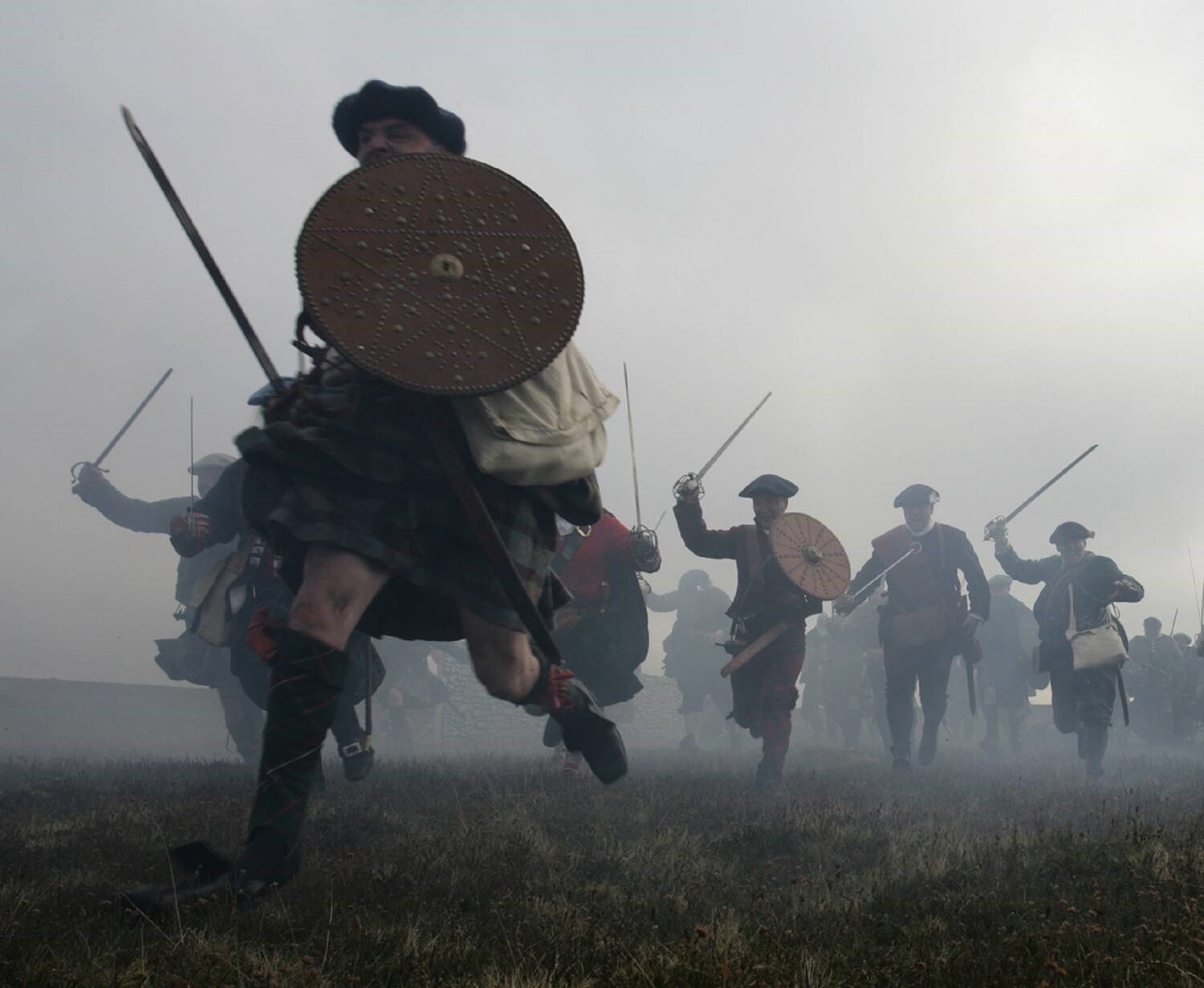
In 1745, Prince Charlie landed in western Scotland, raised his banner at Glenfinnan and declared he had come to reclaim his father’s throne. Robert, then aged 72, took his weapons and joined the Prince’s cause, enlisting in the Atholl Brigade being raised at Blair Atholl by Lord George Murray. Because of his experience, Robert was appointed the Brigade’s (only) Sergeant, or Training Officer. As such he taught the three battalions of the Atholl Brigade battle tactics, especially the Highland Charge, which involved a lot more than is commonly thought. Robert taught the clansmen to run forward, brandishing their weapons and shouting warlike slogans, until they were 20 feet from the Sassenach (English) line, then fire their muskets and pistols at the English, throw those weapons as hard as they could to injure the Sassenachs, then drop down as the English returned fire over them. Then, when the Sassenachs were reloading, Robert would shout the order for the Atholls to stand up, form wedges and hack into the Sassenachs with their broadswords and dirks.

Culloden

Robert is listed in the muster roll of the Prince’s army as King but he took the nom-de-guerre of MacRae, the maiden name of his first daughter-in-law, because the King family had started to grow wealthy again, running ships from Port Glasgow to the American colonies, and he feared if he was captured under his real name the English would take vengeance on the family business.

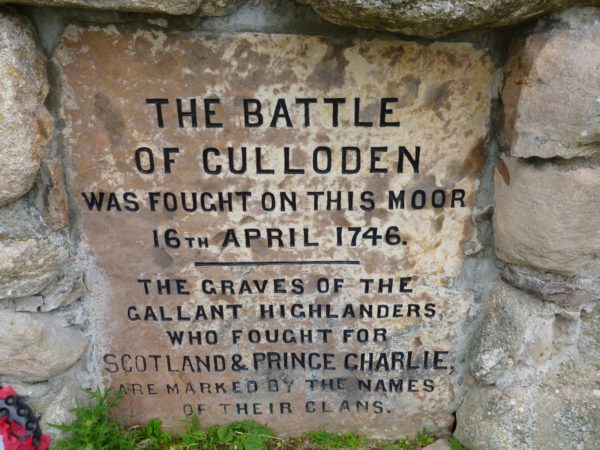
Robert led the Atholl Brigade in the charge at Prestonpans on 21st September 1745, when General Cope’s English army was routed by the Scots. Robert continued serving the Prince in the Jacobites’ march into England in late 1745, when they reached Derby, and then the return march to Scotland. Later, Robert led the Atholl Brigade in another highland charge at Falkirk Muir on 17th January 1746, when the Scots defeated the Sassenachs again. Things seemed to be going the Scots’ way until the English Prince William, Duke of Cumberland, led a large, heavily armed English and Hanoverian army into Scotland to suppress the Rising. The Scots and Hanoverian armies came together at Culloden moor just east of Inverness on 16th April 1746.

At Culloden, Cumberland declared he would give the Jacobites “No Quarter”. Prince Charlie’s generals argued about whether to fight that day and if so the best tactics. Lord George Murray ordered Robert to lead the Atholl Brigade onto the moor on the right wing, the position of honour, while the generals continued arguing.

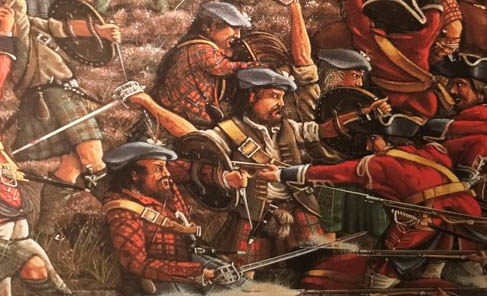
Robert formed up the Atholl Brigade’s second battalion on the moor and took his position in the middle of the front rank. They stood for twenty minutes while the English artillery bombarded them. Finally, Lord George Murray gave the order to charge. Robert led the Atholl’s in a highland charge down the right side of the battlefield. First, the Atholls came under musket fire from treacherous Campbells hidden behind walls on their right. Then the Atholls came under volley fire from Wolfe’s English infantry drawn up perpendicular to the main Sassenach line, so as to pour musket fire into the attacking Scots from their right flank. Robert led the Atholls into Wolfe’s regiment, and they did great slaughter there. Then Robert led them on into Barrel’s and Munro’s regiments of the main English line, and the Atholls did great slaughter again, although at the expense of heavy Jacobite casualties.

Robert fought with his broadsword and dirk for forty minutes, no mean feat for a man of 73 years. When he realised the battle was going against the Scots, Robert led an orderly withdrawal and the Atholl Brigade, or what was left of it, left the battlefield in good order with pipes playing, then dispersed into the Highlands.

A love bond

After Culloden, redcoat Sassenachtroops scoured the Highlands to hunt out Jacobites. They ravaged and killed Highlanders, whether Jacobites or not, killed their livestock and burnt their dwellings. In July 1746 Robert was captured and taken to Carlisle Castle in northern England, where he was confined in the dungeons with about 200 other Jacobite prisoners-of-war.

The English feared another Jacobite rising and wanted to ensure there were not enough Highlanders to form another Jacobite army. Initially they decided to execute all Jacobite prisoners-of-war in their keeping, as they had done with the Scots wounded and captured at Culloden. However, they also wanted to reach a political settlement with the Scots, so they decided to execute one in ten of their Jacobite prisoners and let the others go free. Because of his age, 73 years, Robert volunteered to be one of those executed, so allowing a younger man to go home.

On 18th October 1746 Robert and nineteen other Jacobite prisoners-of-war were taken from Carlisle Castle to nearby Harraby Hill. There they were executed by the atrocious English way of killing “traitors”, being hung, drawn and quartered. After the appalling process, their heads were placed on spikes over the castle gateway and their quartered body parts were sent to be displayed in four distant locations in England.

Robert’s execution inspired the words of the folksong Loch Lomond. The young Jacobite whom Robert saved “took the high road” (that is, he walked home) and Robert “took the low road” (was killed) but Robert was “in Scotland” (in spirit) “afore ye” (before the younger man reached home); but “me and my true love (Janet Kissock) would never meet again on the bonnie, bonnie banks o’ Loch Lomond” where they had courted 46 years before.

Thus, Loch Lomond is a love song, about a love bond that lasted almost 50 years. It is also a lament, about the severing of that bond by the Sassenachs when Robert and Janet might have lived together for many more years. It is a lament too for the Highland culture crushed by the Sassenachs after Culloden in the bloody aftermath of the battle and then the devastating Highland Clearances.

The author is the five-greats grandson of Robert King who led the charge at Culloden. He is immensely proud to be of Scots heritage and, in a sense, a son of Culloden, and is profoundly moved whenever he hears the tune Loch Lomond.

Support the Scottish Banner! To donate to assist with production of our publication  and website visit: The Scottish Banner

Are you a West Coaster?

Tourism group launches campaign to find kindred spirits.

Visit Wester Ross, a voluntary tourism association based in Wester Ross in the Scottish Highlands, has launched a campaign designed to attract visitors who have an affinity with Wester Ross and the people that live there.  Launched in January, Are you a West Coaster? comprises a series of films featuring West Coasters who run businesses in Wester Ross and are looking to develop sustainable tourism to the area, which is also designated a Biosphere by UNESCO. Douglas Gibson, Co-ordinator at Visit Wester Ross, explains what it means to be a West Coaster: “People living in Wester Ross share the same mindset. We are passionate about where we live, we treat our stunning natural environment and each other with respect and we are proud to welcome visitors from all over the world and share our home. But a key difference is that we take ‘Highland time’ – this landscape and our culture has developed over a long period of time and is not something that needs to be rushed. We think there are fellow West Coasters all over the UK and indeed the world. People who want something different, people who want an authentic experience in a place where people, place and land are inextricably linked, people who want to stay and spend quality time, not just pass through for a selfie. So, we are asking people to identify as a West Coaster and come and spend some quality, Highland time with us.”

Breath-taking landscapes

A series of films will be released featuring West Coasters in their places of work, talking about what it’s like to live in Wester Ross and the impression the area makes on visitors. Viewers will be introduced to the Mountaineer West Coaster, the Nature West Coaster, the Water West Coaster, the Cultural West Coaster and the Foodie West Coaster, each giving their perspective and asking the question: Are you a West Coaster? This campaign is the latest development in the tourism strategy for Wester Ross, supported by national efforts spearheaded by VisitScotland to develop sustainable tourism. Natasha Hutchison, General Manager of the Wester Ross UNESCO Biosphere, is proud that Wester Ross has been included in the world’s first UNESCO trail which was launched by VisitScotland last year.

Natasha highlights the significance of the UNESCO Biosphere designation for Wester Ross: “UNESCO Biospheres are often located in breath-taking landscapes and Wester Ross is no exception. This makes them wonderful places to visit. But living in a UNESCO Biosphere is about actively working towards a sustainable future and finding that delicate balance between development and conservation to ensure the wellbeing of our people and place for generations to come. We hope that this campaign strikes a chord with people and encourages visitors who are as passionate about Wester Ross as we are.”

Wester Ross was recognised as a Biosphere Reserve in 2016 by the United Nations Educational, Scientific and Cultural Organisation (UNESCO) for the fantastic array of landscapes, wildlife and cultural heritage that the region offers. Biospheres house dynamic local partnerships, rooted in communities that work collaboratively with Biosphere teams in a global network, to explore how – through education, science, culture, communication and information – we can learn to live in harmony with our environment.

More information about Visit Wester Ross can be found at: www.visitwester-ross.com

Scotland’s anthrax island

Tucked away in a secluded bay on Scotland’s west coast, the remote island of Gruinard concealed one of British Intelligence’s most deadly secrets for over half a century.  Gruinard Island is a small island approximately 2 kilometres (1.2 mi) long by 1 kilometre (0.6 mi) wide, located in Gruinard Bay. The island was selected by Second World War scientists as the perfect spot to test an anthrax bomb after the government of the day became anxious about Hitler’s capacity to develop biological weapons.  The experiment in 1942 was horrifically successful, in that it annihilated a flock of sheep and left the 520 acre island enshrouded in anthrax and out of bounds to any human being until 1990. Approximately 95% of people infected with anthrax die.

Gruinard’s importance

Even though particulars of the pollution programme were familiar locally, Gruinard’s importance was officially recognised in documents declassified in 1997. It was during the 1980s that Dr David Kelly (who tragically committed suicide after being involved in the controversy about Iraq’s weapons of mass destruction), was head of microbiology at the Chemical Defence Establishment at Porton Down and oversaw the operation to decontaminate the island.  Cleaning and purifying an entire island proved a mammoth challenge, but ultimately it was accomplished in 1986 with the help of 280 tonnes of formaldehyde dissolved in seawater.

On 24 April 1990, after 48 years of quarantine and four years after the cleaning of Gruinard, the island was certified as safe and four years later a local crofter, John Robinson successfully reintroduced sheep. According to the wartime newspapers, scientists concluded that anthrax had ‘enormous potential’. The wartime government was so taken aback by this statement that it declared that “these forms of frightfulness” should play no role whatever in the war effort.

Today you can take kayaking tours around the island and take it in its beauty. However some experts still today insist that the island will remain dangerous for several hundred years, as it is simply impossible to destroy the remnants of the anthrax in its territory.

Actress Karen Gillan named Grand Marshal of 2022 NYC Tartan Day Parade

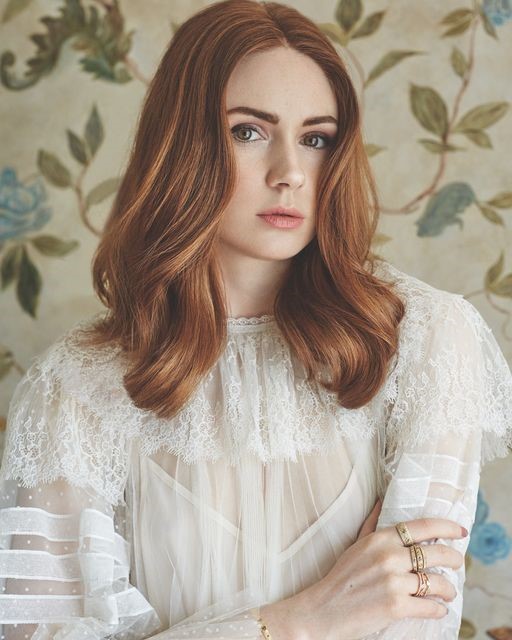
The National Tartan Day New York Committee is honored to announce award-winning Scottish actress Karen Gillan as Grand Marshal of the 2022 New York City Tartan Day Parade. The popular Scottish-themed event, entering its 24th year, will be held in midtown Manhattan on Saturday, April 9, 2022, returning in person for the first time since 2019. Gillan will helm the parade, followed by a lively procession of Pipe & Drum bands, Highland dancers, Scottish family clans, Shetlander Vikings and more. The annual celebration of Scottish heritage and culture brings together a rich tapestry of participants along with many thousands of spectators.

“I am absolutely delighted to represent Scotland in the next New York City Tartan Day Parade,” Gillan says. “I’m honored to help celebrate Scotland in America, and I look forward to playing a part in broadening the public’s awareness of Scotland’s history and cultural contributions.”

Karen Gillan is internationally known for her film, television and stage acting in productions including fan favorites from the Marvel Cinematic Universe: Guardians of the Galaxy Vol. 1 and Vol. 2, Avengers: Infinity War, and Avengers: Endgame, in addition to several other projects such as Gunpowder Milkshake, Jumanji, Jumanji: The Next Level, and Doctor Who. Her most recent credits include Dual and the upcoming The Bubble. She is currently in production on Marvel’s Guardian’s of the Galaxy Vol. 3 and it was recently announced that she will be voicing the title character in Rhona Who Lives by the River for Disney+. Gillan’s work has been recognized with multiple British film and television awards, such as an Empire Award and a National Television Award. She has additionally received a Teen Choice Award in the United States and nominations for a BAFTA Scotland Award and Saturn Award.

Gillan was born and raised in Inverness, Scotland. In addition to her impressive roster of acting credentials, she is also a filmmaker and garnered a Best Feature Film nomination from British Academy Scotland Awards for her Inverness-set film The Party’s Just Beginning.

Registration for the 2022 NYC Tartan Parade is now open. Groups and individuals are invited to march in the 24th Annual New York City Tartan Day Parade on Saturday, April 9, 2022 for free and can register by visiting:  www.nyctartanweek.org

The King at Pleasure and Prayer

By: David McVey

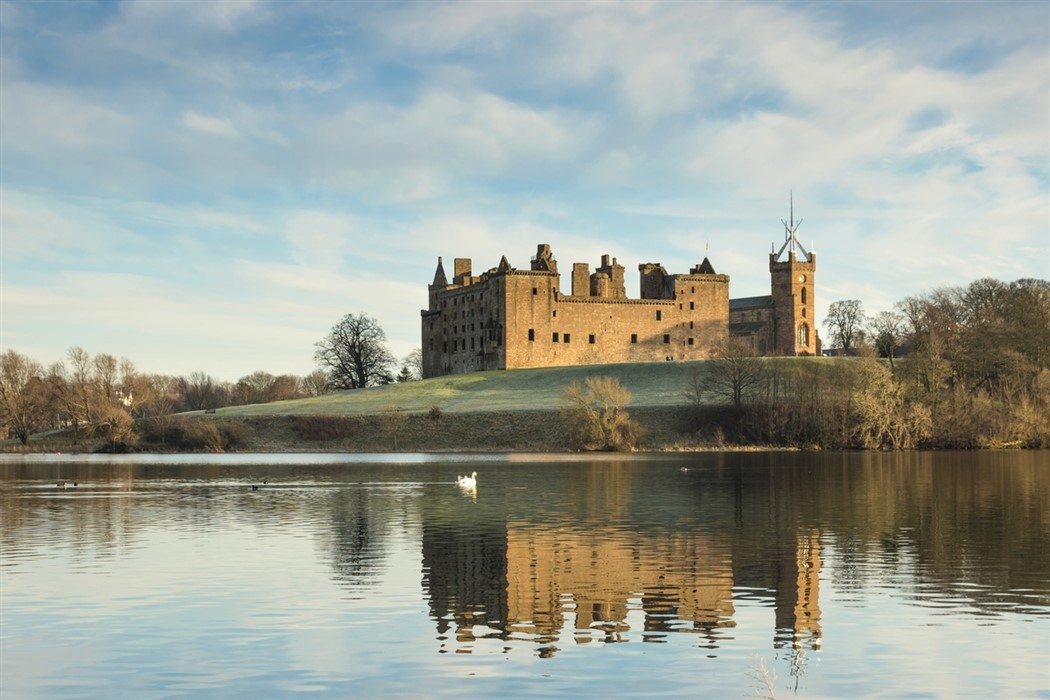
James IV is usually remembered as the tragic king who not only lost the Battle of Flodden in 1513, but also died on the field. In fact, he was a very much more complex and interesting figure who influenced both the world of the church and the world of the arts. One place where these interests came together was Linlithgow Palace.

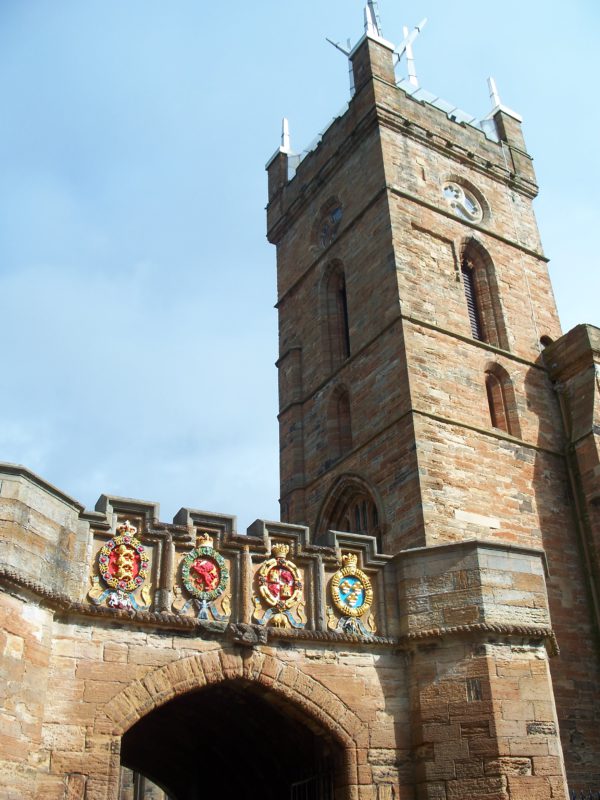
Linlithgow figures prominently in the Flodden story; it was in St Michael’s Kirk (adjacent to the Palace and also surviving today) that, before Flodden, James reportedly saw a blue-gowned apparition that warned him not to march with his army to England. Well, we can take that, as all such stories, with a hefty pinch of salt but if James IV were to see a ghost when in church, he’d be likely to see it in St Michael’s for he regularly went to Linlithgow. He commissioned a number of developments and enhancements to the palace. It’s been called ‘James IV’s Pleasure Palace’, but it was also a place of prayer with its own Chapel Royal – as if St Michael’s Kirk wasn’t grand enough.

The arts

St Michael’s Chapel. Photo: David McVey.

James IV had one especially distinguishable characteristic; he travelled about his kingdom a great deal, being seen in public, carrying out engagements and making agreements with local power bases. This was a probably a deliberate contrast to his late father, James III (a lot of Stewarts were called James) who had been criticised for rarely venturing outside Edinburgh. James, by contrast, progressed, in traditional royal fashion, between his various palaces including Edinburgh, Linlithgow, Stirling Castle and Falkland.

James encouraged the arts. He ordered the completion of the Chapel Royal and the Great Hall at Stirling Castle (both of which we can still appreciate today) and poets like William Dunbar and Gavin Douglas were encouraged to flourish. James became the patron of King’s College, Aberdeen in 1505 and in 1507 licensed Scotland’s first printing press. Scottish sacred music also began to get noticed, Robert Carver being its key figure.

Carver was an Augustinian canon at Scone Abbey near Perth, but also a composer of church music. He is most notable, however, for compiling what is now known as the Carver Choirbook, a collection of polyphonic sacred music, which included some of his own compositions. The National Library of Scotland suggests that the Choirbook was put together at some point between 1513 and 1520 (ie, after James IV’s death), possibly for use in the chapel at Scone Abbey, or the Chapel Royal at Stirling Castle. However, it’s just possible that the collection was compiled a little earlier for use in the Chapel Royal at Linlithgow Palace in the presence of James IV.

James IV was devoted to the cult of St Catherine and was known to celebrate her feast day (November 25) at Linlithgow. His alleged spectral warning about Flodden came in the St Catherine’s Aisle of St Michael’s Kirk and he paid fifteen visits to a healing well at Liberton in Edinburgh that was dedicated to St Catherine. The well still survives, in the grounds of a restaurant, and is sometimes known as ‘the Oily Well’ because of the oil that naturally appears on the water from local shale deposits. It may be significant, then, that the Carver Choirbook includes a number of works referencing St Catherine.

The sound of live Renaissance worship

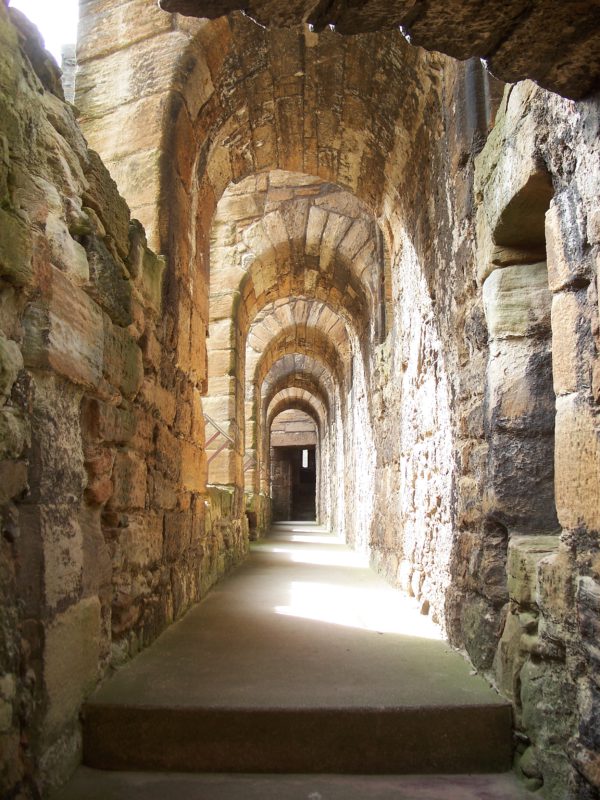
Inside Linlithgow Palace. Photo: David McVey.

Two research projects, involving Edinburgh University and funded by the Arts and Humanities Research Council – Space, Place, Sound and Memory and Hearing Historic Scotland – have been investigating the appearance, layout and acoustic properties of the Linlithgow Chapel Royal during James IV’s time. The aim is to enable people today to experience what the sound of live Renaissance worship was like. Linlithgow Palace is now mostly ruinous (though still impressive) and the Chapel Royal is a bare, roofless, windowless space. The researchers surveyed the existing chapel using laser technology and studied the likely furnishings and layout of the space in James IV’s time. The aim was to make recordings and to develop an app that would allow listeners to experience the music as it might have sounded in Linlithgow’s Chapel Royal in its heyday.

Informed by the Hearing Historic Scotland project, a CD was recorded and issued, composed of selections from the Carver Choirbook (although none of the chosen music is by Carver himself) including some pieces dedicated to St Catherine. The music was performed by the Binchois Consort, conducted by Andrew Kirkman. James VI is known to have celebrated Easter at Linlithgow in 1512, so the selections are designed to be a possible order of service for that occasion, performed in the presence of a king who reverenced St Catherine. Using the app, listeners can compare how the music would sound in the recreated chapel of 1512, with the sound in today’s cold bare space.

Renaissance sacred choral music may not be your cup of tea, but these studies add to our understanding of James IV. It’s remarkable how much of the world that he knew can still be visited today. The sacred well at Liberton is freely accessible and so are James’ royal palaces, although Stirling, especially, was much remodelled later by his son James V. Even the burial place of his parents, James III and Margaret of Denmark, can be visited at the site of Cambuskenneth Abbey, a quiet spot near Stirling.

Much of what we know about James concerns his piety; the chapels, the music, the sacred sites. There is also his Book of Hours, a spectacular illuminated prayer book created probably in Ghent, Belgium, and now held in the Austrian National Library in Vienna. And yet, in the strange world of the 15th and 16th centuries, he was able to combine his religiosity with a liberal love-life. He had several children by a string of mistresses.

James IV was a fascinating if not a particularly admirable man. Recent research now enables us to appreciate even the music he heard during his devotions. He was more than just the king who received a ghostly warning about an impending battle, ignored the warning, and rode out to his death.

You can see a sample page of the Carver Choirbook at the National Library of Scotland’s website: https://digital.nls.uk/scotlandspages/timeline/15032.html

Details of the Hearing Historic Scotland and Space, Place, Sound and Memory research can be found at: https://www.eca.ed.ac.uk/research/space-place-sound-and-memory

Main photo: Linlithgow Palace. Photo: VisitScotland.

Scotland has a ‘golden opportunity’ to spark snow sports boom after two seasons effectively lost to Covid-19

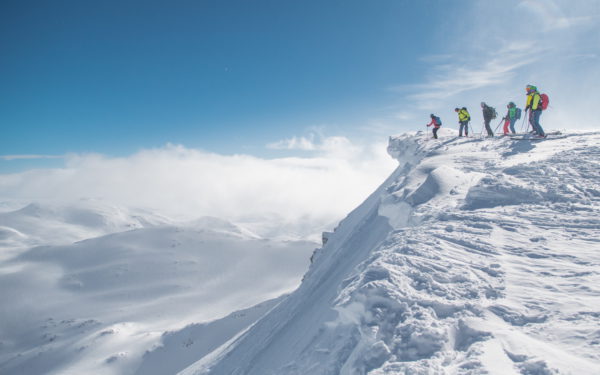
A group of skiers standing above the entrance to the Back Corries at Nevis Range.

The Scottish ski season is ready to return with a bang after two lost years due to the Covid-19 pandemic. That’s the view of Snowsport Scotland CEO Trafford Wilson, who believes the first full season since the beginning of the pandemic, ongoing uncertainty around overseas travel, plus the impact of the 2022 Beijing Winter Olympics, create the perfect conditions for a snow sports boom in Scotland as its five resorts prepare to fully open this winter. More than 750,000 tickets are sold at Scottish snow sports venues every year in an industry worth more than £30 million to the nation’s economy annually. The Scottish Ski Industry (SSI) also supports a workforce of more than 1,000 people, as well as almost 50 elite athletes involved in the Snowsport Scotland performance programme, which includes stars such as freestyle skier Kirsty Muir. 

However, the pandemic has significantly restricted the last two winter seasons, meaning the upcoming 2021/22 ski season is pivotal to the recovery and future of the industry in Scotland. The past two years have been challenging for the Scottish snow sports industry – with the stop-start disruption of the pandemic grinding ticket sales to a halt, resulting in snow sport facilities facing a £20m reduction in revenue.  Snowsport Scotland, the governing body overseeing Scottish snow sports activity at all levels, independently verified Snowsport facility losses from the pandemic over the past two winter seasons – even accounting for mitigation from furlough, redundancies, and deferred capital payments – are more than £12m.

Look to Scotland this winter season

However, despite the difficulties, Mr Wilson, who marks four years at the helm of Snowsport Scotland in May, believes Covid-19 provided opportunity by putting the industry under the magnifying glass and highlighting its importance to Scotland’s economy and tourism industry. He said: “While Covid has been a massive headache to say the least, particularly the stop and start nature of it, it’s also provided the opportunity to gain heightened support from the Scottish Government and other agencies and promoted the national importance of the snow sports industry.  Snow sports matters in Scotland. As evidenced through independent research the snow sports industry injects £30m into the Scottish economy every year, supports a workforce of more than 1,000 professionals, plays an important role in tourism, and allows literally hundreds of thousands of people each year to enjoy the physical and mental benefits that snow sport activities offer.”

In response to the many financial setbacks spurred on by Covid-19, the Scottish Government provided a £7m “ski centre fund” to safeguard Scotland’s commercially run snow sport centres – Nevis Mountain Range, Glencoe Mountain Resort, The Lecht Ski Centre, Glenshee Ski Centre, Bearsden Snowsports Centre, Snow Factor – Glasgow, Newmilns Snowsports Centre and Glasgow Ski and Snowboard Centre.

However, for the centres and the communities around them to thrive, Mr Wilson believes more investment is needed, which will hopefully be achieved in part, by strong ticket sales in the coming winter season.  With thousands of people also facing uncertainty due to the ever-changing quarantine rules in European countries, Mr Wilson hopes more people may look to Scotland this winter season.  

He said: “There’s a golden opportunity to get people in the UK thinking about coming to Scotland as concerns remain about travelling abroad. We hope that this opportunity allows more people than ever before to experience snow sports in the UK; and want to come back for more in the years to come.  It’s fundamentally important we have a good season. We want people to ski and snowboard in Scotland, enjoy it, and make it a habit going forward. This winter season presents a great opportunity for people to make the most of the varied terrain on offer, explore our backcountry playgrounds and to learn how to ski or snowboard on home soil.  With GB Snowsport looking to confirm 2022 Winter Olympic and Paralympic squads, Snowsport Scotland expects to see a strong base of Scottish athletes included. We are enormously proud of the number and quality of athletes preparing to compete at the 2022 Winter Olympics and Paralympics and look forward to seeing how their performances help inspire the next generation of snow sport participants in Scotland.”

For more on Snowsport Scotland and its activities, visit www.snowsportscotland.org.

Did you know?

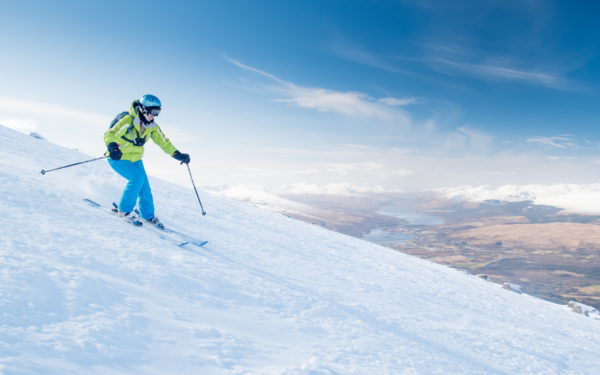
Charne Hawkes from Inverness, skiing high above Loch Linnhe and Loch Eil, at Nevis Range.

•There are 5 mountain resorts in Scotland; Cairngorm Mountain; Glencoe; Glenshee; Lecht 2090; and Nevis Range.

•There are 16 artificial snow sport centres; Aberdeen Snowsports Centre; Glasgow Ski & Snowboard Centre; Midlothian Snowsports Centre – Hillend; Snow Factor; Bearsden Ski and Board Club; Newmilns Snow and Sports Complex; Polmonthill Snowsports Centre; Firpark Ski Centre; Alford Ski Centre; Glenmore Lodge; Huntly Nordic and Outdoors Centre; Lagganila Outdoor Centre; Loch Insh; and, RM-Condor Arbroath.

•There is calculated to be demand for approximately 840,000 ‘skier days’ per year in Scotland, with 580,000 taking place on artificial slopes and a further 260,000 at mountain resorts.

•750,000 ‘skier days’ were recorded in the 2018-19 winter season (the last season recorded prior to covid)

•Currently, 18 of the 48 athletes on the UK Sport funded winter sports programme are Scottish.

•Snowsport Scotland’s membership has increased by 39% over the last 4 years (4,112 new members).

Diana Gabaldon, Bestselling author of Outlander novels, to be honored as NTSUSA’S 2022 Great Scot

American author Diana Gabaldon has brought the romance and drama of Scottish history to life for more than 50 million readers worldwide with her bestselling Outlander novels. Gabaldon’s novels, and the Starz television series they inspired, tell the story of a British army nurse who mysteriously travels back in time to 18th century Scotland. Now, The National Trust for Scotland Foundation USA will recognize her extraordinary contributions to Scotland and America’s shared heritage by presenting her with the 2022 Great Scot Award at their 15th annual fundraising gala, A Celebration of Scotland’s Treasures, on April 14, 2022.

“2022 has been designated Scotland’s Year of Stories, and so it seems especially appropriate to honor Diana Gabaldon, whose stories have come to embody Scotland and Scottish culture for millions of readers and television watchers around the world,” said Helen E.R. Sayles CBE, The National Trust for Scotland Foundation USA’s chair. “We are delighted to have the opportunity to thank her for inspiring so many readers to explore and fall in love with Scotland.”

Ms. Gabaldon’s first novel, Outlander, was published in 1991, and the story has extended across eight additional New York Times bestselling volumes. Her books have sold 50 million copies in 39 languages and 114 countries. The latest and ninth book, Go Tell the Bees That I Am Gone, was published in November 2021.  Largely set in 18th century Scotland, many of the Outlander novels use actual historic events as the backdrop for Claire and Jamie Fraser’s romance. Some of these, including the 1746 Battle of Culloden, are historic sites now in the care of the National Trust for Scotland. In addition, National Trust for Scotland properties including Falkland Palace, Preston Mill, and the Village of Culross, have been used in filming the Sony/Starz television series based on Ms. Gabaldon’s work. The series stars Catriona Balfe and Sam Heughan, and its sixth season premieres on March 6, 2022.

Americans have embraced Scottish culture through their love of Outlander

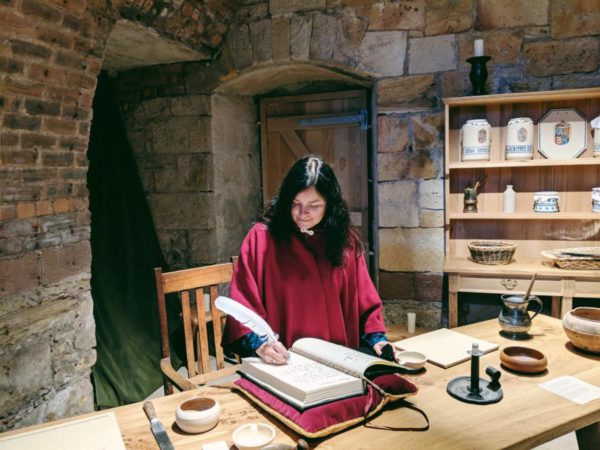
Diana Gabaldon visiting Falkland Palace in Fife, Scotland, a property cared for by the National Trust for Scotland.

“I have seen firsthand how Americans have embraced Scottish culture through their love of Outlander,” said Kirstin Bridier, executive director of NTSUSA. “Many Outlander fans have contributed generously to the preservation of National Trust for Scotland sites associated with the novels and television show – sites like Preston Mill. We could not ask for a better ambassador for our work.”

The presentation of the Great Scot Award is at the heart of a black-tie event that raises funds to support Scotland’s largest conservation charity. Past recipients of the award include documentary filmmaker Ken Burns, comedian Sir Billy Connolly, award-winning actors Alan Cumming and Brian Cox, endurance athlete and world-record breaking cyclist Mark Beaumont, sculptor Andy Scott, and authors Denise Mina and Alexander McCall Smith.

A Celebration of Scotland’s Treasures is a festive evening that features a whisky tasting by The Macallan; the recitation of Burns’ Ode to a Haggis by Alasdair Nichol, Chairman of Freeman’s auction house and a frequent appraiser on PBS’s Antiques Roadshow; Scottish country dancing; and live and silent auctions. Before heading home, guests form a circle, clasp hands, and sing Auld Lang Syne. The National Trust for Scotland cares for 100 natural and cultural heritage properties across Scotland, including several sites that commemorate historic events described in Outlander or used for filming the Sony/Starz television show.

The Great Scot Award will be presented on April 14, 2022, at The National Trust for Scotland Foundation USA’s first in-person fundraising gala since 2019. The National Trust for Scotland Foundation USA (NTSUSA) exists to support the work of Scotland’s largest conservation charity. NTSUSA makes grants for projects that protect Scotland’s natural, built, and cultural heritage on behalf of future generations. Since 2000, NTSUSA has committed more than $10 million in funding for the National Trust for Scotland’s most urgent conservation priorities. Donations to NTSUSA, a registered 501(c)3 non-profit organization, are tax-deductible to the fullest extent allowed by law. To learn more about NTSUSA or to become a member, please visit www.ntsusa.org.

To learn more about the A Celebration of Scotland’s Treasures gala, visit www.ntsusa.org/about-us/celebration-gala.

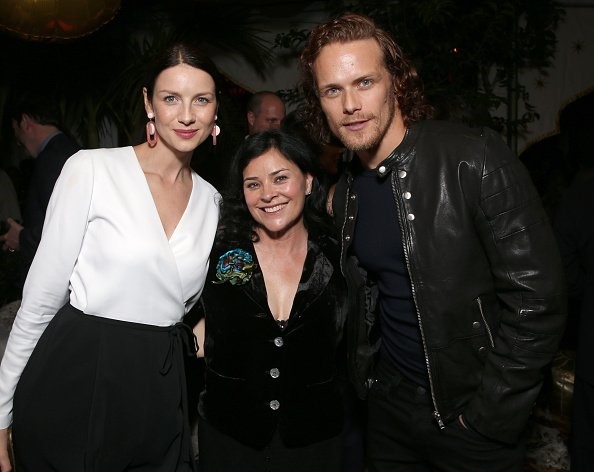
Main photo: Great Scot Award honoree Diana Gabaldon with Outlander stars Catriona Balfe and Sam Heughan.

Auld Lang Syne ritual lodged in Scotland’s past

It is a custom observed worldwide by millions every New Year, now research has uncovered why revellers link arms when they sing Auld Lang Syne. A study of Robert Burns’ best-loved song links the practice to freemasonry, where singing with arms crossed and hands joined was a parting ritual in many Lodges. University of Edinburgh musicologist Morag Grant, who has just published a book about the song, spotted the Masonic connection while sifting the archives of Glasgow’s Mitchell Library. A newspaper report of an Ayrshire Lodge’s Burns Supper in 1879, describes the song being sung as members formed ‘the circle of unity’ —a common masonic ritual, also called the ‘chain of union’.

Global popularity

Dr Grant says the tradition of singing the song at times of parting, and doing so with crossed hands, emerges in the mid-19th century – not just among Freemasons, but in other fraternal organisations too. The Masonic link is hardly surprising, according to Dr Grant. Burns was a Freemason all his adult life and the organisation was instrumental in promoting his work during his lifetime and after his death. Dr Grant has studied a range of historical sources – including written accounts, newspaper reports, theatre playbills, printed music and early recordings – to illuminate the song’s path to global popularity.

Auld Lang Syne’s sentiments didn’t just resonate with Freemasons”, says Dr Grant. “Some of the earliest reports of the song’s use at parting come from American college graduations in the 1850s.” Within decades, the use of the song at graduation had crossed to Japan, where the well-known tune — known as Hotaru no hikari—is still played at the close of business in some shops.

Dr Grant’s study shows that Auld Lang Syne’s global fame predates the invention of sound recording and radio. Many commentators had previously linked its rise to the dawn of the broadcast era. Historical analysis suggests otherwise. In 1877, Alexander Graham Bell used it to demonstrate the telephone, and in 1890 it was one of the first songs recorded on Emil Berliner’s gramophone. The song’s use at New Year emerged around the same time, principally through exiled Scots gathering outside St Paul’s Cathedral in London, but also expatriates living abroad. By 1929, the tradition was so well established internationally that a line from the song was displayed on the electronic ticker at New Year’s celebrations in Times Square. The Scouts too played a key role in spreading its fame. The song was sung at the end of the first World Scout Jamboree in 1920 and versions in French, German, Greek and Polish soon followed.

Song’s origins

Dr Grant’s book, Auld Lang Syne: A Song and its Culture, also explores the song’s origins and Burns’ role in creating the modern song from older models. The book examines the part played by his publisher, George Thomson, in picking the tune generally sung today, which is not, in fact, the one Burns intended. Auld Lang Syne quickly became popular with Scottish audience when it was published in this form in 1799 and soon became well known elsewhere.

A key step in this process was its inclusion in an opera called Rob Roy Macgregor, or Auld Lang Syne – which premiered in London in 1818. Before long, it was being performed in North America. Says Dr Grant, who’s based in the Reid School of Music at Edinburgh College of Art: “It’s remarkable how this song, written in a language which even most Scots don’t fully understand, has become so synonymous with New Year the world over. The many traditions and rituals associated with the song – as well as it simple, singable tune – are key to understanding its phenomenal spread, and why we still sing it today. Auld Lang Syne is a song about the ties that bind us to others across the years and even though its appeal is now global, it’s very much rooted in the world Burns inhabited,” says Dr Grant.

Auld Lang Syne: A Song and its Culture by M J Grant is published by OpenBook Publishers and is available to read free online at: www.openbookpublishers.com/product/1253

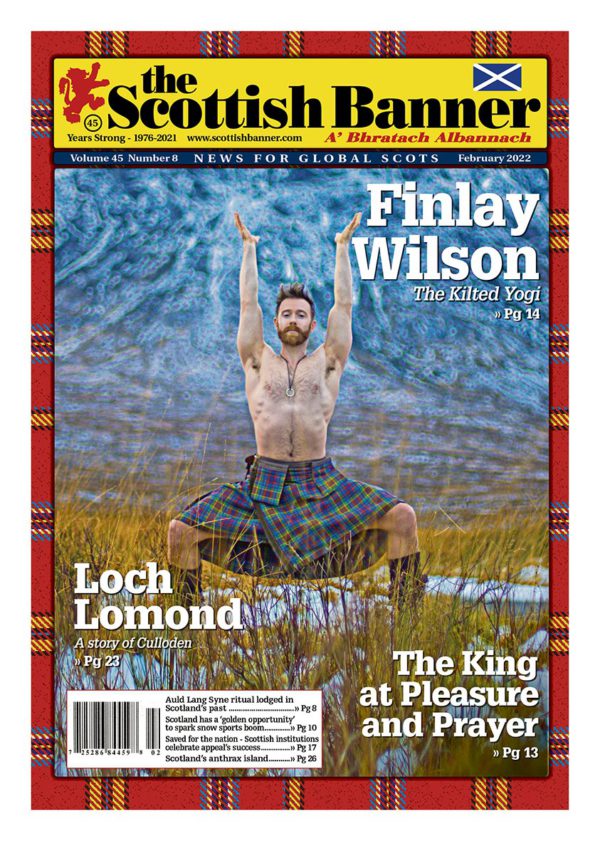
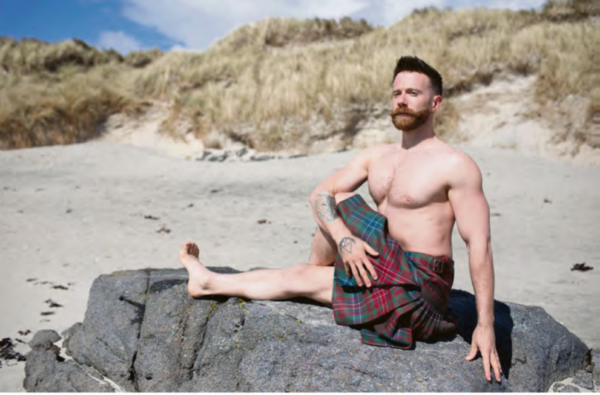
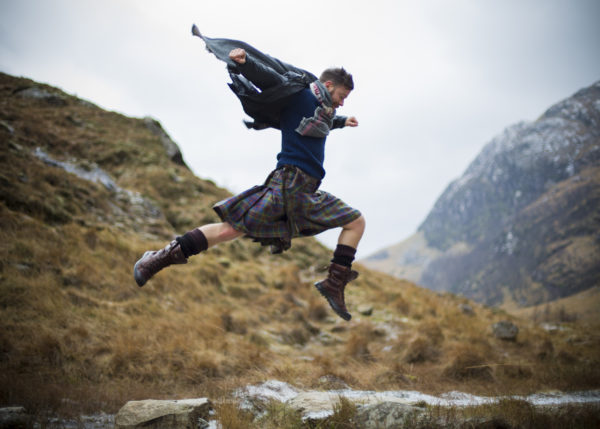
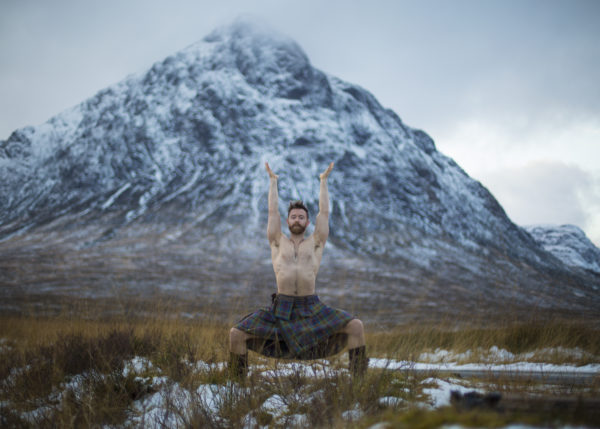
Finlay Wilson-The Kilted Yogi

Viral Scottish yoga star Finlay Wilson is back with his new book Wild Kilted Yoga: Flow and Feel Free, get ready for more tartan, more dramatic scenery and more tips and tricks to make your yoga practice extra special. Finlay took time to speak to the Scottish Banner on his love of yoga, his rescue dog Amaloh, tartan and of course Scotland. 

Finlay you have fused Scotland’s incredible scenery, the iconic kilt and the ancient, but non-Scottish, practice of yoga to become a viral Scottish yoga star a few years back. Since then, you have helped sell yoga, kilts and Scotland to the world. How has your life changed since 2017 and are you still surprised how merging these elements has been enjoyed by millions of people across the world?

FW: It constantly surprises me that every week new people engage with it. I get messages and comments from all over, some first timers to yoga, but most that are big fans of Scotland. If it gets more people thinking about yoga and a practice for themselves, then great!

You have said your dog Amaloh is the reason you created Kilted Yoga and that you rescued Amaloh from Sri Lanka with a yoga strap as a collar. Can you tell us more and how has having Amaloh in your life changed you?

FW: If it weren’t for the on-the-spot decision to rescue him, the chain of events would have meant Kilted Yoga never happened! Once Amaloh was over here, I made a video about him that went viral. In the small period of time afterwards people waited for the “what’s next” and were receptive to Kilted Yoga. His three million views were knocked out of the park within 24 hours! On a more serious and less digital note, I had just gone through an awful divorce and having him suddenly in my life gave shape to my days, keeping me from sinking too deeply. He also really enjoys being around when I am doing Yoga, so he was like a familiar that encouraged me to do even that.

As the world changed so drastically last year with many facing isolation and depression. How do you find yoga has helped you during the pandemic and how have you had to adapt your business during a Covid world?

FW: Yoga is my daily practice. The pandemic added a lot more pressure but what it did was move me outside. I found to deal with the challenges mentally, I had to augment my practice by getting outside more and became an avid cyclist, gardener and walker. From a business point of view, teaching online wasn’t new to me, so we were able to transition straight away to online classes without missing a beat. While practicing online isn’t the same as being in person, it was a means to and end that kept our community together and in a routine for the 18 months. Our staff all stayed on full time and our audience grew to span the world, that was a very unexpected bonus!

You do a lot of community outreach from your Dundee based studio and help children, young adults and families and recently became an Ambassador for the Prince’s Foundation, can you tell us more?

FW: I sure can. The studio, Heart Space, just celebrated 10 years since I opened it and now that we are back into the swing of things (albeit with physical distancing still in place) we have a full schedule of classes for families that are free. So far, we offer pregnancy yoga, parent and baby yoga, parent and baby barre, kids yoga, kids aerial yoga, and kids aerial silks and a class called Yoga for Every Body. All of our other classes help fund this and the work we do in the community. With community centres and groups still working out this new environment, we are hoping to keep developing and reforging connections we had 20 months ago.

With this focus and skillset, I was approached by The Prince’s Foundation to be an ambassador for the incredible work that the foundation does around mental health, wellbeing, and education. Without it being too much of a theme, as we come out of the pandemic, my role will become clearer as we find new ways to work with each other.

In 2017 you released the bestselling book Kilted Yoga: Yoga Laid Bare which introduced many to yoga and also some spectacular Scottish scenery.  Now you are releasing Wild Kilted Yoga: Flow and Feel Free. Can you tell us more about the new book, working with your twin brother and how making this book you were able to visit special places in Scotland from your childhood?

FW: Not only was it amazing to get out when restrictions lifted, I also hadn’t spent any meaningful time with my twin brother since the start of the pandemic. So, to be able to go out with a project and a plan felt incredible. Now, the weather had other ideas and we were hit with blizzards as soon as we got to Glen Coe in May, hail, gale force winds and torrential rain. We had to move some of our locations around and for each sequence (fire, water, earth, and air) we shot in two different locations for each as we navigated the weather. Only one of the locations, air, was new to me as we trekked along single track roads for hours to get to Sanna Beach. It looks more like Caribbean waters than what you would associate with Scotland!

Alastair has taken almost all of the images you see on my pages, we do a calendar every year and I wanted to work with someone that knows me very well, understands the poses and when I am fully in them, but also to celebrate that he is as much an essential part of kilted yoga as the guy doing the yoga!

The book follows on from book one which set the foundations of the practice I teach and moves into four very different sequences that build on these foundations. Each sequence has a different energetic with flowing movements for water and strong holds for fire. There is also a bonus chapter in there for two people practicing together, just like book one.

In 2018 you created the Kilted Yoga tartan which gives a nod to the mystical Scottish wolf. Can you tell how important it is for you incorporate kilts in your work and to also champion the art of kiltmaking and Scottish textiles?

FW: I did indeed. The colours are a cry back to a wolf’s coat with a shot of red through there for other parts of my environmental studies with Red Deer and Scot’s Pine (which has a lovely red hue to the bark). It matches the wolf tattoo on my forearm and is something that has held my imagination since I was younger and began my studies. Prickly Thistle helped design and weave the tartans and a big part of their message is the permanence of traditional Scottish industry vs. fast fashion and plastic-based materials. I know a lot of people growing up inherited a kilt, it has a lifespan beyond that, unlike most clothes and I really put mine through its paces.

Finlay what would you tell someone, regardless of their age, who wants to try yoga? Also, can you tell us about some of the ongoing benefits yoga has given you and how does it make you feel to be taking yoga to such a new level across the world?

FW: A lot of people have tried yoga, one of the things we try to let people know is that there are many styles, systems, methodologies and personalities out there. Depending on what you need (and you may not even know) it is worth shopping around a little. One teacher’s interpretation of gentle may be vastly different to another’s. It is useful to find a teacher that is knowledgeable and experienced, especially if you are navigating any injuries but it is best to check with a physical therapist about the best route for that.

For me, yoga makes me less reactive. I have a core that feels steady in the face of challenges. Breath work and endurance have helped me on so many occasions it doesn’t need mentioning! It is this that I hope brings people to my classes, the desire to explore what they can do rather than adding to a list what they can’t do.

And finally, Finlay in your book and your videos you get to travel across Scotland and show off its beauty to many. How does Scotland’s natural settings compliment yoga and do you have a favourite part of the country to visit when not rolling out the yoga mat?

FW: I love practicing all over but if it’s a peat bog and soaking, I am usually miserable!  Give me dry and grippy rock and we are on to a winner. It’s the fresh air, the feeling of life in with each breath. Whenever I am away travelling it is something I look forward to on my return.

Wild Kilted Yoga: Flow and Feel Free by Finlay Wilson is available now. For more information or to keep up with Finlay see: www.finlay-wilson.com

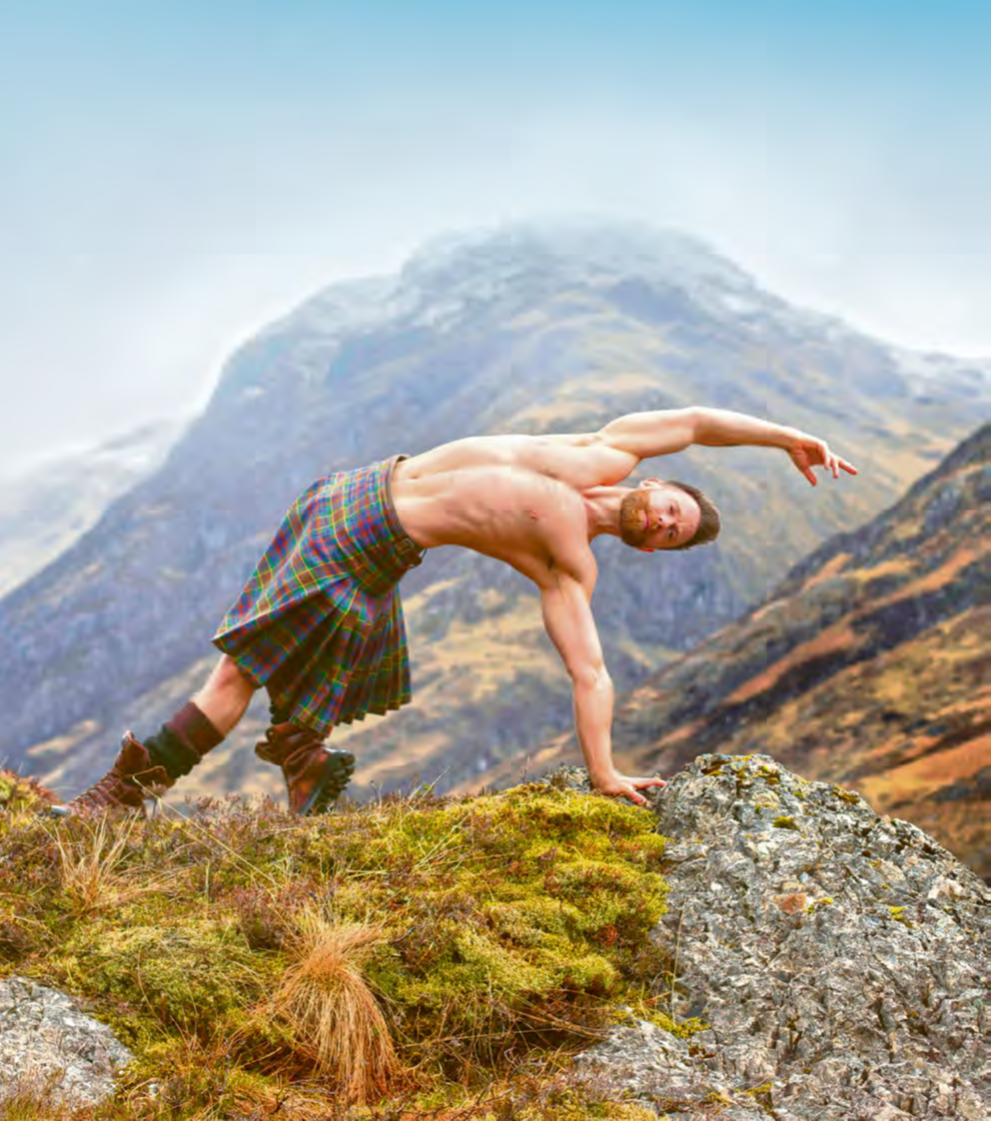
Photo courtesy of: Alastair Wilson/Hodder & Stoughton.

Earlybird tickets on sale now for CelticFest 2022

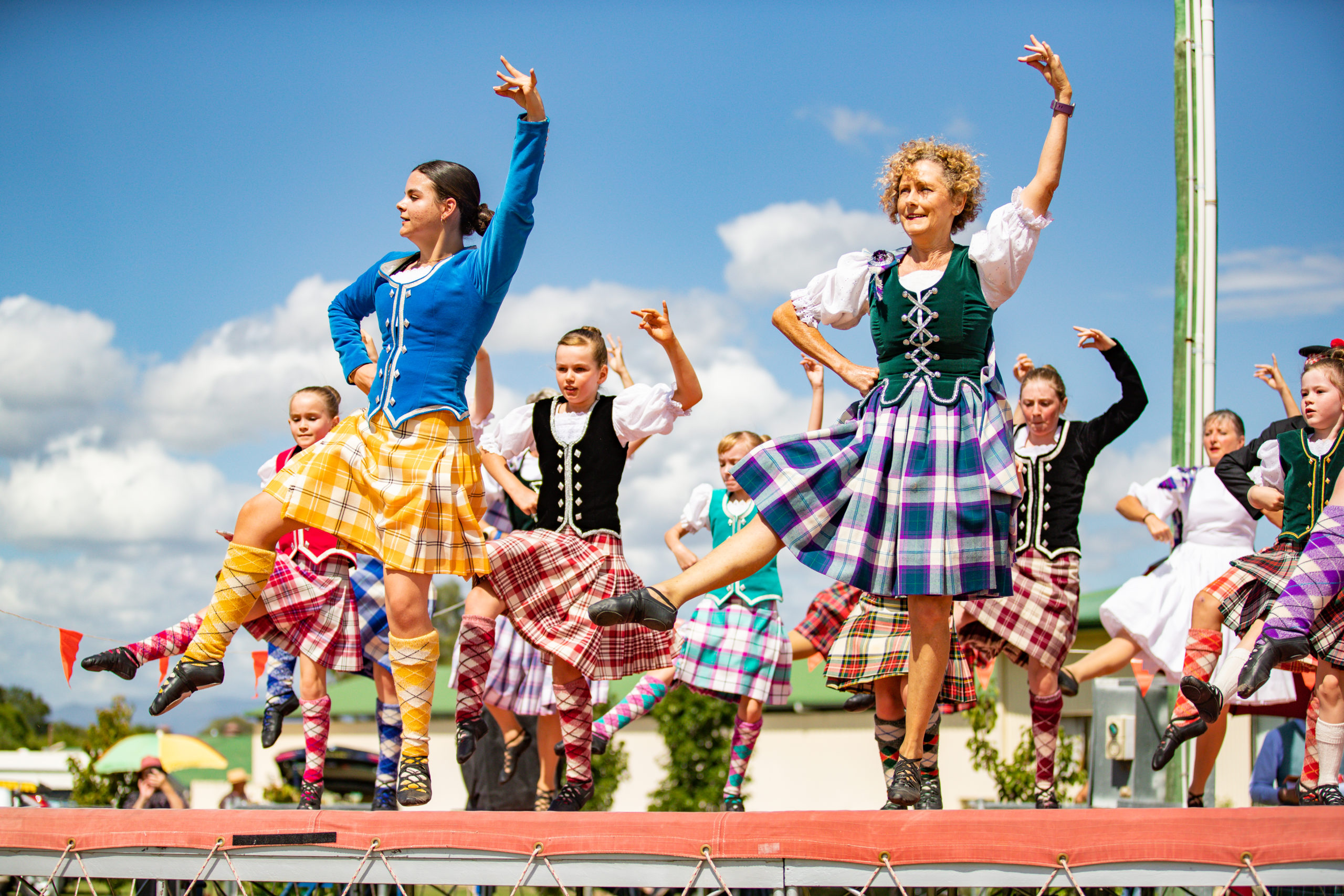
CelticFest organisers are pleased to announce that Early Bird tickets are now available for the CelticFest Gathering, the festival’s main ticketed event to be held on Saturday 26 March 2022 at the Warwick Showgrounds. For the very reasonable price of $15 for adults and $5 for school age children, festival-goers will be able to immerse themselves in a full day of events to celebrate all things Celtic, including highland games heavy events, pipe band competition, Irish dancing, highland dancing competition, clan gathering, Celtic choir, medieval village, Celtic-themed markets, and music from bands such as Limerick.  In the evening, Irish band The Gathering will get everyone up on their feet and dancing. CelticFest Gathering tickets are available at www.eventbrite.com.au.

A celebration of the Southern Downs’ rich Scottish and Irish heritage

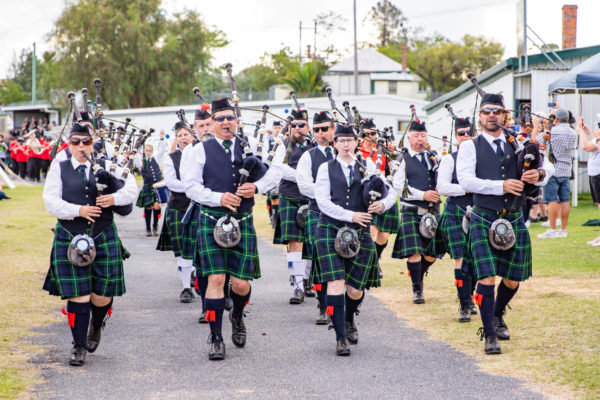
Warwick Thistle Pipe Band.

CelticFest is a celebration of the Southern Downs’ rich Scottish and Irish heritage and continues on from the Warwick Caledonian Society’s 150th Anniversary celebrations in March 2021.

“Those who attended the 150th celebrations in March 2021 will have some idea of what to expect,” said Alexander Manfield, the Society’s chieftain. “From medieval re-enactments to marching bands, from highland games to highland dancing, from pipe bands to Celtic rock bands, from highland coos (cows) to haggis, it will be like the Royal Edinburgh Military Tattoo right here in Warwick.” The Warwick business community will also experience the benefits of CelticFest, with accommodation providers already receiving bookings for the event, Manfield added. “The Warwick Showgrounds is going to transform into a sea of tartan, armour, music, dance and traditional food,” he said. “This is going to be a brilliant festival.”

CelticFest organisers are also delighted to announce that Warwick Sandstone, Warwick Friendly Society, Proterra and Ironside Industry have committed to providing sponsorship for CelticFest. “It is our pleasure to be able to contribute towards an exciting new festival, CelticFest – another reason to put our great town of Warwick on the must-visit map,” said Jill Bockman, from Warwick Sandstone. “Warwick Sandstone wishes the CelticFest planning committee good luck for an exciting and great outcome.”

Celtic-themed events

In addition to the main Saturday event, CelticFest Community events will be held on Friday 25 March and Sunday 27 March. Some of these events will be free, and some will have their own ticketing. The CelticFest Community events will be held across many of the towns and villages in the region including Warwick, Killarney, Allora and Clifton, and will celebrate the area’s Celtic heritage, music, art, dance and natural beauty including workshops, performances and tours.

Club Warwick RSL, a key CelticFest supporter, will host toe tappin’ Irish band Limerick (the Saturday after St Patrick’s) Day, and is planning other Celtic-themed events leading up to CelticFest. Southern Downs Steam Railway will offer a trip to Clifton on Sunday 27th  March, which will include lunch at O’Shanley’s Irish Bar and Restaurant. The Warwick Art Gallery is holding a Celtic-themed art exhibition, titled ‘Cruthaich’ (Gaelic for ‘create’) between March 3-April 19, 2022, for which it is currently inviting submissions from artists; submissions close 11 February 2022.  

Meanwhile Scots PGC College will run a Pipe Band competition, also on Sunday 27th March, and Glengallan Homestead and Warwick’s Pringle Cottage will host roaming pipers while celebrating the region’s history. Warwick Parkrun will host a Scottish-themed parkrun on the morning of Saturday 26th, and is inviting those in town for CelticFest to get their tartan on for a running start to the event. This is just a taste of what CelticFest visitors can expect from what is sure to be an event that will have something to suit everyone’s interest. CelticFest is assisted by the Local Event Funding Program (LEFP), which is a temporary funding program facilitated by Southern Downs Regional Council and jointly funded by the Australian and Queensland Governments as a component of the 2019 Queensland Bushfires Community Recovery Package under Category C of the Disaster Recovery Funding Arrangements.

Information about CelticFest and the CelticFest Community events will be placed on the CelticFest website at www.celticfestqld.com.au, and also on the CelticFest Warwick Facebook page as they are confirmed.

The Asheville Celtic Festival-Haggis, Big Athletes, Scotch, Dogs, Swords and Kilts Return

A Winter Indoor/Outdoor Celtic Festival, to be held on Saturday February 19, 2022 at the WNC Agriculture Center in Flecher, North Carolina.

Entertainment will include Live Celtic Music from bands like ALBANNACH from Glasgow Scotland, Kilmaine Saints from Pennsylvania and Unspoken Traditions from Cherryville, NC. The opening ceremony will occur at 11:00 am with the awakening sounds of The Grandfather Mountain Pipe and Drum Band.

Other entertainment will include LIVE Full Armored Sword Fighting at The Castle by The Warriors of Ashe.

More Features:

•             Border Collie Demonstrations

•             Celtic Educational Role Play Groups

•             Scottish Athletic Demonstrations

•             Celtic Dog Clubs

•             Genealogy Research

•             Celtic Foods

•             A Royal Court

•             A Celtic Village of Artisans and Craftsmen

•             Kilts everywhere!

Mission: The Asheville Celtic Festival is the focused event of the Asheville Celtic Group, a Non-Profit 501 (c) 3 Corporation. The group was founded for the primary purpose of creating various platforms for education on the subject of the historic Celtic cultural influences of settlers from the Seven Nations to the specific region of the Western North Carolina Mountains dating from 1750 to 1850.

For more details see: www.ashevillecelticfest.com or www.facebook.com/ashevillecelticfest

Podcast series: The Road to Culloden

Researched and written by volunteers at Culloden Visitor Centre, ‘The Road to Culloden’ follows the deadly game of cat and mouse between Government and Jacobite forces, concluding with the Battle of Culloden.

Four volunteers at Culloden Visitor Centre – Peter Cowe, John Easson, Ewen Macniven and Emma Tautscher – spent months piecing together information from a variety of sources for the newly released The Road to Culloden podcast series. The script was then checked by the National Trust for Scotland’s historians before being given the seal of approval from Professor Murray Pittock, the Trust’s Scottish History advisor and a world expert on Culloden.

The 275th anniversary of the battle

Each 15-minute episode takes a different point of the story as its theme. A new episode will be released every few weeks until April 2022, marking the end of the commemoration of the 275th anniversary of the battle. These podcasts also mark the beginning of Culloden’s programme of ‘war stories’ – this will run over the next two years, tying in with VisitScotland’s Year of Stories 2022.

The Road to Culloden podcast has been supported by many experts and members of the public, all passionate about the history of both the place and the people, before and after the Battle of Culloden. We are deeply grateful to those who have shared their expert knowledge and to those who donated to make this series possible, including eminent military historian Christopher Duffy, Professor Murray Pittock, the National Trust for Scotland Foundation USA and donors to Culloden’s Fighting Fund. The Road to Culloden has been recorded by veteran broadcaster Clare English and a new episode will be released every 4 weeks.

Episodes

At time of press five episodes are now available and episodes include:

1) Matters a-Rising! From political power struggles to dynastic divisions and civil war, part one of the Road to Culloden podcast, Matters a-Rising, positions the central players in the 1745 Rising and sets the scene for the battle for the throne of Great Britain.

2) Cat chases mouse, or does mouse chase cat? Take part in a deadly game of cat and mouse as Prince Charles and his Jacobites advance across Scotland, pursued by Government troops. Ambushes, subterfuge, and brutal skirmishes defined the opening salvos of the campaign and saw the rebel Prince take up residence in Holyrood.

3) The long way there and back. Following victory in the Battle of Prestonpans Prince Charles Edward Stewart’s eye turned to England and the next stage in the Jacobite Rising. Advancing into England at breakneck pace and with London in their sights, poor intelligence and internal squabbles would ultimately shape the Jacobites’ vision.

4) Decisions, decisions. An out-voted Bonnie Prince is forced to head home under duress as the momentum shifts in the 1745 Rising. Sensing blood, the Government marches north in hot pursuit, with ‘Rebellious Scots to crush’, but there was still hope and victories ahead for the Jacobite forces.

5) The Battle of Culloden and its immediate aftermath. Harried and hunted, the exhausted Jacobites gather at Drummossie Moor for what would be one final and emphatic confrontation. The final episode of the Road to Culloden takes us onto the battlefield and among the ranks for the battle and tells of its brutal aftermath, the effects of which still resonate today.

Listen to The Road to Culloden at: https://pod.co/the-road-to-culloden-podcast

Tartan honouring nursing is woven with gratitude

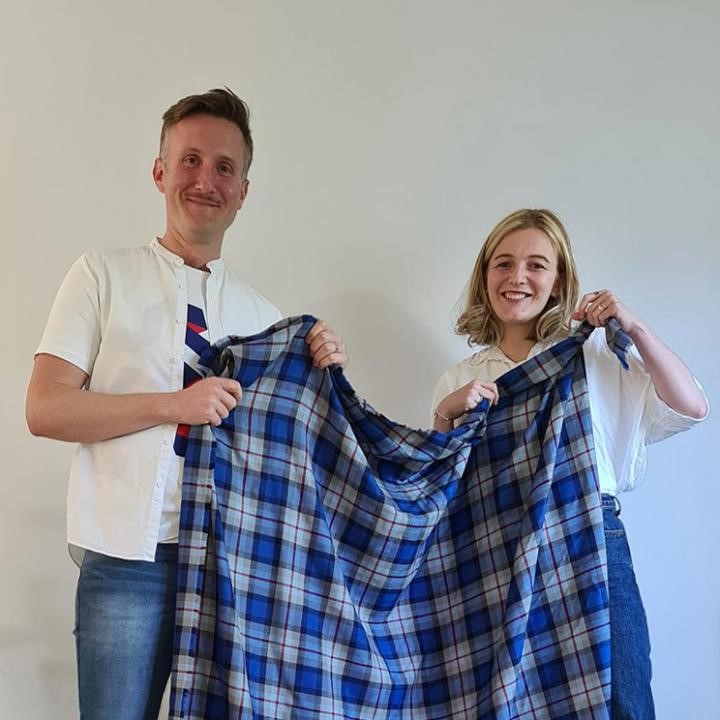
A tartan incorporating the colours of Scotland’s national nurse uniform has been created by nursing students and is the first of its kind to celebrate the profession. The woven cloth features shades of blue with burgundy detail to echo the official outfits worn by NHS nurses, healthcare assistants and student nurses across the country.  The tartan was conceived by Nursing Studies students at the University of Edinburgh, home to the UK’s first nursing degree, the UK’s first nursing research unit, and Europe’s first Professor of Nursing Studies. The Nursing Now – Edinburgh Nursing Studies tartan symbolises identity, kinship and solidarity for nurses, according to its registration with the Scottish Register of Tartans.

Celebrating nursing

The colourful project has been developed in partnership with Nursing Now – a global campaign established in 2018 to promote nursing and its vital role in improving health and transforming heathcare – and as part of the International Year of the Nurse and the Midwife, which was designated by the World Health Organisation in 2020 to celebrate and enhance nursing.  Jamie Smith, a nurse at NHS Lothian and a PhD student at the University, and Georgia Duffy, a former student at Edinburgh and also a nurse in practice at NHS Lothian, initiated the idea for the tartan and its design and said:  “Tartan is such a symbol of kinship which is synonymous with Scotland. We thought by creating this special tartan just for nurses it could help recognise their contribution – a way to support those who are always there to support us.”

A range of tartan merchandise – including facemasks, lambswool scarfs, shawls, stoles, wraps and tartan ties have been developed. People can also show their support for nurses with a charity tartan ribbon available for purchase on the Nursing tartan website. Georgia Duffy, NHS Lothian nurse said: “Capturing the essence of nurses and nursing was paramount to us on the creation of the tartan. Using the national uniform colours achieves this through highlighting the diversity within the workforce. Anyone can wear the tartan and we hope everyone will and can.”

Sales of the products will help raise funds for projects which will equip nurses and midwives to tackle global healthcare challenges.  Proceeds will also support The Burdett Trust for Nursing, a charitable trust which funds a range of projects to empower nurses and make significant improvements to the patient care environment. The Burdett Trust provides support for the Edinburgh Global Nursing Initiative – a University project launched in 2020 which connects nurses worldwide to share research, innovations and knowledge to boost people’s health outcomes. The global initiative’s pioneering projects have a focus on innovating nursing and midwifery in areas where health systems are affected by challenges such as disease outbreaks, poverty and conflict.

Saved for the nation: Scottish institutions celebrate appeal’s success

The Scottish members of a consortium set up to save a unique collection of literature for the nation have welcomed the news that their international appeal has reached its target of £15 million. This means that the Blavatnik Honresfield Library (formerly Honresfield Library) – a treasure trove of items from the world’s most beloved writers, unseen by the public for almost a century – will no longer be sold at open auction and instead will be shared with libraries and other organisations across the UK. The library, collected and curated by a Rochdale businessman in the 1800s, comprises priceless manuscripts, rare first editions and irreplaceable letters. These include works by Robert Burns, Sir Walter Scott, Jane Austen and the Brontë siblings.

A UK-wide consortium led by The Friends of the National Libraries, which includes Abbotsford, the National Library of Scotland and the National Trust for Scotland, was successful in raising half the funds needed from hundreds of individual donors, as well as the National Heritage Memorial Fund, the Scottish Government, the Foyle Foundation, and other organisations, with the balance coming from a generous donation by Sir Leonard Blavatnik – the largest ever given to the UK by an individual for a literary treasure. This achievement has also been made possible by the vendor’s willingness to give the consortium the time needed to launch and run the fundraising appeal, to which countless people from Scotland, the UK and around the world contributed.

Coveted collection of literary treasures

Rob Roy. Photo: Courtesy of Sotheby’s.

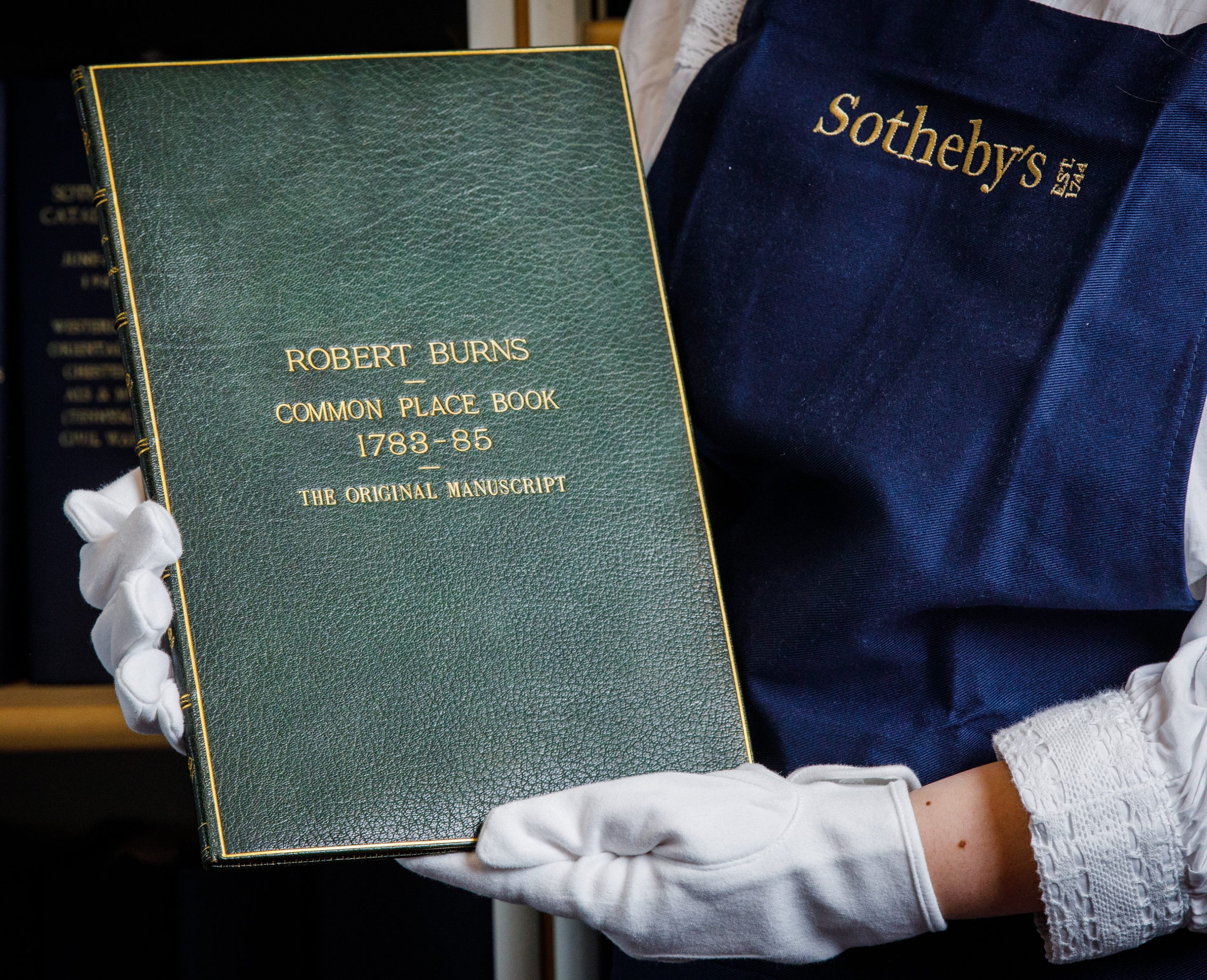
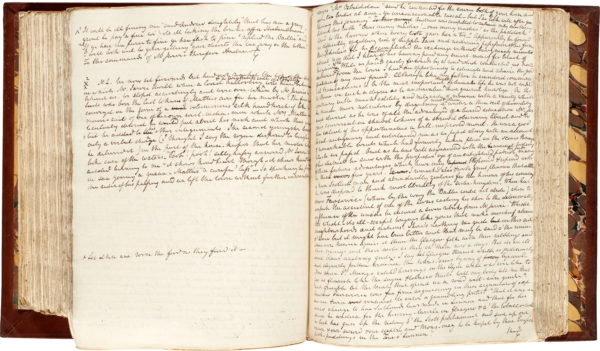
Arrangements will be made in the coming months for the Scottish organisations to take possession of key works from the collection, conserve them and make them publicly accessible. These include an early volume of poems by Robert Burns in his own hand – containing some of his earliest recorded literary works – known as the First Commonplace Book, as well as individual autograph poems (Cessnock Bank and the Brigs of Ayr), and some of the poet’s earliest correspondence, including the only extant letter to his beloved father.

Other Scottish material of huge importance is the complete working manuscript of Sir Walter Scott’s iconic novel Rob Roy, part of the autographed manuscript of Scott’s verse romance, The Lay of the Last Minstrel, his travel journal of an expedition off the Scottish coast in 1814, a copy of Border Antiquities with extensive manuscript revisions, and an exceptional group of Scott first editions in their original condition.

Culture Minister Jenny Gilruth said: “It’s important for the nation that this coveted collection of literary treasures has been saved from being sold into private hands. Once again, books which play a crucial part in Scotland’s literary history were in danger of being withheld from public view. These include some of Robert Burns’s earliest works and the manuscript of Sir Walter Scott’s Rob Roy. The Scottish Government is pleased to support the Honresfield Library appeal by providing £400,000 to ensure these valuable books return to Scotland where our culture and heritage organisations will ensure they are cared for, preserved and made available to the public.”

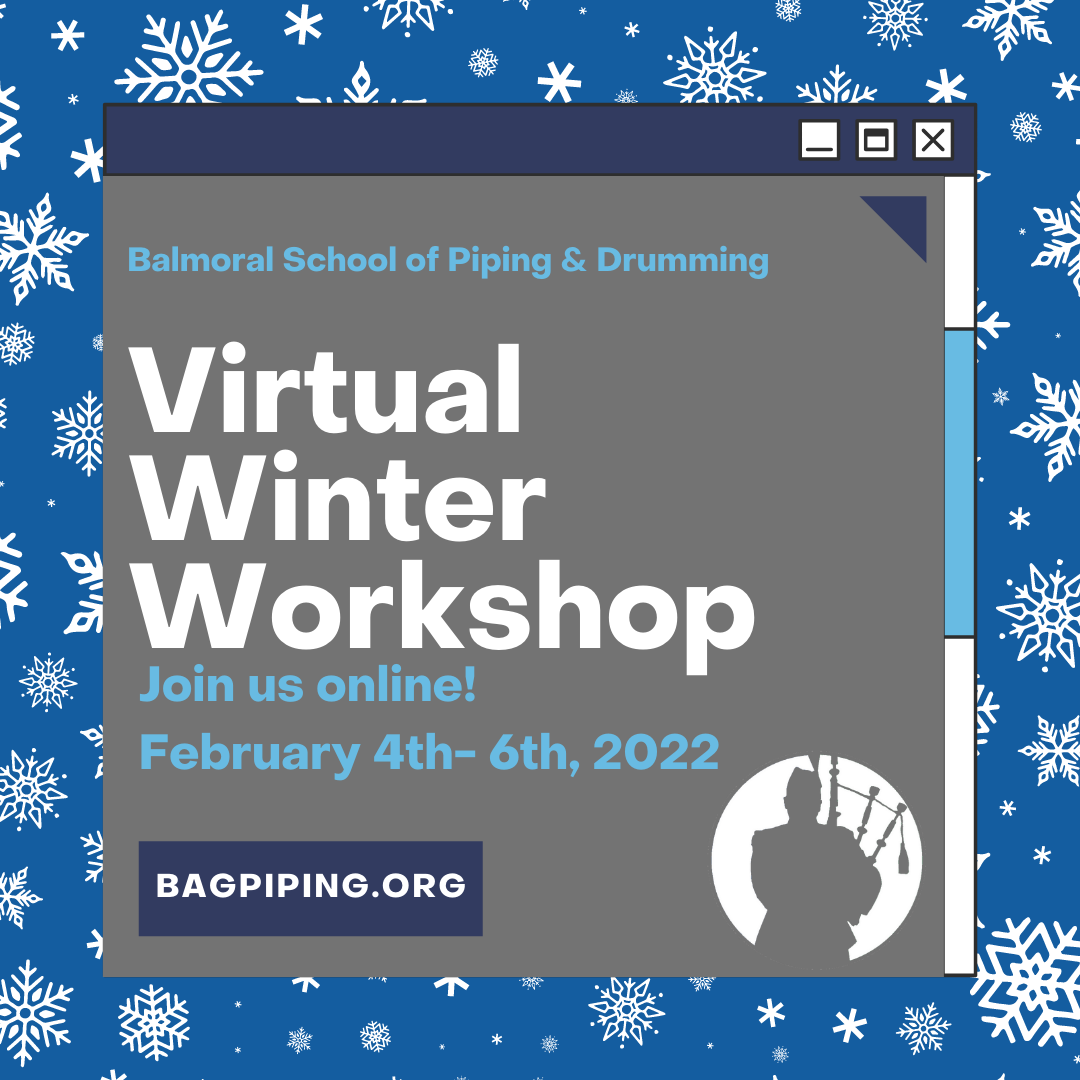
Balmoral 2022 Online Winter Workshop

MacLeod, Gandy, Mathieson & Carlisle to teach at Balmoral’s Winter Workshop.

The Balmoral School of Piping & Drumming is offering a weekend-long Winter Workshop for Pipers, February 4-6, 2022, for a fee of $275 USD. Students who refer new students will receive $50 off the price of the Workshop for each new student referred.

Attendees will receive online instruction via Zoom, with tech help available for those who need it. Our guest piping instructors—Roddy McLeod, Andrew Carlisle, Bruce Gandy, Robert Mathieson— have all won major awards and have incomparable records of teaching and promoting pipe music around the world.

Roddy MacLeod, MBE, of Glasgow, Scotland, won his first Gold Medal at the Northern Meeting in 1986, Argyllshire Gathering Gold Medal in 1988. He is a 10-time winner of the Piobaireachd at the Glenfiddich Solo Piping Championship and has won the overall title five times. While Pipe Major of the Scottish Power Pipe Band, he led it to over 45 Grade 1 Championship prizes including the Cowal Championships and All Ireland Championships. He was Principal of The National Piping Centre from 1996 -2020.

Originally from Northern Ireland, now a resident of Pittsburgh, Andrew Carlisle has won numerous top awards: A Grade Strathspey and Reel at Oban, the A Grade Piobaireachd & Overall at The Cowal Highland Gathering, US Gold Medals for both Light Music & Piobaireachd, and three All-Ireland titles at Senior level. He’s 3-time winner of the Macallan Trophy at Lorient, Brittany, France. Andrew holds the prestigious positions of Professor of Music and Director of Piping at Carnegie Mellon University.

A resident of Halifax, Nova Scotia, Bruce Gandy was a member of the 78th Fraser Highlanders Pipe Band when they were the first non-Scottish pipe band to win the World Pipe Band Championships in 1987. His solo awards include the Canadian Gold Medal, Gold Medal at the Northern Meeting, Gold Medal at Oban, and Bratach Gorm. He is a 3-time winner of the MacCrimmon Memorial Cairn for Piobaireachd and is a Vancouver Indoor 6-Time Metro Cup Winner.

From Hamilton Scotland, Robert Mathieson is a composer of pipe music, as well as an award-winning Pipe Major. He served as pipe major of the Shotts and Dykehead Caledonia Pipe Band of North Lanarkshire, Scotland, from 1986 to 2010. The band won 30 major championships under Mathieson’s leadership and was a 5-time winner of the World Pipe Band Championships.

Special deal for band members! Bring at least a few members of your pipe band to Balmoral and you’ll receive a highly customizable band clinic, tailored to your band’s needs, as part of your Winter Workshop.

For further details see: www.balmoralschoolofpiping.org/winter-workshop

National Dance Company to headline Te Anau Tartan Festival

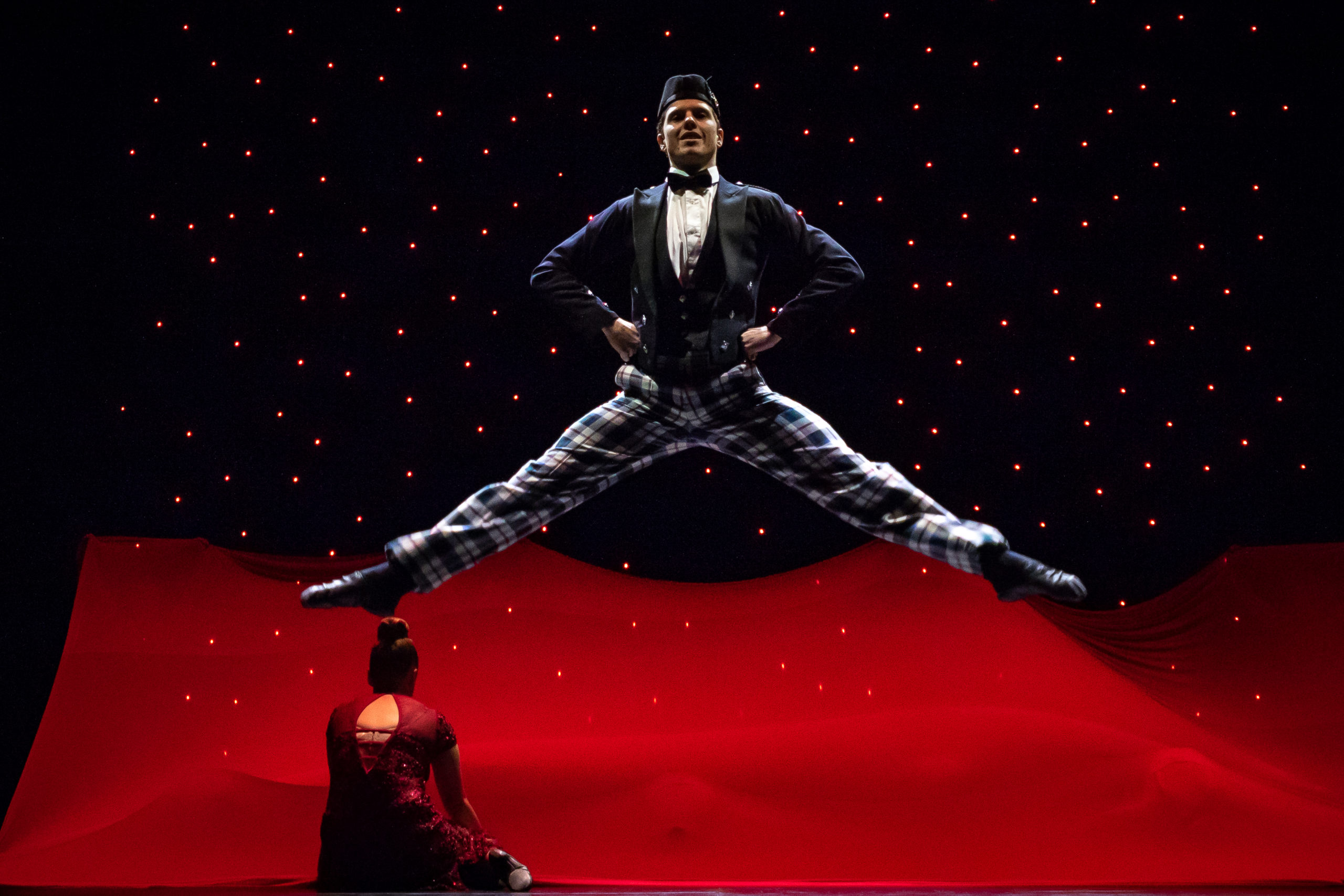
An elite dance company of New Zealand’s champion Highland Dancers, renowned for performing innovative choreography worldwide, will perform an exclusive show at the 8th Te Anau Tartan Festival this Easter. The Highland Dance Company of New Zealand is usually in demand performing its energetic and contemporary acts at festivals, tattoos and shows around the world, but opportunities have been stalled by the Coronavirus pandemic.

With assistance from the Regional Events Fund, which was created to stimulate domestic tourism and travel between regions through holding events, the Te Anau Tartan Festival’s invitation to the dance company to headline this year’s event was met with overwhelming enthusiasm. The company will perform a revised version of its Heart of the Highlands show, which included Invercargill in its 2018 tour, specially adapted to suit the Te Anau town hall stage at the Fiordland Events Centre. As part of their goal to inspire and encourage other young dancers, the company is giving those competing at the festival the exciting opportunity to apply to be part of the cast.

How exciting and innovative Highland Dancing can be

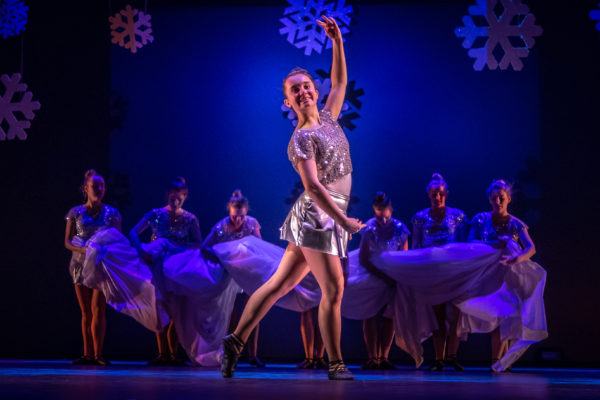
Auckland-based Highland Dancer Imogen Grayson, currently ranked number 2 in the country, will join the cast performing the acclaimed show at the Te Anau Tartan Festival this Easter. Photo: Chris Watson/Profocus Photography.

Numbers are limited and priority will be given to Southland-based dancers. Te Anau Tartan Festival convener Kirsty Pickett, who is also a Highland Dancing teacher, said the festival committee was extremely excited to be hosting the dance company, and she hoped as many people as possible would take the opportunity to come and witness the spectacle, “I can’t emphasise enough just what a unique opportunity this is. While we see them in competition around the country, these dancers usually only come together as a troupe for international performances. Shows around New Zealand are rare. Although it’s grounded in our traditional technique, the choreography and costuming is contemporary and dynamic and will appeal to a wide range of people. I think people will be genuinely surprised at just how exciting and innovative Highland Dancing can be. What these dancers are doing for Highland Dancing is akin to what Riverdance did for Irish dancing.”

Past and present champions and nationally-ranked dancers make up the cast, including the reigning New Zealand Champion, Angus Hendry. Full programme details will soon be unveiled, but the Dance Company will perform two shows over the course of the Tartan festival, the first to open the festival on Friday, 15th April. Tickets will be available on the festival website: www.teanautartanfestival.co.nz. Alongside highland dancing and solo bagpiping competitions, other events planned are the ever-popular have-a-go highland games on Saturday, 16th April, that the whole family can take part in, along with food stalls and a market. And, for the first time, piping and Highland Dancing workshops will be offered on Sunday, 17th April, to encourage competitors and their families to stay in the region longer, and learn from some of the country’s leading tutors.

For details on the Te Anau Tartan Festival see: www.teanautartanfestival.co.nz

Main photo: Reigning New Zealand Highland Dance champion Angus Hendry, of Palmerston North, will join the New Zealand Highland Dance Company at the Te Anau Tartan Festival this Easter. Photo: Chris Watson/Profocus Photography.

Select your currency