Editorial – The Scottish Banner Says….

March 2016 (Vol. 39, Number 9)March 2016 (Vol. 39, Number 9)

The Banner Says…

Celebrating our Celtic cousins

What an amazing month March is, just as we are getting over St Andrew’s Day in November, then Robert Burns events in January-suddenly here we are in March-with not one but two special days to acknowledge and celebrate!

St David

The first one comes very soon in the month. March 1st to be exact, for it is on this day that St David’s Day is celebrated. Who was St David and what exactly does he stand for? Well might you ask, as while he is the patron Saint of Wales, St David is not quite as well-known as another Saint who becomes very popular on the 17th of this month, St Patrick of Ireland. However, we do have some information on St David, one of these being the fact that he was born in Cardiganshire, and later became renowned as both a teacher and a preacher. He also became known as one who founded monastic settlements and churches in both Wales and Brittany. St David stands on the site of the monastery he founded in the Glyn Rhosyn valley of Pembrokeshire. St David, like many other Saints, also performed miracles. The best known of these seemingly, took place while he was preaching in the middle of a large crowd in a Welsh village. While doing this, a white dove suddenly flew down and settled on his shoulder, a spectacle felt by his followers to be “conceived as a miracle”.

After this St David used a white dove as his emblem. Yet St David lived a simple life, his monastic rule prescribed that monks should pull the plough themselves without draught animals. They should also drink only water and eat only bread with salt and herbs. Further, they should spend their evenings in prayer, while also reading or writing. No personal possessions were allowed. Even to say “my book” was considered an offence. St David also taught his followers to refrain from eating meat or drinking beer. His symbol also is the same as Wales, the leek. Referenced further from Shakespeare’s Henry V, Act V scene, when a Welshman addressed the King as follows: “The Welshmen did good service in a garden where leeks did grow, wearing leeks in their Monmouth caps, which we know is an honourable badge of service and we take no scorn to wear the leek upon Saint Tavy’s day.” King Henry responded likewise, “I wear it for a memorable honour, for I am Welsh, you know good countrymen”. David lived for over 100 years and died on March 1st, now known as St David’s Day.

St Patrick

If the thought of a blustery, windswept March (for those in the Northern Hemisphere), doesn’t make you think of St Patrick’s Day, then the stores certainly will. From as early as mid-February, shamrocks, greeting cards, and “Erin Go Bragh” buttons will adorn store shelves, reminding us that our Irish celebration is just around the corner. On March 17th green beer will be sold in restaurants, green lines painted in the centre of streets, and Irish tunes played on the radio. It is indeed a great day for the Irish. But to look beyond the frivolity of St. Patrick’s Day, is to open a veritable Pandora’s box on the ancient Celtic culture, for it was during the Celt’s time that this day began. Patrick, the Patron Saint of Ireland, was born in Scotland of a British mother and Roman father. Later on he went to Ireland to teach Christianity to the pagan Irish. In doing so, he liked to use the shamrock with its three separate leaves coming from one spine as a symbol of the Holy Trinity.

Patrick died on March 17th, 493, but to this day his name is closely associated with the little green shamrock. When Patrick first arrived in Ireland, the Celts were rather wild people. They roamed throughout Britain and Europe, spreading their customs wherever they went. History has told us that these were a strange people who, on the one hand were savage warriors, but on the other loved to adorn themselves in life, as well as in death, with ornaments. Much of their ancient jewellery has been retrieved from old graves and are now, virtually priceless pieces in museums across Britain and Europe.

Some of their matrimonial laws might be as acceptable in today’s society as they were at the dawn of civilization. For instance, if a woman were richer than the man she married, she automatically ran the household herself. But if the marriage broke up the woman was allowed to take her property and riches with her, without any interference from her spouse. The women were recognized as equal to men, even at war where they could fight alongside them if they so wished, the ancient Queen Boadicea stands testimony to this.

The Celts

In spite of their reputation as barbaric fighters, the Celts were terribly afraid of some of their beliefs. Fairies, witches, warlocks and wizards were enough to strike fear into the most savage of Celtic hearts. Thus the night of Hallowe’en was by far the most sinister night of the Celtic year. For it was widely believed that this was the night the sun descended into darkness, fairy hills opened up and dead spirits roamed the earth casting evil where they may. It was indeed, a night to stay home. And yet not all of their beliefs were fearful, for it was the Celts who gave us the custom of kissing under the mistletoe. It is also due to the Celts that we have the festival ‘Midsummers Eve’, which is still celebrated in many parts of Britain today. The Celts themselves have long ago gone from this world. But they have left us much to remember them by. These include their ancient monuments Stonehenge being the most famous of all. It was during these days of the Celts, in another Ireland, that the first meaning and name of St Patrick’s Day arose.

Clydebank Blitz

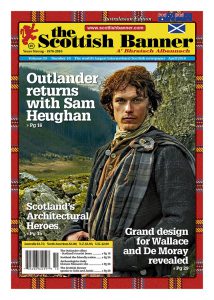
Crossing over the years, as is so easy to do in print, we are reminded of yet another special happening in the past, the 75th anniversary of which takes place this month. I mention this as whilst it is by no means as holy as the forerunner of this article, it is however still something which today many people may still remember. The situation of which I speak is the Clydebank Blitz. Although it was a long time ago, I still believe there are those who can recall that terrible time in ours and Scotland’s life time. We revisit that terrible time in Scotland’s history in this edition and honour those impacted by those terrible events of March 1941.While I am certain those days were terrifying to millions of people, perhaps we should remind ourselves of the horror of war and pray together that we never experience that kind of horror again.

May we all enjoy another March with its two special days and thank you St Patrick and St David, two names from the past who we continue to honour today.

Are you celebrating St David’s Day or St Patrick’s Day? How do you think they compare with Scotland’s St Andrews Day? Tell us about your link to these great Celtic celebrations.

Editorial – The Scottish Banner Says….

February 2016 (Vol. 39, Number 08)

The Banner Says…

Gretna Green-Scotland’s home of love

With Valentine’s Day almost here,  we take a look at the next step, Gretna Green!

The month of February brings with it a very special day-one that is full of warm feelings and love. That day of course, is the 14th, St Valentine’s Day. I well recall as a young girl, waking up that morning, and as our mail man usually delivered the mail prior to anybody getting out of bed, (remember those days?),  I would look down the stairs from my bedroom, and there, sure enough, were a handful of card size envelopes, which I hoped (and thought) may be Valentines cards. I bounded down the stairs and seized the envelopes, before running back up to my bedroom where I carefully opened each and every envelope to see who had taken the time to surprise me, on this, the most romantic of days with a Valentines card.

Of course, as I grew older, there were fewer cards as relationships occurred in those days which were more ‘one on one’, being a natural change from the school age relationships when numerous dates -none of which were serious, to those that came later. However, as we age, relationships continue to change. Life ‘happens’ and things often change whether or not we want them to. Others lives change, as well as our own be it due to health issues or simply just a move to another location.

The idyllic Scottish Borders

Yet as we are approaching this, the  most  romantic time of the year, let us spend a little time thinking about romance and other important issues of the heart.  Somewhat surprisingly, one of the main romantic locations happens to be in Scotland itself! I refer to the millions of runaway marriages over the years, not only from across the U.K.,  but also from across other parts of the world. This romantic and most unique part of the marital world is Gretna Green.

Why did Gretna Green become the worlds’ most romantic and favourite place for those wishing so  fervently  to marry – yet were unable to do so? Perhaps due  to parental feelings  (quite possibly the bride’s father), who would not give his daughter the permission she so badly wanted from him to marry her new loved one. In the 18th century English law lords approved new laws which tightened marriage arrangements quite considerably. This also meant that couples had to reach the age of 21 before they could marry without parental consent. Another big step for many was the fact that in those days marriages had to take place within a church.

Scottish laws however, were quite different and much more simple. They made many English couples decide that marrying at Gretna Green in the idyllic Scottish Borders, would allow them to marry on the spot, in a simple ‘marriage by declaration’ or ‘handfasting ceremony’. This ceremony required only two witnesses as well as assurances from the couple involved that they were both over the age of 16, (unlike the English and Welsh law which stated the age of 18).  With such a relaxed arrangement, and particularly with Gretna Green being within such easy reach of England, as it is the first village in Scotland.  Further, it was also conveniently located on a main route from London going directly into Scotland. There was no other place to compete with it. Gretna Green was the perfect location to take advantage of simpler marriage laws of the two varying countries.

Blacksmith Priests

Sometimes there was also a feeling of haste in the marriage. This might have been partly to do with an angry father of the bride not wanting his daughter to marry the person she had chosen, or perhaps as some other reason.  There were often family feuds about marriage, causing some couples to runaway prior to the rest of the family knowing their plans and therefore try to prevent the marriage itself. If this was the case, as soon as they reached Scottish soil at Gretna Green, the romantic duo could find a place of security where they were able to marry in haste, before angry family members could catch up with them stopping them from what their romantic hearts so badly wanted to do- unite! Yet still more locations have evolved in this very romantic and historic part of the world. Today the Old Blacksmith Shop is associated and best known for Gretna Green Weddings. This has  become an enduring symbol of the romance of the area, with certain ‘Blacksmith Priests’  sometimes, somewhat flamboyant characters who conducted ceremonies in the Famous Blacksmiths Shop, where couples have gone to marry since 1754 still stands there. A modern day blacksmiths shop was created as recently as 1939,  shortly after which came another new idea, that being the ‘Anvil’ blessings. These blessings caused more cash flow to the organisers and were strongly suggested to follow a registrar wedding.

One of the most romantic places on earth

Gretna Green has certainly made its reputation across the world as being one of the most romantic places on earth. Even today thousands of couples are still attracted by its reputation and continue to travel to “The Gateway to Scotland” for their own victuals. The town of Gretna was planned during the First World War. It provided homes for 30,000 employees of a munitions factory that was the biggest in the world,  being an incredible nine miles long. A story was made of the factory at ‘The Devil’s Porridge’ in Eastriggs. Gretna Green itself became famous for being  the ‘marriage capital’ of the UK. It is believed that around 5,000 couples decide to  get married there each year.

Gretna Green marriage

In common law, a “Gretna Green marriage” came to mean, in general, a marriage transacted in a jurisdiction that was not the residence of the parties that were being married, to avoid restrictions or procedures imposed by the parties jurisdiction. In 1856 Scottish law was changed to require 21 days’ residence for marriage, and a further law change was made in 1940. The residential requirement was lifted in 1977. Other Scottish border villages used for such marriages were named Coldstream Bridge, Lamberton, Mordington and Paxton Toll.  Yet still Gretna Green is the one that stand out as the most exciting and romantic part of Scotland. Many thousands of young girls plan a romantic wedding at Gretna, however, as they mature a little, many of them decide to have the original wedding, with her husband to be at her side, being ‘given away’ by her father(usually with a tear in his eye, plenty of loving  family to watch). Its’ a little more ‘acceptable’ way of becoming married in a church. Gretna’s status as the ultimate wedding destination remains still today as the village with a population of just 2,700 , hosts almost two weddings per person per year, following the many thousands who have said “ I do” at Gretna since 1754.

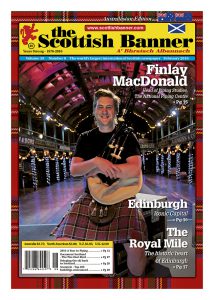
This month we also continue our look at the 2016 Year of Innovation, Architecture and Design with a focus on Scotland’s ancient capital, Edinburgh. Regardless of who or what you love, I hope it you enjoy your February.

Have you been to Gretna Green or perhaps wed there yourself? Tell us about your Gretna Green story.


Editorial – The Scottish Banner Says….

January 2016 (Vol. 39, Number 07)

The Banner Says…

A time for reflection

If Christmas is full of hustle and bustle, New Year is a time of parties, yes but more than that, it is a time of reflection.  Just look around and think for a moment about those who touch your life, not just during the holiday season, but all year round. Think of the difference they make just by being ‘there’. Sadly, we are unaware sometimes how much they mean to us, until they are no longer, often leaving a void which is both painful and difficult for us to accept. After a discussion on this very subject during the holiday season, I took some time to think about those who affect my everyday life, bringing with them pleasure and often lighten an otherwise busy or stressful day. At the same time I reflected on those who have helped so much in bygone days bringing their own talents to the Scottish Banner, thus helping overseas Scots forge a link and voice their opinions with others. These have often become good personal friends, both now and in times past. Some are still with us, but others have now gone, leaving pleasant memories and the shadow of a warm smile.

Looking back

Some years ago I met Scots author and actress Molly Weir. A well-known and delightful lady, Molly and I soon became firm friends. Molly never had a computer they were hardly known when she wrote for the Banner.  Instead we received long typewritten pages, which in turn had to be re-typed into our computers upon receiving them.  Always, there was a very long private to letter to me tucked in the envelope telling me what was happening in her life, etc. Eventually these letters, brought more and more news  of her husband Sandy’s sickness, and finally his death. I knew her heart was broken through her last letters and eventually the letters, and the columns, stopped altogether. My dear friend Molly had gone to be with her Sandy, which is where I knew she wanted to be. I still miss ‘our Molly.’

Author Nigel Tranter, was perhaps the most well known and most loved writer to ever come out of Scotland. He wrote many famous books as well as numerous prolific articles about Scottish history for the Banner – which he seemed to know like the back of his hand. These were often  accompanied by the same warm and friendly letters.  I was astounded and very surprised when he first offered to write articles for us, and of course, agreed with his offer. Nigel did continue to write for us, until he could no longer when he departed this earth. There are still dozens of Nigel’s’ private letters to us in files here at the Scottish Banner office. They can never be discarded as they are his words, written just for the Banner. Upon his death his daughter inherited all copyright to his works.  She knew her father held the Scottish Banner in high regard and shortly after his passing, gave us permission to use his articles in future issues. A most generous and cherished legacy, and for which I am still most grateful. Yet I still miss Nigel himself and am very proud to have known such a man of his calibre.

Charlie Mill who also wrote for the Banner was not a famous man, but for us he was a true hero, coming through as he did, with many interesting articles each month. We cherished him greatly and although we knew he had health problems, it was a terrible and tragic  blow when we heard from his daughter that he  had passed away. He did so leaving us with lovely memories of his views on Scottish life. But this is not meant to be about those who have gone before. There are others whose names we are proud to have in these pages, and who have been there for a long time, and who we hope will continue be there for a much longer time to come.

Looking forward

My dear friend and fellow writer, Ron Dempsey is one of these. Ron brings us an enlightening column on Scottish names each month and is an important part of the Scottish Banner team. Ron has a loyal and strong readership who would probably revolt were he to miss a month! Lady Fiona MacGregor whose friendship I have treasured  for many years, continues to write wonderful articles from the across Scotland. Using her pen the way an artist uses brushes, she paints a veritable picture of life in her part of the world every month.  We are also so fortunate to have some other great contributors such as Angus Whitson, Dr Ken B Moody, Marieke McBean, Joyce Milne D’Auria , David McVey and Jim Stoddart, all who help us make the Scottish Banner what it is today as we go into our 40th year of publication. These are just a few of those who come to mind when I think of those whose lives not only touch on mine, but also reach out across the miles with their words touching readers around the world.  I say this knowing how many wonderful comments they receive here at the Banner.

Our wishes for 2016

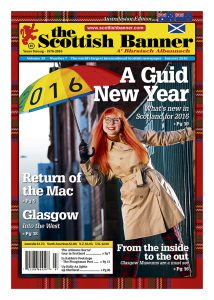
At this New Year, I would also like to recognise our readers, without whom there be no Scottish Banner.  At these offices we will continue bringing you news and views of Scotland, both from today and yesterday. From all of us on the Banner team both here in North America and from our offices in Australia, so ably handled by my son Sean, may we wish all of our readers, contributors, advertisers and friends, a happy and healthy 2016.  This year also sees the Scottish Banner reach the incredible milestone of 40 continuous years of monthly publication in July. In Scotland January starts The Year of Innovation, Architecture and Design 2016 which you can read about in this and future editions throughout the year, this month we start with a focus on Glasgow.

The best small country in the world

To Scotland, the best small country in the world, long may she flourish and may the fire never dim within the hearts of her sons and daughters, no matter where in this world they have settled. And last but by no means least, to this amazing world we all share. May we continue to live in peace, freedom and happiness along with others we share it with. May we have pride in our hearts when we consider where we live and how fortunate we are in so many ways. God bless 2016

Select your currency