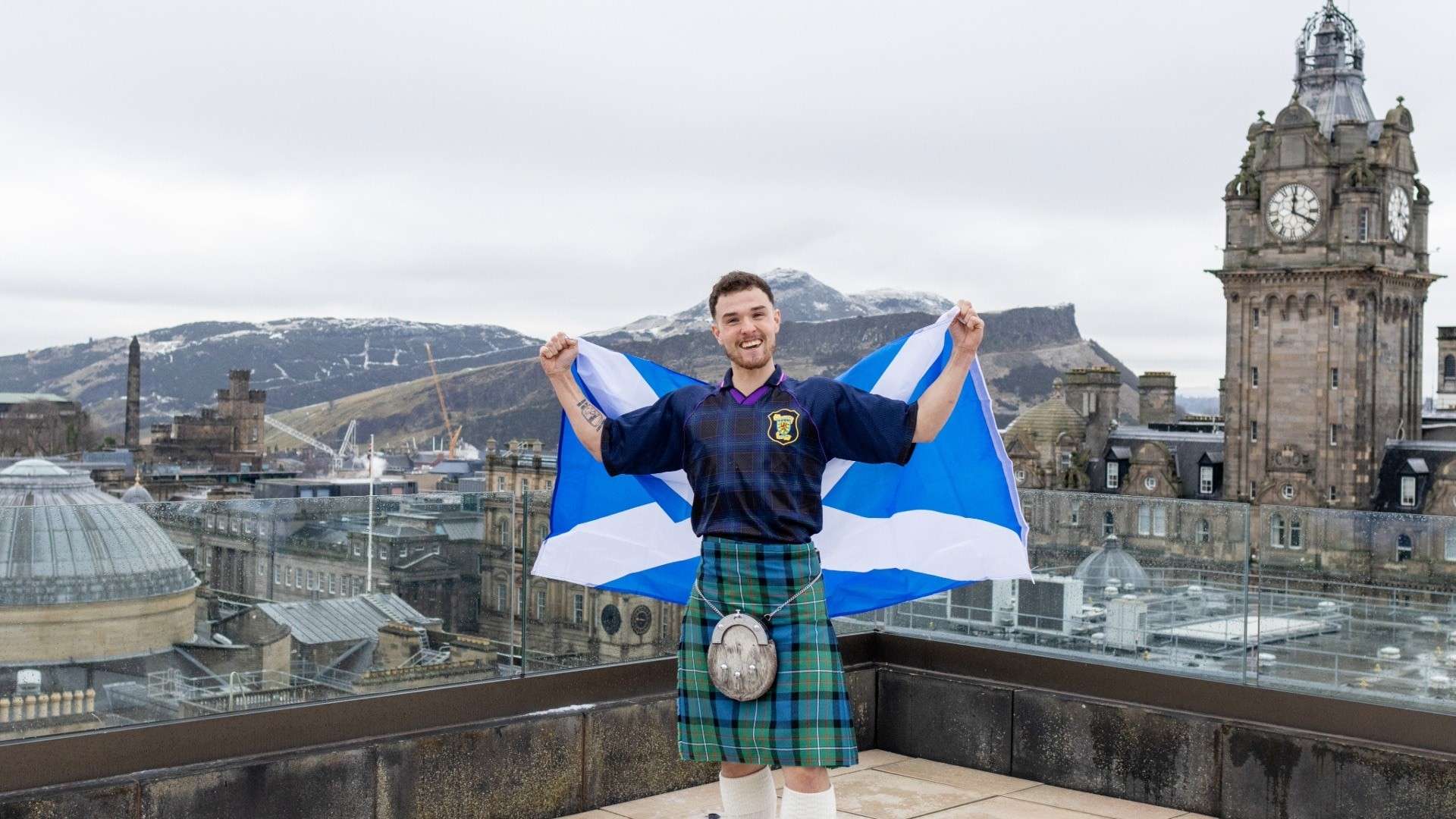
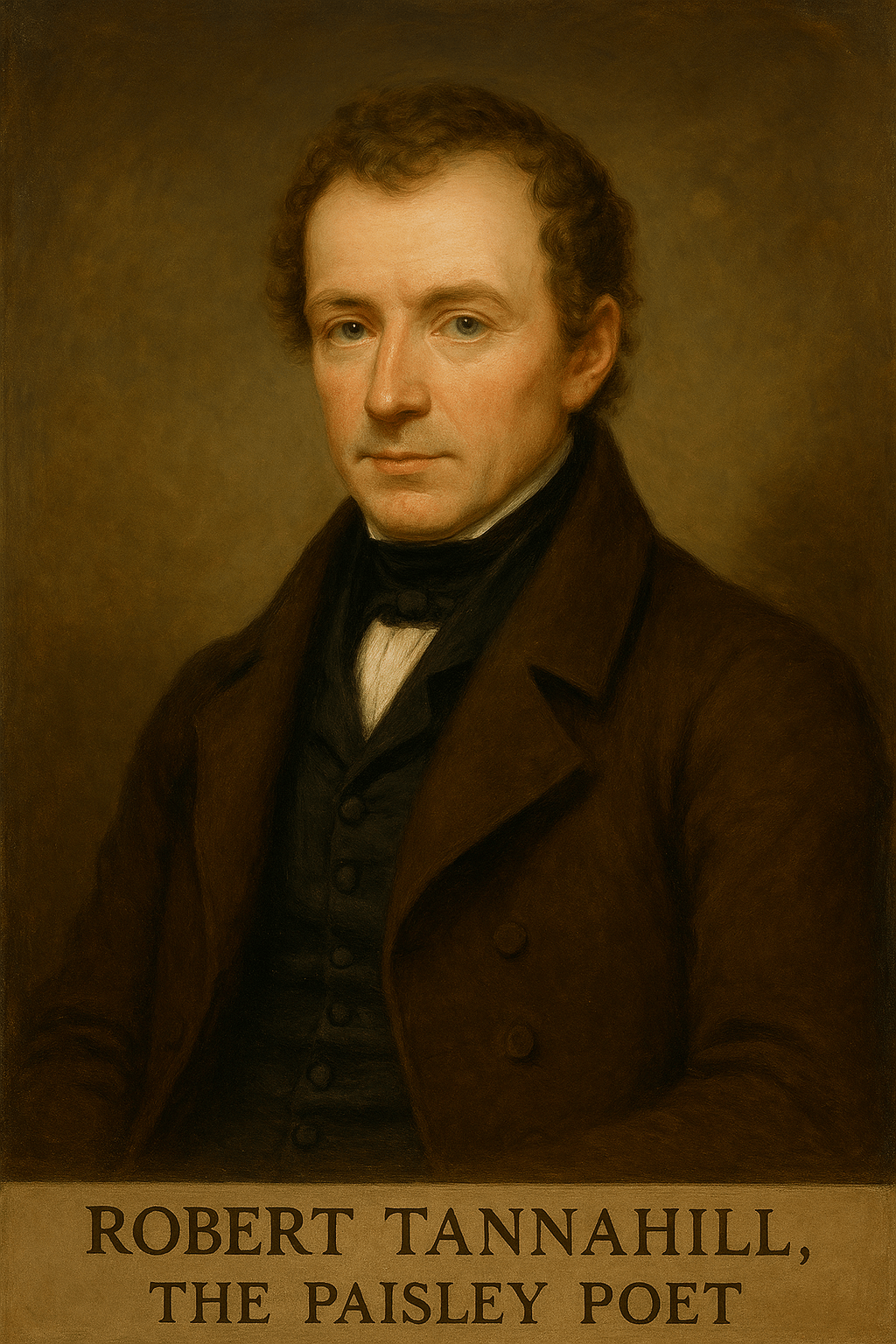
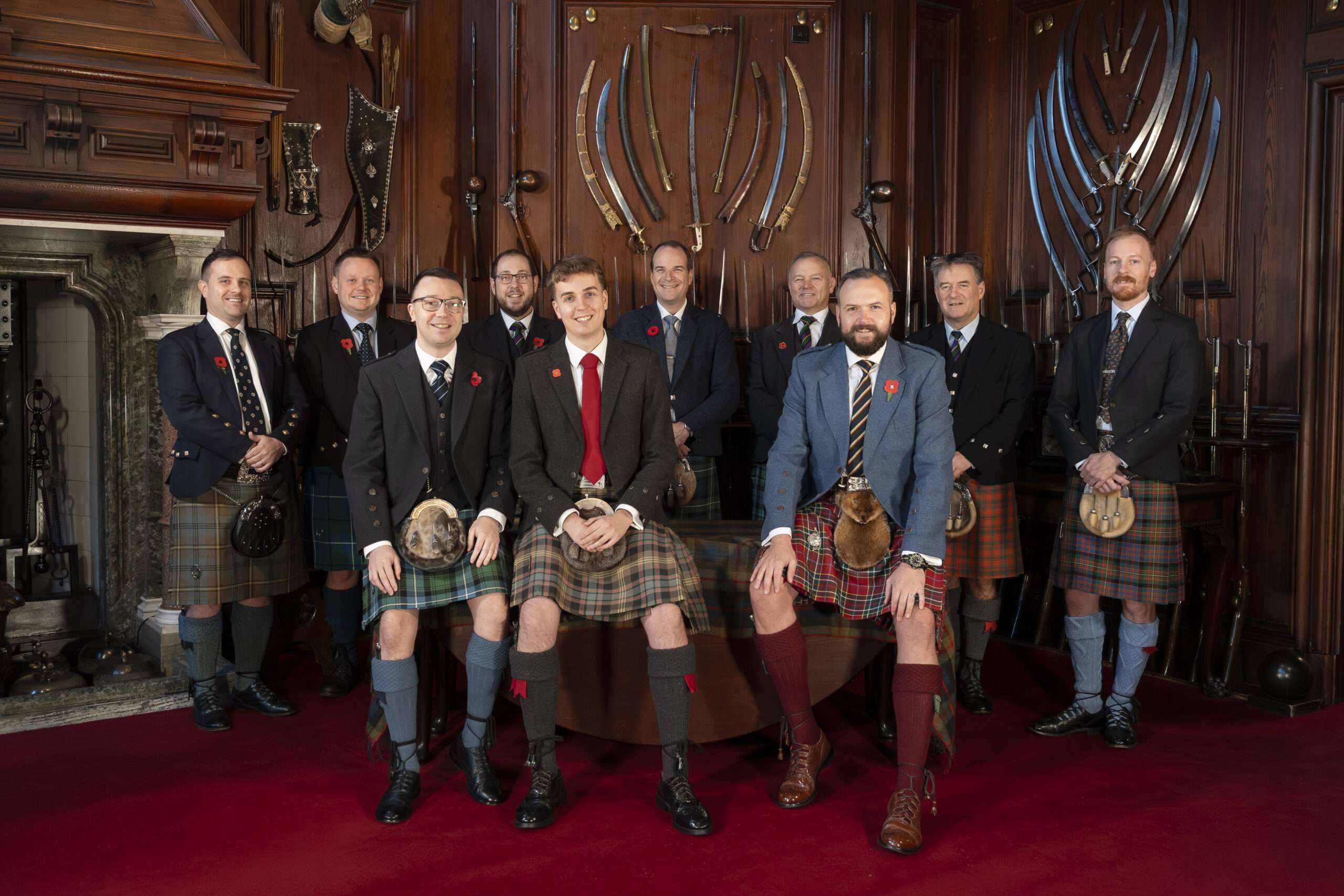
A Scottish charity campaigner has begun an extraordinary 3,000-mile endurance challenge across the United States to raise funds and awareness for mental health support in Scotland. Craig Ferguson, a Paisley-based mental health advocate, will walk from Los Angeles to Boston, completing a full marathon every day for 104 consecutive days, aligned with the upcoming Fifa World Cup 2026. Kicking off in February, this awe-inspiring pursuit will see Craig cover the equivalent of more than three thousand miles on foot, with the aim of reaching Boston in time for the Scottish national football team’s opening World Cup match on 14 June.
He was inspired to undertake this journey following his own experience of mental health challenges, and in tribute to friends and loved ones in his life who have been affected. Through this effort, he hopes to shine a spotlight on mental health, and to raise £1 million pounds of vital funding for Scottish Action for Mental Health (SAMH). Craig is no stranger to ambitious endurance fundraising. In 2024, he completed a remarkable 1,000-mile walk from Glasgow to Munich ahead of the UEFA European Football Championship 2024, passing through six countries and raising more than £70,000 for the Brothers in Arms men’s mental health charity, before being greeted by cheering fans on arrival in Germany.
Training for the “Tartan Trek” has been intensive, with Craig covering between 100 and 120 kilometres each week, alongside gym sessions of up to four days a week, as he prepares to brave the elements. He will complete the entire walk wearing a kilt – a powerful symbol of his connection to Scotland which, Craig says, also gives him a strong sense of motivation and personal empowerment. Craig hopes to be welcomed at the finish line by family and friends, as well as members of the Tartan Army, echoing the scenes in Munich where supporters gathered to celebrate the completion of his first endurance challenge in 2024. Like many Scottish football fans, he is also hoping to secure a ticket to watch his national team compete during the tournament.
Overcoming the challenge
When asked about the upcoming journey, Craig said: “I’d be naïve to think this is going to be a walk in the park. This challenge is three times the size of anything I’ve taken on before – physically and mentally – but that’s exactly what makes it so special. For me, it’s about pushing through, overcoming the challenge, and making it to the finish line in one piece. I chose to support SAMH because mental health causes are incredibly important to me, and I wanted to open up the conversation on a much bigger scale. We see the impact of mental health across Scotland and around the world, and SAMH are leading the way by breaking down barriers and making support accessible to all. I’m incredibly proud to be backing their life-changing work.”
Billy Watson, Chief Executive at SAMH, said: “Craig’s Tartan Trek captures exactly what SAMH stands for – courage, compassion and taking action when it matters most. Mental health challenges affect people in every community, and early support can make the difference between coping and crisis. The funds raised through this challenge will help us continue to provide accessible, community-based mental health support across Scotland, including through initiatives like The Nook. We’re incredibly grateful to Craig for taking on this remarkable challenge and for helping ensure that no one has to face mental health problems alone”.
Funds raised through the “Tartan Trek” will support SAMH’s nationwide services, which provide practical, emotional and social support to thousands of people experiencing mental health challenges each year. This includes adding to its national network of Nooks – welcoming, walk-in, barrier-free mental health support hubs available across Scotland.
Hazel McIlwraith, Director of Fundraising & Major Appeal at SAMH, added: “Craig’s Tartan Trek is one of the most extraordinary fundraising challenges we’ve ever been part of. Walking more than 3,000 miles coast to coast across the United States – a marathon a day for over 100 days – is an incredible physical feat, but what truly matters is why he’s doing it. Craig is using this challenge to shine a light on mental health, to show people that it’s okay to ask for help, and to raise vital funds that will directly support our life-saving services across Scotland. We are immensely proud to support him on this journey and grateful for his honesty, courage and determination.”
For more information on the Tartan Trek or to support Craig’s journey, visit: www.thetartantrek.co.uk
Do you enjoy our content?
Content on the Scottish Banner website remains free for users. Stories and events listed for the international Scottish community continue to be an important resource for many across the world. As advertising revenue remains a challenge, our readers can donate to help us produce unique Scottish content for global Scots. Every contribution counts and thank you for considering your support.
Support the Scottish Banner! To donate to assist with production of our publication and website visit: The Scottish Banner
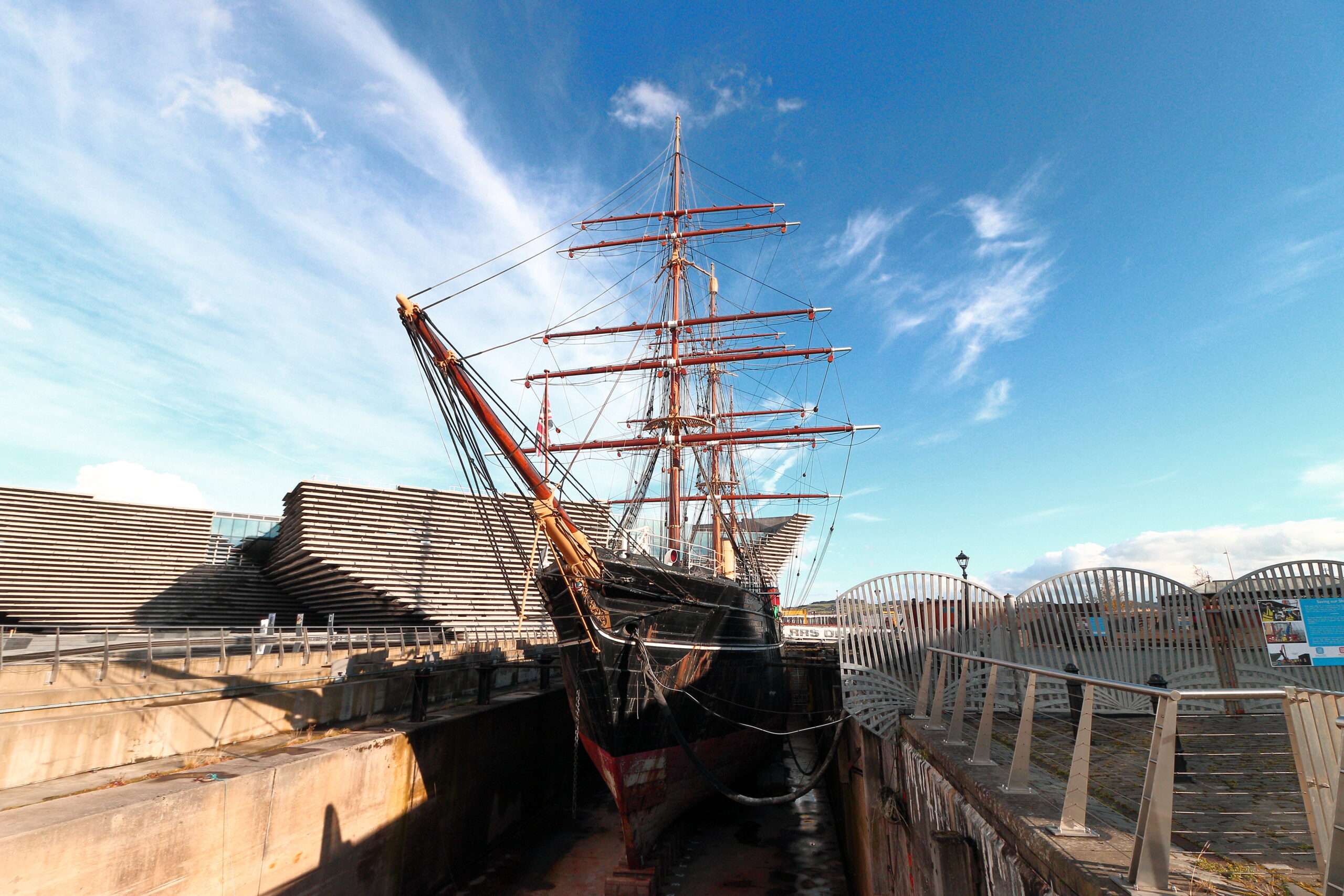
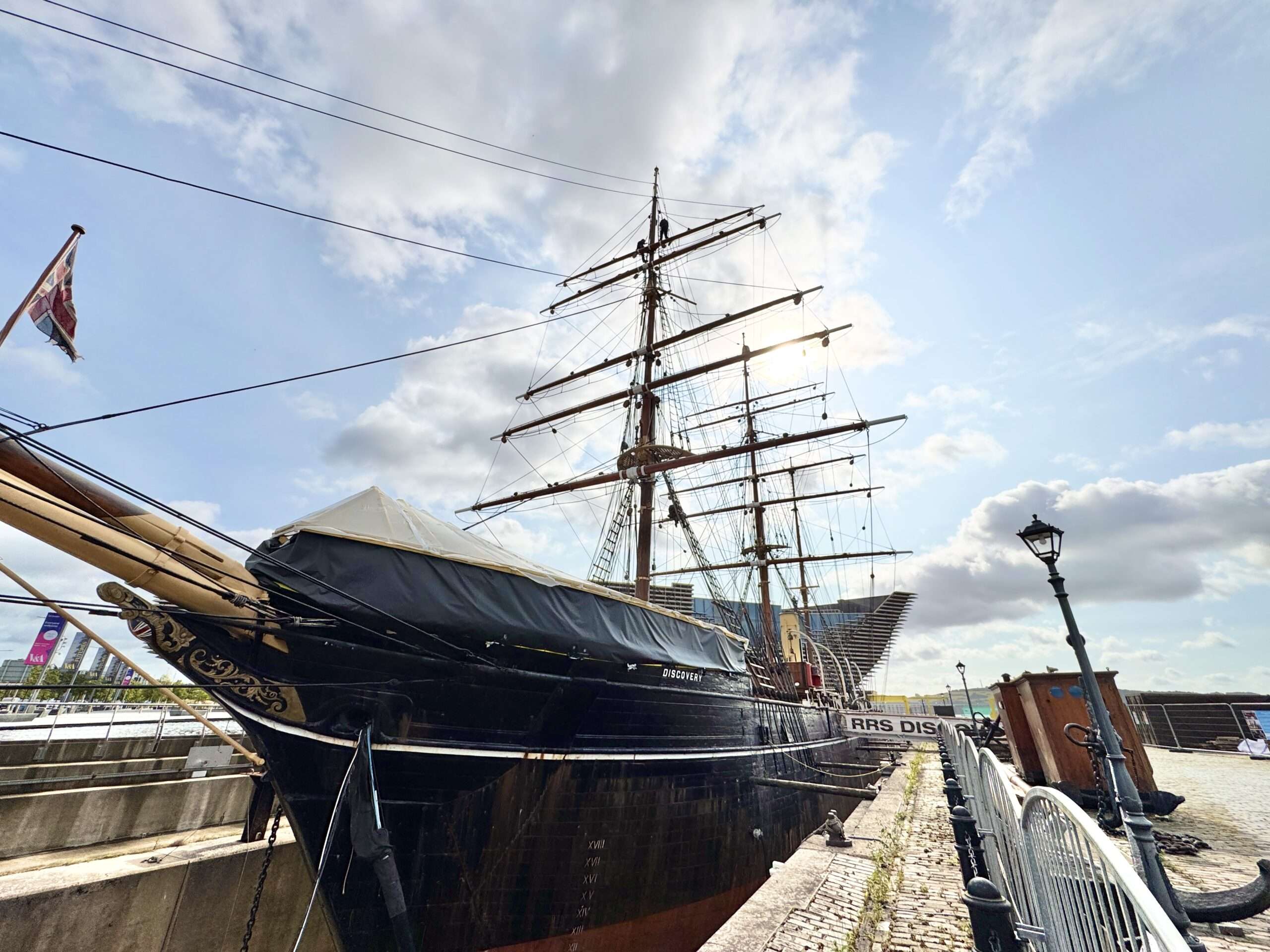
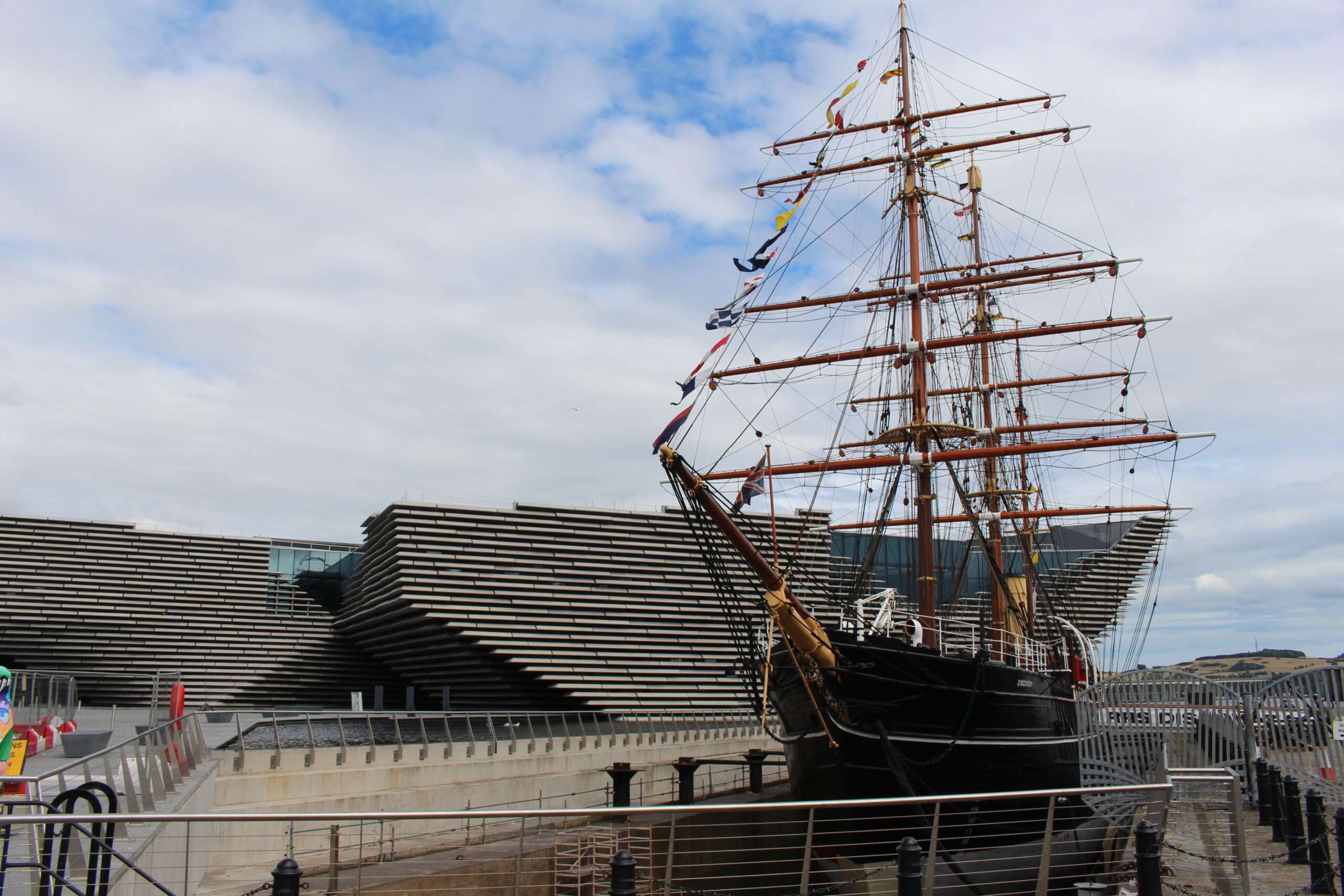
Dundee Heritage Trust (DHT), the guardian of Captain Scott’s pioneering Antarctic ship, the Royal Research Ship Discovery in Dundee, has announced the beginning of the second phase of a major repair and conservation project aboard the ship. This next phase, coinciding with the 125th anniversary of the Dundee-built polar research ship, will involve extensive repairs to the weather-beaten bulwark and stanchions, and create a fully supportive habitat for the vessel for the very first time. The works are expected to cost in excess of £2M and are generously supported by The National Lottery Heritage Fund, the Tay Cities Region Deal, the Northwood Charitable Trust, the Headley Trust, amongst others. Discovery Point and RRS Discovery will remain open as usual to visitors throughout the works, a rare opportunity to observe both traditional shipwrighting skills and modern conservation methods in action, as tales are uncovered from within the ship’s historic timbers.
The first phase of the major works project took place from 2023 to 2025 and focused on £1.4M of urgent structural repairs to the most vulnerable stern section of the ship. This included conserved areas of the ship’s deck and stern, involving traditional shipwrighting methods such as caulking, steam bending, and blacking—endangered skills at risk of being lost to over 1,000 historic ships across the UK, including 6 operated as visitor attractions in Scotland. Through the project, these traditional techniques are being preserved, documented, and shared for future generations.
125 years of Discovery
The announcement of the next phase of conservation work comes as the RRS Discovery approaches its 125th anniversary on March 21st. The Royal Research Ship (RRS) Discovery was built in Dundee and launched in 1901. It was the first ship in the world purpose built for scientific research in ice-packed Antarctica, providing the ideal vessel for the first official British exploration of the region since the voyage of James Clark Ross sixty years earlier (1839–1843). The 1901 expedition launched the careers of some of the leading figures in what was to become known as the ‘Heroic Age of Antarctic Exploration’, including Robert Falcon Scott (who led the expedition), Ernest Shackleton, Edward Wilson, Frank Wild, Tom Crean and William Lashly. The RRS Discovery is the sole surviving UK ship from the Heroic Age of Antarctic Exploration, which lasted between the end of the 19th century and the Shackleton–Rowett Expedition of 1921–1922.
The expedition carried out scientific research and geographical exploration in what was then largely an untouched continent. It was seen as a trailblazer for later ventures and a landmark in British Antarctic exploration history, with many notable discoveries including the Cape Crozier emperor penguin colony; snow-free dry valleys in the western mountains; the Antarctic plateau (upon which the South Pole is located); evidence that the Ice Barrier was a floating ice shelf; and the discovery of many new marine species.
Following further Antarctic expeditions in 1925 and 1929, as well as an extended period as a Sea Scout training ship based in London between 1931-1979, RRS Discovery returned to Dundee in 1986, where it has resided as a multi-award-winning visitor attraction operated by Dundee Heritage Trust, attracting over 80,000 visitors a year.
Returned to its home city by Dundee Heritage Trust in 1986, RRS Discovery is today at the geographic, economic and cultural heart of Dundee, explored by tens of thousands of visitors from across the globe each year. Part of the UK’s National Historic Fleet, she is officially recognised as one of the UK’s most important historic ships. Formed in 1985 with a mission to preserve the ship for future generations, the Trust also has responsibility for Discovery Point, an Accredited museum and one of the region’s most popular visitor attractions telling the story of Discovery and her groundbreaking scientific expeditions. The current project aboard the ship is a part of the Trust’s wider transformation project at DiscoveryPoint, which hopes to transform the museum for the next generation.
Emma Halford-Forbes, Heritage Director at Dundee Heritage Trust said: “We’re thrilled to be moving on to the next phase of works aboard the internationally significant RRSDiscovery. We’ve formed an excellent team, who have guided us through the first phase of works and shared so much knowledge and skill with our team and volunteers. We’re delighted to be working with them for the next two years.”
Do you enjoy our content?
Content on the Scottish Banner website remains free for users. Stories and events listed for the international Scottish community continue to be an important resource for many across the world. As advertising revenue remains a challenge, our readers can donate to help us produce unique Scottish content for global Scots. Every contribution counts and thank you for considering your support.
Support the Scottish Banner! To donate to assist with production of our publication and website visit: The Scottish Banner
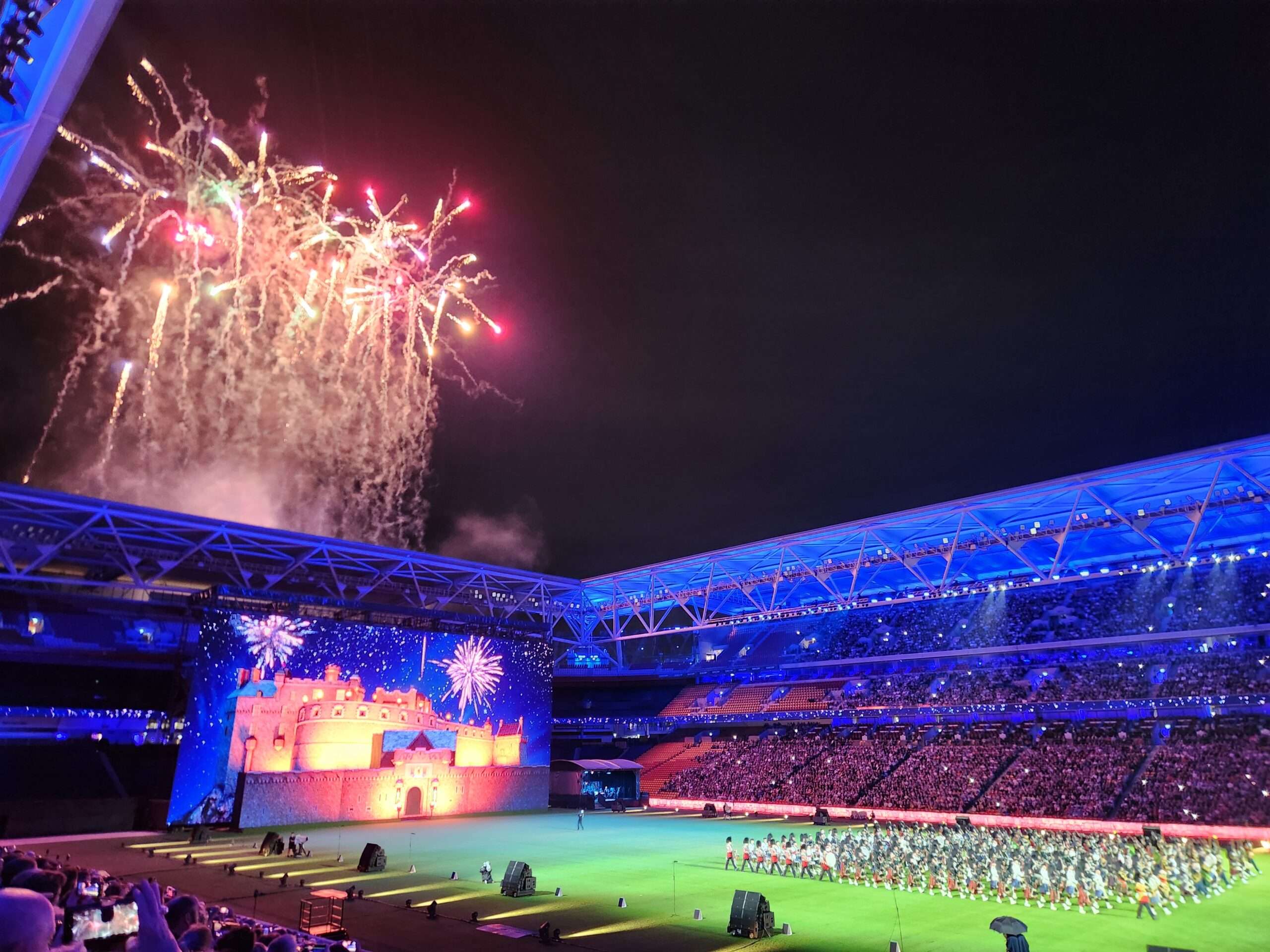
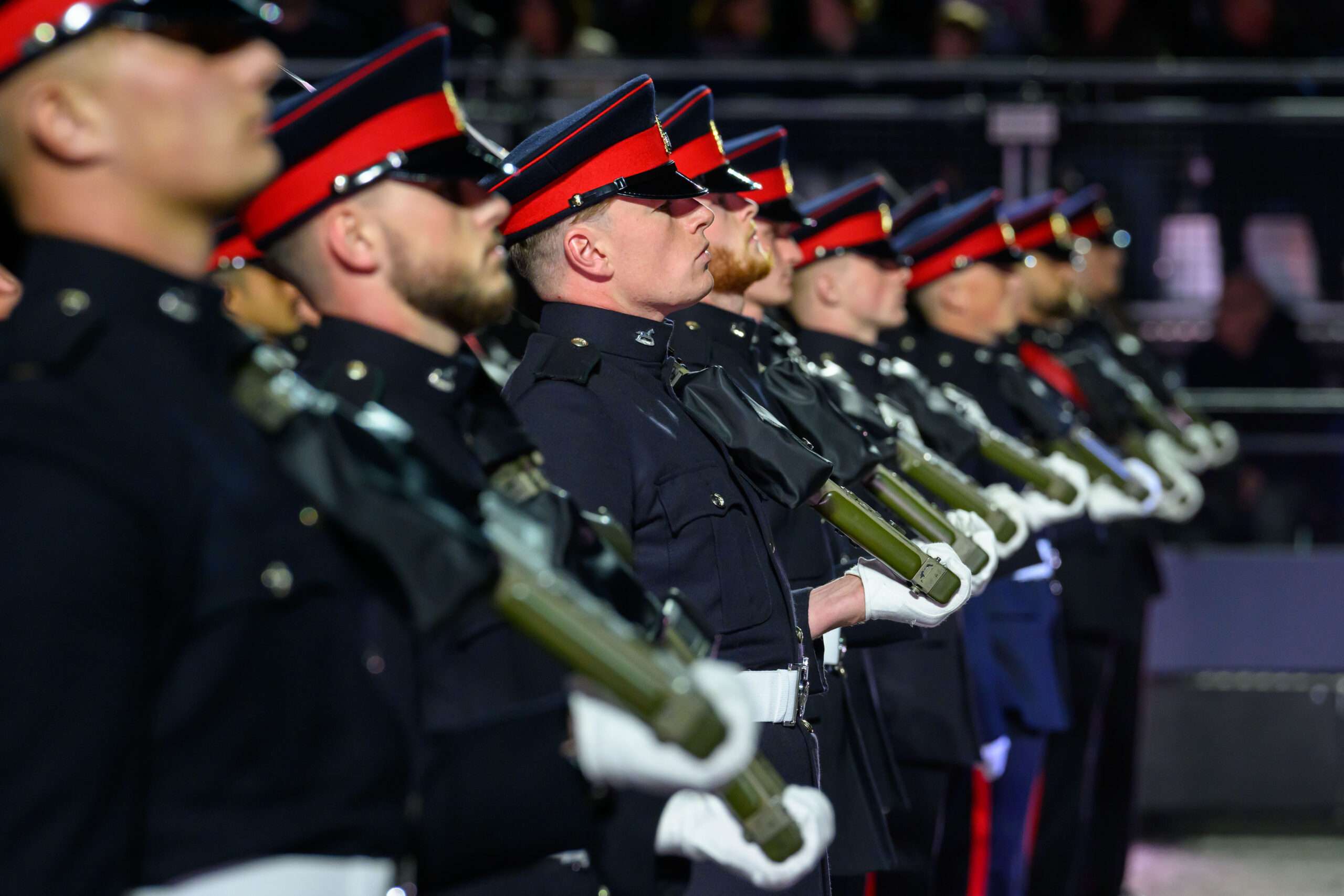
More than 1,000 performers from 13 countries descended on the city of Brisbane for The Royal Edinburgh Military Tattoo, exclusively at Suncorp Stadium to celebrate the iconic event’s 75th anniversary milestone.
International arrivals included more than 800 musicians who flew into Brisbane from across the world, as well as over 38,000 Tattoo fans from intestate and overseas, with the expected economic impact an estimated $39 million to Queensland.
A living canvas of music, movement, ceremony and precision
Alexander Middlemis, Sian Roach and Macey Bennett and Freddie Bailey.
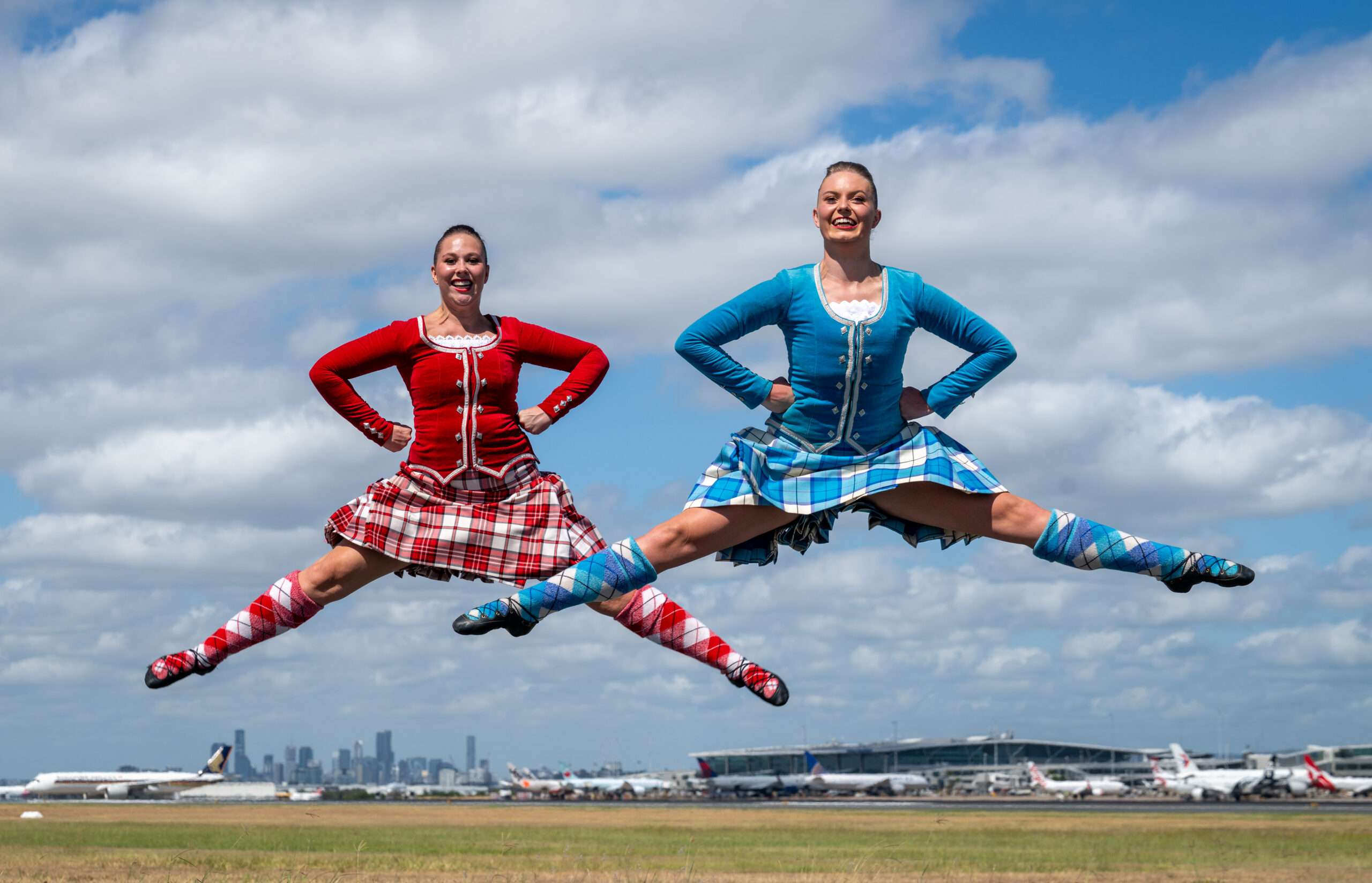
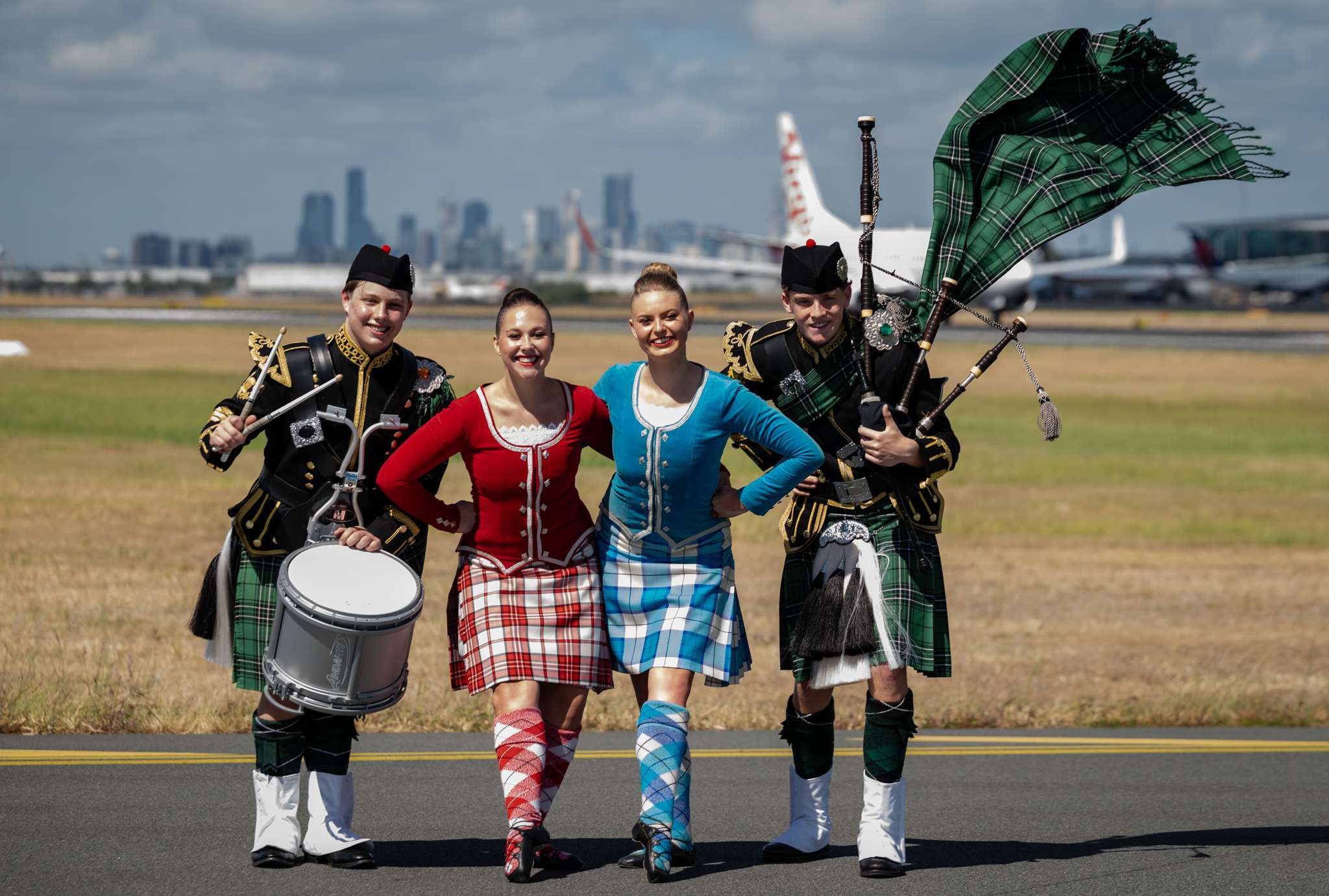
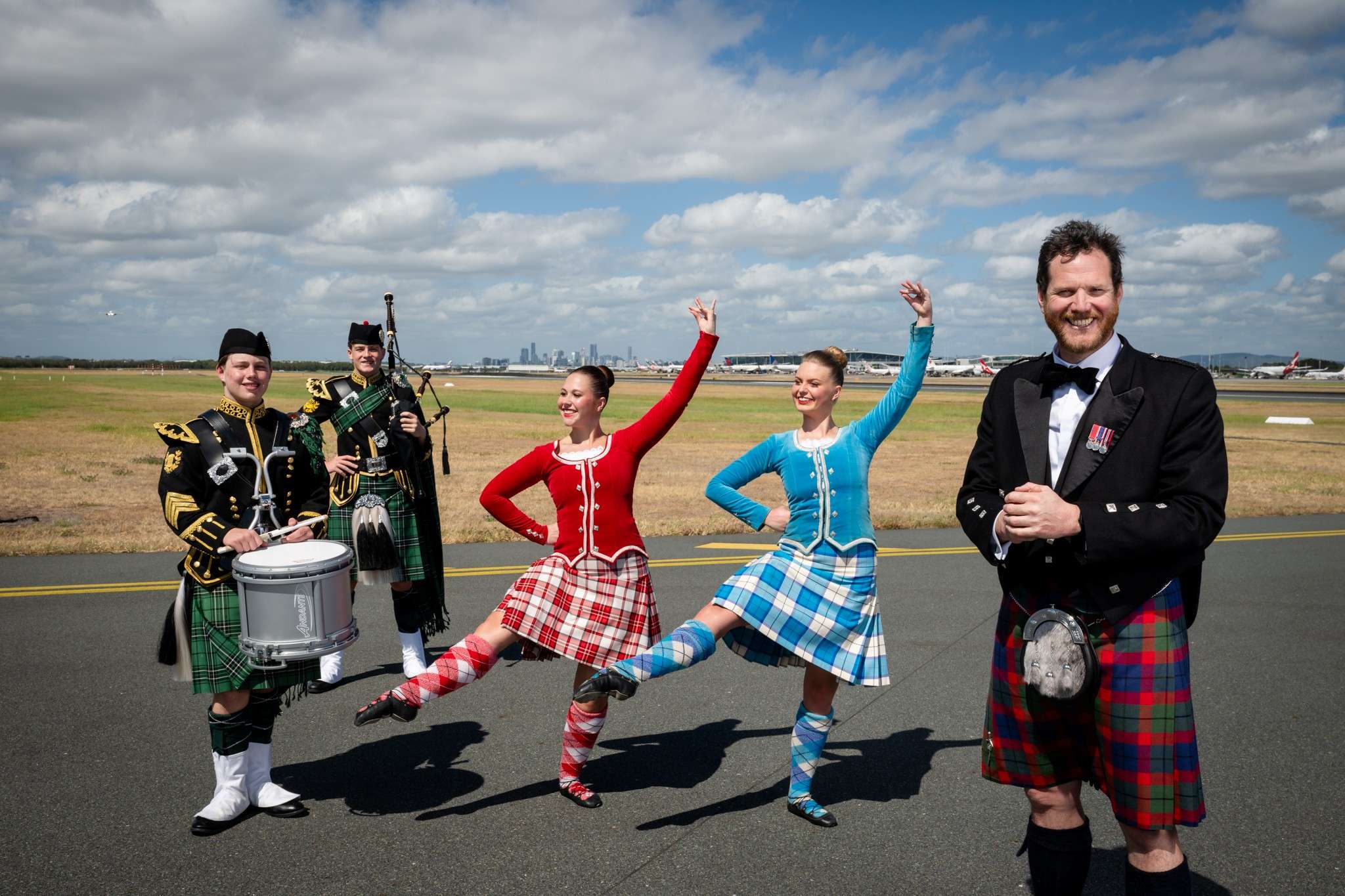
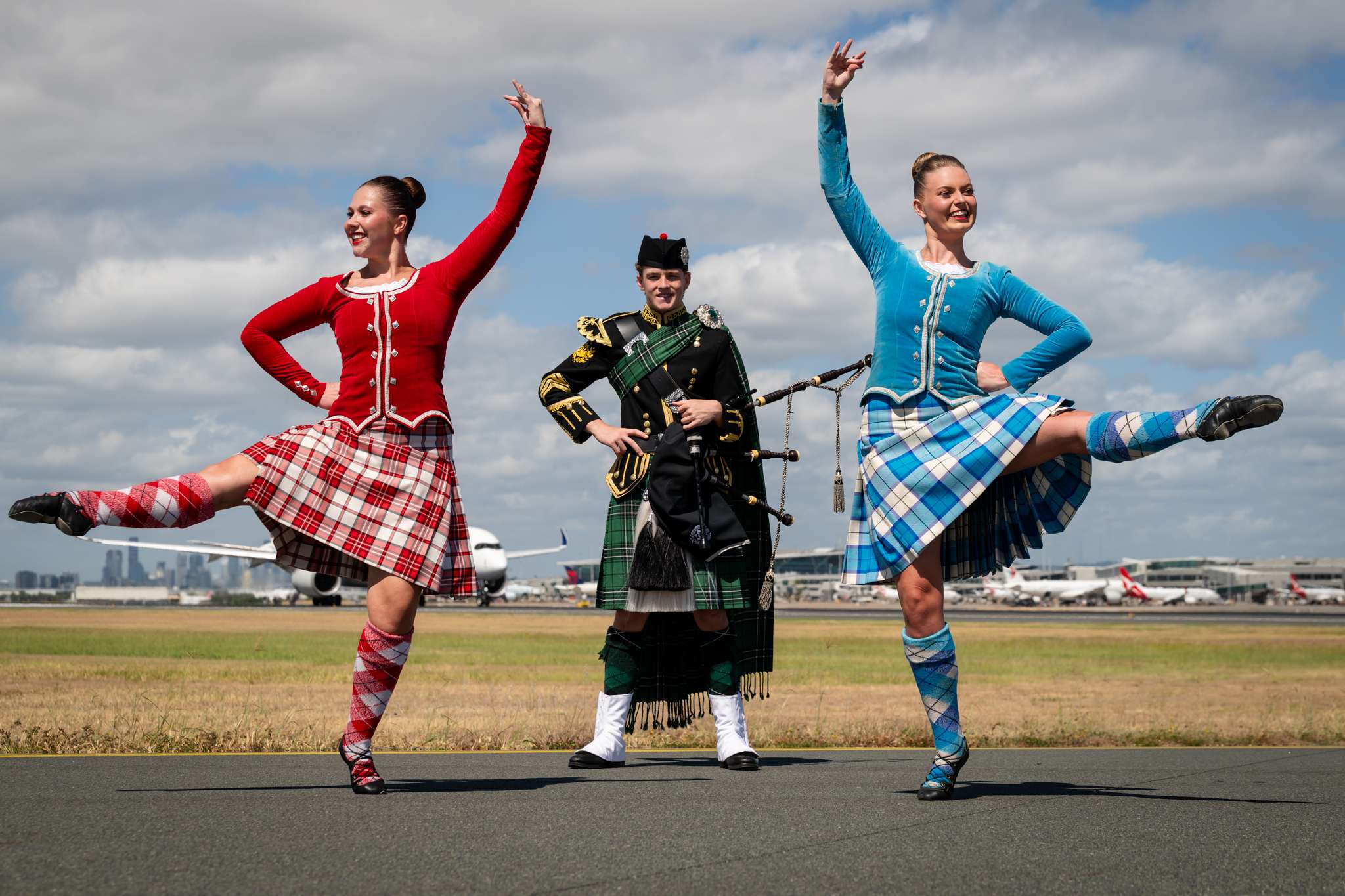
Freddie Bailey, Pipe Major at Brisbane Boys College Pipe Band and Alexander Middlemis on drums, with Highland Dancers, Macey Bennett and Sian Roach, and Alan Lane, Artistic Director of the Tattoo put tartan on the tarmac at the Brisbane international Airport to welcome fellow performers and interstate and international fans. In a record-breaking Australian first, the world-renowned Tattoo presented four consecutive nights at Suncorp Stadium, the first time any act has delivered four back-to-back performances at the iconic venue. Representing Australia, New Zealand, Canada, Japan, Norway, Switzerland, Tonga the United Kingdom, the United States and more, the cast created one of the most globally diverse line-ups ever assembled for an international Tattoo production.
Ahead of opening night performers arrived in Brisbane to undertake four days of intensive, full-scale rehearsals, transforming Suncorp Stadium into a living canvas of music, movement, ceremony, and precision. These final rehearsals brought together military bands, cultural groups, dancers, drummers, and pipers, many performing together for the very first time, to deliver a seamless, emotionally charged production under the stars.
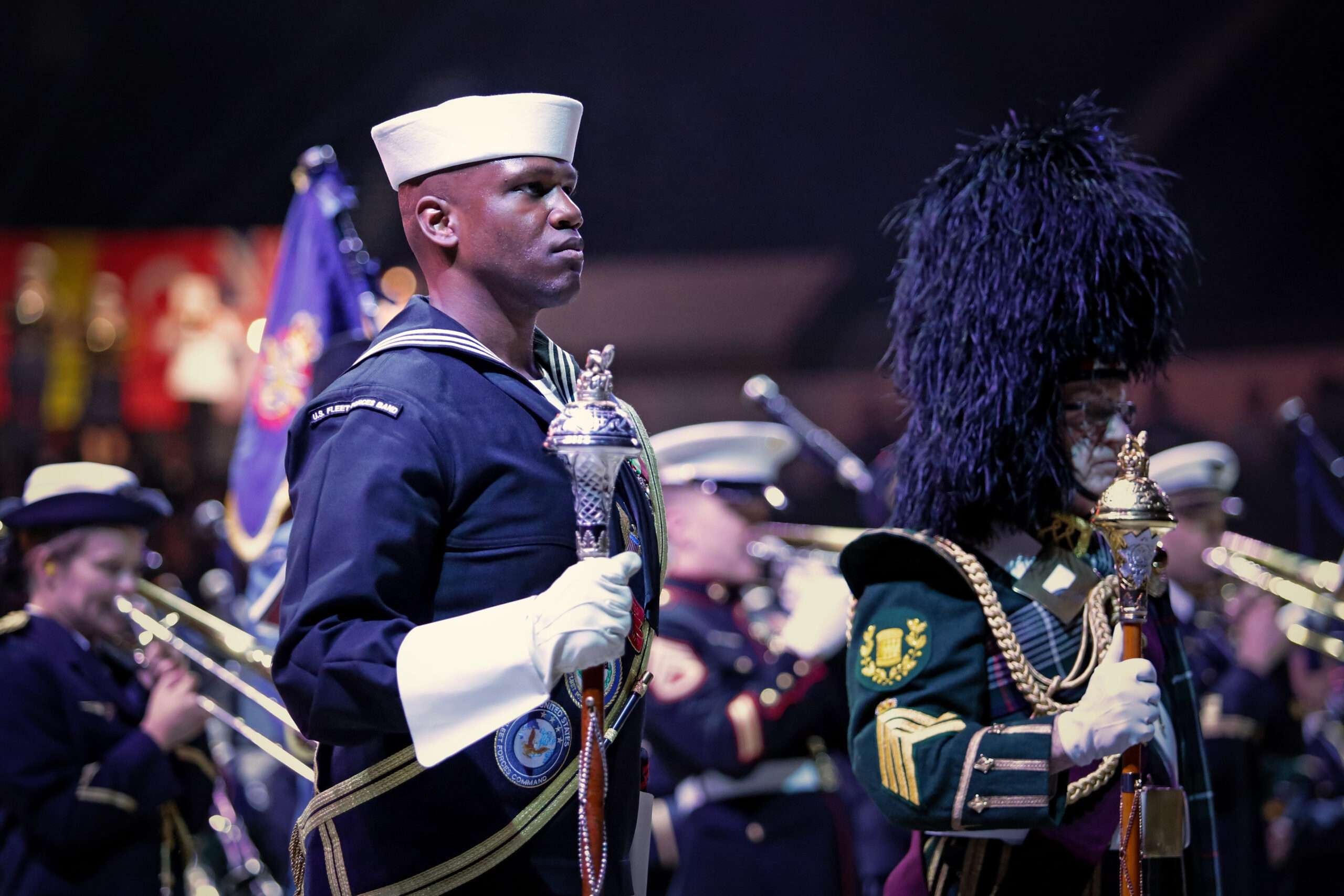
More than 30 bands and cultural groups performed in The Heroes Who Made Us, including UK Military Bands from the Royal Navy, British Army and Royal Air Force, The Combined Military Bands of the Australian Defence Force, Queensland Police Pipe Band, Western Australia Police Pipe Band, Australia’s Federation Guard, His Majesty the King of Norway’s Guard Band and Drill Team, Japan Air Self-Defence Force Central Band, His Majesty’s Armed Forces The Royal Corps of Musicians Tonga, Top Secret Drum Corps, United States Marine Drum and Bugle Corps, and the Brisbane Boys’ College Pipe Band, alongside performers from New Zealand and beyond.
Renowned for stirring music, military precision, cultural displays, and dramatic performances set against the backdrop of Edinburgh Castle, The Royal Edinburgh Military Tattoo is a global phenomenon, drawing over 230,000 spectators annually in Scotland and over 100 million more worldwide through international broadcasts. Hundreds of thousands have flocked to previous Australian editions of the Tattoo in Sydney (2005, 2010, 2019) and Melbourne (2016).
Unique in global performance
Alan Lane, Creative Director of The Royal Edinburgh Military Tattoo, with cast members.
For many involved, the Brisbane performances carry deep personal meaning. Among the cast were members of a fourth-generation Scottish family, who prepared to share this emotional milestone together on Australian soil, a living reflection of the heritage, pride, and continuity the Tattoo represents. Alan Lane, Creative Director of The Royal Edinburgh Military Tattoo, said ahead of opening night: “With the energy and excitement building. Each day sees the arrival of more of the creative team and cast from around the world.
Transforming over 1,000 cast members into one seamless production in just a few days is the challenge of the Tattoo. A challenge that makes the Tattoo unique in global performance. Performing four consecutive nights at Suncorp Stadium is something no artist has done before. I can’t wait for Australian audiences to see the Show we’ve prepared for them.”
Highland Dancers Sian Roach and Macey Bennett with Freddie Bailey, Pipe Major, Brisbane Boys College.
Brisbane Lord Mayor Adrian Schrinner added: “We’re thrilled to host the Royal Edinburgh Military Tattoo in Brisbane for the very first time. This spectacular, world-class event will draw visitors from across the country, deliver a big boost for local businesses, and shine a global spotlight on Brisbane as Australia’s lifestyle capital.”
Brisbane Airport CEO, Gert-Jan de Graaff said: “We’re proud to play our part in bringing The Royal Edinburgh Military Tattoo to Brisbane and it’s fair to say we’ve never seen this much tartan on our tarmac. As the city’s gateway, Brisbane Airport plays a vital role in welcoming performers and supporting the logistics that make world-class cultural events possible.”
Returning to Australia for the first time since 2019, the Brisbane season represents one of the Tattoo’s most ambitious international stadium productions to date. Cutting-edge lighting, immersive sound design, and large-scale visual effects will elevate the performance, blending the timeless traditions of the British Armed Forces with modern storytelling and world-class production innovation. The Tattoo then travelled to Auckland’s Eden Park for its successful New Zealand run.
The Royal Edinburgh Military Tattoo will take place in Edinburgh August 7-29th. For details see: www.edintattoo.co.uk
Do you enjoy our content?
Content on the Scottish Banner website remains free for users. Stories and events listed for the international Scottish community continue to be an important resource for many across the world. As advertising revenue remains a challenge, our readers can donate to help us produce unique Scottish content for global Scots. Every contribution counts and thank you for considering your support.
Support the Scottish Banner! To donate to assist with production of our publication and website visit: The Scottish Banner
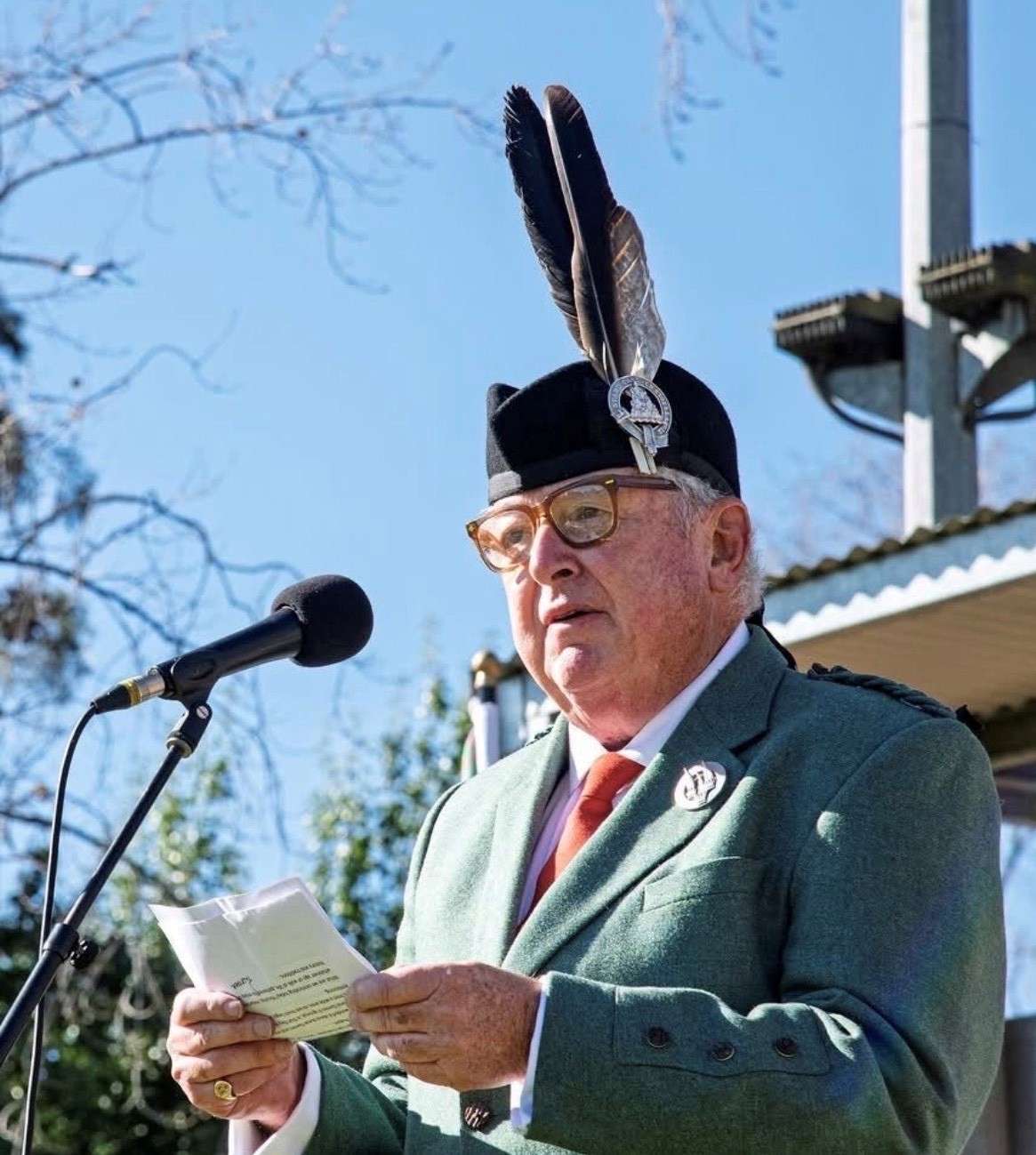
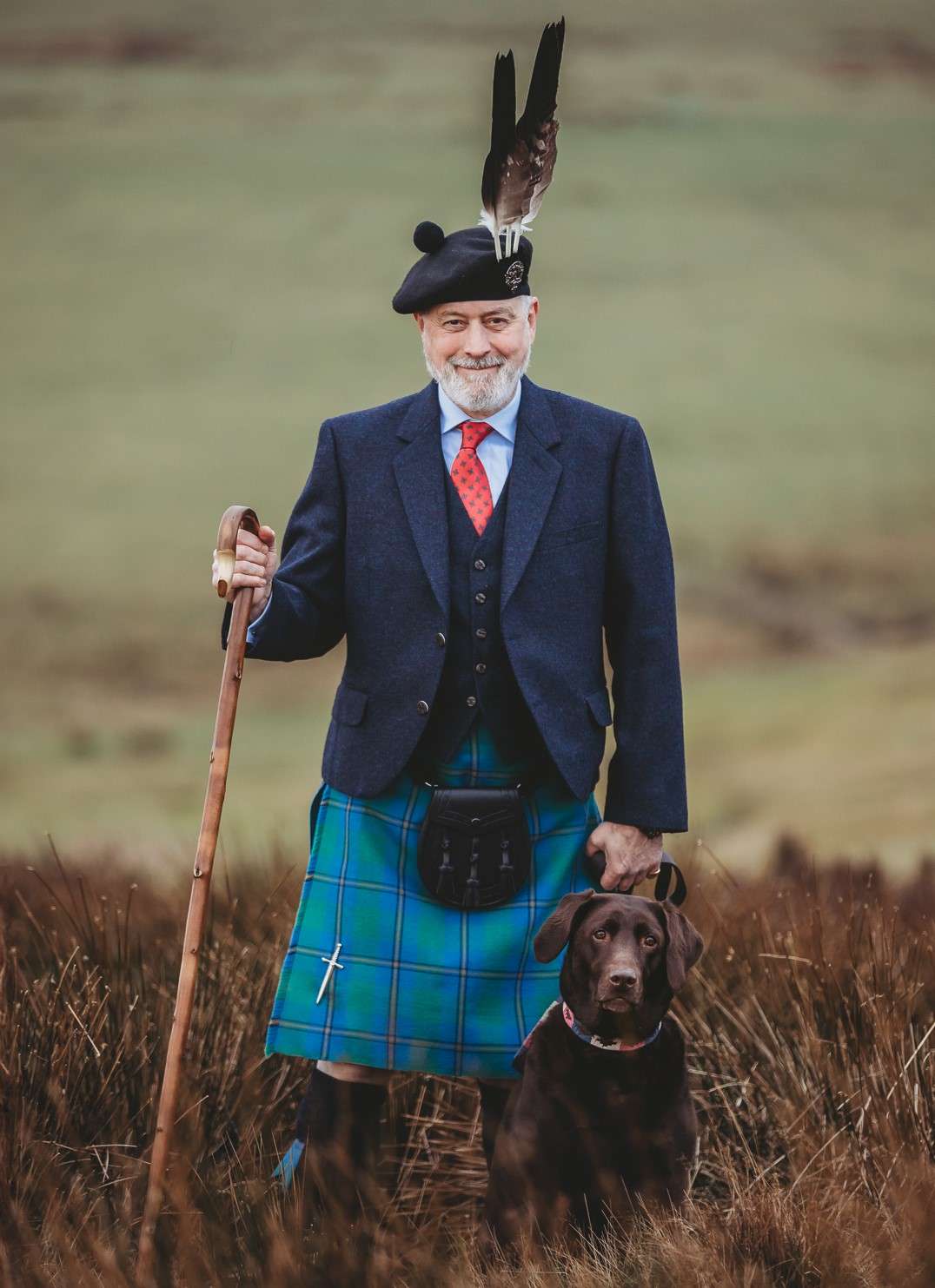
As hereditary Chief of a Scottish Clan, I feel a strong sense of duty, reaching out to my fellow kinsmen worldwide, to bring them together in friendship, embracing our past and enjoying all aspects of our Clan Society today. Our activities are far reaching, from Highland and Celtic Games and Clan Gatherings to exploring our history, ancestry, Highland dress, tartan, music, dancing, Gaelic traditions and whisky.
I greatly enjoyed my first visit to Australia last year, when I was privileged to be Games Chieftain at the Bundanoon Highland Games in April. My Clan Society team, headed by Hon Troy Grant, took me on a splendid tour over the Mountain Range from Sydney to Brisbane, taking in local Scottish heritage sites at Glen Innes and Maclean.
I was delighted to be invited by Ian Young and the Committee to be Chieftain at the Melbourne Highland Games and Celtic Festival on 29 March. I am very much looking forward to that occasion, visiting Melbourne and meeting both Grants and fellow Celtic followers alike.
My great grandfather Frank, being a second son, emigrated to New Zealand in 1870, seeking fame and fortune, as was typical at the time. He farmed near Otago, stood for Parliament in 1884 and became the Earl of Seafield in 1888. He died shortly after and was buried in Oamaru.
His eldest son, James inherited and returned to the UK, only to die in the trenches in 1915, passing the Seafield titles to his daughter Nina and the Grant titles and Chieftainship of the Clan to his brother Trevor, my grandfather, who became Lord Strathspey. He returned to the UK with his family in 1912, the year his son Patrick was born, my late father.
I therefore have a strong connection with New Zealand. We are re-starting our Society there, which in the 80s had more members than our US Society! Canada also has a special significance for me, as a Baronet of Nova Scotia. The title was granted in 1625, by King James 1st of England and 6th of Scotland to my forebears, who helped fund an early settlement mission to Nova Scotia.
I attended a 400-year Anniversary Celebration at Stirling Castle last July, which included lectures about the Mission, early settlers and the present day. My title of Lord Strathspey is a Barony, which allowed my forebears to sit in the House of Lords in Westminster. As the senior title, this takes precedence over the Baronetcy title of Sir and is therefore my correct form of address.
The Chieftainship of the Clan is my most significant position
I regard the Chieftainship of the Clan is my most significant position. My mission is to support our Clan worldwide, increase global participation in events and history, developing and sustaining our bond of kinship. I helped my late father set up the International Societies in the 1980s and am following his footsteps in my various trips abroad and Clan activities. Life is now so very different, the internet and social media bringing instant connectivity, the sharing of ideas and events as they happen. This necessitates a change in the way our Societies are run, embracing the new technology.
Personal contact remains all important and thankfully meeting together, whether at a Gathering, Games or just socially remains key, IT (in theory!) simply making all such arrangements easier to set up and manage.
Our Societies in the UK, USA, Australia and New Zealand are either re-starting or evolving in a similar manner. We have agreed to set up a global website and a digital historical archive for all to share, access and enjoy.
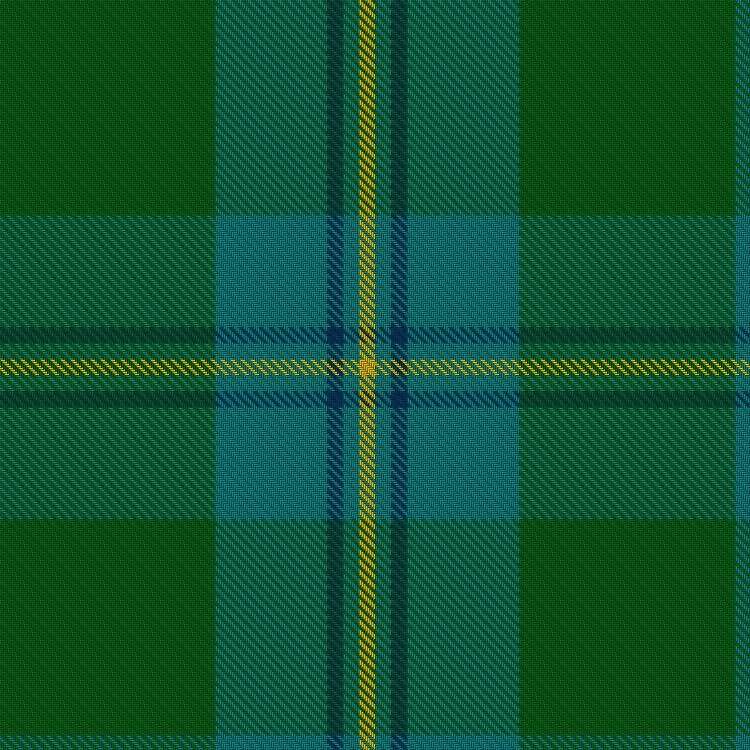
Meanwhile, we have launched the Grant 1714 tartan, one of the earliest Clan tartans on record, the traditional Clan tartans, including Grant, having been registered in the 1850s. We are following this with the launch of a Grant 1714 branded Highland single malt Scotch whisky.
I work closely with all those involved in the Societies, trying to help bring about change, expand our “offering” and reach out to members, both old and new, embracing the spirit and bond of Kinship.
Our Annual Gathering in Scotland will take place from 7-13 August in Grantown on Spey, including the Abernethy Games on 8th and the Grantown Show on 13th. All Grants, affiliated families and friends are all most welcome!
I feel blessed to work with our Clan Grant Society teams and to meet the ancestors of longstanding Grant families from around the world.
The Melbourne Highland Games and Celtic Festival takes place on Sunday March 29th for information visit: www.melbournehighlandgames.org.au
Do you enjoy our content?
Content on the Scottish Banner website remains free for users. Stories and events listed for the international Scottish community continue to be an important resource for many across the world. As advertising revenue remains a challenge, our readers can donate to help us produce unique Scottish content for global Scots. Every contribution counts, no matter how small, and thank you for considering your support.
Support the Scottish Banner! To donate to assist with production of our publication and website visit: The Scottish Banner
As the USA prepares to commemorate the 250th anniversary of the American Revolution and the founding of the United States, there’s no better place to reflect on our shared story than Virginia. The 2026 Virginia International Tattoo takes place April 16-19 at Scope Arena in Downtown Norfolk, proudly celebrating 250 Years of American Independence.
Presented in partnership with Virginia Tourism Corporation and The Hixon Family, join a cast of over 800 performers from across the globe in a dazzling display of military pageantry, precision, and passion, featuring massed pipes and drums, military bands, drill teams, dancers, choirs, and special guests. Expect heart-stirring moments of majesty and might, timeless traditions, and stirring tributes that will move and inspire.
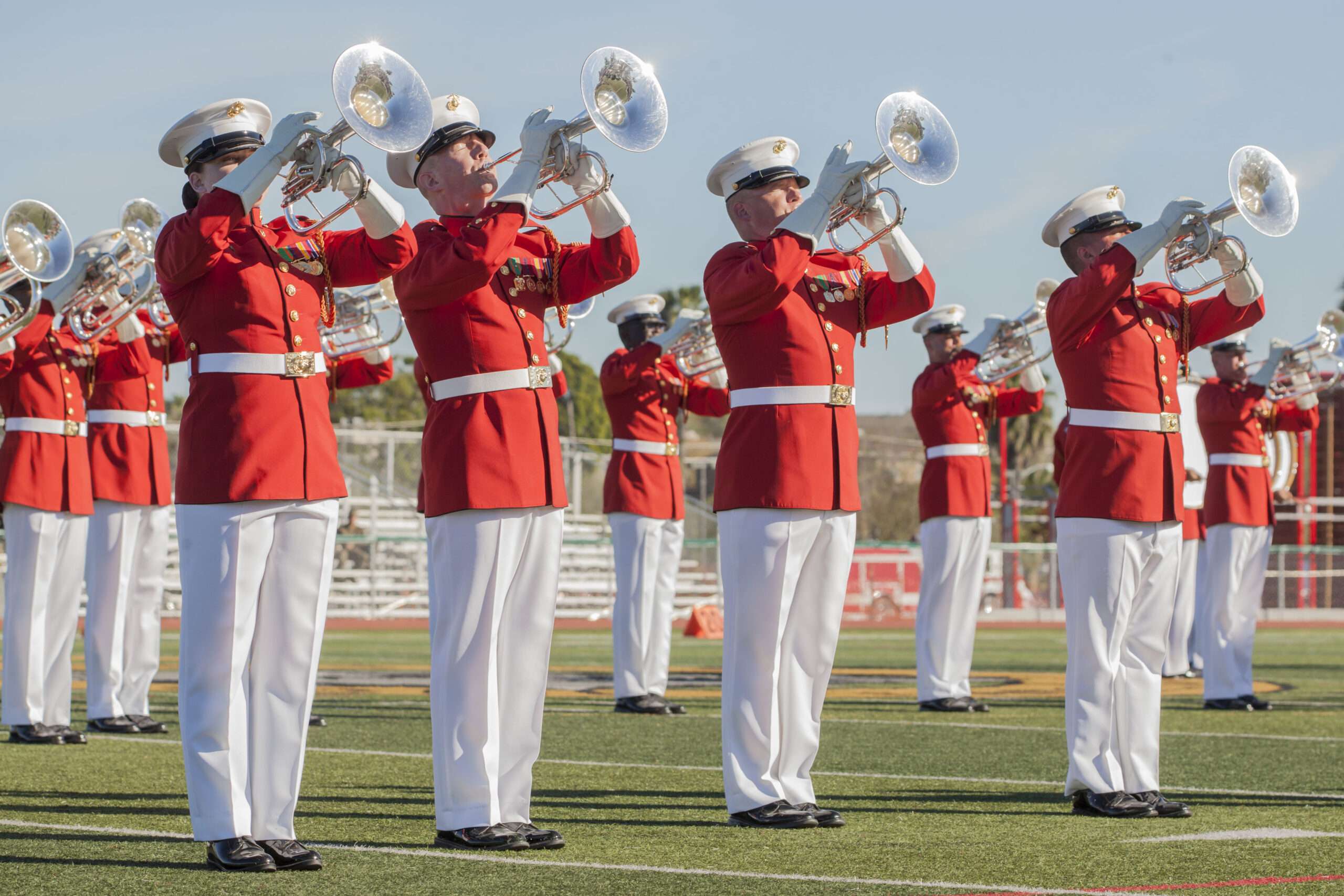
Marine Corps photo by Lance Cpl. Betzabeth Y. Galvan.
“Each of the 2026 Tattoo’s seven performances will be just under two hours long, but the staff, cast, crew, and volunteers of the Tattoo will collectively spend more than 60,000 hours in order to make those two-hour performances happen,” said Scott Jackson, Producer/Director of the Virginia International Tattoo since 2002. “Our performers in 2026 come from five different nations and eight different time zones. That means every hour of every day from now until opening night, someone somewhere in the world will be preparing for the Virginia International Tattoo. Every hour of every day somewhere in the world people will be preparing to share their very best with you, the audience!”
What is the Tattoo?
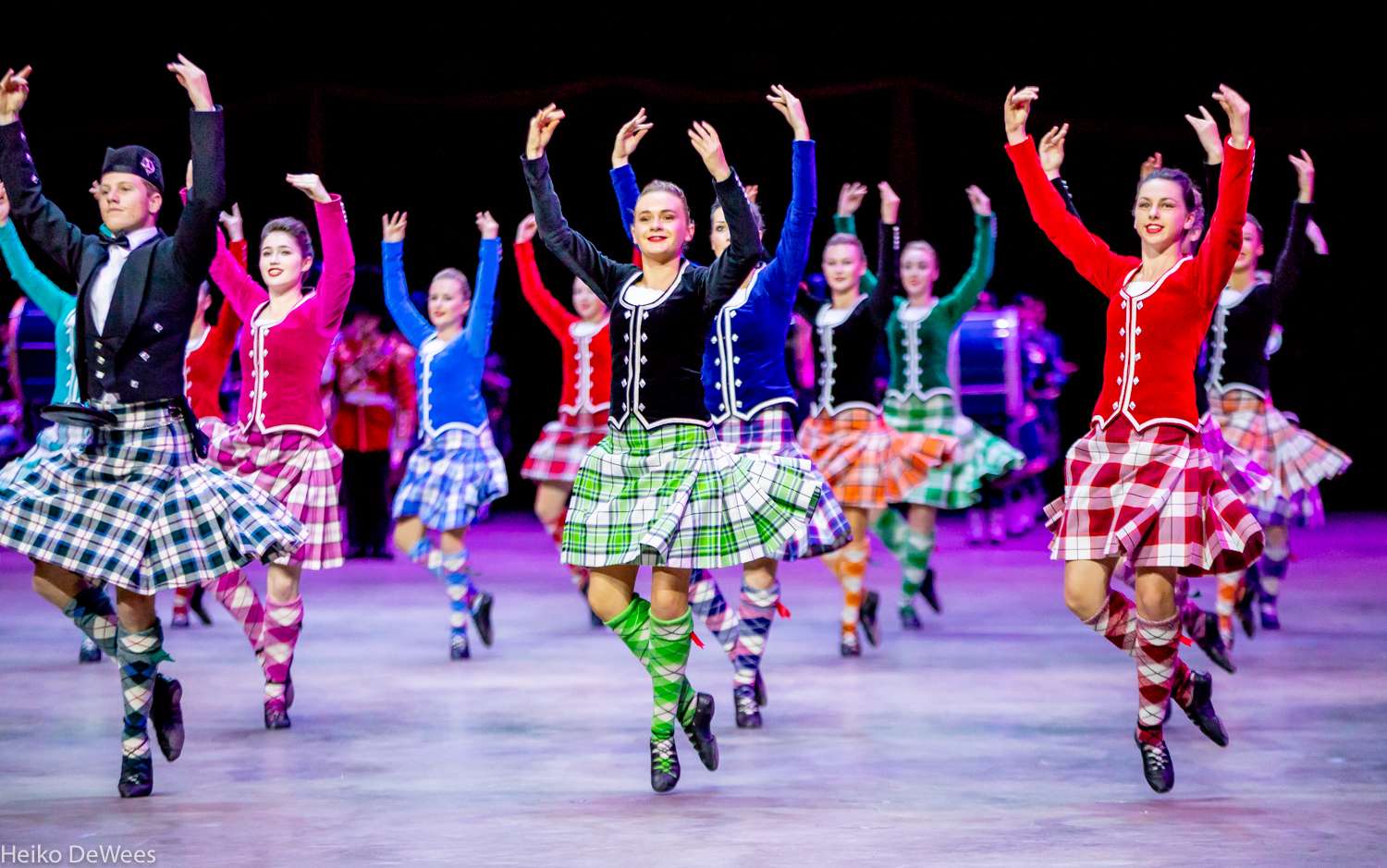
Dance display at the Virginia International Tattoo, Scope Arena.
The centuries-old tradition of Tattoo originated as a signal from drummers instructing Dutch innkeepers near military garrisons to “Doe den Tap-too” or “turn off the tap”. Hearing the call “Tap-too” soldiers would return to their barracks for an evening roll call. The ensuing parade of soldiers evolved into a military marching band performance now known worldwide as “Tattoo.” The Tattoos seen across the world today are ceremonial performances of military music by massed bands. Each Tattoo is influenced by the culture of the country they represent.
Fans of these massed spectacles of music and might flock to the world’s great Tattoos including The Royal Edinburgh Military Tattoo in Scotland, Basel Tattoo in Switzerland, and Royal Nova Scotia International Tattoo in Canada. But the greatest Tattoo in the United States, and rivaling the largest in the world, is the Virginia International Tattoo.
This year’s performers include Royal Canadian Air Force Pipes and Drums (Canada), Musique de la Marine Nationale (National Band of the French Navy), Republic of Korea Army Military Band and Honor Guard Battalion, King’s Color Squadron of the Royal Air Force (UK), and from the USA Camden County Emerald Society Pipes and Drums, Hampton Roads Police Color Guards, The Kiltie Band of York, Norfolk Fire-Rescue Honor Guard, Rhodes Academy of Irish Dance, Tidewater Pipes and Drums, U.S. Air Force Heritage of America Band, U.S. Army Old Guard Fife and Drum Corps, U.S. Marine Corps 3rd Marine Aircraft Wing Band, U.S. Navy Fleet Forces Band, Virginia Symphony Orchestra Chorus and more.
No comparable experience in the United States
As it has been since 1997, one of the anchor events of the Virginia Arts Festival is the Virginia International Tattoo. Led by J. Scott Jackson, the Virginia International Tattoo has become the largest such event in North America and numbers among the largest Tattoos in the world. Selected by the American Bus Association—the nation’s premier travel organization—as the top event in the United States in 2016, the Virginia International Tattoo has drawn visitors from across the country and around the world and has welcomed performers from 31 nations.
There simply is no comparable experience in the United States and no greater voice for expressing our nation’s gratitude to those who serve. Some of the most memorable of the 25 past Virginia International Tattoos have saluted the Tuskegee Airmen, Vietnam Veterans, Medal of Honor recipients, and women in the military. Each show is a moving lesson in history and patriotism for every generation, including the more than 20,000 students who attend the Tattoo every year.
Don’t miss the Virginia International Tattoo – America’s International Military Tattoo. Tickets are available and on sale now at www.vafest.org, by phone at 757-282-2822, or in person at the Virginia Arts Festival Box Office located at 440 Bank St, Norfolk, VA 23510.
Do you enjoy our content?
Content on the Scottish Banner website remains free for users. Stories and events listed for the international Scottish community continue to be an important resource for many across the world. As advertising revenue remains a challenge, our readers can donate to help us produce unique Scottish content for global Scots. Every contribution counts, no matter how small, and thank you for considering your support.
Support the Scottish Banner! To donate to assist with production of our publication and website visit: The Scottish Banner
Independence Days around the world often mean fireworks, military parades and other exuberant traditional festivities. On the tiny Scottish island of Gigha, however, the celebrations are rather less headline-grabbing – yet no less significant. The population of just under 200 mark Gigha Day – their “independence day”, the day the islanders succeeded in purchasing the Hebridean island in a community buyout in 2002 – on March 15.
“For the first few years, it was quite a big day,” explains Ian Wilson, vice chairman of the Isle of Gigha Heritage Trust, which manages the island. “Now at 1pm that day the school kids read a poem, we raise the flag and everyone goes back to the hotel. It’s not like July 4th!” Low key the celebrations may be now, but the community buyout was a landmark event when the islanders bought Gigha from its last private landlord for £4m.
The Hebrides
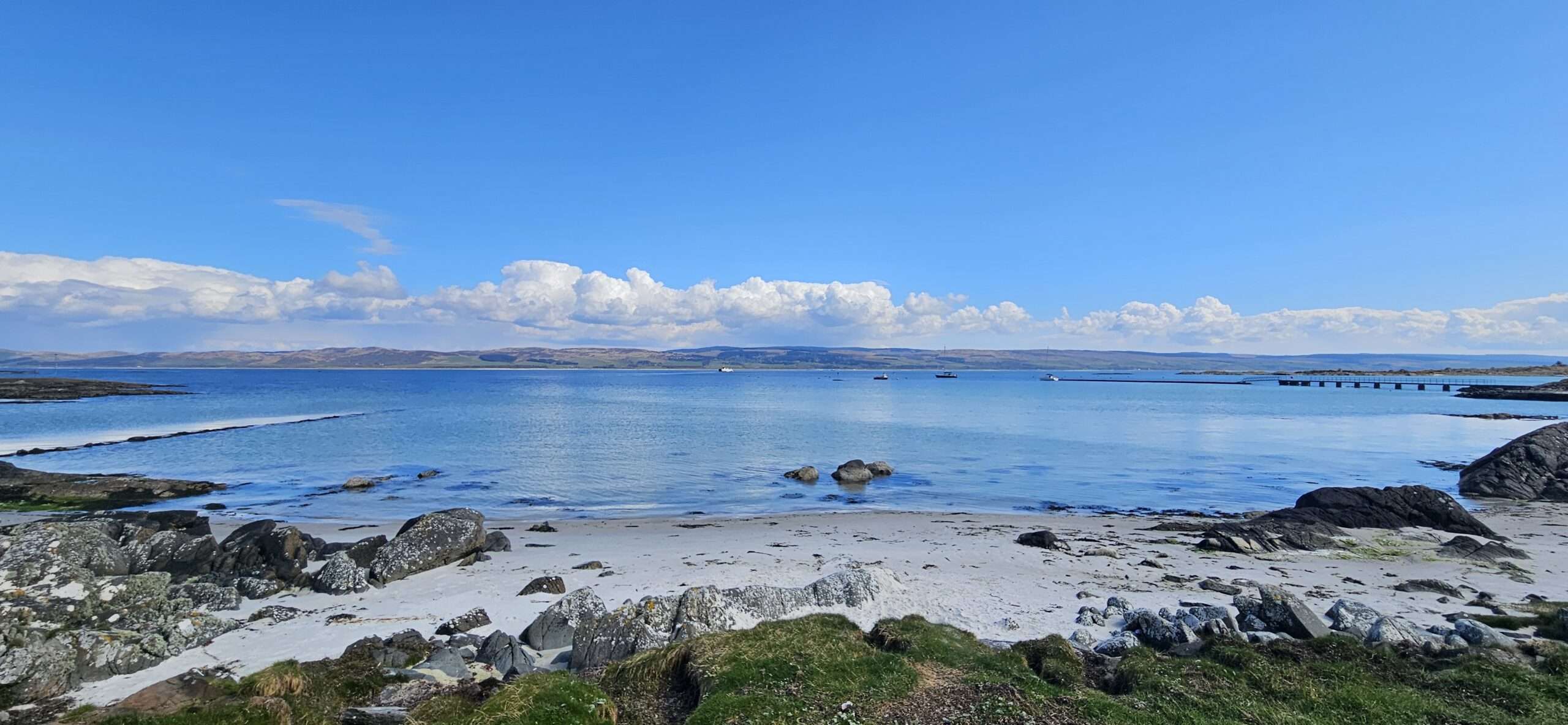
Looking over the Sound of Gigha by Paakman01, CC BY-SA 4.0, via Wikimedia Commons.
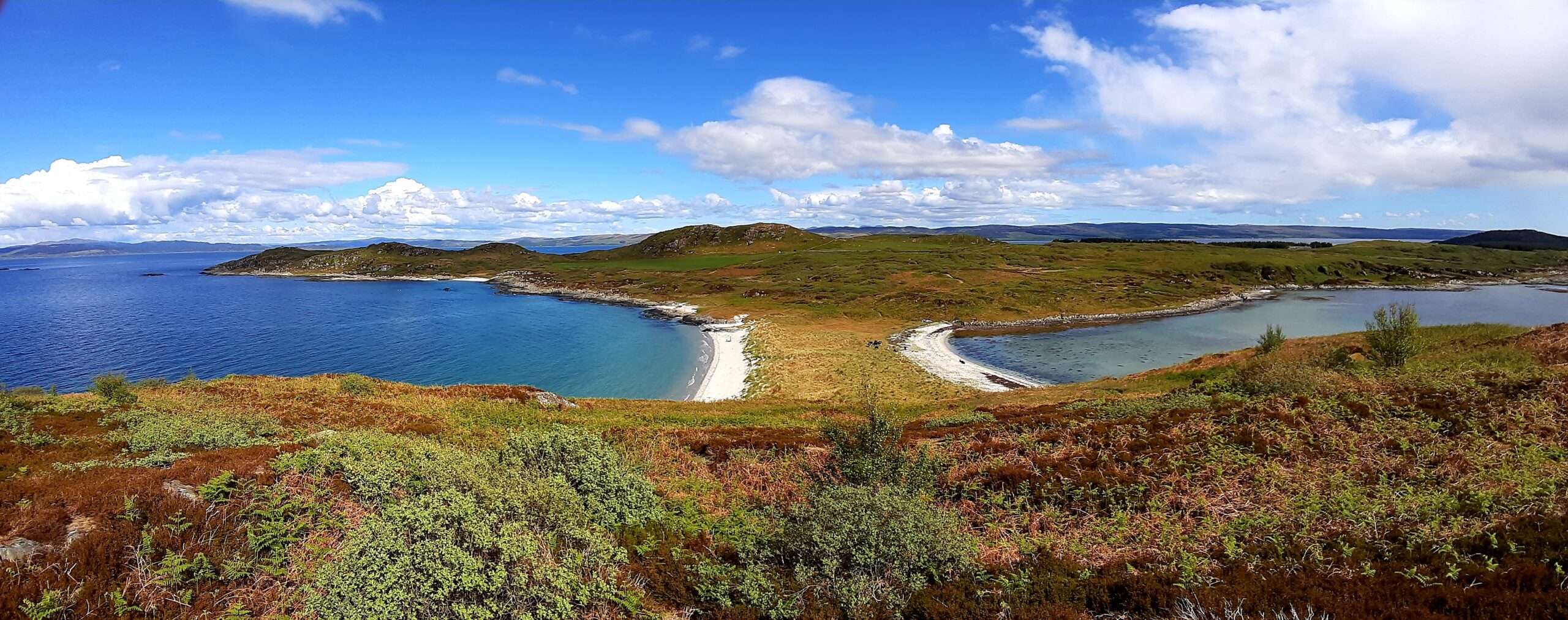
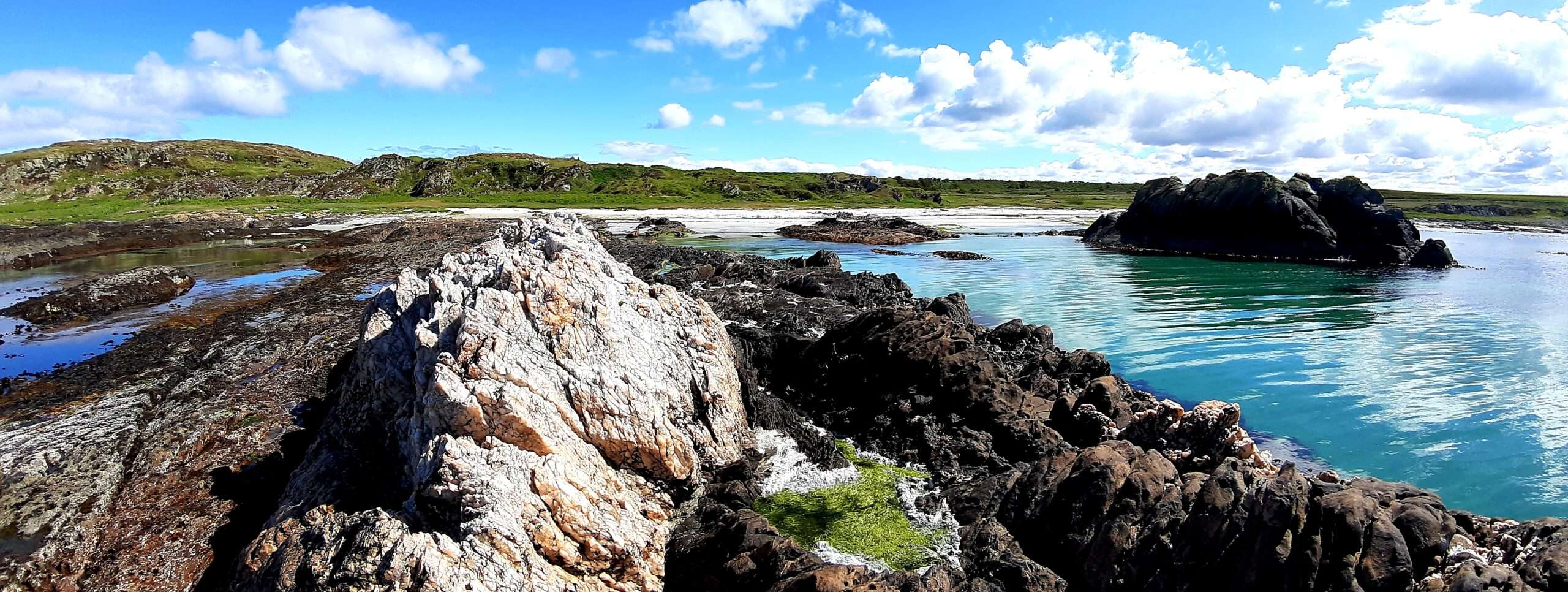
Just seven miles long by a mile and half wide, Gigha is the most southerly of the Hebrides, with stunning white beaches, above average sunshine and amazing views from its west coast across to the islands of Islay and Jura. But before 2002, when the buyout was completed, those beautiful natural assets weren’t enough to keep the population afloat – the number of residents on the island had dropped to below 100 and the primary school was in danger of closing.
Now, the population has nearly doubled, sub-standard housing has been renovated, and a host of projects have proliferated over the last 24 years. These include the creation of 9km of paths, complete with of interpretation boards and information boards, forming loops around the island, allowing visitors and locals alike to explore away from the main north-south road, and a campsite for visitors.
It’s not been an easy ride – “I would say to anywhere else considering it do it as a last resort not a first” says Ian. But he admits: “There are certainly lots of things on the island that wouldn’t be here with a private landlord.” The island’s history with humans stretches back thousands of years to the Mesolithic era. When the sea roads were the super highways of their day, Irish settlers arrived, and the Gaelic language and culture flourished here. For 2,000 years Gigha was a heartland for the language with the 1921 census showing the island as 75 per cent Gaelic-speaking.
Grob Bagh Beach, Isle of Gigha by Brian Turner, CC BY-SA 2.0, via Wikimedia Commons.
Gigha also has a tradition of harp playing, mainly through the Galbraith family, one of three surnames associated with the island; the others being MacNeill and MacDonald, two clans who fought over the land here. The Norse took over in the 9th century, and the island became part of the Viking southern Kingdom of the Isles until the end of the 13th century when King Haakon IV was defeated at the Battle of Largs – his mighty fleet assembled just off Gigha.
But there was little peace for the inhabitants of the fertile island under Scottish rule. Until the late 19th century the island was mainly held by the MacNeills but there were various murderous ups and downs including in 1530, when Ailean nan Sop (or Alan of the Straw, due to his habit of setting light to buildings using straw as kindling) slaughtered several inhabitants and later that century when the Macleans of Duart descended, killing hundreds on Islay and Gigha.
The biggest community buyout in the UK
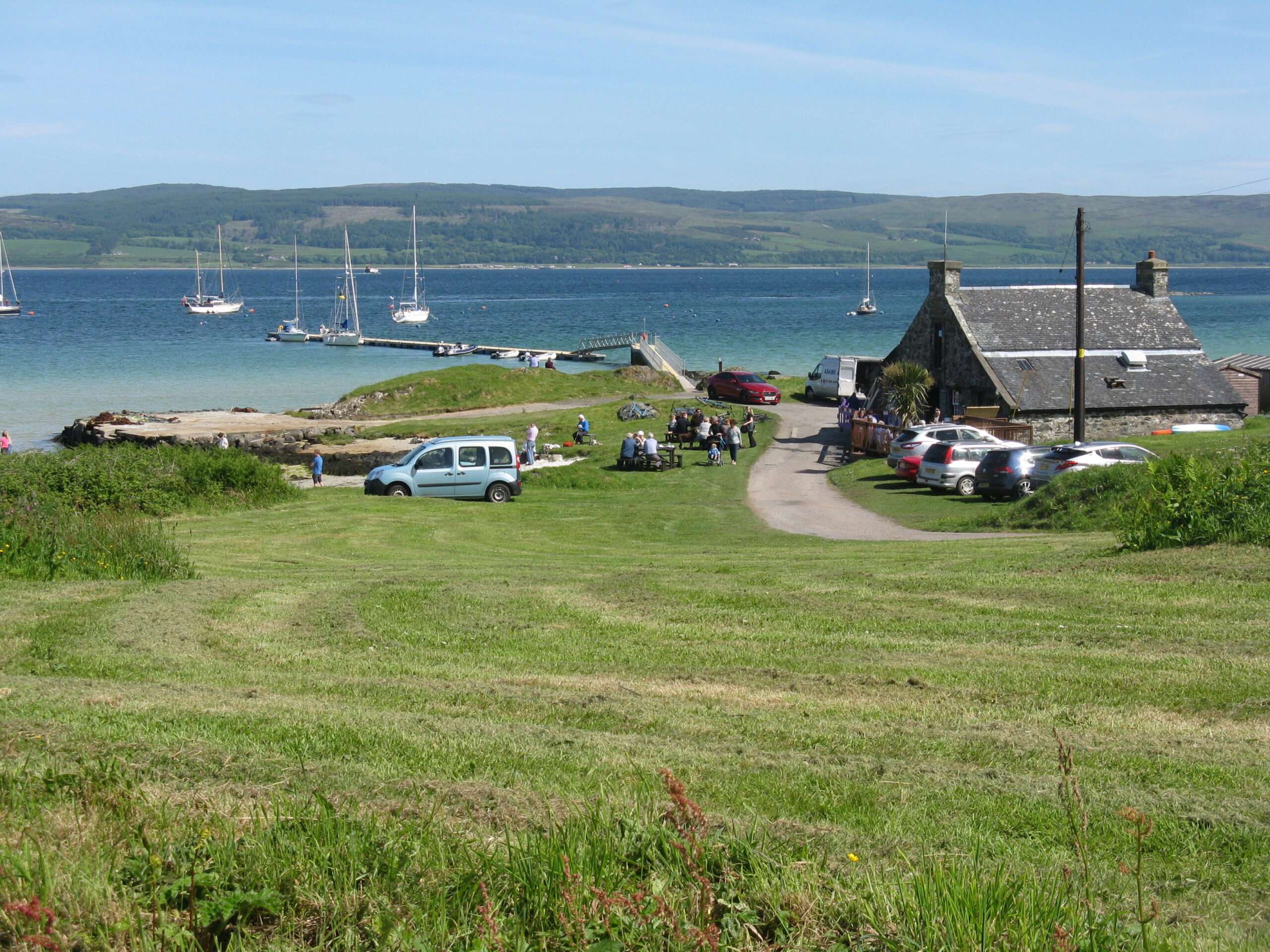
The Boat House restaurant, Gigha by M J Richardson, CC BY-SA 2.0, via Wikimedia Commons.
The MacNeills sold the island for £49,000 to one James Williams Scarlett in 1865 and after that, the island had a succession of owners which coincided with a slide in population from a peak of 600 in the 18th century to below 100 when the island was put up for sale in 2001. Many of those who left in the 18th century boarded ships for the US, joining those from surrounding islands to settle in the Cape Fear area in North Carolina.
Once quite isolated – before the first steamships started passing by in 1877, people rowed or sailed across the three miles to the mainland and the island only got its first pier in 1895 – now there is a regular car ferry which takes just 20 minutes from the mainland. The community voted yes in 2002 on plans to try for a buyout and only 17 days after the ballot the £4 million was raised, the funds coming from the lottery-backed Scottish Land Fund, which gave its biggest grant ever of £3.5 million, and Highlands and Islands Enterprise, which provided £500,000, which was double its previous biggest grant.
It was a landmark decision – the biggest community buyout in the UK at the time with the island’s owner, Derek Holt, having turned down three private offers to allow the community sale to go ahead. There was a small catch – £1 million had to be repaid but a huge fundraising effort by the islanders, with ceilidhs, quizzes, sponsored rows around the island and the sale of the main property, Achamore House, saw that money raised. It hasn’t all been plain sailing – at one point finances were said to be on a “knife’s edge” and there have been highly public fallouts among islanders on the way forward. But there have been some unqualified successes – the sub-standard housing has been renovated thanks to funds from the “dancing ladies”, wind turbines bought by the Isle of Gigha Heritage Trust.
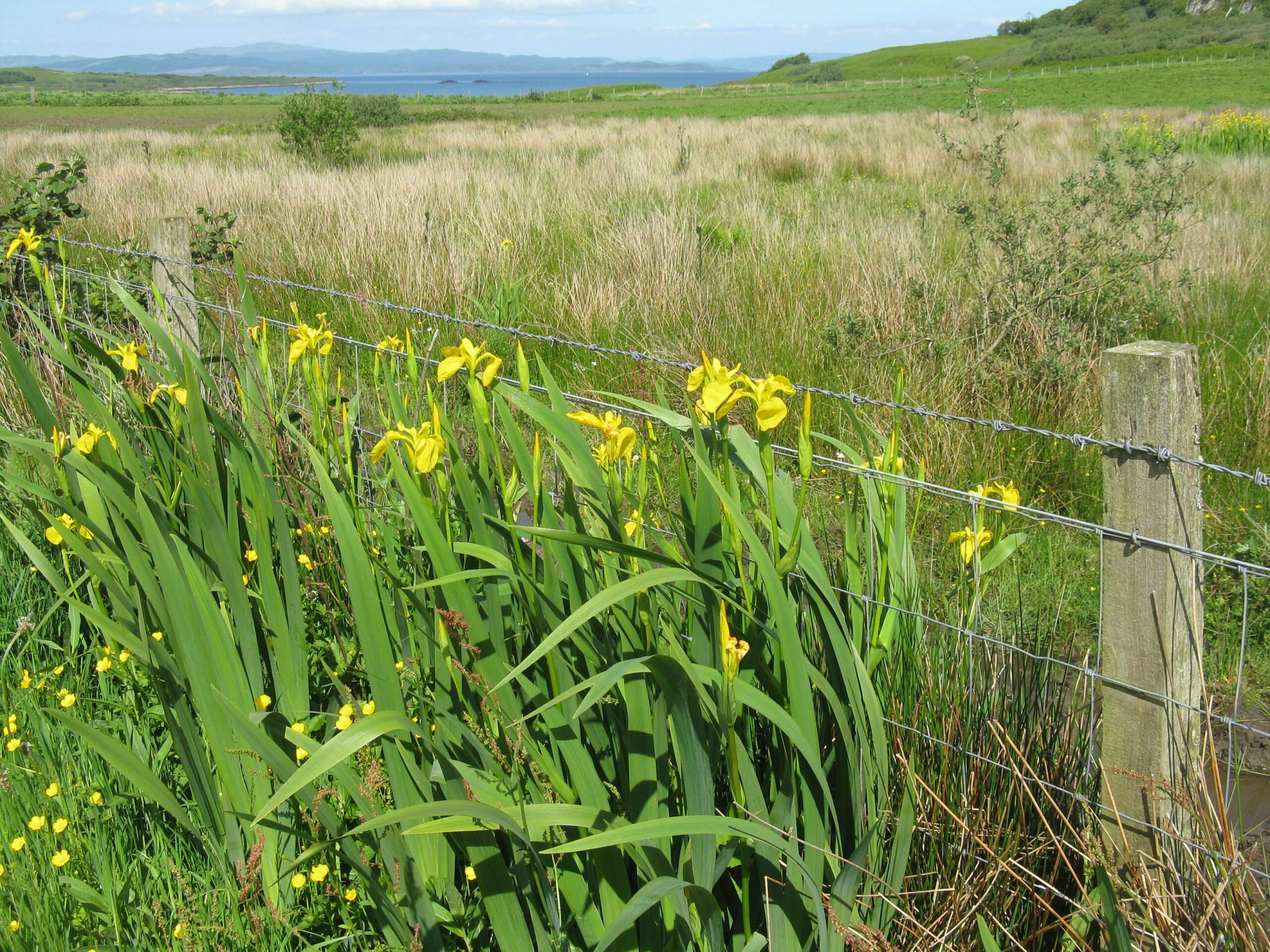
Flag iris on Gigha by M J Richardson, CC BY-SA 2.0, via Wikimedia Commons.
Gigha’s profile was further boosted in 2021 when it became the setting for a reality TV drama called Murder Island, written by famous crime author Ian Rankin, while in recent years the island has been gaining a reputation as a Dark Skies location. A site in the quiet north of the island has been named as a Dark Sky Discovery Site by the UK Dark Sky Discovery Partnership. On cloudless dark nights the Milky Way is clearly visible from here and the group behind the initiative, Dark Skies Gigha, holds several starry events over the year including a party to mark the Perseids meteor shower each August.
Ian says: “It’s a welcoming island, you only have to be here for ten minutes, and you feel you are at home. People come looking for a better quality of life and they find it on Gigha. It’s a fantastic place to live – I can’t explain it, it just gets you.”
BY: Judy Vickers Main photo: Isle of Gigha – Twin Beaches by Brian Turner, CC BY-SA 2.0, via Wikimedia Commons.
Do you enjoy our content?
Content on the Scottish Banner website remains free for users. Stories and events listed for the international Scottish community continue to be an important resource for many across the world. As advertising revenue remains a challenge, our readers can donate to help us produce unique Scottish content for global Scots. Every contribution counts, no matter how small, and thank you for considering your support.
Support the Scottish Banner! To donate to assist with production of our publication and website visit: The Scottish Banner
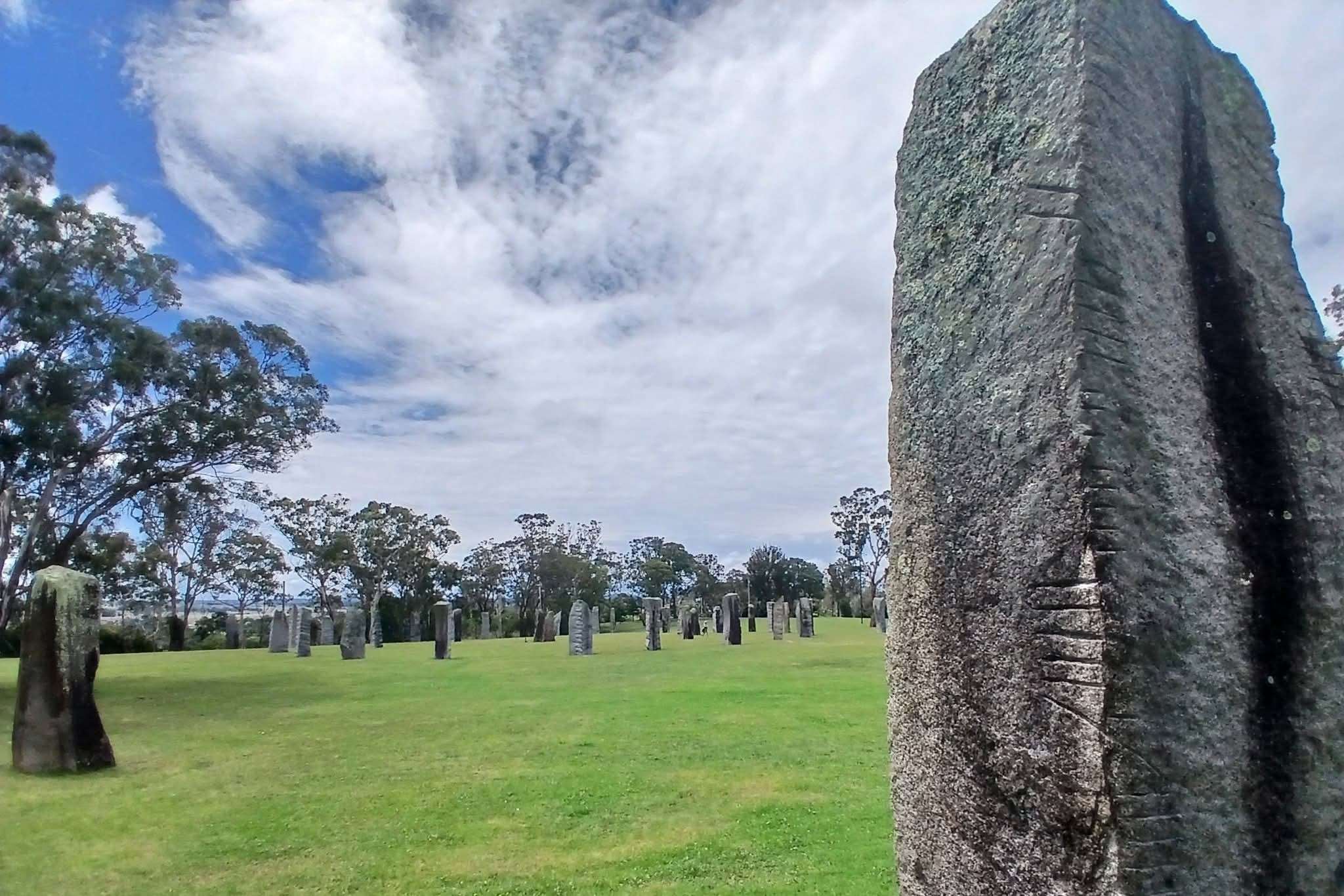
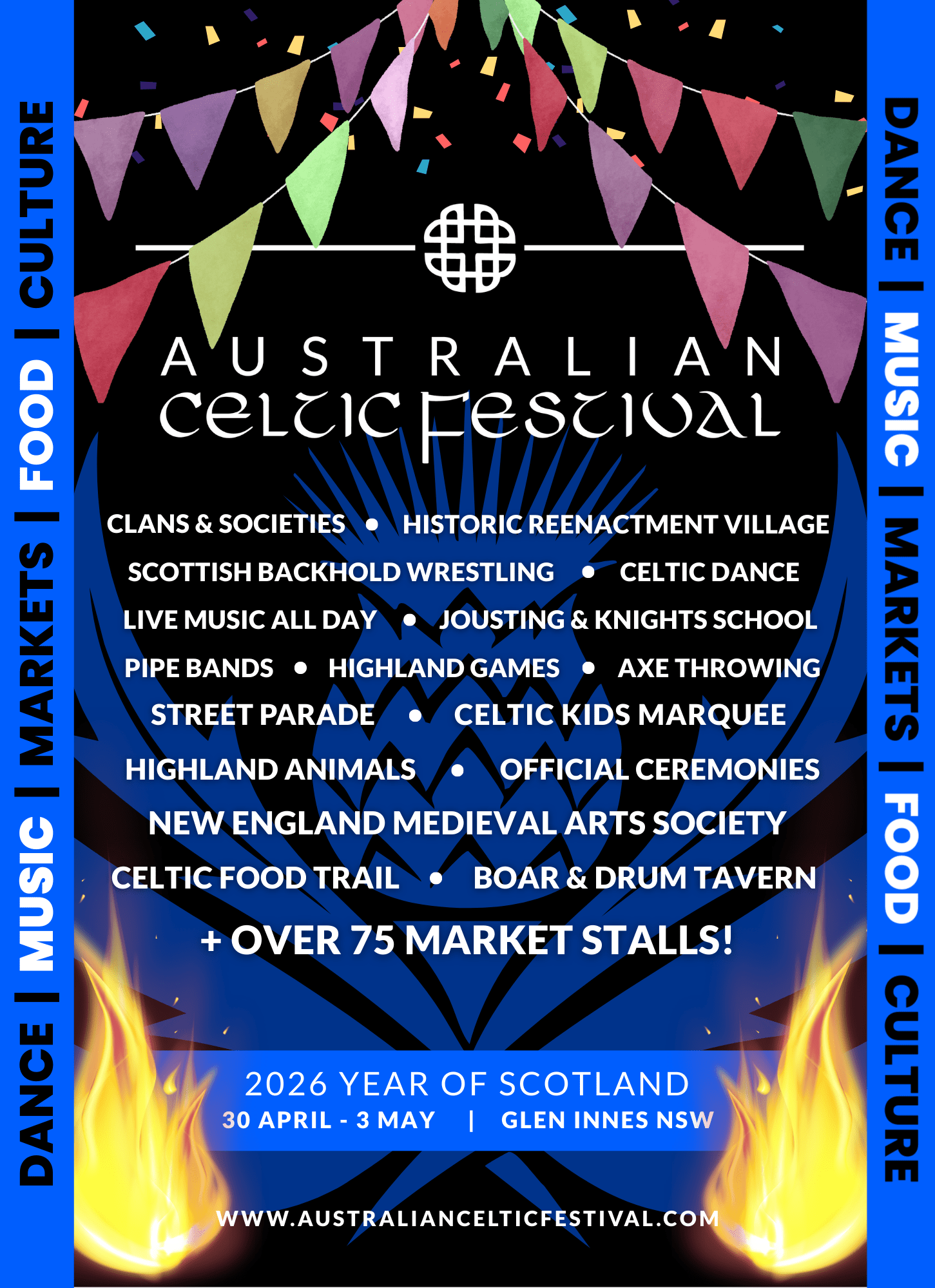
Set in the stunning landscapes of Glen Innes Highlands, in northern New South Wales, the Australian Celtic Festival is a truly unique celebration of living Celtic culture in Australia. Each May, the township of Glen Innes embraces its Celtic heritage and welcomes thousands of visitors from across Australia and internationally to gather among the iconic Australian Standing Stones – the National Celtic Monument of Australia now in its 34th year.
In 2026 the Festival celebrates the Year of Scotland, delivering four days of music, ceremony, culture and action from Thursday 30 April to Sunday 3 May 2026.
Honoured Guest
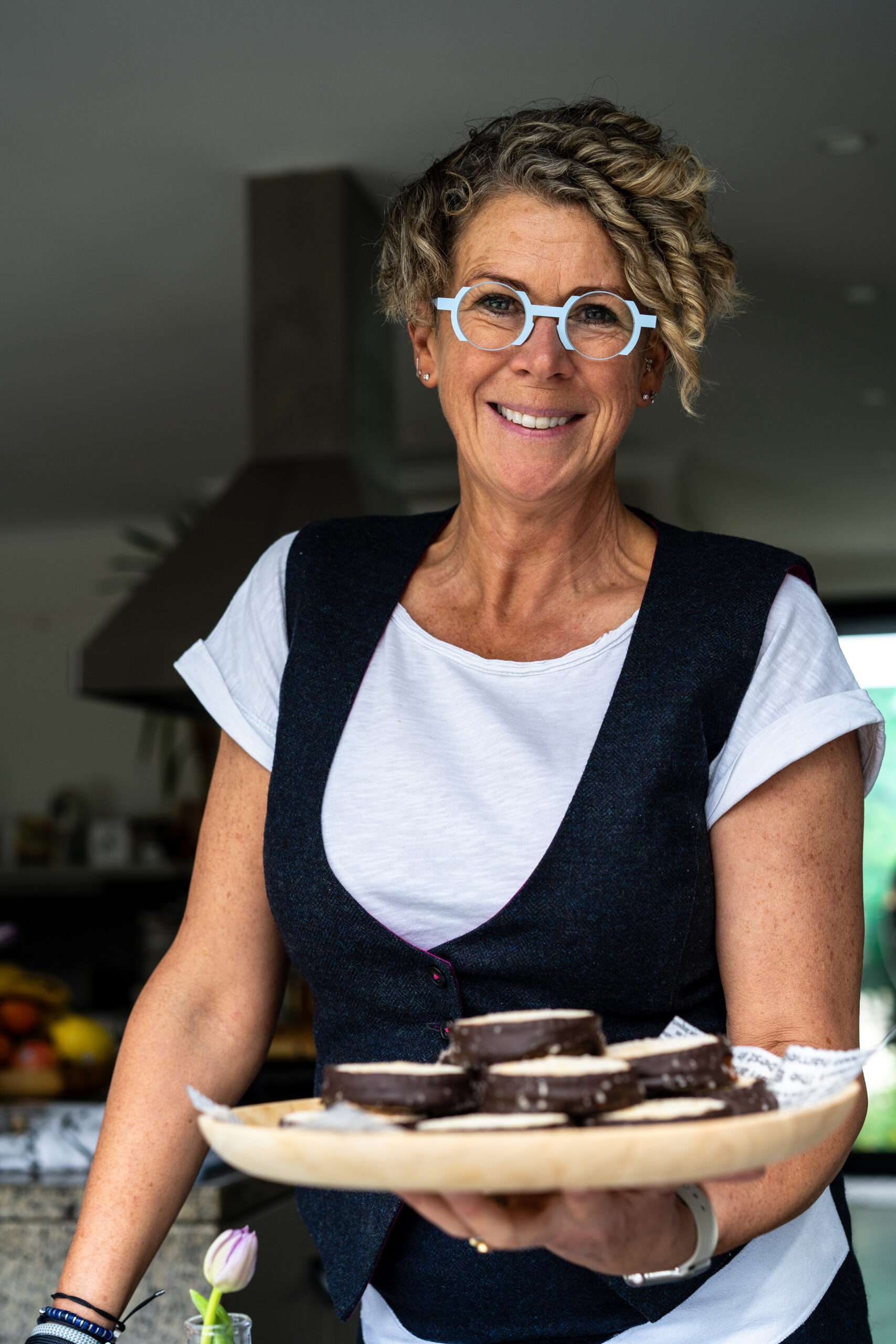
Every year the Australian Celtic Festival is delighted to invite an Honoured Guest who reflects the year’s featured Celtic nation. This year we are pleased to announce acclaimed cook Ali Stoner, known internationally as Roving Haggis, as its Honoured Guest in 2026.
Glasgow-born and Melbourne based Ali demonstrates her creative approach to Scottish food with storytelling and invites us to make her delicious and innovative, yet traditionally inspired recipes celebrating Scottish culture, heritage and connection. Ali will play a central role in the Festival program with a series of special presentations and side events across the weekend, and will officially open the Festival at the Opening Ceremony on Friday 1 May in Glen Innes Town Square.
The Australian Standing Stones venue
The Australian Standing Stones.
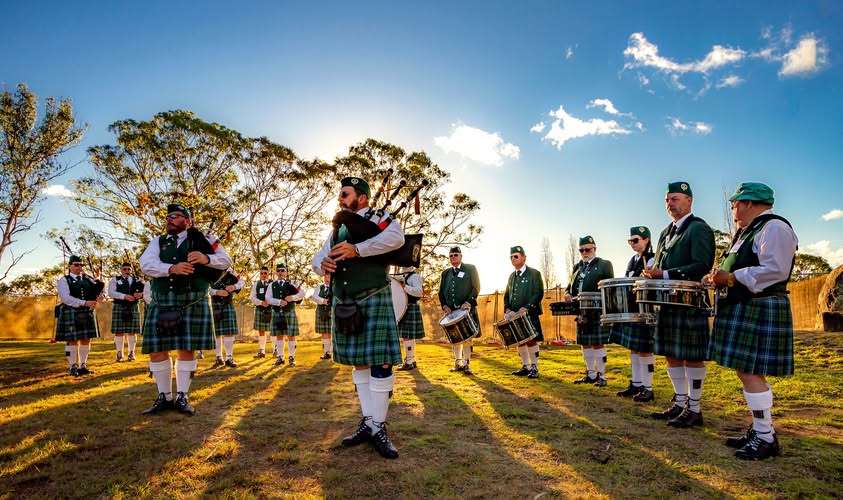
Over the four days, events are held throughout Glen Innes and the surrounding District, with the main Australian Standing Stones venue a hive of activity on Friday evening 1 May, Saturday 2 May and Sunday 3 May, with Celtic inspired market stalls and food vendors, music, dance, piping, ceremony and live action. Visitors can watch thrilling live jousting tournaments on horseback, cheer on competitors in the Highland Games, catch the Celtic nations ceremonies, Kirkin of the Tartan and visit the Clan and society tents around the stone circle. Families will love the Celtic Kids marquee including performances on the Sunday Family Fun Day, especially designed for the young ones, Celtic dog parade and Fashion parade. Our Celtic Cauldron marquee will host the Poets Breakfast and offers the chance to experience the living traditions of Celtic music, song and language in an inspiring environment.
The re-enactors add another fascinating layer to the weekend. Groups such as An T-Arm Albannach and the New England Medieval Arts Society (NEMAS) re-enactment and living history groups will take you back in time with demonstrations, traditional crafts, storytelling, military drills and dramatic battle displays. Their presence gives visitors a real sense of the history behind the culture being celebrated. The entertainment line up at the Highlands Stage has a full program of top Australian Celtic musicians and dancers, harpists to Celtic rock. This stage is adjacent to an array of food vendors and the Boar ‘n’ Drum Tavern and licensed precinct with outdoor screen to listen to the music with old friends and new in the welcoming atmosphere.
Evening Events
Friday Night kicks of the entertainment at the Australian Standing Stones venue, with the Friday Night Céilídh in the Highlands Marquee hosted by energetic Scotsman, Graeme McColgan and Ceilidh Connections. This traditional gathering will have you on your feet faster than you can say haggis!
The Saturday Night ‘Sesh’ hosted by Mick McHugh from The Gathering and featuring a variety of local and visiting artists will make for an energetic evening’s craic!
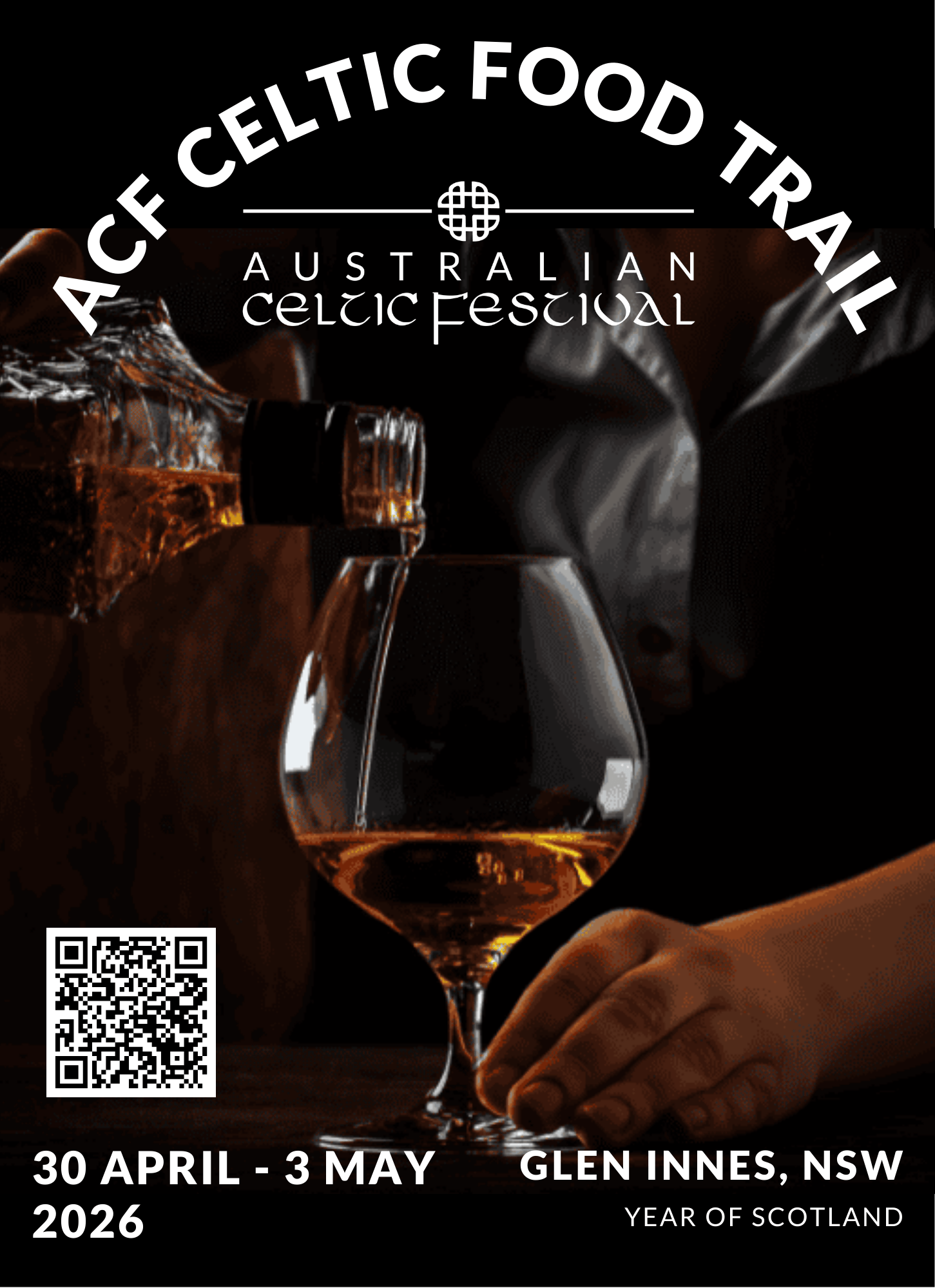
ACF Celtic Food Trail
A major feature of the 2026 Year of Scotland is the expanded ACF Celtic Food Trail, which weaves culinary experiences throughout Glen Innes and the Festival site. Leading this journey is acclaimed Scottish cook and storyteller Ali Stoner, the Festival’s Honoured Guest.
Ali brings warmth, authenticity and deep cultural knowledge to the Festival, sharing traditional Scottish recipes, stories and sustainable food practices. She will appear at the Celtic Cauldron alongside Roberta Muir, host demonstrations, and participate in special side events with local producers, chefs and venues across town. Throughout the week, local cafés, pubs, restaurants and producers will embrace the Celtic theme with special menus, tastings and events that invite visitors to truly “taste Scotland in the Highlands.”
Events Around Town
During Festival week Glen Innes comes alive with events for both visitors and locals. On Thursday evening the much-loved 100,000 Welcomes Concert offers a warm musical introduction to the weekend ahead. Across the town there are talks, workshops, the Highlands Hub Celtic Symposium, a busking competition, the Australian Celtic Cultural Awards for art & fashion. The Land of the Beardies Museum also hosts special programming that connects local history with Celtic heritage.
On Friday morning the official Opening Ceremony takes place in the historic town centre, bringing together civic leaders, performers and community in a proud and festive moment. Saturday morning features the iconic Street Parade from 9:30am, when crowds line the main street to watch massed pipe bands, clans, dancers and community groups march together in solidarity and celebration.
After the parade, many local businesses join the festivities by decorating their shop windows in Celtic themes. Free shuttle buses run throughout the weekend, connecting the town, Showgrounds, Visitor Information Centre and the Australian Standing Stones so everyone can enjoy the Festival with ease.
Stay and Explore
Glen Innes offers accommodation to suit every traveller, from motels and boutique farm stays to caravan parks and scenic camping areas. Many visitors choose to stay longer to experience the beauty of the New England High Country in its peak autumn season, with golden landscapes, crisp air and spectacular natural scenery just a short drive from the Festival.
With accommodation sometimes hard to find, we encourage day trips from neighbouring towns and villages.
Tickets for official Festival events are available online at www.australiancelticfestival.com, where you can also find the full program of events happening across Glen Innes. Follow the Australian Celtic Festival on Facebook and Instagram for updates, artist announcements and behind-the-scenes stories as we prepare to celebrate the Year of Scotland in 2026.
Do you enjoy our content?
Content on the Scottish Banner website remains free for users. Stories and events listed for the international Scottish community continue to be an important resource for many across the world. As advertising revenue remains a challenge, our readers can donate to help us produce unique Scottish content for global Scots. Every contribution counts and thank you for considering your support.
Support the Scottish Banner! To donate to assist with production of our publication and website visit: The Scottish Banner
In a revelation that feels straight out of Outlander, researchers at Robert Gordon University have uncovered new evidence of an assassination attempt on Prince Charles Edward Stuart, better known as Bonnie Prince Charlie, during his stay at Bannockburn House in January 1746. The discovery of a lead ball consistent with an 18th century musket shot, found during conservation work on a historic bed in the room traditionally associated with the Prince, adds a dramatic twist to one of Scotland’s most storied chapters.
Using cutting-edge X-ray technology, archaeological visualisation experts from Robert Gordon University identified a deformed lead projectile concealed within the bed’s footboard—silent testimony to a moment of violence that may have unfolded during the Jacobite siege of Stirling. “This is historical detective work at its finest,” said Dr Catherine Bradley, Conservation Trustee at Bannockburn House. “For centuries, local tradition spoke of a shooting incident here. Now, fragments of that story are aligning with physical evidence. Every new detail takes us deeper into the intrigue of 1746.” The find follows last year’s identification of a musket ball impact on the room’s wall, suggesting not one but possibly multiple shots were fired. Researchers are now asking: How many attackers were involved? How did the Prince escape? Could there be truth to the whispered tales of a secret tunnel?
A living story
Professor Pritchard said: “This research improves our understanding of the Jacobite Rising and the dangers faced by Bonnie Prince Charlie. Our 3D visualisation technologies allow for the digital preservation of fragile objects and sites, creating records that support further research and public sharing. By capturing these assets accurately, we are both expanding our knowledge and guaranteeing their preservation for future study.”
The Bannockburn House Trust, in partnership with Robert Gordon University, Johns Hopkins University, and Historic Environment Scotland, is leading the investigation. Researchers emphasise that the investigation remains ongoing. The emerging evidence does not yet conclusively define the nature of the incident, but it does expand the evidence base. Further analysis and archaeological digs are planned. Malcolm McEwan, Chair of the Trust, said: “This is what happens when community heritage meets world-class research. Bannockburn House is not just a building – it’s a living story, and we’re inviting the public to be part of its next chapter.”
The discovery stemmed from a collaborative programme involving Historic Environment Scotland, Robert Gordon University, and Johns Hopkins University; which brings postgraduate students from the United States to Scotland to engage directly with historic buildings, conservation practice, and digital documentation as part of their training.
Main photo: Bannockburn House. Photo courtesy of Bannockburn House Trust.
Do you enjoy our content?
Content on the Scottish Banner website remains free for users. Stories and events listed for the international Scottish community continue to be an important resource for many across the world. As advertising revenue remains a challenge, our readers can donate to help us produce unique Scottish content for global Scots. Every contribution counts and thank you for considering your support.
Support the Scottish Banner! To donate to assist with production of our publication and website visit: The Scottish Banner
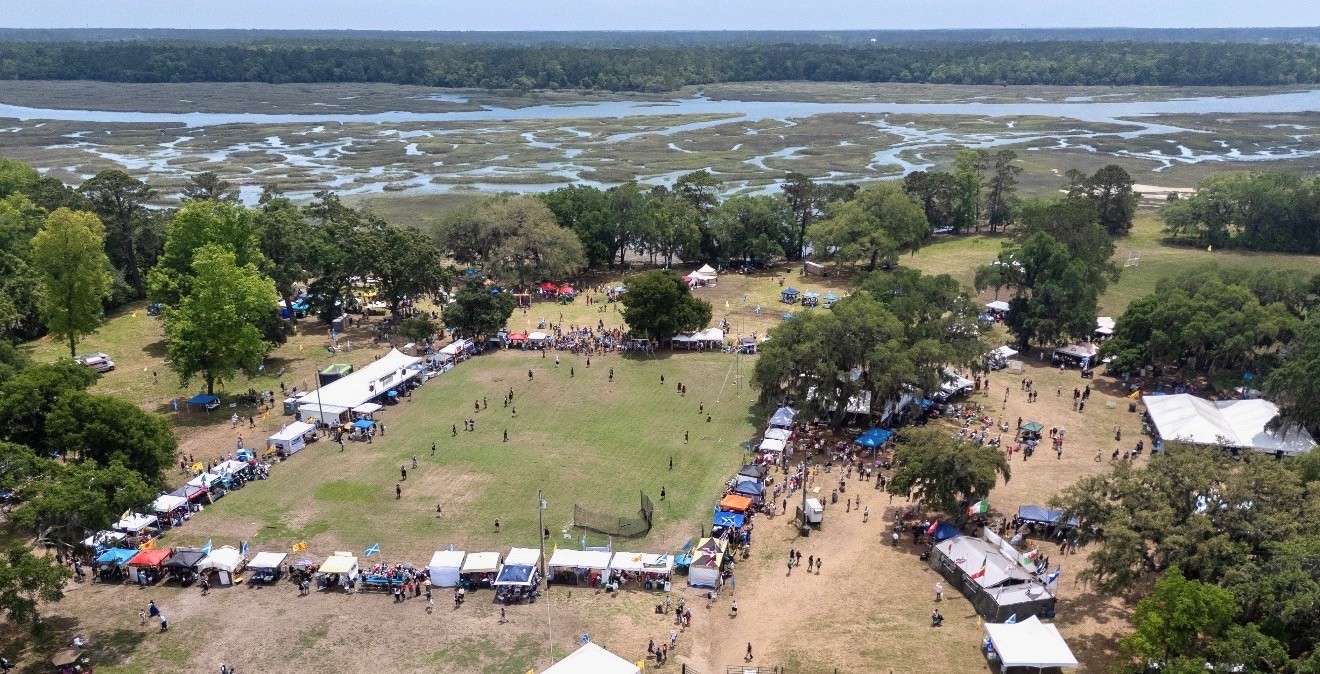
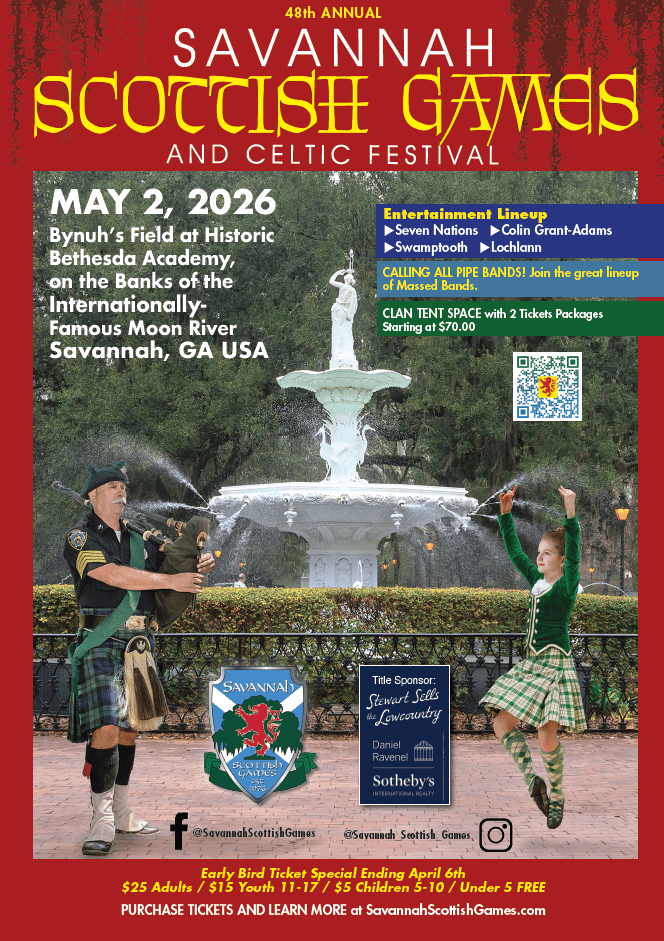
Savannah, Georgia, USA is a beautiful city to visit in May for the 48th annual Savannah Scottish Games. The area is known for old live oak trees draped in Spanish moss, with its long, draping, silvery-gray strands that hang from trees in warm, humid climates like the Southeastern U.S.
Savannah was founded in 1733 by General James Oglethorpe and is renowned as America’s first planned city designed to create a scenic, walkable environment. The design is based on a grid system each containing a central square, surrounded by homes, churches, and civic buildings. Twenty-two often tree-shaded, public spaces of the original twenty-four squares are still in existence today.
Savannah is known for its rich history (including being the birthplace of the Girl Scouts and Midnight in the Garden of Good and Evil), a vibrant arts scene, delicious Southern cuisine, and a reputation for being one of America’s most haunted cities, making it a top destination for history buffs, foodies, and those seeking spooky tales. A perfect backdrop for a Scottish games!
In January 1736, 177 Scottish Highlanders, recruited by Gen. James Oglethorpe, founded New Inverness (later Darien) an hour south of Savannah on the Altamaha River to serve as a military buffer against Spanish Florida. Led by John McIntosh Mohr and Hugh Mackay, these settlers were renowned for their warrior skills, crucial in defending the colony.
Fort King George State Historic Site in McIntosh County, Georgia, is the site of the oldest English fort on Georgia’s coast, built in 1721 as the British Empire’s southernmost outpost in North America to defend the frontier against Spanish and French threats. Today, it features a reconstructed colonial outpost with a blockhouse, barracks, and museum, showcasing the hardships of early soldiers and the history of the region. This coastal region is a great day trip from Savannah full of beaches, tidal communities and fresh seafood.
Family friendly festival
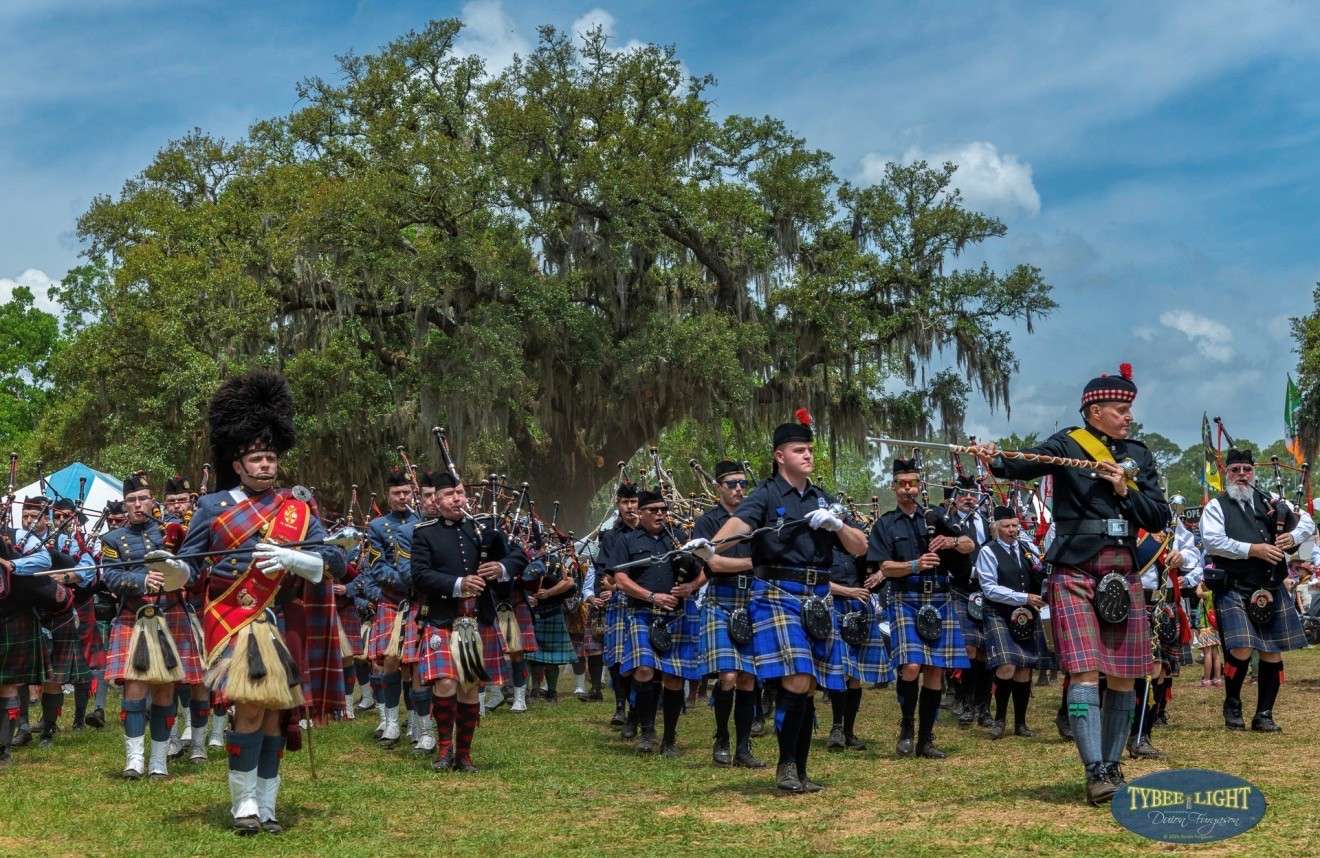
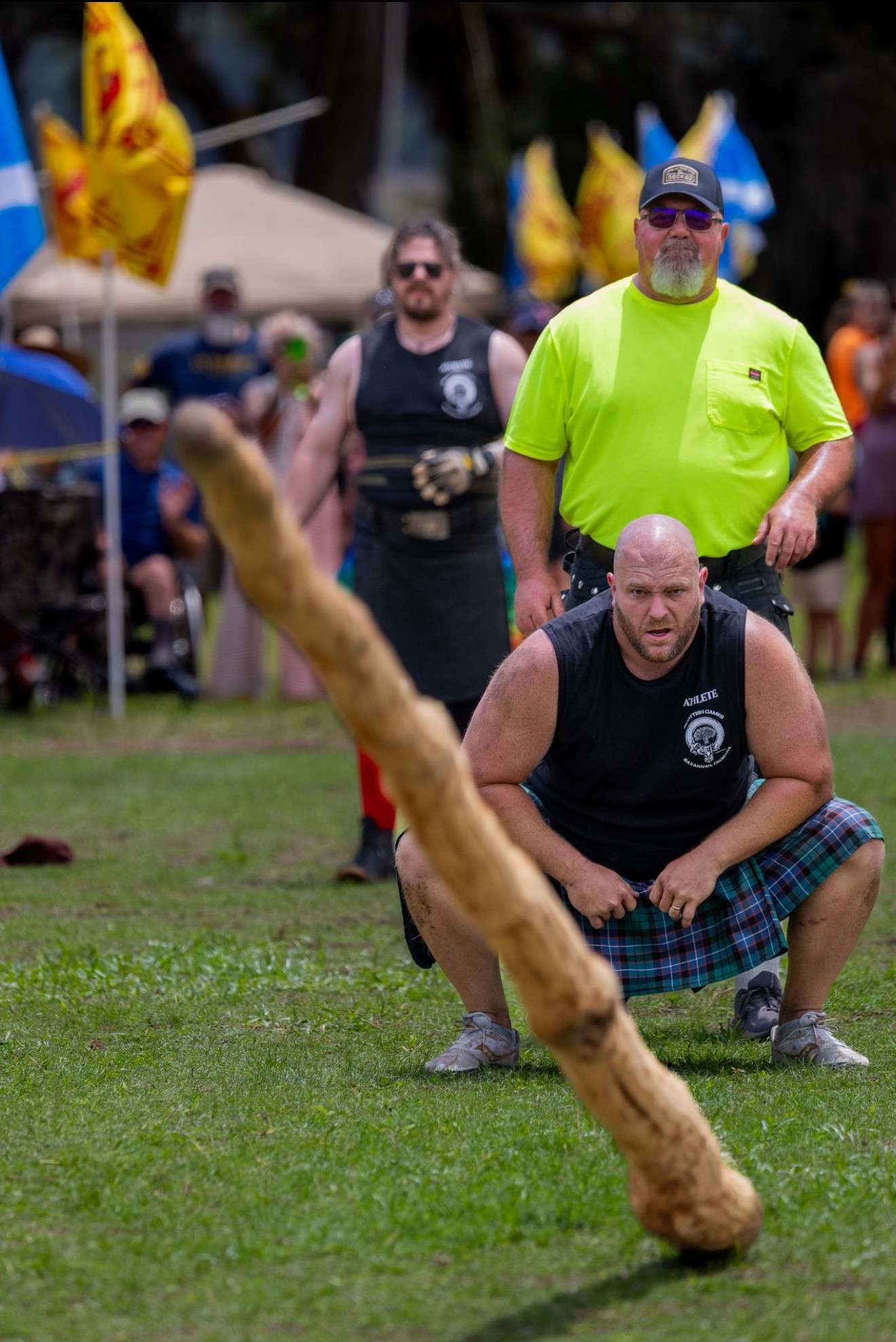
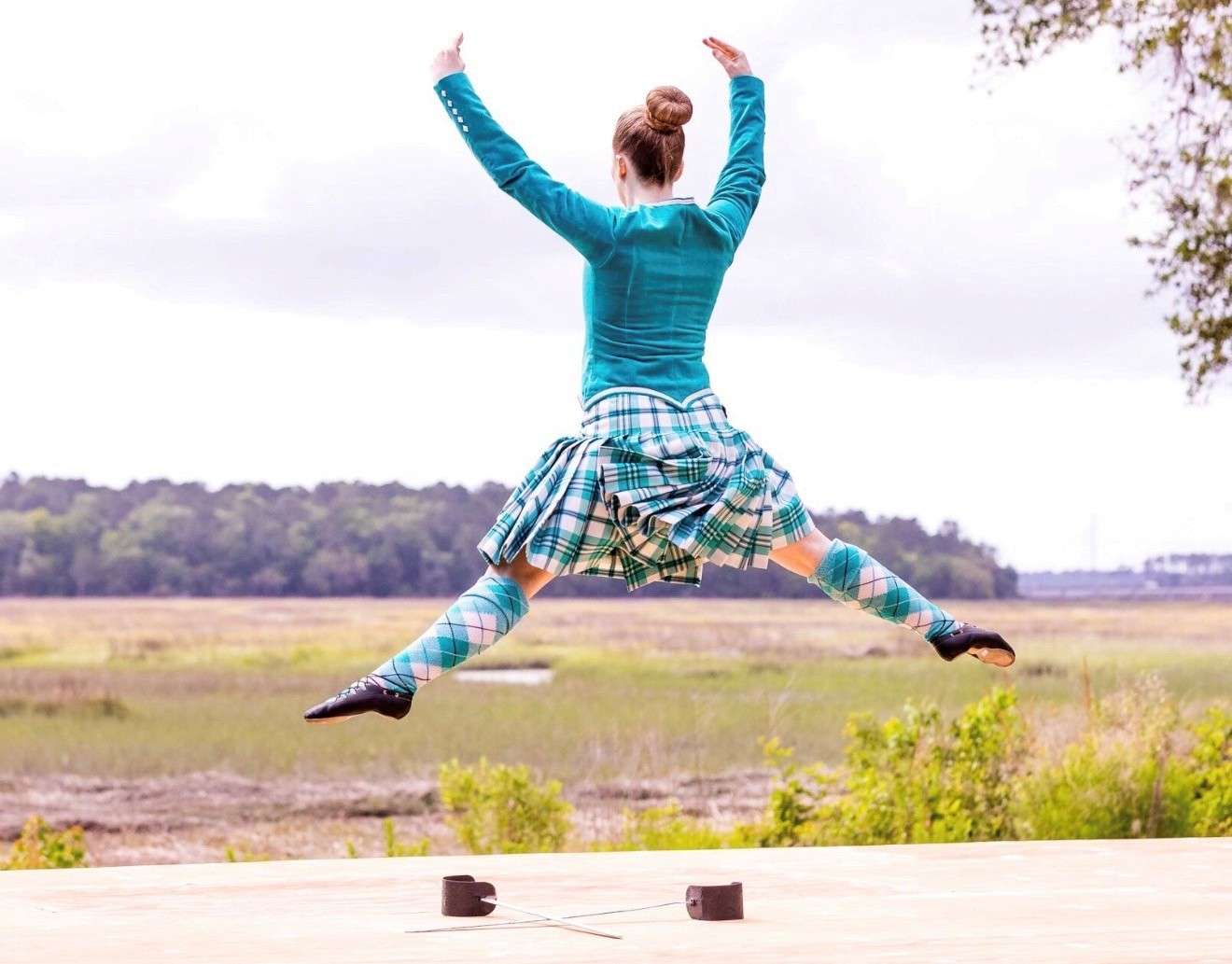
The Savannah Scottish Games is a family friendly festival jam packed with dancing, music, athletics, and fun for all ages. Held at Bethesda Academy for 18 years, the Savannah Scottish Games will welcome you with the sound of bagpipes, the thrill of the caber toss, and the warmth of Highland camaraderie. Bethesda is located approximately 12 miles east of downtown Savannah. Founded in 1740, it features gorgeous marshland on the Moon River with the region’s signature majestic live oaks draped in Spanish moss. A great backdrop for a Highland Games.
Bring a lawn chair and brace yourselves for the ultimate battle of strength on the bonnie fields. Cheer on 60 heavy athletes throwing heavy things. If that is not enough, competitions include tug-of-war and the Irish sport of Hurling. Wee lads and lassies are greeted at the front gate with a Children’s Passport. Visit with the various organizations and clans, collect passport stamps and redeem for a prize! Imaginations soar as sheep/duck herding border collies, birds of prey, hockey and living history reenactments perform demonstrations under the live oaks.
From powerful pipe bands and traditional bands (Seven Nations bringing Celtic rock, and folk music performances by Scotland’s Colin Grant-Adams, and local favorites- Swamptooth and Lochlann), you can take in a variety of music and dancing all day long.
Strolling the marketplace is a unique shopping experience. Enjoy local beer and mead—popular with the Celts and Vikings. Find your new favorite whisky during the whisky seminar & tasting experience.
Where Lowcountry charm meets Scottish tradition—Daniel Ravenel Sotheby’s International Realty/Stewart Sells The Lowcountry, is proud to be the Title Sponsor of the Savannah Scottish Games. Come to the 48th annual Savannah Scottish Games to experience Scotland in Savannah. Come for the heritage. Stay for the music. Leave with tired feet and a full heart!
Content on the Scottish Banner website remains free for users. Stories and events listed for the international Scottish community continue to be an important resource for many across the world. As advertising revenue remains a challenge, our readers can donate to help us produce unique Scottish content for global Scots. Every contribution counts and thank you for considering your support.
Support the Scottish Banner! To donate to assist with production of our publication and website visit: The Scottish Banner
International Women’s Day (March 8) is a global day celebrating the social, economic, cultural and political achievements of women. The National Trust for Scotland celebrates stories of prominent women from its past. The women have enhanced Scotland’s rich heritage in art, conservation, estate management, forestry, horticulture, interior design and photography.
The National Trust for Scotland is celebrating the stories of the remarkable women associated with the special places in its care to mark International Women’s Day on March 8. The pioneering women, who are strongly associated with the conservation charity’s heritage places across the country, have been instrumental in the development of the historic properties, with the legacy of their achievements inspiring the work of the National Trust for Scotland to this day.
The stories of the women from different walks of life have been shared as part of International Women’s Day to celebrate their contributions to the social, economic, cultural, and political advancement of women. Some of them are remembered for their work in different fields from art, conservation and estate management, forestry, horticulture and interior design to name a few. Their work has influenced and enhanced Scotland’s rich cultural heritage that the National Trust for Scotland works hard to care for, share and protect, now and for future generations to enjoy.
Sarah Beattie, National Trust for Scotland Senior Curator, said: “We’re delighted to celebrate International Women’s Day by sharing the inspiring stories of some of the women associated with the special heritage places cared for by our charity. These women, from different backgrounds, have been influential in their respective fields and their achievements have helped challenge societal notions across the 18th, 19th and 20th centuries to leave lasting legacies that we work hard to conserve. It is thanks to the ongoing generosity of our members and supporters, that we’re able to continue our work to care for, protect and share Scotland’s nature, beauty and heritage for everyone.”
Hannah’s love of art grew from staying at Kellie Castle in Fife as a young woman, where she was inspired to compose music and create art, embroidery, paintings and sculptures. Her creativity and curiosity led her to learn about plaster moulding from her family’s renovation of the property, with her skills helping to secure the opportunity to complete the decorative plaster ceilings at Falkland Palace for the Marquess of Bute.
While her brother (John Henry Lorimer) and nephew (Hew Lorimer) became famous for their artistic endeavours, Hannah was never considered a professional artist, but her legacy lives on through her work.
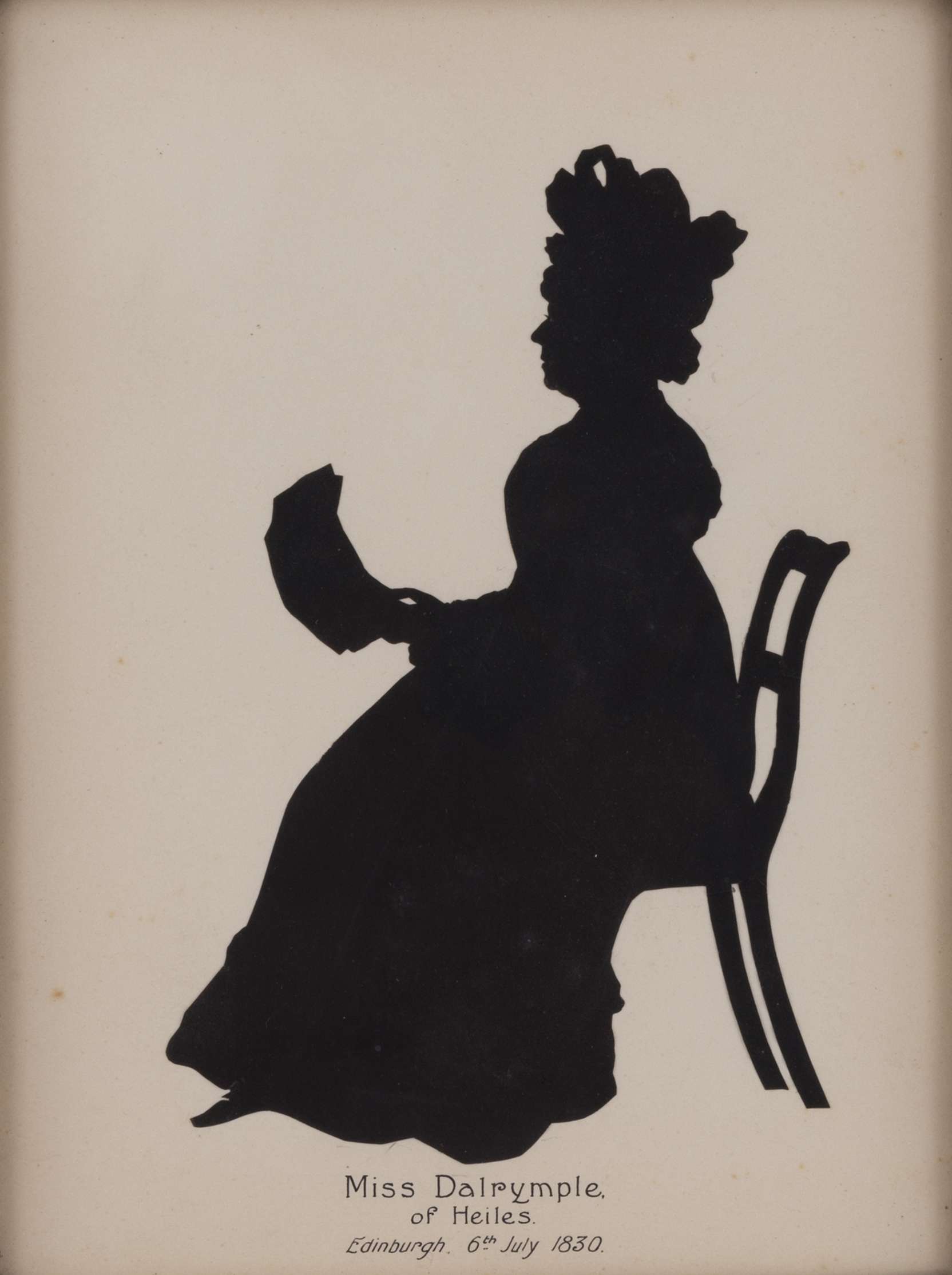
Miss Christian Dalrymple (1765 – 1839) – Newhailes House & Garden, East Lothian
Miss Christian Dalrymple.
Christian inherited Newhailes estate as the eldest daughter of her father, Sir David Dalrymple, Lord Hailes, 3rd Baronet of Hailes, who died in 1792. However, as a woman, Christian, was unable to inherit his baronetcy and focused her efforts to improve and manage the condition of the estate, repairing the library roof, improving the servants’ accommodation and extending the stable block.
As an early pioneer of conservation, Christian protected the grounds from industrialisation, helping to safeguard her legacy and the beautiful landscape at Newhailes for future generations.
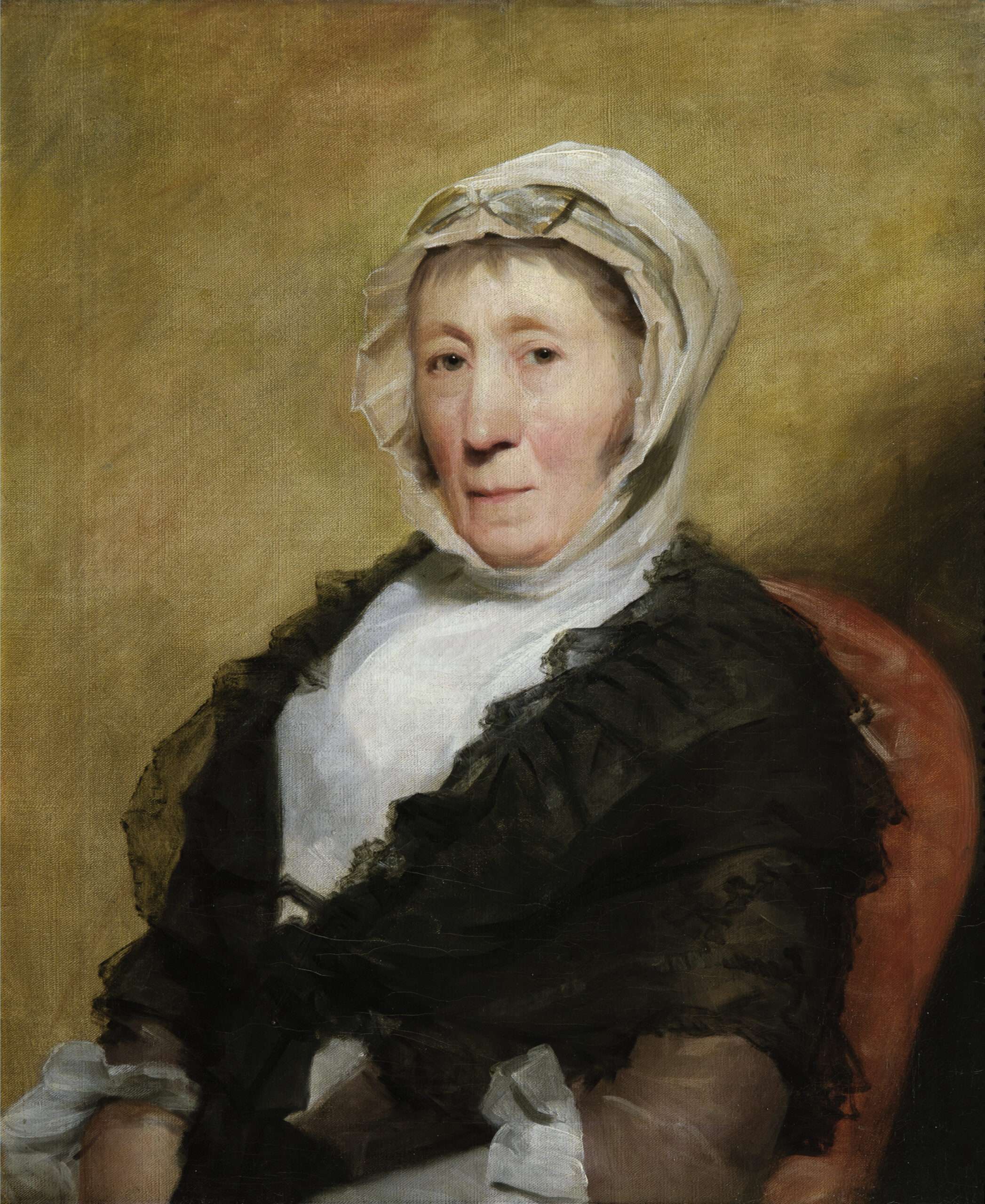
Mary Irvine (1721 – 1779) – Drum Castle, Aberdeenshire
The portrait by Henry Raeburn of Mary Irvine.
A prominent figure from Scottish history, Mary helped her brother, Alexander Irvine, hide from Redcoats in a secret room at the castle following the Battle of Culloden. Following his death in France after his exile, Mary dedicated her life to managing the estate at Drum where she established the Royal Forest of Drum, with remnants from the ancient oak woodland still surviving to this day. Mary was influential in creating and maintaining a working forest and negotiated a good price for oak timber with local shipbuilders.
An advocate for conservation, Mary recognised the importance of the forest and the dual value it offered, expressing her thoughts on the trees, ‘I think they must be profitable as well as pretty’. Mary was daughter of Alexander Irvine, 16th Laird of Drum Castle.
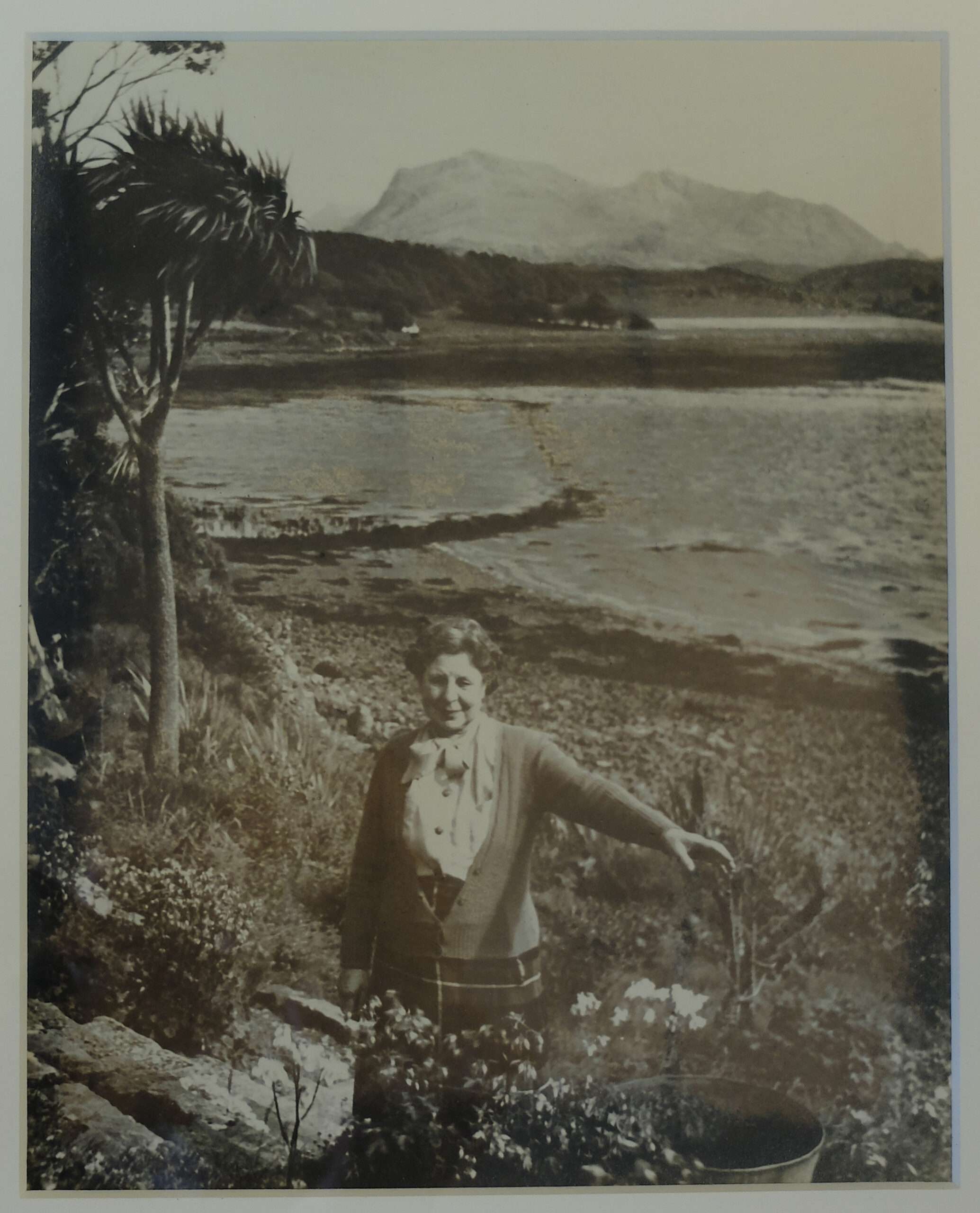
Mairi Sawyer Mairi was inspired to follow in her father, Osgood Mackenzie, who created Inverewe Garden.
Having spent most of her life at Inverewe, it is no surprise that Mairi shared her father, Osgood Mackenzie’s passion for gardening. After his death in 1922, Mairi took over caring for the ambitious loch-side garden, containing plant species from across the globe, which was transformed from a barren wilderness in the Scottish Highlands into a coastline paradise that is a feast for the senses.
Although hindered by labour shortages after the Second World War, Mairi was determined to make the garden a success and in the spirit of inclusion, opened the garden to paying visitors for the first time to share its unusual and exotic plants for everyone to enjoy.
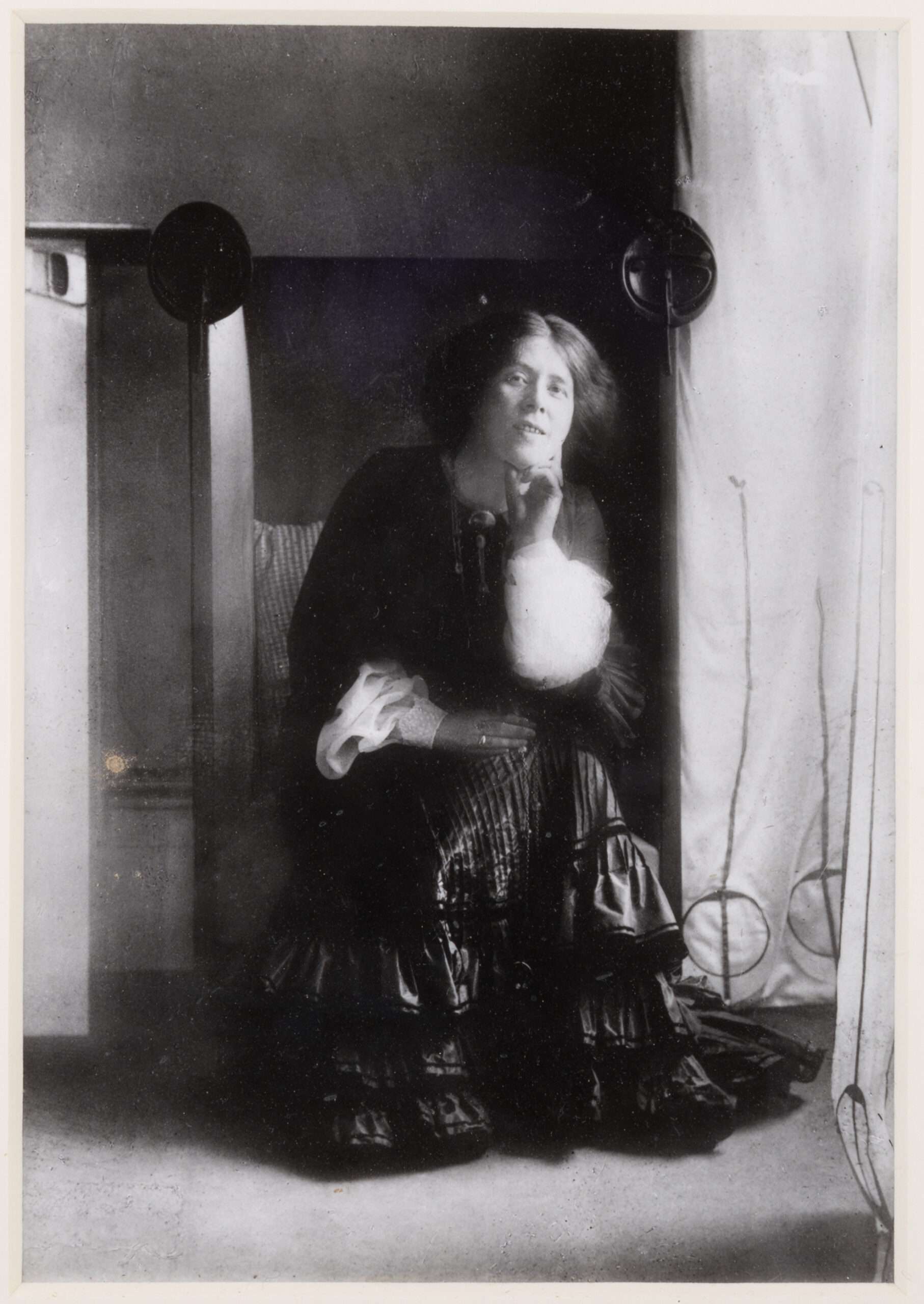
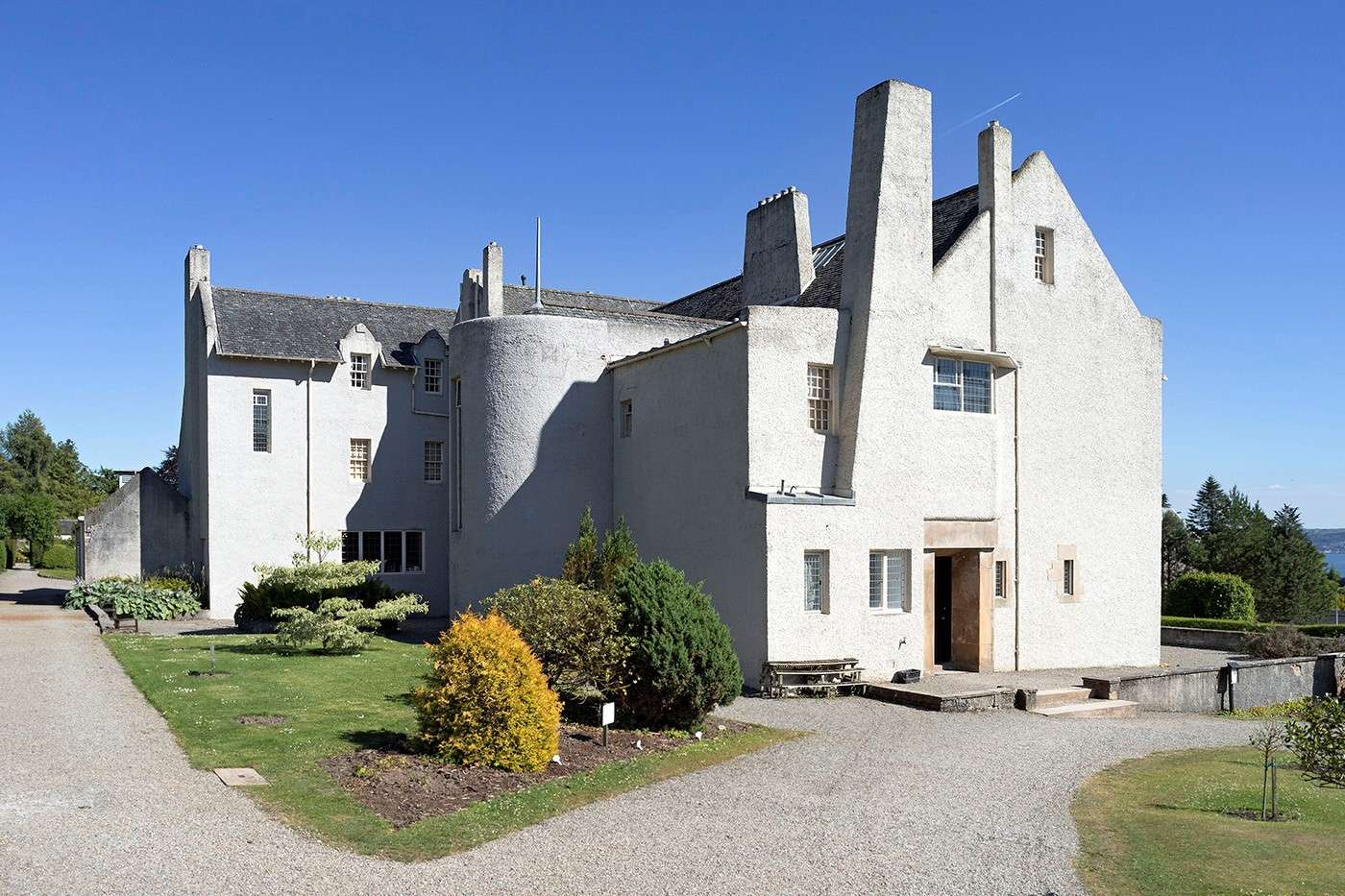
Margaret Macdonald Mackintosh (1864 – 1933) – Hill House, Helensburgh and Mackintosh at the Willow, Glasgow
Margaret Macdonald Mackintosh, the wife of renowned designer Charles Rennie Mackintosh.
Having studied at the Glasgow School of Art in the late 19th century, it is here that Margaret met Charles Rennie Mackintosh, which was the catalyst for a life-long artistic partnership that influenced interior design and architecture in the following years. Despite attracting attention on her own merit, the husband-and-wife duo worked collaboratively on many projects, so it is unclear how much she inspired his work, with both designers having contributed to the development of the ‘Glasgow style’ from 1890s to around 1914.
Regarded as one of the most versatile, imaginative and successful artists working in Glasgow in the early 20th century, original examples of her work can be found inside the Hill House, in Helensburgh, as well as in the recreated interiors of the Mackintosh at the Willow tea rooms on Glasgow’s Sauchiehall Street.
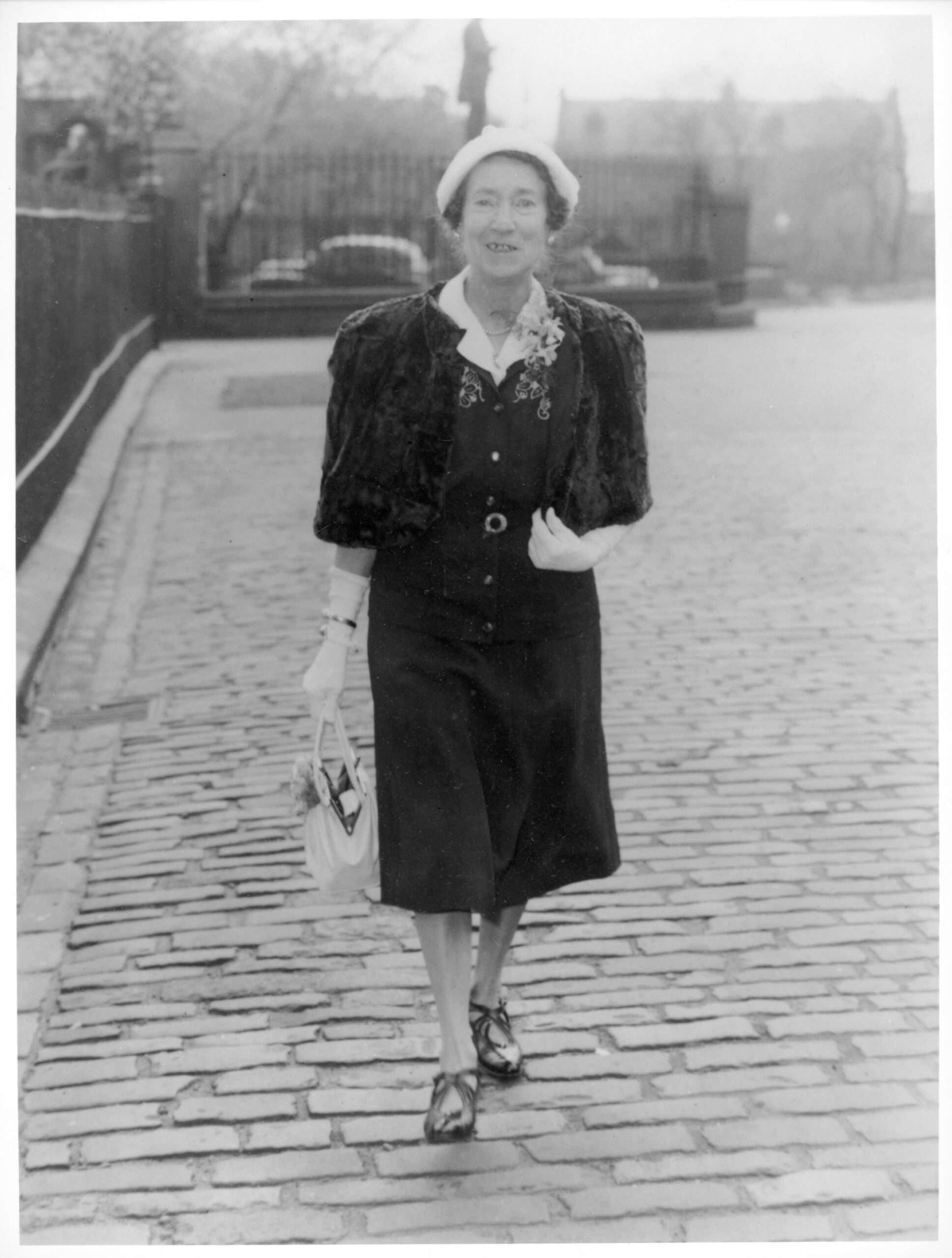
Miss Agnes Toward The former resident of Tenement House in Glasgow.
Mrs Agnes Toward and her daughter Miss Agnes Toward were the epitome of independent Glaswegian women in the 19th and 20th century. Mrs Toward had to provide for her daughter following the death of her husband in 1889 and successfully ran two dressmaking shops in the city to provide a middle-class upbringing for Miss Toward. Despite societal pressure on women to marry and the notion of ‘spinsterhood’ that dictated how widowed and single women were viewed at this time, Mrs Toward led an independent life with her daughter, moving into the Tenement House in 1911.
Miss Agnes Toward was afforded a good education due to her mother’s work ethic, which led her to formal college qualifications that helped her secure and hold the job as a typist with Prentice, Service & Henderson, a role she held for almost 50 years. Unlike many of her colleagues who would have stopped working following marriage, Miss Toward never married and continued working until the age of 73.
Text and images courtesy of the National Trust for Scotland. For more information on the National Trust for Scotland and the properties and stories above, please visit: www.nts.org.uk.
Main photo: Mrs Agnes Toward, the former resident of Tenement House in Glasgow.
Do you enjoy our content?
Content on the Scottish Banner website remains free for users. Stories and events listed for the international Scottish community continue to be an important resource for many across the world. As advertising revenue remains a challenge, our readers can donate to help us produce unique Scottish content for global Scots. Every contribution counts and thank you for considering your support.
Support the Scottish Banner! To donate to assist with production of our publication and website visit: The Scottish Banner
Discover inspiring stories from Scottish trailblazers this International Women’s Day (March 8th).
Scotland is a land steeped in fascinating history and filled with magical tales and experiences for visitors to explore and enjoy. As the world celebrates International Women’s Day on 8 March, it’s a time to reflect on the stories and achievements of Scotland’s well-known women, alongside the unsung heroines who influence the country we know today. From distinguished scientists and social reformers to trailblazing engineers and world-renowned artists and authors – Scotland has produced a plethora of formidable women.
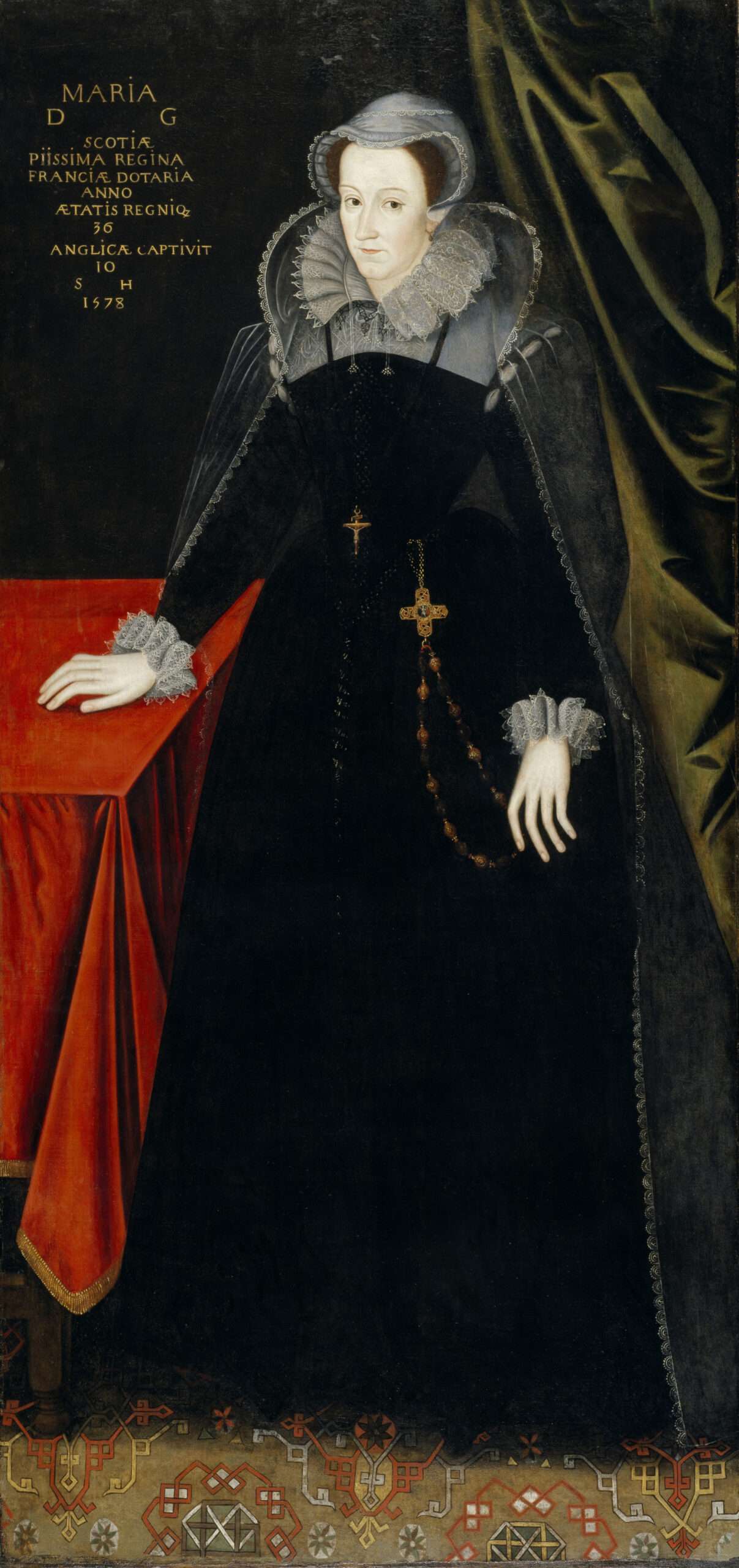
The most famous and intriguing of all Scottish women, Mary Queen of Scots, was born in 1542 at Linlithgow Palace. She became the Queen of Scotland at only six days old. Explore The Mary Queen of Scots Visitor Centre in Jedburgh or visit a range of incredible sites across the country linked to Mary’s eventful history.
Take inspiration not only from the women that have left their mark across Scottish history, but from the vibrant array of Scottish women forging new stories. Women showcasing ingenuity and leadership in tourism and empowering meaningful change across Scotland – the below are a brief example of Scotland’s inspirational stories with women at the core.
Historical & Cultural Experiences
The Glasgow Women’s Library-Glasgow Women’s Library is no ordinary library. As well as a lending library, it holds a wonderful treasure trove of historical and contemporary artifacts and archive materials that celebrate the lives, histories and achievements of women. From Suffragette memorabilia and 1930s dress making patterns to rare 1970s Scottish Women’s Liberation newsletters, it’s all here.
The only accredited museum in the UK dedicated to women’s lives, histories and achievements, Glasgow Women’s Library offers archives, exhibitions and events in the heart of the city’s East End. The library runs a vibrant and diverse programme of events and activities available all year round. Including Women’s Heritage Walks, book readings, exhibitions and so much more.
The Hill House – Margaret Macdonald Mackintosh (Helensburgh, Argyll)-The Hill House in Helensburgh is widely recognised as the most iconic home designed by Charles Rennie Mackintosh, Scotland’s most famous architect. Commissioned by Glasgow book publisher Walter Blackie in 1902, up-and-coming architect Charles Rennie Mackintosh and artist Margaret Macdonald worked collaboratively to create the unique building, furniture and textiles. Mackintosh said of his wife: ‘Margaret has genius, I have only talent’. She is now regarded as one of the most versatile, imaginative and successful artists working in Glasgow in the early 20th century.
Edinburgh International Festival – Nicola Bendetti first Scottish and female Director-The Edinburgh International Festival welcomes the finest performers in dance, opera, music and theatre from across the globe to Edinburgh for a spectacular three-week celebration every August. As well as being one of the most influential classical artists of today, Nicola Benedetti is both the first Scottish and the first female Festival Director since the Festival began in 1947.
Women-Led Tours Showcasing History, Culture, and Adventure
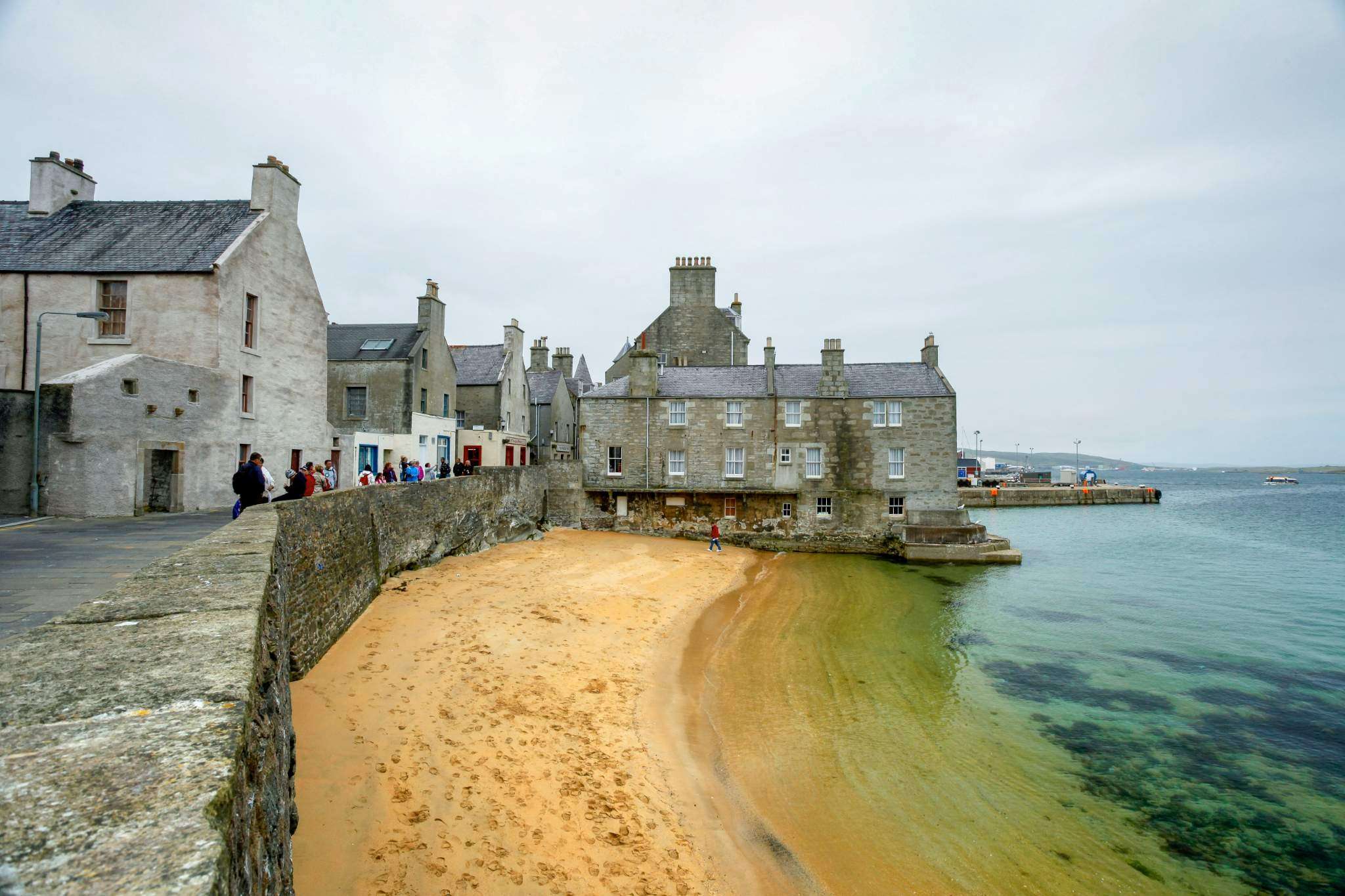
Lerwick, Shetland.
Black History Walking Tour of Edinburgh, Lisa Williams-Discover Edinburgh’s deep links with Africa and the Caribbean over the past 500 years in this guided walking tour. With a focus on the Caribbean and Edinburgh’s role in the Transatlantic Slave System, hear the little-known stories of Edinburgh’s many visitors and residents of African, African American and Caribbean heritage from the 16th century to the present day. The tour is led by Lisa Williams, an author, poet and founder of the Edinburgh Caribbean Association. She curates a range of events across Scotland to promote Caribbean culture and leads walking tours focusing on Edinburgh’s black history.
Invisible Cities, Zakia Moulaoui (Edinburgh, Glasgow, Scottish Borders)-Invisible Cities is a community interest company, set up by Zakia Moulaoui, that trains people who have experienced homelessness to become walking tour guides of their own city. The organisation offers tours that are off the beaten track, personal and highlight real people, and raise awareness about social justice. As we approach International Women’s Day, visitors can join Invisible Cities ‘Real Women of Edinburgh’ tour that uncovers stories about women’s contribution to the city or ‘The People of Glasgow’ tour that explores the communities in Scotland’s largest city.
Shetland with Laurie, Laurie Goodlad- Shetland with Laurie is a Scottish travel writer and tour guide itinerary planner with a passion for all things Shetland. Born to the islands, Laurie can trace her ancestry back hundreds of years and wants to share her deep connection to Shetland with its visitors, allowing them to feel a sense of belonging themselves. Laurie guides visitors through bespoke tours to help unlock the secrets of these fascinating islands.
Food and Drink Experiences by Female Founders
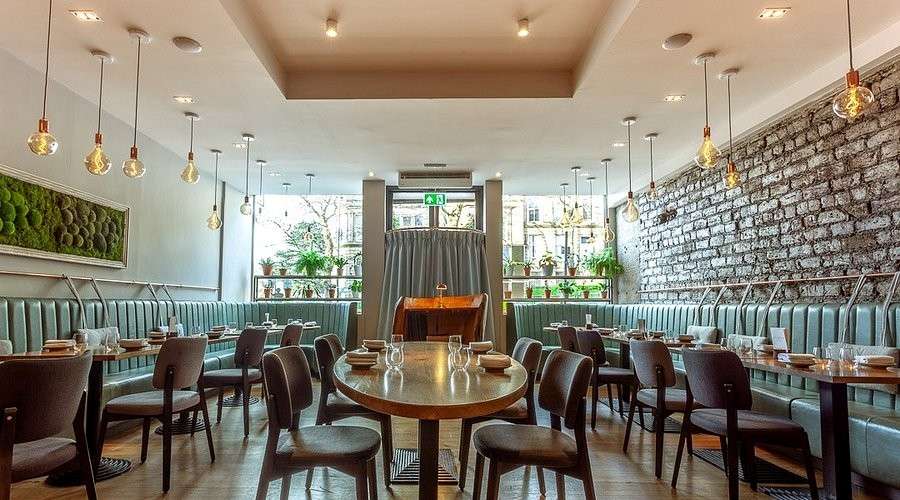
Cail Bruich, Lorna McNee (Glasgow)-One of two Michelin-starred restaurants in Glasgow, Cail Bruich aims to create truly memorable dining experiences, working closely with producers and suppliers to offer guests the highest quality of food and drink. Head Chef Lorna McNee, protégé of the late chef Andrew Fairlie of Two Michelin-starred Restaurant Andrew Fairlie and the only female head chef of a Michelin-starred restaurant in Scotland, took up her first head chef role at Cail Bruich in August 2020. Lorna creates elegant plates of food that make the most of Scotland’s seasonally changing ingredients prepared with respect and a lightness of touch.
Spirit & Spice, Ghillie Basan (Cairngorms National Park)-Ghillie Başan harnessed her intrepid spirit to build a highly distinctive, thriving business at her remote Highland home. She offers remarkable off-the-beaten-track experiences with food and drink at their core. At her business, visitors savour her unique style of food, Scottish spirits, and a real sense of outdoor adventure. Take part in a Whisky Food Safari and enjoy the flavours of the wild landscape while enjoying the stunning views.
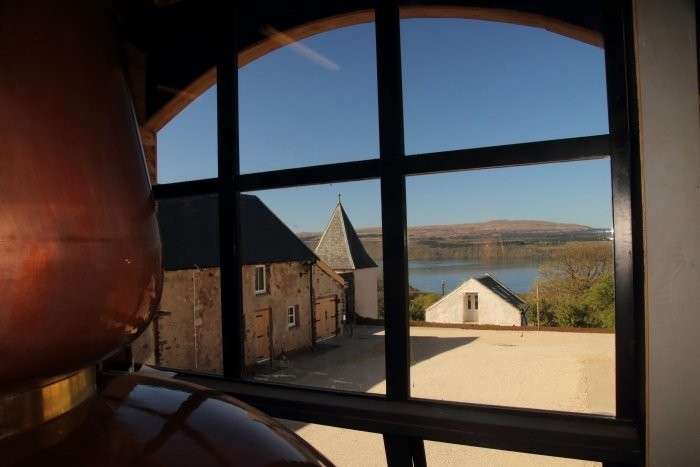
Nc’Nean Distillery, Annabel Thomas (Morvern Peninsula, Scottish Highlands)- Meet Annabel Thomas, founder and CEO of Nc’nean. Nc’nean is an organic whisky distillery nestled on the west coast of Scotland with a focus on sustainability. Nc’nean is one of the first female-founded distilleries in Scotland to be established in 200 years. They were also the first distillery in the UK to receive net zero verification, operating on 100% renewable energy.
Loch Levens Larder, Emma Niven (Kinross)-Nestled amidst the picturesque landscapes of Kinross, Loch Leven’s Larder is a family-run farm, restaurant, food hall and gift shop that celebrates the finest in local produce, craftmanship, and honest farm-fresh foods. Loch Leven’s Larder was founded by Emma Niven and her husband after they took over the family farm and recognised an opportunity to champion the community. The Larder uses as much local produce as possible, from vegetables grown in their own fields to produce from the many artisan makers in the surrounding area and the rest of Scotland.
Lussa Gin – Georgina, Sofie and Claire – (Isle of Jura, Argyll)-Located off Scotland’s west coast, the long and narrow Isle of Jura is home to around 250 people and 6000 wild deer. It is also home to Lussa Gin – an award-winning gin made by three women with 15 botanicals from the island wilderness. Visitors to the remote distillery, 25 miles along the single-track road from the Jura ferry, will be treated to fine views along the way.
Adventure & Outdoor Escapes
Wilderness Scotland-Starting in 2019, Wilderness Scotland decided to introduce an assortment of exciting, fully guided women-only departures to create a space to enjoy the great outdoors. Wilderness Scotland’s new trips have been devised to be even more inclusive to women who want to adventure in the wilderness. Whether a visitor wants to reduce competitiveness, feel confident in trying a new activity, take pride in their own abilities, avoid feeling self-conscious or simply become a part of the wilderness women’s community, these women-only trips open up the wilderness to more women to travel the wilds of Scotland with the kind of solidarity, ease and atmosphere that perhaps doesn’t come in a mixed group.
WanderWomen (Edinburgh, Scottish Borders, East Lothian)-Owned by Anna, WanderWomen Scotland facilitates award-winning, outstanding outdoor experiences for women in a unique mix of mindfulness and adventure. Anna created WanderWomen in 2018 to encourage women to have their space in the male-dominated adventure world. Her retreats include mindfulness walks, meditation, foraging, loch swimming, and more.
Wild Braemar, Annie Armstrong (Cairngorms National Park)-Owned by Annie Armstrong, Wild Braemar offers experiences including guided walks, wild swimming adventures, outdoor learning and creative workshops. Located in the heart of the stunning Cairngorms National Park, Wild Braemar aims to showcase the best of Scottish landscapes and natural spaces with experiences that are tailored to the visitor, providing unique opportunities to connect with nature.
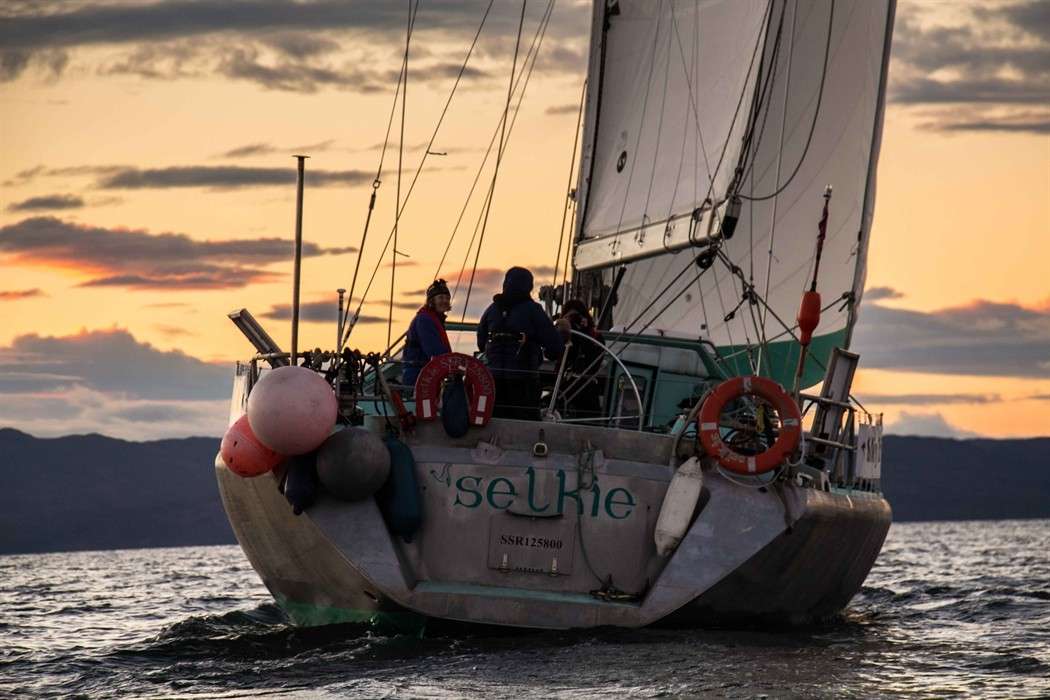
Selkie Explorers, Celia Bull (Isle of Eigg)-Skippered by Celia Bull, an experienced yachtswoman who has sailed the world’s oceans for over 20 years, Selkie Explorers offers female crewed sailing day and multiday trips of the Hebrides, St Kilda and Northern Isles aboard a yacht named Selkie.
Incredible Creators
Siobhan MacKenzie.
Prickly Thistle, Clare Campbell (The Black Isle, Scottish Highlands)-Prickly Thistle is a luxury brand dedicated to Scotland’s iconic cloth, tartan, made by women. The brand has taken their vision and created three unique tartan designs. These designs feature within all of the product ranges which have been manufactured exclusively within Scotland from only the highest quality raw materials.
Radical Weavers, Mari Breslin (Stirling)-Immerse oneself in craft courses where heritage and culture intertwine, offering a chance to learn the art of weaving and explore Scotland’s textile history. Step into the enchanting world of weaving at the Radical Weavers independent charity studio nestled in the heart of Stirling. Experience one of the craft courses where heritage and culture intertwine, offering a unique opportunity to learn the art of weaving and delve into Scotland’s rich textile history. Discover the joy of creating tartan-inspired treasures, a perfect gift experience beyond the ordinary.
Siobhan MacKenzie-Siobhan Mackenzie is a multi-award-winning Scottish fashion designer. Born and raised in The Black Isle in the Highlands of Scotland, her Highland heritage and Clan Mackenzie roots inspired her graduate collection and have remained a firm inspiration transcending throughout the brand. Five days after graduating with a First-Class BA Honours degree in Fashion Design & Production Siobhan launched her self-named label in 2014, aged 21. Whilst a student Siobhan undertook an internship with Scottish kilt-makers Glenisla, where she learnt the art of kilt making and thereafter began to experiment with new techniques. Her innovative design flair mixed with a Made in Scotland brand ethos reinvents the classics into a contemporary label inspired by Scotland. Clients have included Justin Bieber and Alan Cumming on the Traitors.
Text and images courtesy of VisitScotland. To plan your next trip to Scotland, see: www.visitscotland.com
Main photo: Loch Levens Larder.
Do you enjoy our content?
Content on the Scottish Banner website remains free for users. Stories and events listed for the international Scottish community continue to be an important resource for many across the world. As advertising revenue remains a challenge, our readers can donate to help us produce unique Scottish content for global Scots. Every contribution counts and thank you for considering your support.
Support the Scottish Banner! To donate to assist with production of our publication and website visit: The Scottish Banner
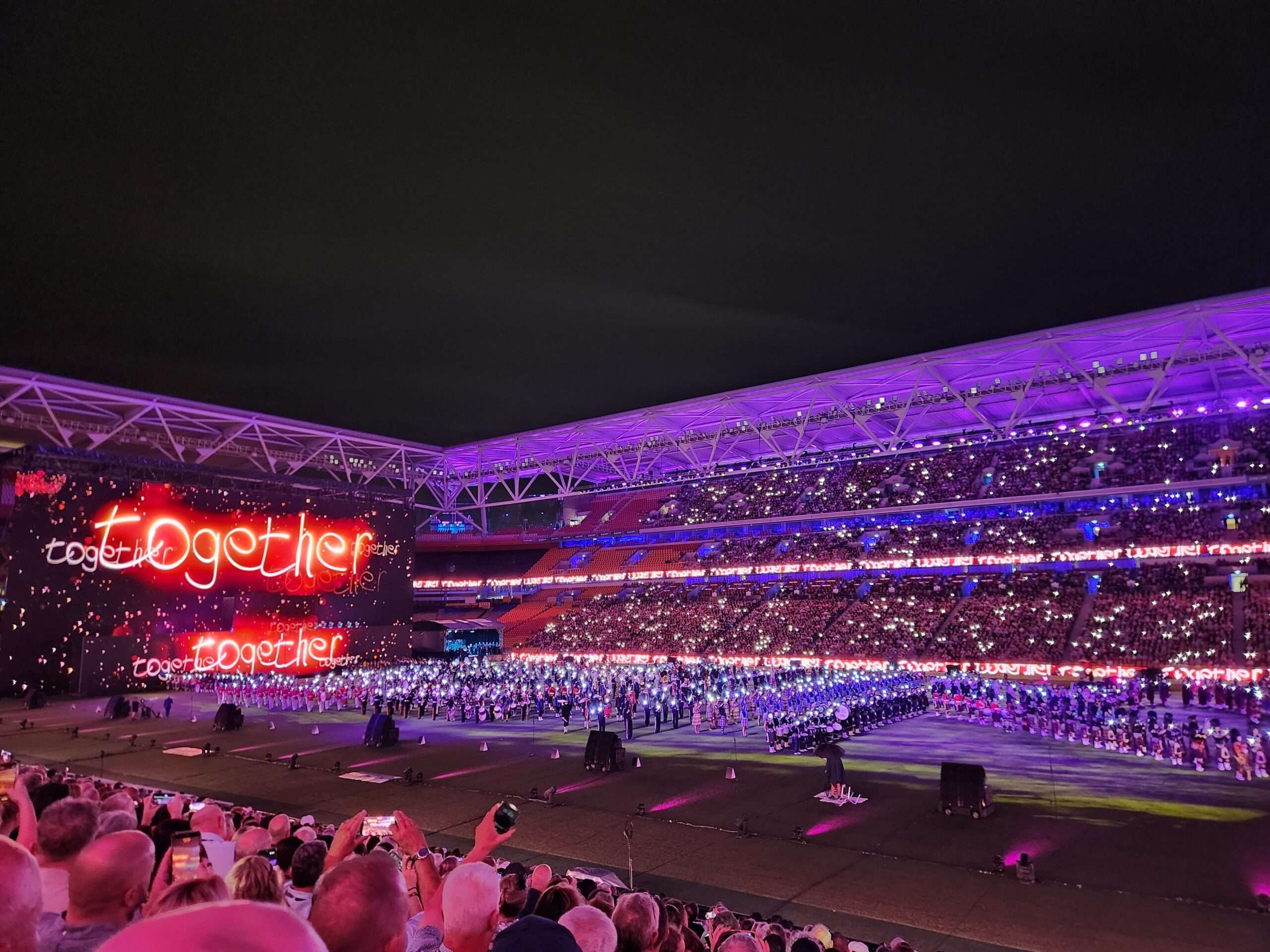
The Royal Edinburgh Military Tattoo’s debut in Brisbane in February 2026 proved to be a landmark cultural triumph, blending Scottish pageantry and international flair with Queensland’s vibrant energy. Staged at Suncorp Stadium from 12–15 February, the event marked the Tattoo’s first-ever full‑scale production in the city and formed the centrepiece of its 75th anniversary celebrations. Audiences were treated to The Heroes Who Made Us, a milestone show honouring the Tattoo’s incredible past while imagining its future.
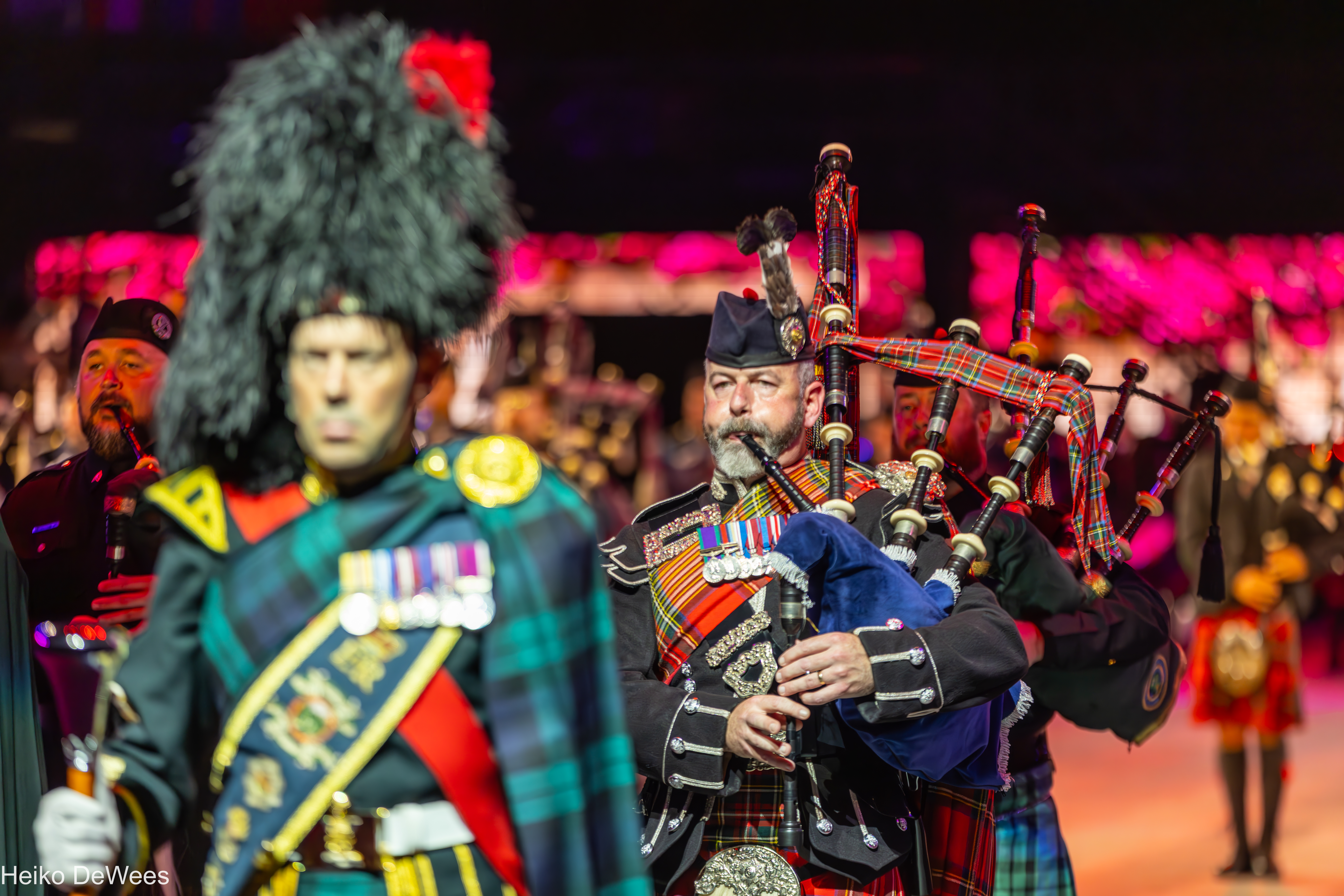
The production showcased the signature elements that have made the Tattoo world‑famous: massed military bands, stirring anthems, precision drill, and the unmistakable sound of the pipes and drums. More than 1,000 elite performers from across the globe, led by the Massed Pipes and Drums of UK military regiments, delivered a spectacle of scale rarely seen in Australia. Performers came from across Australia as well as New Zealand, Norway, Switzerland, Tonga, Japan and the USA.
Brisbane embraced the event wholeheartedly with the city streets alive with Tattoo guests and performers throughout the weekend. Though rain was persistent during the performances the extensive logistical planning contributed to the Tattoo’s polished presentation. Audiences were enthralled with performances being shown on Australia’s largest LED screen, measuring an incredible 50m by 22m, which displayed images of Scottish landscapes including the Tattoo’s home of Edinburgh Castle.
The greatest show on earth
Images: The Scottish Banner.
The Tattoo’s success in Brisbane stemmed not only from its theatrical grandeur but also from its deep history and cultural resonance. The Tattoo has often been called ‘the greatest show on earth’ and the Brisbane production certainly honoured that. The planning and detail that went into this show was like a military operation and audience feedback has been incredible.
Ahead of the Tattoo the show’s promoter told the Scottish Banner that pipe bands would form a focus of this production and that was delivered, along with some incredible local and international cast. The combination of military precision, global performers, and Scottish heritage created a powerful emotional experience for audiences to take home.
By the time the final notes faded on 15 February, the Brisbane season had firmly established itself as a highlight of the Tattoo’s 75‑year celebrations. Its blend of tradition, spectacle, and community engagement ensured that the Brisbane edition will be remembered as a resounding success.
Do you enjoy our content?
Content on the Scottish Banner website remains free for users. Stories and events listed for the international Scottish community continue to be an important resource for many across the world. As advertising revenue remains a challenge, our readers can donate to help us produce unique Scottish content for global Scots. Every contribution counts and thank you for considering your support.
Support the Scottish Banner! To donate to assist with production of our publication and website visit: The Scottish Banner
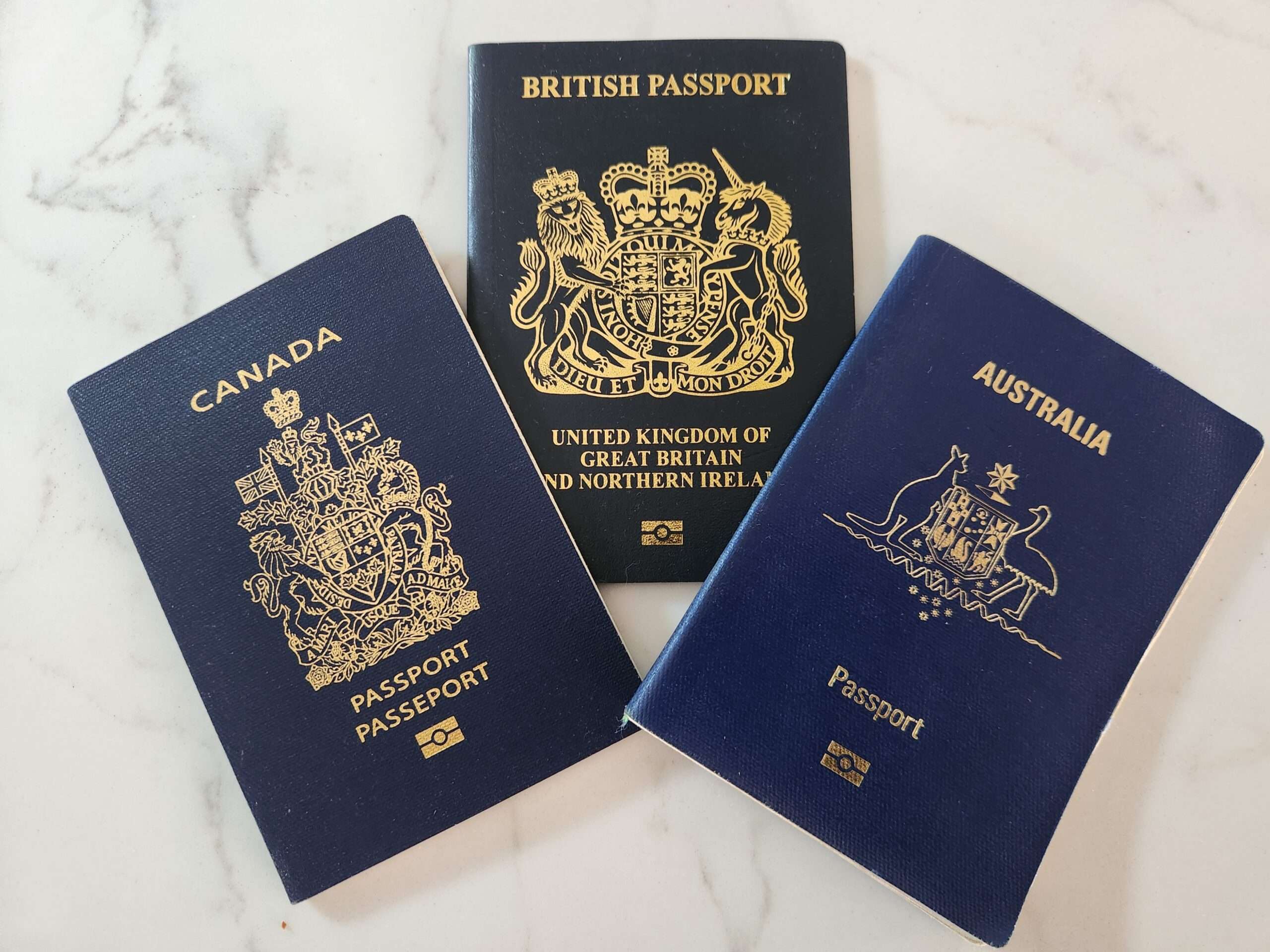
Travellers to the UK need to be up to date with the new policies now coming into effect. Visitors to the UK need an Electronic Travel Authorisation (ETA) if they do not need a visa for short stays of up to six months, or do not already have a UK immigration status. From 25 February 2026 eligible visitors without an ETA will not be able to board their transport and cannot legally travel to the UK. An ETA is a digital permission to travel – it is not a visa or a tax and does not permit entry into the UK – it authorises a person to travel to the UK. Non dual citizens of Australia, Canada, New Zealand and the USA will now be required to apply online in advance for an ETA to visit the UK. An ETA currently costs £16 and permits multiple journeys to the UK for stays of up to six months at a time over two years or until the holder’s passport expires – whichever is sooner.
British and Irish citizens do not need an ETA. However dual British citizens must have a valid British passport or certificate of entitlement when travelling to the UK. It is strongly advised that dual British citizens make sure they have a valid British passport or Certificate of Entitlement, to avoid problems like being denied boarding when travelling to the UK. From 25 February 2026, dual British citizens who cannot produce a valid British passport or certificate of entitlement will need to have additional identity checks and will not be able to go through UK passport control until their British nationality is verified.
Further guidance on ETAs, or renewing your UK passport, is available on: www.gov.uk
Support the Scottish Banner! To donate to assist with production of our publication and website visit: The Scottish Banner
Highland Dancer Sian Roach and BBC Pipe Major Freddie Bailey at Brisbane International Airport. Photo: Sarah Marshall.
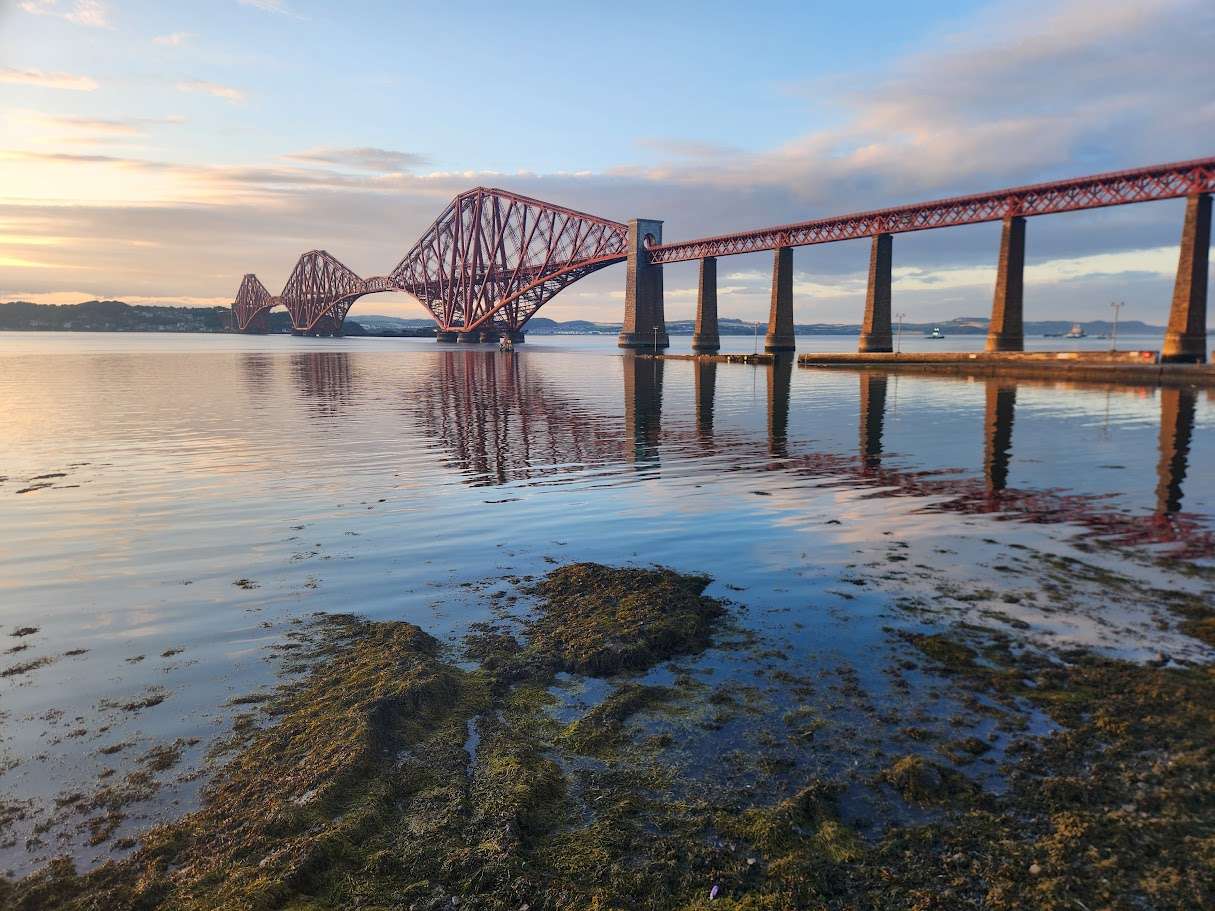
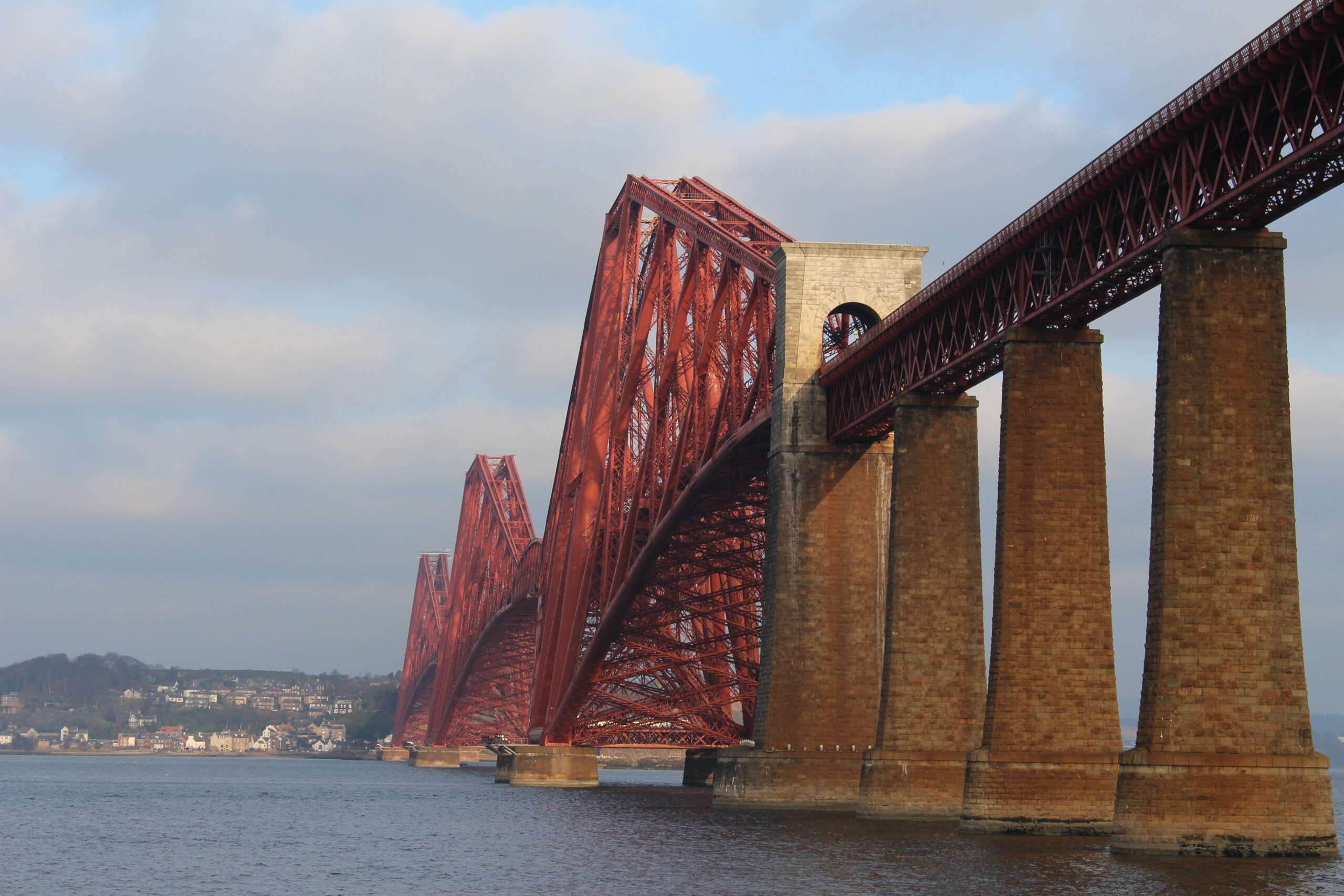
The Forth Bridge stands as one of Scotland’s greatest engineering achievements, a symbol of Victorian ambition and ingenuity. Spanning the Firth of Forth between Edinburgh and Fife, it was designed as a railway bridge to create a continuous East Coast route from London to Aberdeen.
The story of this iconic bridge, however, begins centuries earlier. A ferry crossing between North and South Queensferry operated as far back as the 12th century, serving pilgrims travelling to St Andrews. By the 18th century, this ancient crossing was Scotland’s busiest ferry route, linking the northeast with the capital.
Made from Girders
Taken from my dinner in 2025.
The arrival of the railway age prompted calls for a fixed crossing. Early attempts included a train ferry introduced in 1850 and a proposed suspension bridge designed by Sir Thomas Bouch in the 1870s. However, after the Tay Bridge disaster in Dundee in1879, a bridge also designed by Bouch—confidence in suspension designs ceased and so did his design plans, and a new approach was required. Bouch sadly became a recluse and died the following year from stress at just age 58.
Engineers Sir John Fowler and Sir Benjamin Baker proposed a revolutionary cantilever structure made of steel—the first major British structure to use the material. Made from Girders is the phrase often used, not just by Irn Bru, which highlights the massive, industrial scale of the structure, which used over 50,000 tonnes of steel. Construction began in 1882 and continued until 1889, involving thousands of workers and pioneering safety measures. The bridge opened on 4 March 1890, it was immediately hailed as a marvel of modern engineering. At the time, its two 1,700‑foot cantilever spans were the longest in the world, and its distinctive red silhouette quickly became iconic.
UNESCO World Heritage Site
Today, the Forth Bridge carries around 200 trains per day and remains a vital part of Scotland’s transport network. The bridge still today looks incredible, and many would say better than anything that has come since. In 2015, it was designated a UNESCO (United Nations Educational, Scientific and Cultural Organization) World Heritage Site, recognising its global significance and enduring influence on bridge engineering. It is one of seven Scottish sites recognised by UNESCO.
There are many jokes that have been told about the painting of the bridge being a never-ending job. For over a century, workers used traditional paint, and due to the harsh Scottish weather, by the time they reached the end of the 1.5-mile bridge, it was time to start over. A major restoration project, completed in 2011 involved stripping the bridge back to bare metal and applying a 3-layer, high-performance paint like that used on oil rigs. The modern techniques and paint used means the bridge will not require a full paint for at least 20 years, finally putting an end to the myth that ‘painting the Forth Bridge’ is a never-ending task.
In this issue
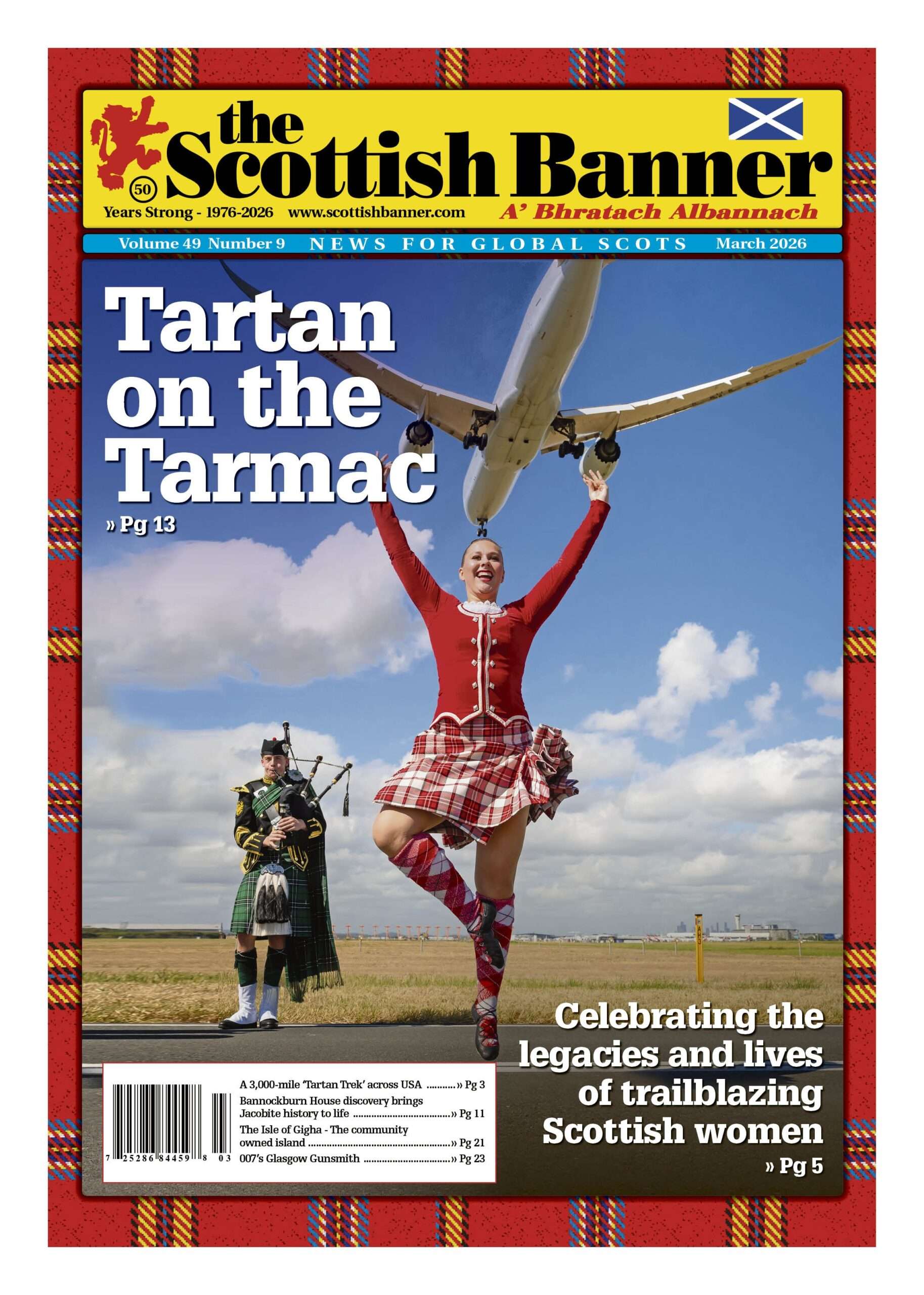
The Royal Edinburgh Military Tattoo has just wrapped up some incredible performances in Australia and New Zealand. This event too is a Scottish icon and to get Highland dancers and pipe band members at the end of a runway at an international airport does not happen every day. I went to the Tattoo in Brisbane and still have the sound of the pipes and drums in my mind and loved every minute of it.
James Bond films blend of adventure, travel, glamour and gadgets. The world’s most famous spy has many connections to Scotland and this month we highlight how a Glaswegian helped keep Mr Bond safe and also inspired one the franchises most loved characters.
This month is International Women’s Day. We are delighted to share just some of the great Scottish women who have made their mark on the nation. I know there are so many incredible women who have helped shaped not just the nation but most of us and we are so happy to honour them this month.
Magnificent structure
The management plan for the Forth Bridge, a UNESCO World Heritage Site, is currently being updated and people with an interest in the bridge and surrounding area have been invited to comment on the draft plan. UNESCO requires that all World Heritage Sites maintain a management plan to support the future management needs of a World Heritage Site, to coordinate the interests of associated organisations, groups and individuals, and to maximise the benefits and minimise any negative impacts from the World Heritage Site status.
The Forth Bridge’s Management Plan is now ten years old and is being updated for the next decade. People are encouraged to have their say by completing an online questionnaire by 31 March 2026 at: www.fife.gov.uk/forthbridge
I have travelled across the Forth Bridge several times and always know it is something special to do. Last year I was fortunate to spend a beautiful evening having dinner next to the bridge and did have a hard time looking at my food as I took in this magnificent structure as the sunset over it. No wonder this bridge, which has stood the test of time, has been hailed as Scotland’s greatest man-made wonder. Its legacy is not only structural but cultural—a testament to human ambition, resilience, innovation and Scotland’s built heritage.
Do you have you any comments from the content in this month’s edition? Share your story with us by email, post, social media or at: www.scottishbanner.com/contact-us
#ScottishBanner, #TheBanner #NewsForGlobalScots
The Scottish Banner is more reliant than ever on our readers helping us to provide you with our unique content by buying a copy of our publication, regardless if by print or digital subscription or at a retail outlet.
We appreciate your support and hope you enjoy this edition.
Support the Scottish Banner! To donate to assist with production of our publication and website visit: The Scottish Banner
Australian Jim Stoddart was born in a Glasgow Tenement and raised in a Glasgow Housing Scheme 1943-1965. Jim will be taking readers on a trip down memory lane, of a time and place that will never be the same again and hopes even if only a few people in the Scot’s Diaspora have a dormant folk memory awakened, then he shall be more than delighted.
A Paisley Poet
The broom, the briar, the birken bush, bloom bonnie o’er thy flow’ry lea;
And a’ the sweets that ane can wish, frae nature’s hand are strewd on thee.
When winter blows in sleety showers frae off the Norlan hills sae hie,
He lightly skiffs thy bonnie bow’rs as laith to harm a flower in thee.
Near thee I pass’d life’s early dayand won my Mary’s heart in thee.
Verses 1, 4 and chorus from Thou Bonnie Wood O’ Craigielea by Robert Tannahill.
Every present day Australian will tell you that nationalist and poet Andrew (Banjo) Paterson wrote the words to that wonderful and haunting tune Waltzing Matilda. Many might even recall that Christina Macpherson is said to have penned the music for him. That event supposedly happened whilst she was playing on her zither on a property in Queensland in 1895. A very much smaller number of ‘Aussies’ will know that Christina adapted that tune from an old Scottish Ballad, Thou Bonnie Wood O’Craigielea written by the Paisley Poet, Robert Tannahill and his good friend James Barr. Both Christina MacPherson and Banjo Paterson were of Scots descent so it should not surprise us that they were already familiar with this very beautiful old tune.
With that said I was impressed a few years ago to discover that the American writer and raconteur, Bill Bryson, also knew where the tune had come from for he mentions it in his book Downunder. He was in fact taking a humerous swipe at Banjo’s choice of words for the song but says”…on the other hand it has a lovely tune, it’s borrowed from an old Scottish Air, Thou Bonnie WoodO’Craigielea…”
The weaver poet
There has been much written about the Australian version of this song analysing Banjo Paterson’s words, their intent and meaning especially for the non-Australian. And that includes Bill Bryson’s take on the matter. But I shall leave all that aside to look at Robert Tannahill who never came to Australia, yet gave this land ten thousand miles away a much loved song that has become so associated with Australia and its people throughout the world.
Robert Tannahill was known locally as the ‘weaver poet’. He was born in Castle Street, Paisley in June 1774, and fourth son of a family of seven. His father was James Tannahill from Kilmarnock and his mother Janet Pollock from Boghill Farm near Beith. Soon after Robert’s birth his family moved to a cottage in Queen Street, Paisley. Robert apparently had a delicate constitution and a limp due to a deformity in his right leg. After leaving school aged twelve he was apprenticed to his father as a handloom weaver. During this apprenticeship Robert began to show his talent for writing poetry and that interest in poetry and music were to fully blossom in adulthood.
His writings began to appear in such publications as The Scots Magazine which co-incidently is the oldest magazine in the world that is still in print today. His music and poetry was contemporaneous with that of fellow poet, Robert Burns, and for that reason he is today considered to have been undervalued in Scotland at that time simply because of the greater popularity of Burns.
An important Scottish poet
My interest in Tannahill began when I realised some of his poetry mentioned places such as Crookston Castle, the castle that featured so much in my childhood as a place to visit and play in during the 1940s and 1950s together with the Glennifer Braes where I once camped with my childhood friends. I was intrigued to realise that he was creating some of his poetic works upon seeing that same castle ruin in his own childhood as well as the slopes of the Glennifer Braes perhaps as early as 1780. Although the Bonnie Woods O’ Craigielea lay at Ferguslie to the north west of Paisley I have to admit that I was not familiar with the song or the place back then even though my wife and I had grown up only a few miles from there. And to some extent that is an indictment upon our otherwise very good schoolteachers at Crookston Castle Secondary who introduced us to Robert Burns and William Shakespeare among others but not Robert Tannahill, a poet and songwriter even closer to home.
Robert Tannahill tragically took his own life in 1810 apparently following the rejection of his work by an Edinburgh publisher. His grave is situated in Castlehead cemetary on Canal Street in Paisley and there is a well named after him at Glen Burn in the Glennifer Braes. Tannahill knew and loved the green hills of the Glennifer Braes and his memorial well is a place where ramblers and wildlife can quench their thirst. It’s dedicated in deference to the immortality of his verse about the places he knew well and that I had also come to know and love in my childhood.
“The Bonnie wee well on the breast o’ the brae,
Where the hare steals to drink in the gloamin’ sae grey.”
That’s not very much in memory of an important Scottish poet and song writer and the man who gifted to Australia its favourite song. And as far as I am aware there is nothing at all in Australia to remind us of who to thank for our tune. In 1973 Australian’s were asked by plebiscite to decide upon a new national anthem for up until then it remained God Save the Queen. The main contenders for the honour of becoming Australia’s National Anthem were Waltzing Matilda, Advance Australia Fair and the status quo choice of God Save the Queen.
There is little doubt that the ever popular tune of Waltzing Matilda would have won hands down if Banjo Paterson’s words had been suitable for an anthem meant to unite and describe something to represent Australia to the world, as well as to ourselves. Banjo Paterson’s words didn’t do that. And of course, the words of Thou Bonnie Wood O’ Craigielea were not suitable either. So Advance Australia Fair, first performed in 1878 became the winner. It waswritten by the Scottish–born composer Peter Dodds McCormack. But that’s another story.
Support the Scottish Banner! To donate to assist with production of our publication and website visit: The Scottish Banner
The shores of Orkney and Shetland are no strangers to odd sightings. Islands that vanish as you approach them, ghost ships floating above the waves, sea monsters thrashing and churning the waves — all and more have inspired peat-fire tales for centuries. Every now and then amid dramatic phenomenon worthy of the sagas, a quieter sort of visitor appears.
Clad in sealskins and cutting a low silhouette barely perceptible above the water line, their vessels appear fused to their bodies. Try to catch one and they will travel as far with one stroke of their oar as you can in a thousand. Let’s meet these mysterious ‘Fin-Men’.
Fin-Men characteristics and sightings
An indigenous kayaker in the David Strait of North America, strongly resembling descriptions of the Fin-Men seen in northern Scotland. From Charles de Rochefort’s ‘Histoire naturelle et morale des’.
In 1703, an account of Orkney, Shetland, and the Pentland Firth by John Brand was published containing geographical, agricultural, and cultural information on the Northern Isles. Alongside more verifiable facts, he reported many conversations with locals relating to the Fin-Men. Brand wrote of them in general, “His boat is made of seal skins, or some kind of leather, he also hath a coat of leather upon him, and he fitteth in the middle of his boat, with a little oar in his hand.” These boats never had sails and could even be paddled when wholly submerged so as to get underneath dangerously breaking waves. A Fin-Man could cross from Norway to Orkney in just seven strokes of their oar, with the actual act of rowing being a total pretence – their vessels moved by magic, not muscle.
Furthermore, Brand reported, the Fin-Men are amphibious, dwelling in an underwater realm in wintertime and upon a hidden island in summertime. The Fin-Men could cast illusions, making their fins appear as human clothing and even being able to pass as humans for short periods when forced to go on land. Their arrival drove all the fish away from an area, making them ill-received by local fishermen. Fin-Men also had a penchant for making holes in human boats and for breaking fishing lines. The 17th century seems to have been the most prolific for sightings across Orkney and Shetland. One Fin-Man was sighted off Eday, Orkney, in 1682 but easily escaped when pursued. Another off Westray in 1684 also got away, but a sealskin boat later found ashore was allegedly kept in the Burray Kirk for decades afterwards. Fin-Men were also reported along the eastern shores of Moray and Aberdeenshire, though seemingly didn’t ply Scotland’s west coast. In all cases, they were only viewed from afar and no direct interaction with islanders is known of.
Theories: who were the Fin-Men?
Images of a kayak and implements allegedly washed up in northeats Scotland, from David Ritchie’s 1912 article ‘Kayaks of the North Sea’.
People in the Northern Isles were well-primed by existing beliefs to be curious about these new interlopers. Seals were vital to island life, with islanders wearing sealskin shoes and harvesting seal meat and fat – though any unnecessary seal-hunting was seen as taboo, given their sympathetic nature and quirks like responding positively to human songs. There was also a widespread belief that each creature on land, even people and all our social complexities, have aquatic equivalents, so the basic concept of human-like beings paddling over and beneath the waves would have raised no eyebrows. Still, the question remains – who, or what, could these Fin-Men have actually been?
The most common explanation takes a hint from the 17th century spelling of their name, ‘Finn-Men’. The indigenous Sámi people of northern Norway, Sweden, and Finland have long been thought of – by southern peoples who exoticised them – as powerful sorcerers. In the 17th and 18th centuries many travellers’ accounts claimed that the Sámi could control the weather, travel huge distances by magic, and shapeshift. The Sámi were, and are, masters of sealskin kayaks and can travel great distances in them. Could Sámi people have drifted south with errant tides, or even deliberately probed the shores of Scotland’s Northern Isles?
The kayaks used by the Sámi certainly bear a striking resemblance to those of the semi-mythical Fin-Men. Made from greased skins stretched over a wood frame, they were very low-lying in the water, long, and slender. An anorak, worn by the paddler to prevent water ingress, would give the impression from afar that the pilot and vessel were indeed one entity. When such sealskin boats became very waterlogged they became less buoyant and partially submerge. Indeed, Sámi paddlers could keep propelling them forward for a while even when the kayaks were wholly submerged, perhaps explaining sightings of mermaids and Fin-Men whose torsos alone stuck up from the water.
It is quite possible that some Sámi probed Scottish shores. It may also be that, during the Viking age, some Norse brought elements of Sámi lore with them which then fused with local tales about selkies and sunken kingdoms. The eminent 19th century Orcadian folklorist Walter Traill Dennison, however, doubted this simple Finnish connection. When asking older folk why they gave the name of Fin-Men to these rowers, the typical reply was, laconically, “Why surely, because they wear fins; onybody may ken that!
Another flesh-and-blood theory relates to climactic changes. The 17th through 19th centuries in Europe brought the ‘Little Ice Age’, a period when sea temperatures cooled to 5 degrees Celsius colder than they were by the end of the 20th century. Arctic ice pushed further south than previously typical. Many characteristics of the garments and vessels of the Fin-Men and Sámi also apply to those used by the indigenous Inuit of the Arctic Circle around Greenland and northern Canada. It is conceivable that small numbers of Inuit people may have followed the ice floes beyond their usual grounds, even as far as northern Britain.
One more explanation is simply that the term ‘Fin-Men’ became inextricably confused with other magical beings. Orkney was already home to the Finfolk, a similarly-named type of aquatic shapeshifter, and of course the ubiquitous selkie who left its sealskin at the shore to temporarily walk among us in fair form. Even fallen angels who landed in the water after their expulsion from heaven are said to have become seals or selkies. Could these folkloric and cultural associations with seals and divine entities explain some of the traits conferred on the kayakers, especially their great command of magic?
Antiquarian Dr Hugh Marwick observed that in Orkney, the term ‘Finn’ was often applied to the above-mentioned Finfolk who lived in their underwater realm of Finfolkaheem beneath the Eynhallow Sound, where Atlantic and North Sea tides crash together. The Finfolk are the ones most often blamed for snapping fishing lines, poking holes in boats, and having magic powers of illusion and weather-control – sound familiar? In Shetland, by contrast, Marwick says that ‘Finns’ exclusively applied to the very real Sámi people.
Even now, scholars have a very difficult time figuring out if historical references to Fin-Folk have any consistency. The term has been used to describe selkies, sea-trows, the Finfolk of Eynhallow, and the mysterious paddlers described above. Furthermore, the kayaking Fin-Folk are said to be turned away by the sign of the Christian cross, a common weakness of many other folkloric creatures in the Northern Isles. It could well be that strange vessels with lone occupants were indeed spotted off Orkney and Shetland, and that local terminology borrowed from existing archetypes to make sense of them and fit them into their existing legendarium.
An enduring mystery
There are no photographs of Fin-Men sightings, no confirmed face-to-face meetings, and no scientific or historical consensus one way or another. I do personally favour the theory that they were wandering Sámi or Inuit (or both), not least because of the fascinating anthropological implications and the prospect of Arctic kayakers having plied Scottish shores in secret potentially for centuries.
Even if we one day find definitive proof one way or another, I doubt we’ll ever untangle the Fin-Men’s alleged powers from those of other folkloric beings of the Northern Isles. That’s the beauty of such stories – over time, keeping the details consistent doesn’t really matter. It’s the sense of wonder and the shared fascination with something on the brink of the known and the unknown that keeps us coming back for more.
For the first time in 30 years, the Australian Pipe Band Championships will be held in Western Australia this April 11. Perth audiences will get to experience the incredible sounds and pageantry of hundreds of bagpipers and drummers performing on Subiaco Oval as the nation’s best pipe bands assemble for a unique battle of the bands. The Championships will see bands travel from Queensland, New South Wales, Victoria and even Singapore to pit their skills against six competitive Western Australian bands hoping to leverage their home ground advantage.
Pipe Bands Australia expects over 20 bands to compete across the various grades. There is also a Drum Majors Flourish competition element where each Drum Major displays their skill at marching while spinning and throwing a mace. This demonstration of precision and showmanship is enthralling for the audience. The event is also a Highland Gathering, with athletes competing in Highland Games such as tossing the caber, putting the stone, hammer throws, and tug-o-war. There will also be demonstrations of Scottish Country Dancing and stall holders for Clan genealogical societies and Scottish arts and crafts.
Sounds of bagpipes and drums
At the end of the afternoon, all competing bands will form a massed band that marches to the pavilion for the announcement of prize winners. The massed band is a goosebump moment, creating an exciting spectacle for the crowds.
Chair of Pipe Bands WA, Stuart Bradford, has been working for years to convince bands based on the east coast to make the journey west. The big sell is Perth’s record for being the sunniest capital city in Australia, and the chance for traveling bands to holiday in WA. Another drawcard is the stunning venue. Subiaco Oval was once Perth’s home of AFL Football in Western Australia, but the hallowed ground will now come alive to the sounds of bagpipes and drums rather than umpire whistles and final sirens! The old stadiums have been removed to transform the oval into a community events space for the City of Subiaco.
Subiaco is a vibrant precinct buzzing with bars, restaurants, entertainment and shopping. Visitors to the Championships can explore, dine and play their way around Perth’s most charming inner-city destination.
The 2026 Australian Pipe Bands Championships are on Saturday 11 April 2026 at Subiaco Oval. Visit: www.pipebandsaustralia.com.au
Support the Scottish Banner! To donate to assist with production of our publication and website visit: The Scottish Banner
Scotland offers some spectacular and dramatic railway journeys. It’s especially true in the Highlands, where the journeys from Inverness to Kyle of Lochalsh and Glasgow to Oban, Fort William and Mallaig are unforgettable – even if most of the trains are rather basic.
Then there’s the coastal stretch of the East Coast Main Line (ECML) between Edinburgh and Berwick-upon-Tweed, with its magnificent cliff scenery and much better trains. In the UK there has been a spate of TV series where a lucky celebrity gets to explore and praise these journeys. I wish I could get a job like that.
Scotland’s railway
Dundee waterfront.
I’m going to describe a less obvious rail journey that is uniquely sensational and exciting, and I’ll also try to suggest how to enjoy it for maximum comfort. Now, if I offer Dundee to Edinburgh by the ECML as a lesser-known Great Railway Journey you might think it a bit odd. After all, thousands of commuters, business travellers, trippers and tourists use it every day. What’s so special about it? Well, it combines two of the great features of Scotland’s railway right at the beginning, and right at the end of the journey.
To help appreciate how remarkable the trip really is, imagine making the same journey in 1726, not 2026. As soon as you leave Dundee, you’re faced with crossing the huge expanse of the Firth of Tay, over three kilometres, over to Fife. And even if you manage to procure a ferry – and you’ll probably want a ferry big enough to take your horse with you – once you’ve crossed Fife there’s another broad stretch of water, the Firth of Forth, to get over. Probably best to divert to the lowest bridging points of the Tay (Perth) and the Forth (Stirling), making a long journey that will probably take several days. If you were rich, you’d just take ship from Dundee to Leith.
How different now. Shortly after you leave Dundee, your train starts to curve onto the Tay Bridge, which runs for 3.2km, and rumbles across the firth. The bridge feels quite low above the water. Downriver the 1965 road bridge rises gently towards the Fife coast while upstream the gleaming waters of the firth reach towards the distant Perthshire hills. On my most recent visit I’d arrived over the road bridge by bus, and so crossing southbound on the train squared matters nicely.
It’s spectacular stuff but, of course, the history of rail crossings of the Firth of Tay includes tragedy. The first bridge, designed by Sir Thomas Bouch, was built between 1873 and 1878. When opened, it was then the longest bridge in the world. Queen Victoria crossed it on her way to Balmoral. But it didn’t last long. On 28th December 1879, a night of gales and rain, part of the bridge collapsed and a train was lost in the Tay, killing all 75 passengers and crew. A damning report said the bridge was ‘badly designed, badly constructed and badly maintained’; Bouch had not fully considered the effects of wind. We all know William McGonagall’s unintentionally hilarious verse in memory of the bridge, but it’s important to remember the real tragedy it represented. Its replacement was opened in 1887 and, if the new bridge isn’t the most imposing structure, it’s still doing a grand job nearly 140 years on. It was substantially refurbished and strengthened in 2003.
After your train makes landfall again, you can enjoy an hour or so of pleasant, green Fife countryside, with the Firth of Forth coming into view at Kirkcaldy and the sandy beaches of Kinghorn, Burntisland and Aberdour looking tempting. Your train swings south through Inverkeithing and North Queensferry before coming to the most spectacular two-and-a-half kilometres on the Scottish rail system.
The Forth Bridge
The Forth Bridge.
In the 1870s, Sir Thomas Bouch was involved in work to create a rail crossing of the Firth of Forth. He was, naturally, dropped after the Tay Bridge Disaster and it was John Fowler and Benjamin Baker who came up with the concept of a cantilever bridge made of steel; it was the first major project in the UK to focus on steel. The Forth Bridge (and it is the Forth Bridge – the two neighbouring bridges, the 1964 Forth Road Bridge and the 2017 Queensferry Crossing are pretty much like many other road bridges) is famously over-engineered but as such it’s utterly solid and of such spectacular design that it’s one of the most recognisable of Scottish landmarks. I’ve heard it described as Scotland’s Eiffel Tower and I wouldn’t argue. It was a target for the Luftwaffe in the Second World War, has featured on pound coins and banknotes, became a UNESCO World Heritage Site in 2016 and was voted as Scotland most spectacular man-made structure. Scotland is proud of the Forth Bridge and so we should be.
Yet it has a dark side: it’s estimated that more workers were killed during its construction than died in the Tay Bridge Disaster. In recent years historians have tried to identify those who died, tell their stories and memorialise them.
No matter how often I go across the Forth Bridge I never tire of it, peering out of the window like a 10-year-old seeing it for the first time. Oddly, I’ve been on trains where people are rather fazed by the bridge, perhaps by the height and the exposure. There’s no need for that. If there’s anything certain in Scotland, it’s that you’re safe on the Forth Bridge. Once you’re over you’ll be in Edinburgh in a quarter of an hour, but you’ll have crossed two mighty firths that used to be enormous barriers to travel, and have done so effortlessly.
ScotRail run two trains an hour for most of the day between Dundee and Edinburgh but I’d recommend checking timetables and trying to find a train operated by LNER. They run four return journeys a day linking Aberdeen, Dundee, Edinburgh with England on big, comfortable trains. If you book in advance, there may be good deals in First Class. So, you can sit in a comfy seat, be plied with food and drink, and speed across two giant firths in a way unimaginable to our distant ancestors.
By: David McVey.
Main photo: The Scottish Banner.
Support the Scottish Banner! To donate to assist with production of our publication and website visit: The Scottish Banner
Fans of the internationally renowned Irish music phenomenon, Celtic Thunder, are in for a special treat as the group announces their brand-new show, An Intimate Evening with Celtic Thunder – touring Australia in March 2026. This unique production will bring audiences a heartfelt celebration of the group’s most beloved songs while reuniting past and present members for an unforgettable evening of music, memories, and camaraderie.
An Intimate Evening with Celtic Thunder is more than just a concert—it’s a journey through the group’s incredible legacy. Featuring a carefully curated setlist of their greatest hits, this show will showcase the powerful harmonies, soaring ballads, and electrifying performances that have made Celtic Thunder a household name. From classic Irish folk songs to contemporary favorites, audiences can expect to hear the anthems that have defined Celtic Thunder’s illustrious career.
An atmosphere of warmth and nostalgia
What makes this show even more special is the reunion of familiar faces. Over the years, Celtic Thunder has been home to some of the finest vocalists in the world, and An Intimate Evening with Celtic Thunder will see Emmet, Damian, Neil and Ronan perform some of Celtic Thunder’s greatest songs. Longtime fans will be thrilled to see their favorite voices come together, blending their talents in an atmosphere of warmth and nostalgia.
Damian McGinty, longtime Celtic Thunder Principal said: “We wanted to create something truly special for our fans, something that feels personal and celebratory. This show is about reconnecting—with the music, with each other, and with the people who have supported us throughout the years. It’s a chance to relive the magic of Celtic Thunder in a more intimate way, and we couldn’t be more excited to share this experience with our audience.”
Tickets for An Intimate Evening with Celtic Thunder are now available and fans are encouraged to secure their seats early for this once-in-a-lifetime experience at: www.davidroywilliams.com/tours/celticthunder2026
Support the Scottish Banner! To donate to assist with production of our publication and website visit: The Scottish Banner
Randy ‘Gil’ Waugh is based in Ottawa, Canada and is closely linked to Scottish and Gaelic culture. Gil is an author, musician and Gaelic scholar who takes inspiration from Scotland’s history, music and culture. Randy ‘Gil’ Waugh took the time to speak to the Scottish Banner on his passion for Gaelic, his latest release and what it was like touring with a Celtic rock band.
Randy playing the pipes at Tartan Day Parliament Hill, Ottawa.
Randy you have been a private investigator, an IT architect and a commercial pilot. What drew you to writing, music and Gaelic teaching?
RW: Writing and music have always been integral to who I am. I’ve been writing since I first learned how—it was my way of understanding and interpreting the world. Looking back, not having a television in my early years was a blessing, not a curse. While many of my friends can still recite cartoon dialogue from memory, I spent that time writing plays, which my siblings and I would act out for our parents—or anyone willing to watch. I recently found one of those early scripts, titled The Lost Flight. It was horrendous, of course—but everyone was a good sport about it, and their encouragement meant the world.
Poetry was my first love. I wrote tomes of it—not because I was particularly good at it, but because it felt magical and cathartic. In fact, poetry was the first kind of writing I had published as a teenager, and to this day, each of my books includes an original theme poem. Music was always present in our home. My father performed on radio and television with his country band when I was young. After we moved to Ottawa, he continued to play—right up until the day before he passed in 2013. His passion left a lasting impact on me. I fell in love with the trumpet at a young age and lobbied relentlessly to learn it. Eventually, my parents gave in, and I took it up. After Fiùran folded in 2023, I returned to the trumpet and now play with the Concert Band of Kanata (CBoK), a wonderful local ensemble that brings me great joy.
I’m also a PDQB-certified tutor (Piping and Drumming Qualifications Board, Scotland) and have taught the Great Highland Bagpipe for many years. I had a particularly special group of young students about a decade ago and formed a band with them. We played gigs and competed regularly, and in 2018, we had the incredible honour of competing at the World Pipe Band Championships in Glasgow.
In 2014, I was invited by Pawl Birt, Chair of Celtic Studies at the University of Ottawa, to become a part-time professor of Scottish Gaelic language and culture. It felt like a dream come true. Eleven years later, I still feel the same way. I continue to teach with passion and love seeing our regular flow of students engaging with the language and the culture—proof that interest in Gaelic remains strong and vibrant. Gaelic has always been part of my heritage, though I only became consciously aware of it in adulthood. When my children were born, I began to explore our family’s roots. That’s when certain things about my maternal grandfather started to make sense—his lilting accent, his expressions, and certain behaviours. I discovered that Scottish Gàidhlig was his first language, though he never passed it on. I used to think this was a rare story, but I’ve since learned it’s far more common than I imagined. Learning about the deliberate and long-standing efforts to suppress our language and culture—both in Scotland and here in Canada—lit a fire in me. I felt compelled to pick up the torch, to do what I could to help reverse the loss, or at the very least, to better understand who we were as a people.
So, to answer your question more succinctly: being a private investigator, IT architect, pilot, and all the other “left-brain” ventures I’ve pursued were primarily to earn a living and support my family. I’ve been fortunate to find success in multiple careers, but those roles, while creative in their own right, never nourished me the way the arts do. Now that I’m retired from working as an IT specialist, I’ve returned to where I began—completely immersed in the creative world. Ironically, those more traditional career paths now provide rich fodder for my writing.
Ar n Òran sings at Diana Gabaldon Outlander launch.
You are not only a Gaelic speaker but also a Professor of Scottish Gaelic Language and Culture, at the University of Ottawa. Can you tell us what drew you to the Gaelic language and any advice for those thinking about learning?
RW: As I mentioned earlier, once I became aware that Scottish Gaelic was part of my family’s heritage—something that had been actively suppressed—it became a passion. I needed to understand why this had happened. What was our story? Where had we come from in Scotland? I’ve since found answers to many of those questions. While it saddens me that our language and culture weren’t deemed valuable enough to pass down, I now understand why that was the case. I’ve spent a great deal of time and energy trying to reclaim that part of our story—not only for myself, but for my children. When it comes to learning the language itself—it’s absolutely achievable. What’s needed is an open mind, a desire to learn, and the tenacity to figure out how you best absorb information—and then to keep going.
The second language I learned was French, which likely won’t surprise anyone from my generation. I was part of Pierre Trudeau Sr.’s era and believed in his dream that every Canadian should speak both official languages (Scottish Gaelic, by the way, almost became Canada’s third official language—but that’s a story for another day.) I didn’t truly learn French until I was immersed in it during stays in northern Québec. Full immersion is, without a doubt, the best way to learn any language. That said, immersion is hard work—and not everyone has the opportunity to live in a Gaelic-speaking region of Scotland or Nova Scotia. Most learners have to find other pathways to the same goal.
For beginners, I often recommend starting with Duolingo. It’s a good introduction and helps users begin forming sentences. Its main drawback is that it doesn’t explain much about why the language works the way it does. I suggest supplementing it with more structured learning—such as courses offered by The Gaelic College in Cape Breton, or by Sabhal Mòr Ostaig on the Isle of Skye (my alma mater). If formal study isn’t possible, there are excellent online resources like LearnGaelic.scot and other organizations devoted to helping learners engage with the language.
Personally, I’m a big believer in a multi-media approach to language learning. Even if you can’t spend time in the Gàidhealtachd, you can still immerse yourself in the language and culture. Listen to Radio nan Gàidheal, watch programming from BBC Alba or MG Alba, read Gaelic books or periodicals (the Gaelic Books Council in Glasgow offers a wide selection), take online classes—and most importantly, practice speaking!
This last point can’t be emphasized enough. In every learning environment I’ve been part of, conversation has been a central focus. I speak weekly with a fluent Gaelic conversation group based at Ionad Chaluim Chille Ìle on Islay. Until recently, I also had weekly chats with my good friend John Morrison, the former CEO of the Royal National Mòd in Scotland. John sadly passed away this past July. I miss him dearly, and the profound connection we shared through our language and culture. Speaking Gaelic regularly—with a group or even a partner—encourages you to think in the language. It pushes you to discuss everyday topics, and gradually, it becomes second nature. That’s the essence of fluency. Yes, it can feel uncomfortable at first—but it’s a vital step on the path to mastering the language.
Should anyone be interested in getting started with their Gàidhlig language learning journey, I would encourage them to reach out. I would be happy to share my thoughts.
Scottish Gaelic has enjoyed a revival in recent years with platforms such as Duolingo, as well as a number of initiatives being supported by the Scottish Government in Scotland. As an active member of the international Gaelic community what would like to see available to international Scots who are interested in the language?
RW: There have been tremendous initiatives supported by the Scottish Government to promote the Gaelic language, including several that are accessible to the diaspora and learners around the world. One standout is LearnGaelic.net, launched in Stornoway at MG Alba in 2011—a fantastic resource for beginners and advanced learners alike. However, one of the greatest missed opportunities, in my view, is the lack of access to Scottish Gaelic programming on BBC Alba for those of us outside the UK. Due to licensing agreements and broadcasting rights, much of this rich content is geo-blocked. For learners, ex-pats, and members of the diaspora, this is a real frustration.
People are creative, of course—and many find workarounds. But rather than relying on that, why not develop a mutually beneficial streaming agreement? BBC knows we’re out here, and I would hazard a guess that most of us would gladly pay a subscription fee to access this content legally. Not only would that generate revenue, but it would also help expand the reach and impact of the language globally. This isn’t just a matter of convenience—it’s about connection. BBC Alba programming is a wonderful learning resource, and restricting access to it limits one of the most engaging and immersive tools available to language learners and cultural advocates abroad.
Your latest book The Piper’s Lullaby: Òran Tàlaidh a’ Phìobaire involves murder and bagpipes and is set on the Isle of Islay. Can you tell us more and why you have chosen Islay as the setting for this historical thriller?
RW: Well, let me tell you a story. Twenty-five years ago, when I wrote my second novel, Evening Song – Òran Feasgair, I did only light research before choosing Islay as the setting for the Gaelic portions of the story and the climax of the thriller—specifically, Rhinns Lighthouse on Orsay. At the time, I chose it almost at random. I had no idea that this was, in fact, the very place my ancestors had come from. The real twist? Evening Song is a story about genetic memory—about messages passed through generations via poetry, story, and song. So, you can imagine the shiver that ran up my spine when I later discovered that I had instinctively set the novel in the land of my forebears. I had, quite literally, lived the very theme I had written about.
Now I know that Islay was the primary origin of my maternal ancestors—the Gaels of Gartnatra and Corrary farm, who eventually emigrated to Canada near Burnstown, Ontario, under a crooked land scheme orchestrated by Alexander McNabb. Many from that line are now buried in Goshen Cemetery, just minutes from Burnstown. This discovery left me with an undeniable urge—to read more, to learn more, to write more about the land of my ancestors. It felt like a return to the origin, as if reconnecting to that place might somehow offer a kind of reset—a re-grounding of identity.
And of course, the kinds of twists and turns I write about would likely never happen on Islay—but maybe that’s all the more reason to set them there. Perhaps it adds a little extra spice to go along with the island’s legendary malt whisky.
John Morrison and Randy in Stornoway.
Are there any plans to release any of your books in a Scottish Gaelic edition?
RW: In short—yes, absolutely. During the COVID-19 pandemic, I wrote a short story in Gaelic to entertain my online students. It centred around a mysterious pen and evolved into a creative twist on traditional Scottish folklore. I hadn’t originally intended to publish it, but it soon became clear that it could stand alone—either as a resource for learners or, as it was recently released, in English for young adults. The Gaelic version is currently being edited and will be published in the near future. As for the Sandalwood Investigation Agency series—translating the books into Scottish Gaelic would be an absolute dream.
My late friend John Morrison and I spoke at length about this. He believed the series would make a valuable contribution to existing Gaelic literature and thought it could be an excellent project for translation students at Sabhal Mòr Ostaig or through Bòrd na Gàidhlig. I agreed wholeheartedly and would still be willing to offer the books royalty-free for such an initiative—perhaps under a limited-time licensing agreement, with proceeds supporting a Gaelic organization in either Canada or Scotland, and rights reverting back to me later. My only stipulation would be the preservation of intellectual property and author credit. John and I also discussed the possibility of securing grants for translators. I’m not sure how to move that idea forward, but I remain very open to conversations with anyone who might help bring this to fruition. And once the translations are complete and edited, if any Gaelic publishers were interested, I would ensure they are published. So yes—bringing The Sandalwood Series into Scottish Gaelic is more than a hope. It’s a long-standing dream.
Fiùran.
You were also involved with the Celtic rock band Fiùran. How does it feel to have been able to create and share Celtic stories musically with audiences?
RW: To understand how fulfilling Fiùran was, it’s helpful to share a bit of the backstory. In 2009—roughly twelve years into my Gaelic learning journey—I founded Comunn Gàidhlig Ottawa (The Ottawa Gaelic Society) and organized and ran Mòd Chanada (A Scottish Gaelic event modelled after The Royal National Mòd in Scotland). To help raise awareness and support for our activities, I also formed and directed the award-winning Gaelic choir Ar n-Òran, as well as a children’s choir, Na Cuileagan-lasrach (The Dragonflies). Both groups saw many successes, performing and competing across Canada, the United States, and Scotland. Ar n-Òran was especially popular and helped build a vibrant Gaelic cultural presence in Ottawa.
As Ar n-Òran began to wind down, I felt myself being drawn back to something I had done in my youth—writing and performing in a rock band. That pull became Fiùran, a Celtic rock project I hoped would be well received by fans. Krista, the lead tenor from Ar n-Òran, stepped in as our lead vocalist, and I reached out to former musical colleagues to round out the lineup. I never imagined we’d go on to record four studio albums, or that our music would eventually be heard around the world. Fiùran became a wonderful platform for sharing both original songs and reimagined Celtic stories through music. We started gaining momentum late in life, but the response was exciting—we won a fan favourite indie award in the heavy metal category in New York City and were lining up promising gigs and tours. Then the COVID-19 pandemic hit.
A Japanese tour was in the works, but priority understandably went to more established acts whose tours had also been delayed. One by one, opportunities dried up. In 2023, after countless setbacks, Fiùran quietly folded—death by a thousand cuts. It was heartbreaking, and I mourned that loss deeply. Even so, I remain proud of what we achieved. Our music is still being played around the globe. I still hold onto the hope that the phone might ring someday, and we’ll hit the road again—but if not, I have countless good memories, and a deep sense of gratitude for what we created.
Just recently, I watched Zach Stuckey—our youngest member and Fiùran’s original guitarist—absolutely light up the stage on The Tonight Show with Jimmy Fallon. The band he’s currently playing with is selling out arenas around the world. Maybe it’s time for the next generation to take the torch. I believe Fiùran has left a formidable legacy that will stand the test of time.
Your books have blended Scottish language, history and music within the characters and storylines. What is it about Scotland’s setting and Scottish stories and themes that you feel make for such great reading?
RW: It’s certainly not a new idea to use the setting, history, language, and culture of Scotland as the backdrop for historical mysteries or thrillers. But it endures for a reason—Scotland is a land of breathtaking scenery and a rich, complex heritage shaped by thousands of years of folklore, legend, and lived experience. These elements offer storytellers an incredibly vivid and versatile palette to work with. If one takes a look at pop culture, music, art, and literature consumed around the world, it’s clear there’s an enduring global appetite for Scottish themes and settings. But for me, it goes much deeper than trend or aesthetics.
Scotland is where my ancestors came from. On my mother’s side—from the Isles of Islay and Tiree, and from Alloa in Clackmannanshire. On my father’s side—from South Queensferry, Cramond and Linlithgow. Though I was born in Canada, am most definitely Canadian and can’t call myself a Scot, I was raised with strong Scottish cultural mores and values. And over the years, one thing has become abundantly clear to me: I come from a long line of Gaels. I am a Gael.
For many years, I was a Gael with no Gaelic. But now, after much effort and discovery, I can say with conviction: ‘S e Gàidheal a th’ annam! I am a Gael.
The President and Committee of the Bundanoon Highland Gathering Inc. are delighted to announce that that Frank McGregor, High Commissioner and Chiefs Lieutenant for Clan Gregor Australia and the Honorary Consul for the United Kingdom in Tasmania has accepted their offer to be the Chieftain of the Day in 2026
High Commissioner and Chiefs Lieutenant for Clan Gregor Australia
Frank and Fiona McGregor.
Frank is the High Commissioner and Chiefs Lieutenant for Clan Gregor Australia and the Honorary Consul for the United Kingdom in Tasmania. In 2015, Frank McGregor was elected on to the Council of the Clan Gregor Society in Scotland as the Overseas Representative for Australasia. The Clan Gregor Society SCIO is one of the oldest clan societies in the world being established in 1822. In 2016, Frank helped co-ordinate a documentary on the Clan Gregor Society with Charles Wooley from Sixty Minutes called No Surrender.
Also in 2016, Frank became the Honorary Consul for the United Kingdom of Great Britain and Northern Ireland in Tasmania and continues in this role. He says it’s an incredible honour to work for the British Consulate. Then in 2018, Clan Chief Sir Malcolm MacGregor awarded Frank with the title of High Commissioner for Clan Gregor in the Commonwealth of Australia and Chiefs Lieutenant with the approval and official documentation from the Lord Lyon Court of Scotland enabling Frank to wear the feathers of the position.
In October 2025, Frank was appointed as the new Dean of the Consular Corps of Tasmania with the ceremony taking place at Government House. Frank is a passionate historian for the Clan Gregor Society and enjoys travelling around Australia representing the clan at various Scottish related gatherings. He is the Patron of the annual Tasmanian Highlands Gathering held in June each year. Frank is married to Fiona McGregor and has two sons, William and Angus McGregor and enjoys getting out in his classic cars when he gets time.
Clan Gregor
Clan Grego at Brigadoon.
Clan Gregor are one of the most ancient and famous of all the highland clans in Scotland. Historians believe Clan Gregor to be the purest branch of the ancient Gael of Scotland now in existence – true descendants in short, of the native stock of the country. Known as Clan Alpine or Race of Alpine, they descended from the first known inhabitants of Scotland and were the first people to boil water and create smoke in their ancient lands of Glenorchy. The Clan claims descent from Griogar, son of King Alpin who was the first united King of Scotland. It was from this that derived the Clan Motto of “Royal is our Race”
In 1589, King James VI, issued an edict proclaiming the name MacGregor “altogidder abolished,” meaning that those who bore the name must renounce it or suffer death. MacGregor’s were ordered to take on different names or to continue using the name MacGregor openly was to invite an immediate execution. It was practically the genocide of a Scottish Clan. To hide from their persecutors, they became known as the Children of the Mist. Famous MacGregor’s include Scottish rogue Rob Roy MacGregor, John McGregor the Piper at the Alamo and another John MacGregor was Bonnie Prince Charlies personal Piper during his campaign.
In Australia, the clan are proud of the fact that they have had representation at every Bundanoon Highland Gathering since its inception. Since Frank has been involved with the Society, the MacGregor’s have outnumbered every other clan at Bundanoon, sometimes having as many as seventy MacGregor kinfolk in the march or in front of the clan tent for our annual photo. The current Clan Chief is Sir Malcolm MacGregor of MacGregor Bt.
The Bundanoon Highland Gathering is being held in Bundanoon, NSW in the beautiful Southern Highlands on Saturday, April 18th. For more details visit: www.brigadoon.org.au
Support the Scottish Banner! To donate to assist with production of our publication and website visit: The Scottish Banner
Looking for some inspiration for Valentine’s Day? Here are some great ideas for romantic Scottish getaways and days out for your next visit to Scotland.
The Pineapple.
Depending on where you’re from, and how far back through history you look, you might enjoy all sorts of Valentine’s Day traditions. In England it was once said that if you put bay leaves at each corner of your pillow, you would have sweet dreams and visions of your future spouse. In Wales, at the end of January, they also celebrate St Dwynwen’s Day, when they give each other intricately carved wooden ‘lovespoons’.
The most popular date for getting married in the Philippines is 14 February – every year mass weddings take place across the country, with hundreds of couples tying the knot simultaneously (and hopefully being careful where they throw the bouquet!).
Scotland tends to celebrate Valentine’s Day in a more traditional way, with flowers, cards and chocolates. Of course, people are always looking for new ways to celebrate the life romantic, and here are some great getaway ideas for your next visit to Scotland.
Romantic places in Scotland
Beautiful Iona.
We’re not short on romantic scenery here in Scotland, but what about those places you might not think of (and which might be a little less crowded than Edinburgh or Glasgow city centre)? Few places compare to Iona – an island steeped in spiritual history – for a sense of tranquillity and romantic atmosphere, plus a trip here can include a quest to find the Well of Eternal Youth.
Further south, in Dumfries & Galloway, Rockcliffe is part of a National Scenic Area. It has some of the prettiest coastal landscapes anywhere in Scotland, and we’ve even got a wonderful holiday cottage here too, so you can stay the night.
Craigievar Castle.
For anyone in Aberdeenshire, or for those who fancy venturing north from Edinburgh and Glasgow, Craigievar Castle feels like a magical fairytale tower, not just because of its pink hue but also because the interiors are free from artificial lighting. Then there’s The Pineapple near Stirling, a unique historic building bringing a touch of the exotic to a chilly February day.
Romantic walks
Ben Lomond.
To make your Valentine’s Day a memorable one, why not bag a Munro? A short drive north from Glasgow will bring you to the foot of Ben Lomond, Scotland’s most southerly Munro, and you can reach the peak with a 5-hour ‘couple’s climb’ (we’re going to make it a thing). From there you’ll enjoy soaring, soul-stirring views over Loch Lomond and the Trossachs.
There are more Munros at Mar Lodge Estate National Nature Reserve – 15 of them, in fact – as well as a vast number of treks and hikes that take in the spectacular pinewoods and heather-clad moorland. Pack a picnic and stay out for the whole day, just like Queen Victoria used to do.
Of course, it’s not only our countryside properties that are great for walks – our castles all come complete with beautiful grounds, each filled with loads of things to see and do. Among the woods, beaches and parkland of Culzean Castle & Country Park you’ll find hidden caves, glasshouses and the stunning Swan Pond, while at Kellie Castle you can meander your way through an exquisitely colourful and rose-scented Arts & Crafts garden.
Scotland’s snowdrops
Did you know that in Denmark people often send pressed snowdrops to their beloved instead of roses? We have lots of places where you can see snowdrops in bloom, with some of them taking part in the Scottish Snowdrop Festival At Branklyn Garden near Perth you’ll find some stunning snowdrops with unique heart markings, while at Threave Garden the spectacular snowdrop displays are accompanied by hellebores that provide an extra pop of complimentary colour.
At House of Dun & Montrose Basin Nature Reserve the floor of the ancient woodlands are carpeted with snowdrops as far as the eye can see.
Outlander spots
Royal Burgh of Culross.
Claire and Jamie’s epic love story has had audiences all aflutter since 2014. You can spend Valentine’s Day tracing their footsteps at one of the Outlander linked places and re-enacting their fiery time-travelling romance.
Keen fans of the show might recognise the Royal Burgh of Culross from certain scenes, and both the inside of Culross Palace and the palace garden were used in the series. The winding, cobbled streets of this authentic 17th and 18th century burgh are wonderfully atmospheric, and it’s one of the easiest places to get to for anyone staying in and around Edinburgh. You could even squeeze two Outlander sites into one day with a visit to tranquil Preston Mill in East Lothian, which was used both as a mill on the Fraser estate and as a court for a witchcraft trial.
Text and images are courtesy of the National Trust for Scotland. For more information on the Trust or to help them protect Scotland’s heritage see: www.nts.org.uk
Main photo: Exploring the natural beauty of the Isle of Arran with your special someone. Photo: VisitScotland/Allan Myles.
Support the Scottish Banner! To donate to assist with production of our publication and website visit: The Scottish Banner
Ministerial approval has been granted to introduce an entry fee at Calanais Standing Stones to help conserve the site, improve visitor experience and deliver community benefits, while retaining free access for local residents. Historic Environment Scotland (HES) has received ministerial approval to introduce an admission charge at Calanais Standing Stones on the Isle of Lewis.
The introduction of an entry fee will support the long-term sustainable future of the monument, an enhanced visitor experience, and help care for heritage across the Outer Hebrides. This new model unites the Calanais Standing Stones and Visitor Centre, creating a world-class experience that brings to life over 5,000 years of history. This model is possible through a collaboration between HES and Urras nan Tursachan (UnT). HES will continue to manage, conserve and care for the Stones while UnT, an independent notfor- profit charity, will operate the redeveloped Visitor Centre at the site.
Plans to develop an integrated approach and improve the visitor experience have been in discussion over the past few years, leading to a public consultation in 2024. Feedback on proposals was used to further develop plans and final proposals were submitted to Scottish Government for approval in 2025. Responses to the consultation also highlighted the need to provide access to the stones for a number of groups and individuals who visit for spiritual purposes. To address this, a process will be established to consider requests for cultural or spiritual visits.
One of Europe’s most significant prehistoric monuments
“We know how special Calanais is to the people of Lewis and to visitors from across the world,” said Katey Boal, Head of North Region at HES. “Our plans will help enhance the visitor experience and allow us to invest in the wider cultural and economic future of the Outer Hebrides. Our approach balances the need to protect one of Europe’s most significant prehistoric monuments while ensuring local residents can continue to enjoy free access to their local heritage. By working closely with Urras nan Tursachan, we can create a world-class visitor experience that supports conservation, the local community, and heritage projects across the Outer Hebrides.”
In addition, Historic Environment Scotland has also applied for planning permission to reinstate a path around the Callanish Standing Stones, lower a section of boundary wall and relocate fencing at the Lewis site. A 2020 erosion survey commissioned by HES found that increased visitor numbers is now causing physical damage to the monument, with the bases of the standing stones and central cairn especially impacted.
Support the Scottish Banner! To donate to assist with production of our publication and website visit: The Scottish Banner
The vibrant sights, sounds and traditions of Scotland and the wider Celtic world will come alive once again when the Melbourne Highland Games and Celtic Festival returns to Eastfield Park Reserve, Croydon, on Saturday, 29 March.
This year’s festival proudly hosts the Victorian Pipe Band Championships, a prestigious competition that will bring together pipe bands from across Victoria to compete for the State title. Audiences will be treated not only to championship performances but also to the stirring spectacle of the Massed Bands Parade, where pipers and drummers unite in a powerful and unforgettable display of sound and pageantry.
A celebration of history, culture and community
The day will also feature a rich program of Scottish and Irish dance, including traditional Highland dancing, Irish dance, and inclusive folk dancing, where members of the public are encouraged to join in and experience this welcoming, community-based form of dance. A major highlight of the festival will be the return of the Heavy Games, with elite athletes competing in traditional events such as hammer throwing, stone lifting, and other feats of strength that have been part of Highland Games for centuries.
Designed as a true family-friendly event, the Melbourne Highland Games and Celtic Festival offers something for all ages. Visitors are invited to relax, enjoy the atmosphere, wear their tartan colours with pride, and explore opportunities to learn more about their Scottish and Celtic heritage through cultural displays and community organisations.
The Melbourne Highland Games and Celtic Festival is a celebration of history, culture and community, delivered in a relaxed and welcoming setting and remains one of Victoria’s premier cultural events.
February is the month of love, marking as it does St Valentine’s Day on the 14th. And Scotland has strong connections to the Italian patron saint of lovers – his forearm is kept at a church in Glasgow. The saint’s relic arrived in Scotland in 1868 when a wealthy French family donated it to St Francis’s Church in the Gorbals area of the city – in 1999 it moved to the nearby Blessed John Duns Scotus Catholic Church.
However, his heart – after all the part of the body most associated with love – is in Ireland. But Scotland has claim to many other hearts, both real and symbolic.
Robert the Bruce
Robert the Bruce statue at Edinburgh Castle. Photo: Ad Meskens, CC BY-SA 3.0, via Wikimedia Commons.
The Braveheart of the Mel Gibson movie might have been William Wallace, but it was his sometime compatriot in arms, Robert the Bruce, whose actual physical heart has a story to tell well beyond the death of its owner. Bruce, the hero of Bannockburn and one of Scotland’s most revered kings, died in 1329, his promise to go on Crusade unfulfilled. His loyal knight, Sir James Douglas – The Black Douglas – promised to carry out his dying wish and take his heart to the Holy Land.
As there was no Crusade to the Holy Land in the offing, Douglas and his men instead headed to Spain where Alfonso XI of Castile was battling against the Moorish kingdom of Granada. Sir James and most of his men were wiped out at the siege of the castle of Teba in 1330 but amazingly the casket containing the Bruce’s heart, which Douglas was wearing around his neck, was recovered.
Melrose Abbey. Photo: Holger Uwe Schmitt, CC BY-SA 4.0, via Wikimedia Commons.
The heart was taken to Melrose Abbey in the Scottish Borders where it was buried. But that is not the end of the story of Bruce’s unquiet heart. In 1921, archaeologists found a casket within the abbey; it was opened, found to contain the remains of a human heart and reburied – but the location was again lost. In 1996, the casket was rediscovered and the presence of a “small, prune-like” shrivelled heart inside was confirmed by endoscope to prevent any further damage.
Donald Dewar, the Secretary of State for Scotland at the time, said the discovery was “one of great significance and symbolism for the people of Scotland” but archaeologists have warned that there is no way of knowing for certain that it is Bruce’s heart. That said, the heart was reburied at the abbey as per the mighty king’s final wishes. One of the reasons it’s tricky to confirm the authenticity of the heart at Melrose is that hearts were often removed from bodies during the Middle Ages – when John Balliol died in 1268, his widow Lady Dervorguilla of Galloway had his embalmed heart put into an ivory casket which she carried with her.
When she died in 1289, she was buried in the religious institution she had founded, holding her husband’s heart. And the name of that religious institution? Sweetheart Abbey is located eight miles south of Dumfries.
Sweetheart Abbey. Photo: Billy McCrorie, CC BY-SA 2.0, via Wikimedia Commons.
Four hundred years later, James Graham, the Marquess of Montrose, the dashing Royalist commander, lost his heart shortly after losing his life in a public hanging at the Mercat Cross in Edinburgh in 1650. He had been condemned to death for treason and, flamboyant to the last, appeared on the scaffold in a bright red coat and fur hat.
Denied the usual nobleman’s privilege of the swifter death of a beheading, he was hanged and his body dismembered, with his head placed on a spike near the Tolbooth and one limb each sent to Inverness, St Andrews, Stirling and Aberdeen, to be displayed above their city gates. His torso was buried in consecrated ground at Burghmuir but his niece had managed to remove his heart beforehand which was placed in a box made from the blade of his sword and taken to France for safekeeping.
Marker stone for the burial place of Robert the Bruce’s heart, Melrose Abbey. Photo: Stephencdickson, CC BY 4.0, via Wikimedia Commons.
Sadly, however, his heart was lost during the French Revolution whereas ironically most of his limbs, his head and his torso were reunited when political fortunes changed and Charles II came to the throne and entombed at St Giles’ Cathedral in Edinburgh.
Heart of Midlothian
The Heart of Midlothian. Photo: Visions of Domino, CC BY 2.0, via Wikimedia Commons.
Not all the hearts in Scotland with a tale behind them are physical hearts. The Tinker’s Heart at Loch Fyne in Argyll is the only permanent memorial to Scotland’s traveller community. Located at the junction of three roads, the memorial is made up of white quartz pebbles formed in the shape of a heart and is said to have been first created to commemorate the travellers who died at Culloden.
For years afterwards, travellers’ weddings and christenings were celebrated there – now a scheduled monument, the heart has become a popular place for proposals.
The Old Tolbooth and St Giles’ Cathedral by Henry Gibson Duguid. Public domain, via Wikimedia Commons.
The Heart of Midlothian is an 1818 novel by the famous Scots writer and nationalist Sir Walter Scott – the heart in question referring to the location of the Old Tolbooth in Edinburgh, which was then in the county of Midlothian. The Old Tolbooth was a prison, and the story revolves around a young woman, Effie Deans, locked up in the Tollbooth awaiting execution for the alleged murder of her baby and her sister’s attempts to free her.
The tollbooth was demolished in 1817 but a mosaic heart was set into the Royal Mile, just outside St Giles’ Cathedral, marking the place where it stood. Locals often spit on it for good luck! And the name of Heart of Midlothian, one of the city’s football teams formed in 1874, usually known as Hearts, derives from the novel and the mosaic.
And where is the heart of the whole of Scotland? Not including the islands, the Ordnance Survey shows it as being close to Schiehallion – with islands included it is above Loch Garry, near the Pass of Drumochter.
Main photo: The Heart of Midlothian. Credit – Rafael Tello, CC BY-SA 4.0, via Wikimedia Commons.
By: Judy Vickers
Support the Scottish Banner! To donate to assist with production of our publication and website visit: The Scottish Banner
Honoring Scottish Heritage, Supporting Community, and Shaping the Future.
Founded to celebrate and preserve the rich traditions of Scotland, the St. Andrew’s Society of Oregon marked a historic milestone in 2025: its 150th anniversary. For a century and a half, the Society has been a beacon for Scottish culture, community, and support in Oregon and neighboring regions. Established in 1875, the St. Andrew’s Society of Oregon stands as one of the oldest Scottish cultural organizations in the Pacific Northwest.
As a nonprofit, the Society is dedicated to perpetuating Scottish heritage, traditions, and arts. Through outreach, events, and educational programs, the Society seeks to foster a welcoming community for Scots and those interested in Scottish culture, regardless of background. Our mission is to celebrate the enduring spirit of Scotland and to ensure its culture thrives across generations.
Scholarship Program
A core part of the Society’s commitment to the community is its annual scholarship program, designed for high school seniors in Oregon and Clark County, Washington. The program encourages youth to engage with Scottish heritage and the arts, supporting their educational and cultural journeys.
Eligibility Criteria:
Applicants must be graduating high school seniors residing in Oregon or Clark County, Washington.
Applicants should demonstrate an interest or involvement in Scottish heritage, arts, music, dance, or related cultural activities.
Scholarships are awarded annually and may be renewed based on continued involvement with Scottish culture or arts, as well as academic performance. Recipients are honored at the Annual Banquet and Scholarship Awards Evening each November.
Annual events
The Society hosts a variety of events throughout the year, with the November Banquet being the cornerstone celebration. This festive evening brings together members, friends, and the Scottish community for dining, entertainment, and cultural exchange.
November Banquet Highlights
Traditional Scottish fare and hospitality
Live performances of bagpipes, Highland dancing, and Scottish music
Scholarship awards and recognition of outstanding students
Opportunities to learn about membership and get involved
The event is open to all who wish to experience the warmth and vibrancy of Scottish culture.
Membership and Donations
Membership in the St. Andrew’s Society of Oregon is open to anyone interested in Scottish heritage and culture. Members enjoy exclusive access to events, networking opportunities, and the chance to make a positive impact on the community.
How to Join
Visit the Society’s official website and navigate to the Membership page.
Complete the online membership form and submit annual dues.
New members are welcomed at the Annual Banquet and other Society events.
Donations to the scholarship fund are vital to sustaining future generations of Scottish culture and arts. To contribute, please visit the Scholarship Donations page on the website. Your generosity helps students pursue their passions and keeps Scottish heritage alive.
On Tuesday, August 12, 2025, Chief Philip Farquharson, 17th of Invercauld and Monaltrie, Chief of Clan Farquharson and Chieftain of the Ballater Highland Games, welcomed His Majesty King Charles III to Station Square in Ballater. The King inspected the Laird’s banner, which displayed his new Coat of Arms, with explanations provided by Gordon Casley of the Heraldry Society of Scotland. The Arms were presented on banners by Clan Farquharson UK committee members, Colonels of the Invercauld Highlanders, Gary Humphries and Randall Finlay.
His Majesty then received a royal salute from Captain Fraser (Honorary Vice President, Ballater Highland Games), before inspecting the Highlanders on parade, which included troops from Invercauld, Monaltrie, Atholl, Lonach, Duff, and the Balaklava Company, 5 SCOTS. Music was provided by Scots College, Sydney, Australia.
Following the formal proceedings, the Chief and His Majesty mingled with large groups of guests and members of the public, both outside in Station Square and inside at a reception hosted by Clan Farquharson UK in Victoria Hall. Just days before retreating to Balmoral for his annual summer holiday, King Charles III made a quiet but meaningful appearance in Ballater, Scotland — and most people nearly missed it. The monarch, 77, visited the village to inspect the new banner of Clan Farquharson, the family who originally sold Balmoral to the royals in 1852.
The King’s visit came ahead of last summer’s Ballater Highland Games, a beloved Scottish tradition featuring piping competitions, Highland dancing, and the famed Hill Race. While there, he also met members of the Invercauld Highlanders and the Pipes and Drums of the Scots College, Sydney. This stop wasn’t just ceremonial — it tied directly to Balmoral’s royal history and Charles’s personal love for Scotland’s heritage and conservation.
Support the Scottish Banner! To donate to assist with production of our publication and website visit: The Scottish Banner
The Centre for Robert Burns Studies is calling on people worldwide to help create a crowdsourced archive of Burns Night events, viewable through an interactive global map launching in July 2026 on the 225th anniversary of the first Burns Supper. They could never have imagined the outcome of a small gathering of friends and admirers in July 1801 in memory of Scotland’s national bard. That intimate memorial to mark the 5th anniversary of the death of Robert Burns has since grown into one of the world’s most enduring cultural and literary rituals – the Burns Supper.
Now, the Centre for Robert Burns Studies (CRBS) at the University of Glasgow is launching a new campaign, The Burns Supper at 225 Years: Scottish Tradition, Global Reinvention. Building on nearly six years of pioneering research, the CRBS is calling on people worldwide to help create a crowdsourced archive of Burns Suppers events, viewable through an interactive global map to be launched in July on the 225th anniversary of the first Burns Supper. It is hoped the new archive will feature poems and songs performed at Burns Suppers around the world as well as videos, photographs, recipes and clothing worn. This new crowdsourced archive of global Burns celebrations will also form the basis of a submission to a UK wide search for traditions to be recognised as UK living heritage following ratification of the UNESCO Convention on Intangible Cultural Heritage.
A modern phenomenon
Left to right: Professor Pauline Mackay and Dr Cleo O’Callaghan Yeoman. Photo: Martin Shields.
Professor Pauline Mackay, Director of the Centre for Robert Burns Studies (CRBS), said: “The Burns Supper is not just a historic ritual, it’s a modern phenomenon and one of the most wide-reaching and impactful examples of Intangible Cultural Heritage to come out of Scotland and, indeed, the United Kingdom. This celebration is a living tradition that continues to evolve and we want to capture that and link people around the globe celebrating Scotland’s national bard by finding out what foods they eat, what they drink and which Burns poems or songs feature in their celebrations. We are not only interested in who celebrates the Burns Supper and how, but also the ways in which it has been adapted to incorporate different cultures.”
From Ayrshire to Vancouver, from the Arctic Circle to the summit of Kilimanjaro, more than 9.5 million people now celebrate Burns Night each year on 25 January, the poet’s birthday. The CRBS’s interactive Burns Supper map, first launched in 2021, already features over 2500 events across five continents. Now, with the 225th anniversary of the first Burns Supper approaching in July, the Centre has expanded its research to capture the full diversity of this remarkable tradition. The Burns Supper today has become a living and evolving tradition blending heritage, cultural expression and global voices in memory of Scotland’s bard which can be seen in everything from haggis pakora in Scotland to Reggae-infused Burns celebrations in Jamaica.
Scotland’s national bard
Professor Murray Pittock added: “Burns is not only Scotland’s national bard, but he is also one of its greatest economic and cultural assets. His legacy drives tourism, festivals, food and drink and education. The Burns Supper is a key part of that legacy. Its global reach and adaptability show how heritage can be both rooted and responsive, traditional and transformative. Austria has long capitalised on the Mozart brand and the country’s capital Vienna today gains over €10bn earnings from cultural tourism. Compared to that, Burns and the Burns Supper remain an underleveraged resource – a sleeping giant in Scotland’s culture, heritage as well as food and drink industries. This next phase of research will help us understand how Burns continues to shape Scotland’s identity and economy in the modern world.”
Angus Robertson MSP, Cabinet Secretary for Constitution, External Affairs and Culture, said: “As we approach the 225th anniversary of the very first gathering in honour of Robert Burns, this global tradition of Burns Suppers continues to evolve in remarkable ways. The Scottish Government welcomes the launch of pioneering research by leading academics from the University of Glasgow’s Centre for Robert Burns Studies into how Burns Suppers are celebrated and reimagined around the world. The largest social gathering linked to a single writer in the world, the Burns Supper is a symbol of Scottish friendliness, humanitarianism and internationalism and forms a vital means of developing our Scottish Connections worldwide.”
Exploring the natural beauty of the Isle of Arran with your special someone. Photo: VisitScotland/Allan Myles.
Some look at February not only as the shortest month of the year, but also a month of love. However, most would not connect the notion of love with the Glasgow suburb of the Gorbals. Glasgow’s connection to Valentine’s Day is one of those fantastic and unexpected pieces of history that gives Scotland’s largest city a unique claim to romance.
While Paris, Vienna and Venice may market themselves as capitals of love, Glasgow holds something far more tangible-some of the physical relics of Saint Valentine himself and it sits in one of the city’s most infamous suburbs. In the Gorbals, at the Blessed John Duns Scotus Church, a casket is believed to contain part of the martyr’s remains, specifically a forearm, making the city an unlikely pilgrimage site for lovers and the curious alike.
The story begins in 1868, when a wealthy French family donated a small wooden box, labelled ‘Corpus Valentini Martyris’ which translates to ‘the body of Saint Valentine’, to the Franciscan order in Glasgow. The relics were housed first in the early Franciscan chapel and later in the grander St Francis’ Church in the Gorbals, where they remained until 1999. Those remains rest today in the Blessed John Duns Scotus Church, where each 14 February the casket is adorned with flowers and a special Mass is held to honour the saint’s legacy.
Today couples from around the world visit the Glasgow relics of St Valentine, light candles, leave flowers, and take quiet moments to pray for their relationship or future together. Many also take photos beside the casket containing the saint’s forearm, treating the church as a small but meaningful pilgrimage of love.
Patron saint of lovers
The Gorbals, on Glasgow’s south bank, began as the small medieval settlement of Bridgend (named for a wooden bridge that linked the south to the city) and grew rapidly with industry in the 19th century to house the industrial workforce. It became known for dense housing, poverty, vibrant immigrant communities and was considered one of Europe’s worst slums. The Gorbals was not a place synonymous with St Valentine and love and most certainly was a place where a ‘Glasgow Kiss’ was not the meeting of lips but more of a strike to the face or nose using the forehead!
This unusual connection has led some to affectionately call Glasgow a “City of Love,” a playful counterpoint to its tougher reputation. Yet the presence of the relics of St Valentine has genuinely played its part in local tradition. Couples will no doubt again visit the church this month on Valentine’s Day to again light candles, offer prayers, or simply enjoy the symbolism of standing before the patron saint of lovers and maybe giving a card to their special someone signed “from your Valentine”.
There is some question of course if these remains are in fact those of St Valentine. Other locations also claim to have some of St Valentine’s body parts such as Rome and Venice, Italy; Birmingham, England; Roquemaure, France; Chełmno, Poland and Dublin in Ireland.
In this issue
Keeping with our Valentine’s theme this month we get the heart of some of Scotland’s history with how both literal and symbolic hearts are part of Scotland’s landscape and folklore today.
Scottish folklore is full of intriguing tales from across the country. The mysterious Fin Men in the Northern Isles are just one of these tales that has passed through generations of Scots. These sealskinwearing, small boat-paddling travellers were occasionally spotted off Scottish shores, with many theories abounding on their origins and intentions. In Orkney and Shetland these Fin Men became mystical and magical creatures and part of local history and storytelling.
I remember as a teenager one of my first overseas trips with friends to Scotland. It was a huge adventure, and we purchased our BritRail pass to get around. Today rail travel links communities across Scotland and takes both locals and visitors to all parts of the country. Scotland is full of great rail journey’s, including the less obvious ones which are highlighted this month, which still provide some adventure to those who are looking to ride the Scottish rails.
A real historical quirk
I have a strong family connection to Glasgow, I have lived there and it is a city I love. Glasgow is a city of many layers and scratch under the surface a bit and you will find an incredible spirit, people and history. Glasgow’s link to Valentine’s Day is not some marketing invention but a real historical quirk—one that blends faith, folklore, and is no doubt a source of pride to Glaswegians.
It’s a reminder that romance often appears in the most unexpected places, and that even a city famed for its grit can hold a tender secret at its heart. I wish your heart a wonderful month ahead.
Do you have you any comments from the content in this month’s edition? Share your story with us by email, post, social media or at: www.scottishbanner.com/contact-us
#ScottishBanner, #TheBanner #NewsForGlobalScots
The Scottish Banner is more reliant than ever on our readers helping us to provide you with our unique content by buying a copy of our publication, regardless if by print or digital subscription or at a retail outlet.
We appreciate your support and hope you enjoy this edition.
Support the Scottish Banner! To donate to assist with production of our publication and website visit: The Scottish Banner
The Gaelic and Scots languages have gained official status in Scotland. The designation forms part of a range of measures which came into effect on St Andrew’s Day November 30, 2025 through the Scottish Languages Act 2025. These include powers for ministers to commission research into the use of Gaelic and Scots and establish teaching standards for the languages.
Measures of the Act include: empowering parents to ask for a Gaelic school to be established in their area, supporting the creation of areas of linguistic significance in Gaelic communities so that ministers can better target policies to support the language’s growth, enabling parents in every part of Scotland to apply for Gaelic nursery and early years places for their children, ensuring that more qualifications are available in Gaelic and introducing targets on the number of people speaking and learning Gaelic.
Deputy First Minister Kate Forbes said: “St Andrew’s Day is a fitting time to celebrate Scotland’s identity by recognising Gaelic and Scots as official languages. This is a historic milestone which acknowledges the vital place these languages hold in Scotland’s culture and heritage. This has been made possible through the Scottish Languages Bill which received unanimous support from MSPs. To support the continued growth of both languages the Scottish Government has already allocated £35.7 million for Gaelic and Scots initiatives this year, ensuring that this milestone translates into meaningful change for communities across the country.”
Support the Scottish Banner! To donate to assist with production of our publication and website visit: The Scottish Banner
In 1980 a packed crowd gathered for a gig in the University of Strathclyde’s Student Union, a renowned music venue back then. Tonight, in one of the smaller rooms, it was standing room only. A huge cheer welcomed the main act – a little round man in his late 60s with a beefy face, a prominent red nose and a tiny grey moustache. He didn’t sing or play; he just gave a talk and slide show about his life as mountaineer and naturalist. This was Tom Weir.
I first encountered Weir when he presented short filmed segments about hills, legend and history on STV’s Scotland Today news programme. Later, they were edited into the first series of Weir’s Way, a programme that was a huge hit in Scotland and was picked up by some English ITV regions. Weir was an experienced mountaineer who had climbed in the Himalaya, in Kurdistan and Norway, yet he could find things worth seeing just down the road.
Later, I got to know Weir’s writing; he was a regular in the Glasgow Herald and The Scots Magazine but from his books I learned that Weir, like me, had been born in Springburn in northern Glasgow; like me, he had started his outdoor life in the Campsie Fells, getting there, like me, on the Campsie Glen bus. Mountaineers and explorers were often Old Etonians or ex-Sandhurst types. Tom Weir was one of us.
He was born in 1914. His father died in 1916, a victim of the First World War in Mesopotamia, and in his early teens Weir had to leave school and work as a Co-operative delivery boy. When he found a full-time job in the local Co-op grocery, his mother happily described it as ‘a job for life’. Tom, though, dreaded a lifetime in a shop; ‘born a man,’ he summed up his likely fate, ‘and died a grocer.’
The world was opening up
The incredible panorama of Loch Lomond and the Luss Hills from the summit of Duncryne.
In the 1930s, Weir became part of the first wave of working-class people to discover outdoor leisure. After Saturday’s half-shift, thousands of Glasgow people flocked to the countryside, joining those unemployed people who had already decided to walk the hills rather than the streets. There he met his early outdoor companions including John McNair, a railwayman on the West Highland Line (still the best way to reach the hills from Glasgow), and Matt Forrester, a Glasgow butcher. Matt was a gifted writer who encouraged Tom to take an Art of Writing class and to submit his work to magazines and newspapers. By the outbreak of war, much of his work was being published. ‘The world was opening up,’ he later wrote, ‘just as Hitler was shutting it down.’
During the Second World War Tom served in the Royal Artillery and trained as a gunnery surveyor. This experience helped him to get a job with the Ordnance Survey (OS) in 1946. He left the OS in 1950 to join the Scottish Himalayan Expedition, the first to be allowed into Nepal after the Second World War.
Later, Tom would walk and climb in many countries and expand his writing and photography. He married and settled in Gartocharn, a quiet village near Loch Lomond’s southern shore. He often wrote about Duncryne, a tiny 463ft summit near his home that he climbed every day. For its puny height, Duncryne offers a quite jaw-dropping panorama of Loch Lomond and the surrounding peaks.
Tom’s Statue gains a scarf.
His first book was Highland Days, written during the war and published in 1948. It’s a moving record of his 1930s wanderings in the Highlands and is now a valuable historical document, describing meetings with local families in homes now vanished and trips to glens and straths now flooded by hydro schemes. It also captures the experience of tramping through the Highlands before the domination of the motor car. Weir wasn’t one of those outdoorsmen indifferent to the people of the countryside; he did not want to see the glens become unpopulated wildernesses.
Tom Weir’s Scotland (1980), a collection of previously published articles, is my favourite of his books. His pieces were unlike those you found in climbing magazines. Yes, he wrote about hills and mountaineering, but his enthusiasm carried him over into ornithology, wildlife and history. ‘Taste the History Before the Climb’, is an article in the book (about Criffel, the peak on the Solway shore); he was always true to that advice and demonstrated a welcome curiosity about how the countryside and its people had come to be.
Weir had the writerly knack of evoking a sense of place, but his deeper personality and feelings rarely broke through. In 1994 he published Weir’s World, subtitled ‘an autobiography of sorts’ – apt since it gave little away beyond the mere facts of his life, wandering off instead to celebrate companions, conservation, mountains and wildlife. However, when Weir did write with passion – for example, in the 1990s when railing against a bulldozed track that had despoiled the Loch Lomond shore – the effect was powerful, even devastating.
A yearning for green places that would not be denied
Campsie Glen – where adventures begin.
I never actually met Tom Weir to speak to, but after hearing his talk at Strathclyde Union, I had two more encounters with him. In 1994 The Scots Magazine published Jock, my short story about the working-class Scottish walkers of the 1930s. I was delighted to receive a kind letter from him praising the story. It’s one of the daftest things I’ve ever done, losing that letter…
Then, in 2004, I was waiting for a bus at Balmaha on Loch Lomondside after a day’s walking. Ahead of me in the queue were Weir and his wife Rhona. By now nearly 90 and frail, he could no longer explore the hills, but was still able to enjoy a bus trip along his beloved Loch Lomondside. He was chatting to a West Highland Way walker who was travelling back to his bed and breakfast in Drymen. He was from Germany and couldn’t possibly know how revered a figure he had met.
Tom Weir died in 2006. A plaque commemorates him in Campsie Glen, and in 2014 a statue, sculpted by Sean Hedges-Quinn, was unveiled at Balmaha, barely a hundred yards from the bus stop where I’d seen him a few years earlier. He’s portrayed wearing his trademark bobble hat and it’s becoming a tradition for an actual woolly hat to adorn the statue. Balmaha is a tourist honeypot and the statue no doubt puzzles many overseas visitors, but it has become a place of pilgrimage for outdoor enthusiasts from all over the UK. In inspiring us, Tom Weir pulled off quite a trick: he made TV programmes that encouraged people to go outside and experience fresh air and exercise.
In Highland Days Weir described how, after his first adventure in the Campsie Fells, he returned home; …with a yearning for green places that would not be denied. Mountains and birds seemed the most important things in life. The search for fulfilment in these things is the story of this book.
He inspired many others to do the same.
Words and photos: David McVey.
Support the Scottish Banner! To donate to assist with production of our publication and website visit: The Scottish Banner
Early in 2024, Wade King an occasional contributor to The Scottish Banner, published his family history, History of the King Family of Scotland, the West Indies and Australia. The book is of 550 pages. It records 42 generations of the King family over 1300 years. All those generations have written evidence to support them, from 778 A.D. which was about the time of the beginning of written history in Scotland. Before that history was recorded orally and memorised by those that undertook that responsibility. As a scientist (a specialist physician), Wade chose to rely only on written evidence, even though the family obviously had earlier ancestors going back into the mists of time well before the 8th century A.D.
The work is considered likely to be the longest family history ever written. At least, it was described as such by Iain Ferguson, recent Director of the National Archives of Scotland, who helped Wade with his research. With his thorough knowledge of the records, Iain was an invaluable helper.
Wade had a “leg-up” in the form of his surname. The surname King was given in the 11th century A.D. to denote membership of the King’s family. The King to whom it referred was Duncan I, King of Scots 1034 to 1040 A.D. King Duncan had a daughter Princess Bethóc (in the Gaelic) who was Wade’s ancestor. The genealogy of King Duncan I was, of course, recorded , so Wade was able to trace his ancestry back to King Kenneth MacAlpine, the first High King of both the Picts and the Scots, who ruled 843 to 858 A.D. and before him to his father Alpin, lived 778 to 843 A.D. (whom Wade designated generation).
A long family history
Wade had another “leg-up” in the form of a family tree stored in the Manuscripts and Archives Section of the University of Aberdeen library. This document showed the generations of the family in Scotland from Princess Bethóc down to the 18th century A.D. From then on it was easy to trace the generations using the website ScotlandsPeople. The family tree showed 14 generations of the family who were lairds of the Barra Estate in the Garioch district of Aberdeenshire and until 1596 lived in Barra Castle (which is still standing and used as a family home). It showed the generations after that who lived in the Ellon district of Aberdeenshire until 1652, when they were forced away from their estates in Ellon by Cromwell, who ravaged Aberdeenshire looking for royalists, Episcopalians and Tories who had supported King Charles I in the British Civil Wars.
The King family moved to Renfrewshire, a Whig area where Cromwell would be unlikely to look for Tories. They settled in Port Glasgow on the River Clyde and developed a shipping company there. The family tree shows Robert King (of generation 33) who led the Atholl Brigade in the last great Highland Charge at the Battle of Culloden in 1746. Robert is the subject of a previous article in the Scottish Banner (Loch Lomond- A story of Culloden, February, 2022).
The tree also shows John King (of generation 36), born in Port Glasgow in 1776. He moved to the West Indies in 1803 to open a branch of the family’s shipping and trading company, based in Port Glasgow on the Clyde. Specifically, John went to the island of St. Thomas in the (then) Danish West Indies and settled in its chief town Charlotte Amalie. St. Thomas is now part of the U.S. Virgin Islands. John’s son Dr. William King lived on the neighbouring island of Tortola, the main island of the British Virgin Islands. In turn, Dr. William’s son James King (of generation 38) travelled from Tortola in the 1880s and settled in Sydney, Australia. The family has lived in Australia for the four generations who followed that James. Wade is of generation 40 and his grandson James (James King the twelfth of his line) is of generation 42.
Of course, having a long family history does nothing special for the individual. Everyone alive has 42 generations of ancestors. The difference is that Wade and his many King cousins know who those ancestors were, where they lived and what they did during their lives. The published family history gives Wade and his cousins a sense of connection with his King forebears and the ability to visit the places in which they lived.
Have you been looking into your family history? How far back can you go? Share your story with us by email, post or at: www.scottishbanner.com/contact-us
Main photo: Robert King leading the Atholl Brigade in the Charge on Culloden Moor, 16th April, 1746. Detail from the historically accurate painting by G.W. Baxter.
Support the Scottish Banner! To donate to assist with production of our publication and website visit: The Scottish Banner
Imagine someone described as a force of nature. Who do you conjure? Perhaps a daringly dressed, larger-than-life dynamo who is constantly the centre of everyone’s attention. Maybe an artist at the peak of their creative intensity, or someone completely unwavering in their single-minded pursuit of a goal against the odds. Or, how about a seemingly frail, elderly woman, walking alone as cold rain pours down who, in a gentle and calm voice, asks if you might share your shelter with her.
This unassuming woman is the Cailleach, not only a force of nature but the very embodiment of nature’s elemental cycles. To the Celts of Scotland, Ireland, and the Isle of Man, the Cailleach is a creation goddess who was here before even the hills and seas. There are many variations on her name’s meaning. Cailleach most directly translates to English as an “old woman”, but her name can also be interpreted as “veiled one” or “divine hag”.
Shaped Scotland
Ben Cruachan looming over Connel Bridge in Argyll. Wikimedia Commons, CC-BY-SA-4.0.
Indeed, the Cailleach shaped Scotland itself. The mountains and glens of the Highlands were made when, in giant form, she stomped across the land. The islands of Scotland’s west coast were rocks that fell out of the basket she carried on her back, with Ailsa Craig off the shores of Ayrshire once being a mere pebble that shook loose and fell through a hole in her apron.
The Corryvreckan in the Sound of Jura is the world’s third-largest whirlpool and is where the Cailleach washes her great plaid. When she hangs the plaid up to dry, ice crystals form upon it which then sweep across the land. This brings winter to Scotland, the season when the Cailleach is at her greatest power. When the Corryvreckan’s white foam surged to its highest point it was said that the Cailleach had ‘put on her kerchief’. Approaching the whirlpool in these conditions meant certain death.
In order to bring warmth and light back into the world, the Cailleach’s subjects must rebel against her wintery rule. They do this on the 1st of May, a vital turning point in the agricultural year, by holding fire festivals and preparing for the return of Angus and Bride, the king and queen of summer and plenty. Thus the Cailleach’s reign is ended, and she returns to slumbering in the upper reaches of sacred mountains like Ben Cruachan in Argyll, Beinn na Caillich in Skye, and Beinn a’ Bhric in Lochaber.
No one-trick goddess
The Cailleach, depicted in Donald Alexander Mackenzie’s ‘Wonder tales from Scottish myth & legend’, 1917.
Many flairs were added to the Cailleach’s repertoire over the centuries. Some versions depict the Cailleach riding a chariot pulled by huge black hounds, perhaps a memory of the Bronze Age and Iron Age when tribal elites rode across battlefields in chariots. Sometimes she hurls fireballs from her chariot, blasting stones apart with their power. Whatever the particular twist, the Cailleach was clearly no one-trick goddess: whether fire and ice or water and rock, all of the powers of nature are at her disposal.
Above all else it is a just balance of forces which the Cailleach seeks to instil in her subjects, both human and animal. Though she is a protector of wild things, she also encourages deer hunts when populations rise to the point of denuding the landscape of other forms of life. She is known to have given some young hunters the power of exceptional accuracy or good fortune. Some tales connect the Cailleach with the Fianna, the warrior-bards of ancient Ireland and Scotland including Ossian, Diarmad, and Fionn mac Cumhaill (Finn McCool), whose renown for hunting was unparalleled.
Two miniature stone figures at Tigh nam Bodach, Glen Lyon, representing the Cailleach and the Bodach (old man).
On the other hand, the Cailleach directly punished those who took too much. Poachers especially drew her wrath, but hunters who killed animals than they needed were also punished. The Cailleach would often send a deluge of water from the mountains to inundate the land which the offender lived on, ruining their crops and inflicting hardship for the winter ahead as the price of their greed. Similar judgments awaited those who, on encountering the Cailleach in the form of an old woman caught out in a storm, denied her their shelter, thus breaking the great taboo of ‘guest rite’.
The spectre of the Cailleach was used in social shaming when it came to the vital agricultural work required to sustain small, rural communities. The cutting of corn (meaning grains like barley and bere) took place in the autumn, and many communities across Scotland placed great importance on not leaving crops unharvested for too long. The first farmer in a district to finish cutting their corn made a little straw doll to represent the Cailleach. They passed the doll to their nearest neighbour, who in turn passed it to the next person to finish their harvest. The farmer who finished harvesting last of all was given the doll and expected to ‘feed’ it with some of his grain for the remainder of the year.
Belief
Ballachulish Figure in National Museum of Scotland. Photo: David C. Weinczok.
From the Iron Age through until the 19th century, belief in the Cailleach in the Highlands and Islands would have been nearly universal. Modernity, however, has taken its toll. As belief in the Cailleach has shrunk so, too, has the Cailleach herself, reduced now to the size of a garden fairy or teapot. There are some places, however, where the Cailleach still holds sway.
Deep in Glen Lyon is Tigh na Cailleach, the ‘house of the Cailleach’. There you’ll find a tiny shieling occupied by little stone figures barely larger than your fist. Every May Day (May 1st) these figures, representing the Cailleach, the Bodach (old man), and their family, are brought outside the shieling to face down the length of the glen. Glen Lyon, it should be noted, has long been central to the tales of the Fianna in Scotland. On Samhain (Halloween) the figures are placed inside for the winter.
View from near the summit of Bean Cruachan, one of the Cailleach’s Highland homes. Photo: David C. Weinczok.
The ritual movement of the figures at Tigh na Cailleach is believed to be the oldest Celtic ritual still practiced in its original form anywhere in Europe. The last named person to move the figures, local shepherd Bob Bissett, did so dutifully year after year. When he passed away, the people who took on the estate vowed to continue the practice. I am happy to confirm, by word of mouth from a recent visitor, that the figures are currently inside their shieling.
No doubt that come May Day in 2026, they will feel the touch of the sun and stand guard over Glen Lyon once more.
By: David C. Weinczok
Support the Scottish Banner! To donate to assist with production of our publication and website visit: The Scottish Banner
Looking for a line-up of whiskies, all of which are linked to the life (and loves!) of Robert Burns? Here are details of five drops, with poems they can be associated to, which went down well at a Burns Night in Inverness last year, as Hamish Malcolm explains.
Glenlivet ‘Illicit Still’, 12-year-old single malt
Glenlivet, founded in 1824, is undoubtedly one of the most respected and established distilleries, based in the ‘heartland’ of Scotch whisky, Speyside. This limited-edition version, comes in at 48% ABV, which is stronger than the majority of most Glenlivet official bottlings ; harking back to the days of a more rugged style of production. The concept of illicit distilling links us to Robert Burns brief career as an exciseman, when he was employed to crack down on the ‘not so legal’ aspects of whisky distillation and production. This was at something of a turning point in Burns’ life , after he had shelved his plans to emigrate, and was looking to gain a steadier source of income.
See Burns’ poem: An Extemporaneous Effusion to being Appointed to the Excise.
2.Douglas Laing ‘Timorous Beastie’ 25-year-old Blend 46.8% ABV. Limited edition , one of 1600 bottles
A bottle which is clearly a reference to the line from one of Burns most famous poems To a Mouse. While in some sectors ‘blended’ malt whisky can be overlooked in favour of single malt, there is a great range of excellent whiskies to be found in the blended segment ; often representing strong value for money. It is clear from Burns work, that he was very much a ‘man of the people’, and so would spoken up for blends as being the ‘underdogs’ of the whisky market. Douglas Laing have been at the forefront of the independent bottling market since 1948.
See Burns’ poem: To a Mouse.
Glen Scotia 15-year-old, 48% ABV
Glen Scotia, founded in 1832 is one of three distilleries in Campbeltown – which was once the ‘world capital’ of the whisky world , with more than 30 active distilleries located in one single town. As is often the case in Scottish history, the ‘boom’ was followed by ‘bust’, leaving the once vibrant area with only two distilleries – one short of the number required to still be recognised as a ‘region’ in Scotch whisky. Today sees Campbeltown very much in a period of renaissance, with planning permission for a further three distilleries. Mary Campbell, better known as ‘Highland Mary’, was one of Burns lovers, spent part of her life in Campbeltown, before she died at the age of only 23. They had planned to emigrate to Jamaica together.
See Burns’ poem: The Highland Lassie O, Highland Mary and To Mary in Heaven.
Glen Wyvis ; single cask, Oloroso Quarter Cask 61.9% Limited edition ,one of 153 bottles
A hefty, sherry-based whisky from one of the Highlands newer distilleries, which started production on St Andrews Day 2017. GlenWyvis is based in Dingwall, close to the location of long shut Ferintosh distillery ; immortalised in Burns poem Scotch Drink. GlenWyvis is unique in being both crowdfunded and also being the world’s first fully community owned distillery.
See Burns’ poem: Scotch Drink.
Lochlea (exclusive bottling for the Aberdeen Whisky Shop) 60.3%
To finish this ‘Burns themed’ tasting; a lightly peated dram from another one of this century’s distilleries, Lochlea. Lochlea launched their inaugural whisky on Burns Night 2022. Burns father farmed the very land on which the distillery is now located, giving it a very unique link to the Bard.
See Burns’ poem: John Barleycorn, A Ballad.
Hamish Malcolm, known as The Dram Caddy, offers unique whisky experiences in the Scottish Highlands. For more information visit: www.dramcaddy.com
Support the Scottish Banner! To donate to assist with production of our publication and website visit: The Scottish Banner
Mary, Queen of Scots’ Last Letter will go on display in Perth Museum this year, giving people a once-in-a-generation opportunity to see the manuscript up close. At 2am on Wednesday 8 February 1587, Mary, Queen of Scots wrote what is believed to be her last letter, writing to her brother-in-law in France to put her affairs in order. Her execution at Fotheringhay Castle was to take place six hours later.
Several centuries later, Mary remains a key figure of Scotland’s history and culture. Her last letter will go on display as part of ‘OUTWITH: National Library around Scotland’ – a special programme of loans, events and activities taking place at locations around the country to mark the National Library’s centenary. Mary’s letter is rarely seen outside of storage. While the vast majority of the Library’s collections can be accessed by anyone in the reading rooms, the letter leaves the vaults only in very special circumstances, owing somewhat to its historical and cultural significance, but primarily for conservation reasons.
A close-up of the signature on Mary, Queen of Scots’ last letter. Photo: National Library of Scotland.
The letter will be on display at Perth Museum from 23 January until 26 April. The letter will form the centrepiece of an exhibition and events programme bringing Mary’s story and connections to Perthshire to life. Some 500 metres away at AK Bell Library, other items from the National Library’s collections will be on display to complement the letter in an exhibition entitled The Legacy of Mary, Queen of Scots. This display will feature Robert Burns’ poem Lament of Mary, Queen of Scots, On the Approach of Spring written in Burns’ own hand, and early manuscripts from Liz Lochhead’s iconic play Mary Queen of Scots Got Her Head Chopped Off.
Mary’s story continues to resonate
Portrait of Mary, Queen of Scots (1542–1587). Reigned 1542 – 1567. Unknown artist. Oil on canvas, painted c.1610–1615. Courtesy of the National Galleries of Scotland. Purchased 1925.
Ashleigh Hibbins, Head of Audiences and Learning at Culture Perth and Kinross, said: “We are so proud to welcome Mary, Queen of Scots’ last letter to Perth Museum, the first time this precious piece of history has travelled north of Edinburgh in the modern era. Perth and Kinross is at the heart of Mary’s story, particularly her imprisonment, abdication, and dramatic escape from Lochleven Castle. Mary’s poignant last words will be displayed within a wider immersive exhibition, directly above the Stone of Destiny and objects from the reigns of her son and grandson, so we really do view this as a homecoming. Mary’s story continues to resonate with people, which is why we are also delighted to be able to share a companion display of original material from Robert Burns and Liz Lochhead at AK Bell Library, two equally iconic Scots who were inspired by the doomed queen. It’s an honour that the National Library has entrusted us to display these cherished objects as part of the OUTWITH programme, which will be such a boost for our local communities.”
Cabinet Secretary for Constitution, External Affairs and Culture, Angus Robertson, said: “Mary, Queen of Scots is one of the most well-known figures in Scottish history. Her last letter, penned just hours before her execution, is a priceless record from somebody who lived over 400 years ago and we owe an immense debt of gratitude to all those who have preserved it from her hand to the care of our national library. Scotland’s history belongs to all of us, so I am delighted that it is going on display in Perth, as part of the library’s centenary celebrations. Due to its age this letter is rarely on display, so I would strongly encourage people across Scotland and beyond to make the most of this opportunity, before it goes back into storage for safekeeping.”
The Last Letter of Mary, Queen of Scots will be on display from Friday 23 January until Sunday 26 April 2026 at Perth Museum. To find out more about the exhibition and events visit: www.perthmuseum.co.uk/mary. The Legacy of Mary, Queen of Scots display will be held at AK Bell Library, Perth from Friday 23 January until Saturday 25 April 2026. Access to both exhibitions is free.
Support the Scottish Banner! To donate to assist with production of our publication and website visit: The Scottish Banner
Scotland is set to shine in 2026 with a captivating lineup of new attractions, world-class events, and soul-stirring experiences. From walking in the footsteps of Outlander’s final season to witnessing the long-awaited opening of the Inverness Castle Experience, visitors will find Scotland bigger, bolder, and more cinematic than ever.
The unveiling of the magnificent Paisley Museum will further elevate the country’s cultural landscape, celebrating a globally renowned design legacy in a striking new setting. On Lewis, the reimagined Calanais Standing Stones Visitor Centre will immerse visitors in ancient wonder, while Glasgow buzzes with the energy of the Commonwealth Games. Each corner of the country offers a new way to connect with history, imagination, and community.
Scotland in 2026
Blending heritage with contemporary trends, Scotland embraces everything from noctourism in Galloway’s brand-new dark sky observatory to learning about Scotland’s fascinating history. Whether seeking adventure or a mindful escape, travellers will find experiences that nourish the senses and ignite inspiration. Scotland in 2026 promises to be a year where every moment feels made for the soul, discover the latest trends and experiences on offer for visitors below:
Paisley Museum, Paisley, late 2026-Preserving Paisley’s remarkable legacy, the Paisley Museum will reopen in 2026 as a world-class visitor attraction at the heart of the town. Home to over 350,000 objects, including the globally unrivalled collection of 1,200 Paisley shawls, studio ceramics, and astronomical instruments, the museum celebrates the town’s rich heritage. As part of its transformation, the museum will share Paisley’s world-changing stories with new audiences, revitalise the High Street, and become a vibrant community hub for learning, creativity, and connection. Look out for even more exciting news from the museum which will be revealed in the coming months! For those keen to uncover Paisley’s charm check out Paisley Tours, which opened five months ago and take visitors on a journey through the town’s historic streets, revealing its stunning architecture, legendary shawl-making heritage, and hidden cultural gems.
The Inverness Castle Experience, Inverness, now open.
The Inverness Castle Experience, Inverness, now open- The Inverness Castle Experience transforms the city’s iconic castle into a must-see cultural destination. Once home to courts and a prison, the castle and its esplanade gardens are being reimagined through the rich landscapes, heritage, culture, and people of the Highlands. Visitors will follow the voices of the seanchaidh (storyteller) through the South Tower Experience, discovering stories in every room. The ticket also includes access to contemporary exhibits in the North Tower – Cèilidh Rooms and the North Tower Gallery. The castle has now open for a winter preview, with a full opening coming in 2026.
Royal Botanic Garden Edinburgh Palm House, Edinburgh, 2026-After four years of careful conservation, the Royal Botanic Garden Edinburgh is entering an exciting new chapter as its historic Palm Houses reopen. Now transformed into a cathedral-like temperate space, the beautifully restored 19th-century glasshouses will welcome back nearly 600 extraordinary plants, from delicate begonias to towering palms and lush ferns, each meticulously nurtured during the restoration. This highly anticipated redevelopment significantly elevates the experience, making it a must-see for both visitors and locals keen to explore the Garden’s new offering. Guests will embark on a captivating journey, uncovering the stories behind each specimen, enjoying stunning films, and exploring the collection through guided multimedia tours.
Abbot House, Dunfermline, date TBC-Discover Dunfermline’s rich medieval heritage with the exciting addition of a new visitor centre planned for Abbot House. Known fondly as the ‘pink hoose’ by locals due to its distinctive pink colour, Abbot House is located within Dunfermline’s Heritage Quarter next to the Dunfermline Abbey and the Dunfermline Carnegie Library & Galleries. Once the project is complete, the visitor centre will feature immersive themed rooms, rare historical artefacts, and innovative digital storytelling to make history accessible and engaging for everyone. From sensory experiences to online resources, Abbot House promises a unique journey through the city’s past that’s perfect for history lovers and curious explorers alike.
Tomb of the Eagles, South Ronaldsay, April 2026-After a five-year absence, the legendary Tomb of the Eagles returns in 2026 ready to welcome visitors once more. A cornerstone of Orkney’s Neolithic heritage and a must-see attraction in South Ronaldsay, the site will feature a brand-new viewing platform, refurbished visitor centre, enhanced interpretation, and guided walks that bring its fascinating history to life. Perched high above the dramatic cliffs of South Ronaldsay, the Isbister Chambered Cairn -better known as the Tomb of the Eagles- is one of Orkney’s most captivating archaeological treasures. Discovered by local farmer Ronnie Simison in the 1950s, this remarkable Stone Age tomb revealed an extraordinary collection of human and animal bones, placed here some 5,000 years ago. Visitors can step back in time by entering the tomb itself via a 3-metre passageway. Whether one chooses to crawl or hop aboard the ingenious trolley, exploring the chamber beneath its skylit roof is a unique experience.
Scottish Dark Sky Observatory, Dumfries & Galloway, late 2026-The Scottish Dark Sky Observatory will reopen on the banks of the Clatteringshaws Loch in Galloway Forest Park in late 2026. The site, within a “gold tier” dark sky park, has been selected for the exceptional quality of its dark night skies. The £1.5m development will comprise of two observing domes, each with a large telescope, and a 360-degree planetarium offering immersive educational shows and night sky simulations. The site will also offer educational spaces, an exhibition area, gift shop and cafe for visitors with a love of the night sky.
The Callanish Standing Stones On The Isle Of Lewis.
Calanais Standing Stones Visitor Centre, Isle of Lewis, spring 2026-The Standing Stones of Calanais are a renowned Neolithic monument known for evoking a powerful, mysterious, and atmospheric feeling in visitors. While their original purpose remains largely a mystery, people report a range of personal and spiritual effects from visiting them. Now, a major new chapter is beginning for the site itself. The Calanais Visitor Centre on the Isle of Lewis is undergoing a stunning transformation, reopening in spring 2026. This £10.1 million redevelopment will create a state-of-the-art hub that brings the iconic Calanais Standing Stones and their dramatic landscape to life like never before. Visitors can look forward to enhanced exhibitions, a welcoming café, a vibrant shop, and improved accessibility, all designed to celebrate local heritage and culture in fresh, inspiring ways.
Saxavord Spaceport Visitor Centre, Unst, Shetland, now open-As we await the UK’s first vertical rocket launch from the island of Unst, Saxavord Spaceport has recently opened their new visitor room titled “The Place for Space.” It features a mix of interpretive boards, video content, a kids’ corner themed around their education mascot Fredo and his resources, and an interactive activity where visitors can design their own launch site.
Macduff Marine Aquarium, Macduff, Aberdeenshire, spring 2026-Reopening spring 2026, visitors will have plenty to see and do at the new-look aquarium after a multi-million pound extension and redevelopment. Enjoy a habitat trail showcasing the diversity of the Moray Firth alongside new displays and fresh interpretation. Learn about the lifecycle of lobsters at a new Lobster Hatchery and get hands on in the new learning room, before enjoying a break in the upper floor café/restaurant with fabulous views over the Moray Firth.
Raise a glass to Scotland
Did you know Scotland has over 150 whisky distilleries, making it the greatest concentration of whisky production in the world. In addition, the country packs in nearly 100 gin distilleries and Scotland produces 70% of the UK’s gin. You can find distilleries spread across the country and new for 2026 why not consider some of the following:
Isle of Barra Distillery, Isle of Barra, October 2026-This £12 million development transforms this Outer Hebridean icon into a full-scale whisky distillery, visitor centre, café, and retail space. Alongside the thrill of arriving on the Isle of Barra via its world-famous beach runway (one of the most unique airport approaches in the world!), visitors can explore a distillery that celebrates Scotland’s unique coastal flavours with sustainably sourced seaweed botanicals and honey vodka, offering a taste of the island’s heritage.
Galloway Distillery, Dumfries & Galloway, now open-Sam Heughan, actor, philanthropist and owner of The Sassenach Spirits, has announced the launch of his new distillery in his hometown of Galloway. Sam and the distillery team will significantly develop and expand the visitor offering over the coming 12 – 14 months, so that it becomes a signature attraction and an ultimate destination for the South of Scotland.
Eden Mill Distillery, Fife, now open-Just outside St Andrews on the banks of the Eden Estuary, Eden Mill unveiled its new state-of-the-art distillery and visitor centre on 11 October 2025. Fully operational for gin and single malt whisky, the site offers guided tours, immersive tasting experiences, a top-floor cocktail bar with panoramic estuary views called “The Lookout”, and a golf simulator. Built sustainably with 100% renewable electricity, Eden Mill blends traditional flavours with modern, low-carbon design.
Glencadam Distillery, Angus, now open-Glencadam Distillery has unveiled a brand-new visitor centre in Brechin to celebrate 200 years of whisky making heritage. Newly opened on 15 November 2025, visitors can enjoy guided tours, tutored tastings and an interactive exhibition, tracing Glencadam’s journey from its 1825 origins to its place among Scotland’s most celebrated single malts today.
Stornoway Distillers Co., Isle of Lewis, now open-Stornoway Distillers Co. have opened a gin distillery right in the heart of Lewis. Visitors can enjoy tastings and even distil their own gin using local Hebridean botanicals. A spirited way to connect with the island’s natural elements.
Scotland on screen
Outlander Season 8. Photo: Starz.
Scotland is stepping into the spotlight like never before, as the silver screen continues to shape travel dreams in 2026. From the sweeping Highlands immortalised in Outlander’s final season, to the gothic allure of Frankenstein, and the intrigue of hit series like The Traitors, Scotland’s landscapes and landmarks continue to be global stars. VisitScotland recently published an insight report revealing that the cultural and economic impact of Outlander remains strong across Scotland.
According to this research, around one in five visitors to Scotland say that film, TV or literature inspired their decision to travel, with the figure rising to over a third among European and long-haul visitors. The enduring impact of the hit television series Outlander has driven dramatic visitor growth at many locations featured in the show, making it a prime example of how storytelling can power regional tourism and year-round interest.
Scotland’s starring roles in 2026
*NEW, Outlander Season 8 (Final Season), 6 March 2026, Starz-As the beloved saga of Outlander heads into its much-anticipated final chapter with Season 8, viewers will be transported back to the rugged heart of Fraser’s Ridge. With new arrivals, hidden betrayals and the question of what the Frasers will sacrifice to stay together, this season promises a sweeping, emotionally resonant finale. A date to note: the epic closing chapter premieres 6 March 2026 on Starz; The series is set to premiere in the UK on 7 March 2026 on MGM+.
*NEW, The Odyssey, July 2026-Scotland’s cinematic pull reaches new heights in 2026 with Odyssey, Christopher Nolan’s epic reimagining of Homer’s classic tale, set for release in July 2026. With a star-studded cast – including Tom Holland, Matt Damon, and Anne Hathaway – bringing the myth to life, the production has transformed parts of coastal Moray into striking backdrops for Odysseus’s perilous journey.
*NEW, Spiderman: Brand New Day, 31 July 2026-Get ready for the blockbuster spectacle of 2026: Spider Man: Brand New Day swings into cinemas on 31 July 2026, and it boasts a major Scottish twist. Filmed on the streets of Glasgow, with city-centre locales such as Merchant City, George Square and Trongate standing in for New York’s high-octane action zones, the film showcases Glasgow’s dramatic urban landscape in full superhero mode.
Available now, Frankenstein, Netflix-Dive into the gothic grandeur of Frankenstein, where sweeping Scottish landscapes and historic streets become characters in their own right. Released on Netflix in early November, discover Scotland’s cinematic secrets and explore the places where legend and film collide.
Scotland 2026: A year of culture, creativity, and celebration
Up Helly Aa Vikings. Photo: VisitScotland.
From world-class art and design to music, comedy, cinema, and centuries-old traditions, Scotland in 2026 promises a year brimming with energy, imagination, and inspiration. Across cities, islands, and countryside, visitors will discover bold new festivals, major anniversaries, and one-of-a-kind experiences that celebrate the nation’s creativity, community, and cultural heritage.
Whether drawn by the fiery glow of Up Helly Aa, the active Commonwealth Games in Glasgow or the tradition of Highland Games, 2026 will showcase Scotland at its most dynamic and diverse. A place where every visitor will find something to be inspired by, whether through sport, visual arts, or Scotland’s many cultural traditions. The Commonwealth Games 2026 takes place in Glasgow, 23 July – 2 August 2026, with 3000 athletes, 11 days and 10 sports. Glasgow welcomes athletes and fans from across the Commonwealth for a spectacular celebration of sport, unity, and culture in one of Europe’s most vibrant cities. In 2026, The Royal Edinburgh Military Tattoo invites audiences to unite at the Edinburgh Castle Esplanade for an unforgettable evening of spectacle, storytelling, and celebration. A Call to Gather will run from 7 – 29 August.
A large number of events and festivals will again fill the calendar across Scotland, hopefully you too can experince Scotland in 2026.
The Irvings of Bonshaw have a deep-rooted history with its line of Clan Chiefs dating back to 1506 in unbroken succession. Further research has indicated there are records going back to the 1120s and this work continues. As a Clan we are fortunate to have The Book Of The Irvings &c that was put together by Colonel J.B. Irving, in 1907, a remarkable achievement given this was done without computers and modern technology.
I am led to understand there is a Location Index for originals at Bonshaw Tower with books located worldwide: The House of Commons Library in the UK, Australia, New Zealand and in the United States of America including the Library of Congress, Washington DC.
With that history and family connection to it, we felt it would be a good idea to have the book cross-referenced and checked for validity by professional ASGRA researchers and what we found is quite surprising. The Book itself is 98% correct with a couple of anomalies that were ironed out by the research.
The Clan Chiefs Irving of Bonshaw
My father was encouraged to matriculate his Arms when he retired as we discovered the last person to do so was back in the 1890s, so we decided it was time to do something about it. In 2014, the Lord Lyon King of Arms formally confirmed my father as Chief of the Name and Arms of Irving of Bonshaw a direct descendant of William Irving of Bonshaw, who was the first to be registered in the 1672 Public Register of All Arms and Bearings in Scotland, a legal record of every coat of arms registered in the country.
This was a significant moment for us as a family as it reaffirmed what we knew about our history and role within the Clan. On my father’s passing in 2021, I felt that it is important to continue with matriculation of the Arms and this was kindly approved by Lord Lyon in March 2021. To have this formal recognition carries with it a certain responsibility I believe that still has relevance in today’s digitally driven environment. The role of Clan Chief evolves over time and today there is a particular focus as the guardian or keeper of each Clan’s history, its roots and above all else its unique identity.
The Irvings & Irvines in Scotland
Bonshaw Tower and Manor Tower.
Within the Irvings & Irvines, we have a situation with two Chiefs being granted Arms formally recognised by the Court of the Lord Lyon. In itself this is not unique, given other clans such as Fraser, Stewart and Macleod for example.
The Irvines of Drum, located in Aberdeenshire, are a Scottish Family being appointed by the monarch in 1324 to the Forest of Drum with the barony created in 1326. Their present Chief is Alexander Irvine of Drum 27th Baron. The Irvings of Bonshaw, located in Dumfries & Galloway, are a Scottish Border Reiver Clan with Gaelic origins and earliest records back to 1120s. The present Chief is Rupert Irving of Bonshaw 20th Clan Chief.
The Standing Council of Scottish Chiefs
The Standing Council of Scottish Chiefs was formed in March 1952 in Edinburgh, with the Earl of Elgin, Chief of the House of Bruce, as its founding Convener. At the annual meeting this year his grandson, Lord Charles Bruce, agreed to become the new Convener, succeeding Sir Malcolm MacGregor of MacGregor.
The council and its members not only liaise actively with their clan societies but also with umbrella groups in the US and Canada. Back home, the council also works closely with the Scottish Government both in furthering Scottish interests around the world and in raising awareness within Scotland of the vital role played by heritage tourism in the economy. Today, there are more than 135 members of the council, including the heads of almost all the major Clans and Families in Scotland. Both Rupert Irving of Bonshaw and Alexander Irvine of Drum are members of The Standing Council.
Tartan
Irving of Bonshaw tartan. Image: Scottish Register of Tartans.
This was in itself a unique event that is being continued annually in Edinburgh. I have to say this great fun and there were a good number of Chiefs available to march in the parade. I was particularly impressed with the number of people in the parade itself and strong sense of community on the day. For 2026 Tartan Day, there are planned to be 2,500 participants and the Chiefs will be taking a leading role in the parade.
There are two Clan/Family tartans formally registered with The Scottish Register of Tartans in Edinburgh. The other Irvine and Irving tartans are formally registered as Personal only. There is the ‘Irvine’ tartan which is not affiliated with any particular Clan or Family and can be worn by Irvines & Irvings worldwide diaspora. The ‘Irving of Bonshaw’ tartan is for all those individuals and families affiliated with the Old Scots Border Clan of the Irvings & Irvines. Both are attractive tartans to wear, easy on the eye and both look just as excellent in formal or day wear, so our view is that if you like them then why not wear either or both of these tartans. I have both kilt and trews, and I do prefer wearing the kilt as this has become recognised worldwide as Scottish National dress.
Going forward
There is growing interest in Scottish heritage and family history with contact from Clan members over the years increasing in followers in recent times. The website www.clanirving.com is proving to be the primary point of contact and people’s interest is highlighted when they recognise and understand their Border Reiver heritage.
If you have any questions, the best place to start is probably to drop me a note to [email protected]. A lot of the questions I am asked are to do with research and I help as best I can to steer people in the right direction. It is genuinely a pleasure to hear from people.
By: Rupert Irving of Bonshaw, Chief of the Border Clan Irving
Support the Scottish Banner! To donate to assist with production of our publication and website visit: The Scottish Banner
Up Helly Aa is a series of fire festivals held every winter in the Shetland Islands. January in Shetland means Vikings and one of the planet’s greatest winter fire festivals. Scotland meets Scandinavia in Shetland with this Norse enriched event which lights up the dark Shetland lights and heralds soon a closing of winters door as Elsie Maclean from Tobar an Dualchais/Kist o Riches explains.
The origin of the name ‘Up Helly Aa’ is uncertain, but we think it refers to a celebration of the last day of Christmas festivities: a day of fire, feasting and fun. The festival’s roots date back to the early 1800s. Groups of young men in disguise would drag barrels of lighted tar on sledges through the streets of the islands’ capital, Lerwick. Burning tar often spilled as the men tried to navigate sledges along the narrow streets, causing damage to properties. Tar-barrelling was banned in 1874 in an attempt to stop such practices. The young men refined their activities, resulting in the first Up Helly Aa torchlight procession in 1881.
Other elements have been added to the festival over the years, becoming an integral part of the traditions celebrated today. Some of these elements incorporate Norse traditions and celebrate Shetland’s Viking heritage.
Up Helly Aas
Up Helly Aa festivals are also organised in areas outwith Lerwick. These are referred to as ‘country Up Helly Aas’. Although smaller in size than the Lerwick Up Helly Aa, they are nonetheless very impressive. For many people in Shetland, the Up Helly Aa festivals are the highlight of the year. Participating communities spend hundreds of hours planning and organising them.
On the day of an Up Helly Aa festival, squads gather together for the torchlight procession, marching through the streets while carrying wooden posts topped with paraffin-soaked sacking. Each squad is dressed in themed costumes, and they are referred to as guizers.
The central figure in the proceedings is the Guizer Jarl, the chief guizer and leader of the Jarl Squad. This squad is made up of the Jarl’s supporters and is the lead squad for the event. Each year the Jarl takes the name of a character from the Norse Sagas and there is great secrecy surrounding both the name and the costume he will don. The procession culminates in the burning of a replica Viking long-ship. The guizers gather round the vessel to sing the traditional Galley Song before throwing their torches onto it.
The Norseman’s Home
Up Helly Aa Vikings. Photo: VisitScotland.
Once it has burned, the guizers sing The Norseman’s Home before visiting local halls where each squad performs an act or skit of some sort, usually of a humorous nature, and where drinking and dancing are the order of the night. This is an extract of a recording of guizers singing The Norseman’s Home, which was recorded at the Lerwick Up Helly Aa in 1982.
The Norseman’s home in days gone by, was on the rolling sea,
And there his pennon did defy, the foe of Normandy.
Then let us ne’er forget the race, who bravely fought and died,
Who never filled a craven’s grave, but ruled the foaming tide.
The Lerwick Up Helly Aa takes place on the last Tuesday in January every year. It is a spectacular sight so if you ever get the chance to go, we’d highly recommend it. The following day is known as ‘Hop Night’, when further dances and celebrations are held. If not, don’t worry. The country versions take place between the middle of January and the end of March.
This article was written by Elsie Maclean from Tobar an Dualchais/Kist o Riches, a project dedicated to the presentation and promotion of audio recordings of Scotland’s cultural heritage. It was originally published on the Historic Environment blog in 2018. www.tobarandualchais.co.uk
Main photo: Up Helly Aa Vikings at Hogmanay. Photo: Edinburgh Hogmanay.
Support the Scottish Banner! To donate to assist with production of our publication and website visit: The Scottish Banner
Make tartan, trumpets and total spectacle your New Year resolution for 2026 as audiences are being invited to get tickets now for the once-in-a-lifetime Australian & New Zealand exclusive season of The Royal Edinburgh Military Tattoo, marching into Brisbane and Auckland in February 2026 for its 75th anniversary spectacular. With performers from across the globe and Australia and New Zealand coming together for this historic milestone, there’s never been a more perfect way to start the year.
From 12-15 February in Brisbane and 19-21 February in Auckland, more than 30 bands and cultural groups from over 12 countries will take centre stage in the powerful new production The Heroes Who Made Us, marking the largest Tattoo ever staged anywhere in the world.
Military music and cultural roll call
Photo: The Royal Edinburgh Military Tattoo.
The international line-up reads like a military music and cultural roll call of the globe, including:
The UK Military Bands from the Royal Navy, British Army and Royal Air Force;
His Majesty the King’s Guard Band and Drill Team of Norway;
The Japan Air Self-Defence Force Central Band;
His Majesty’s Armed Forces’ The Royal Corps of Musicians (Tonga);
The Combined Bands of the Australian Defence Force (Air Force, Army and Navy);
Australia’s Federation Guard;
The Queensland Police Pipe Band, Western Australian Police Pipe Band, and the Brisbane Boys’ College Pipe Band;
New Zealand Army Band.
Renowned worldwide for its stirring music, military precision, massed pipes and drums, cultural storytelling and spine-tingling finales, the season will see more than 1,100 performers descend on Queensland and Auckland, including Scottish actor Terence Rae as narrator and the sensational, crowd-favourite Top Secret Drum Corps. Alan Lane, Creative Director of The Royal Edinburgh Military Tattoo, said the 2026 cast was shaping up to be one of the most exciting in the event’s 75-year history.
Mr Lane said: “We are absolutely thrilled with the cast we’ve assembled for Australia and New Zealand. This is a truly world-class line-up that brings together the very best of music, pageantry and performance. The Tattoo has always been about celebrating culture, connection and spectacle, and to be able to share that spirit with audiences on such a scale is a real delight. We can’t wait to light up Suncorp Stadium and Eden Park with the colour, energy and precision that makes the Tattoo so iconic.”
This will be the Tattoo’s first-ever performance in both Brisbane and Auckland.
Last year was a fantastic year of events across the piping and drumming world, with packed out audiences watching great performances across the breadth of the traditional music world. We are already looking ahead to 2026 and what it holds.
On of the first piping and drumming events of the new year will take place in Christchurch, with the RNZPBA’s Summer School from 7th-11th January, featuring an all-start teaching line up for a fantastic week of tuition.
The National Piping Centre’s home city of Glasgow comes alive at the darkest time of year, as the UK’s premier celebration of celtic music, Celtic Connections presents a full 17-day programme from 15th January – 1st February celebrating 32 years of world music. Piping and drumming features across the programme. On Saturday 17th January, take in the Gordon Duncan Tribute Pipe Band: Live ‘N’ Well @ 30. This high-octane show will be a heartfelt tribute to the music, arrangements, and innovation of a true master, bringing powerful, contemporary pipe-band tradition to the Celtic Connections stage.
On the 24th January, a The Conundrum brings together leading exponents of the world’s great piping traditions in a unique celebration of shared heritage and musical innovation. Featuring pipers Finlay MacDonald, Ailis Sutherland (Scotland ), Michael McGoldrick and John McSherry (Ireland), alongside Brittany’s Jean-Michel Veillon & Nicolas Quémener and the acclaimed pipe band Bagad Cap Caval. This is just two of a huge range of piping and drumming events at Celtic Connections this year. Head over to the website now find out more – www.celticconnections.com
Plethora of pipe band events
PipingLive!
As well as Celtic Connections, solo pipers are heading to Kansas City once again this January as Winter Storm, organized by MHAF, returns from 15th – 18th January. The Competition League for Amateur Solo Pipers also returns in January, with an in-person event in Glasgow on 10th January. This league has an overall and online-only titles, and has recently introduced a practice chanter grade, so you can compete as an amateur solo player from anywhere in the world. The latest online event saw competitors from Hong Kong to Hawai’i join the event! If you are an amateur player and would like to find out more go to www.theclasp.co.uk. With summer in full swing in the Southern Hemisphere there is a plethora of pipe band events, solo competitions and more. The Royal Edinburgh Military Tattoo “The Heroes that Made Us” show will visit Brisbane, Australia from 12th – 14th February, then it will head to New Zealand stopping at Auckland’s Eden Park 19 & 21 February 2026.
Also, on 21st February the National Piping Centre Junior Piping Championship will return, one of a host of fantastic contest for young pipers aged Under 18 across the country every year. It aims to encourage all young players to compete, with chanter competitions through to Piobaireachd events.
The 20-21st March see the 2026 New Zealand Pipe Band Championships being held in Taranaki, New Zealand, closely followed by the 2026 Australian Pipe Band Championships which will be held in Perth, Western Australia, at the iconic Subiaco Oval on Saturday 11 April. The Glengarry Highland Games in Maxville, Ontario are home of the North American Pipe Band Championships on July 311-August 1st.
PipingLive!
On 21st March, the adult solo piping season kicks off in Scotland with the Duncan Johnstone Memorial Competition which is held at The National Piping Centre and managed by the Competing Pipers’ Association for B and C graded pipers.
As we move into the Scottish summer (keeping everything crossed for some sunshine!) the piping season begins in earnest with a huge range of Highland Games across the country, all of which feature some kind of piping with pipe bands, solo piping and ceilidhs across Scotland. This year’s World Pipe Band Championships has been announced as the 14th and 15th August. Keep up with all the pipe band news at; www.rspba.org
Piping Live! returns in full force to the streets of Glasgow in the run up to the World’s once again as Glasgow hosts the world’s biggest week of piping! This year, we are celebrating the 21st edition of our festival running from Sunday 9th– Friday 14th August, which attracts performers and audiences from across the world. In 2025, we welcomed performers from Ukraine, Brittany and Ireland performing on their own styles of bagpipes, as well as Scottish Pipe Bands from Australia, USA and Canada as well as from across Scotland. The reimagined outdoor, ticketed, festival site gave audiences two stages to choose from, and it will all be back for another year in 2026! We can’t wait for this year’s festival – you can get tickets now and keep up with what’s happening by registering for email updates at; www.pipinglive.co.uk
Solo competition
The Glenfiddich Piping Championship, 2025.
At the end of August, the piping world turns its focus to top level solo competition, with the Argyllshire Gathering taking place in Oban on 26th and 27th August, and the Northern Meeting in Inverness happening on 3rd – 4th September. These see the world’s best solo performers gather to compete for the most prestigious solo piping prizes, as well as a chance to qualify for the Glenfiddich Piping Championship.
The Glenfiddich Piping Championship takes place at the end of October each year, and in 2025 will celebrate its 52nd event on Saturday 31st October. 10 competitors will gather at Blair Castle to compete in Piobaireachd and March, Strathspey and Reel disciplines to be crowned champion. Tickets to join us in person at Blair Castle or to watch through the livestream will go on sale around mid-July through the National Piping Centre website.
But October isn’t all about solo piping, as the World Solo Drumming Championship takes place, here in Glasgow, with the best drummers gathering to compete over several rounds to be crowned the best. The date is still to be confirmed for 2026, but it will likely be around 24th October – check the RSPBA website – www.rspba.org for the latest updates. This will be a hotly contested event in 2026, that’s for sure!
The Glenfiddich Piping Championship marks the end of the 2026 season, only for the 2026 season to start shortly after in London with the Scottish Piping Society of London’s annual competition, which celebrates its 88th year in 2026 on Friday 13th – Saturday 14th November. Also, in the USA and Canada there are a number of piping events through November, with the An Crios Gréine – Sun Belt Invitational Solo Piping Competition taking place in Florida and the George Sherriff Memorial Invitational for amateur players taking place in Hamilton Ontario. Dates for these events will be confirmed later this year.
So, if you are travelling this year, come and hear piping in Scotland – or look out for it around the world!
You can find out more about all The National Piping Centre’s projects at www.thepipingcentre.co.uk or get the latest news and results from the piping world at www.bagpipe.news which will give you details of events happening across the globe.
Text by: The National Piping Centre, Glasgow.
Support the Scottish Banner! To donate to assist with production of our publication and website visit: The Scottish Banner