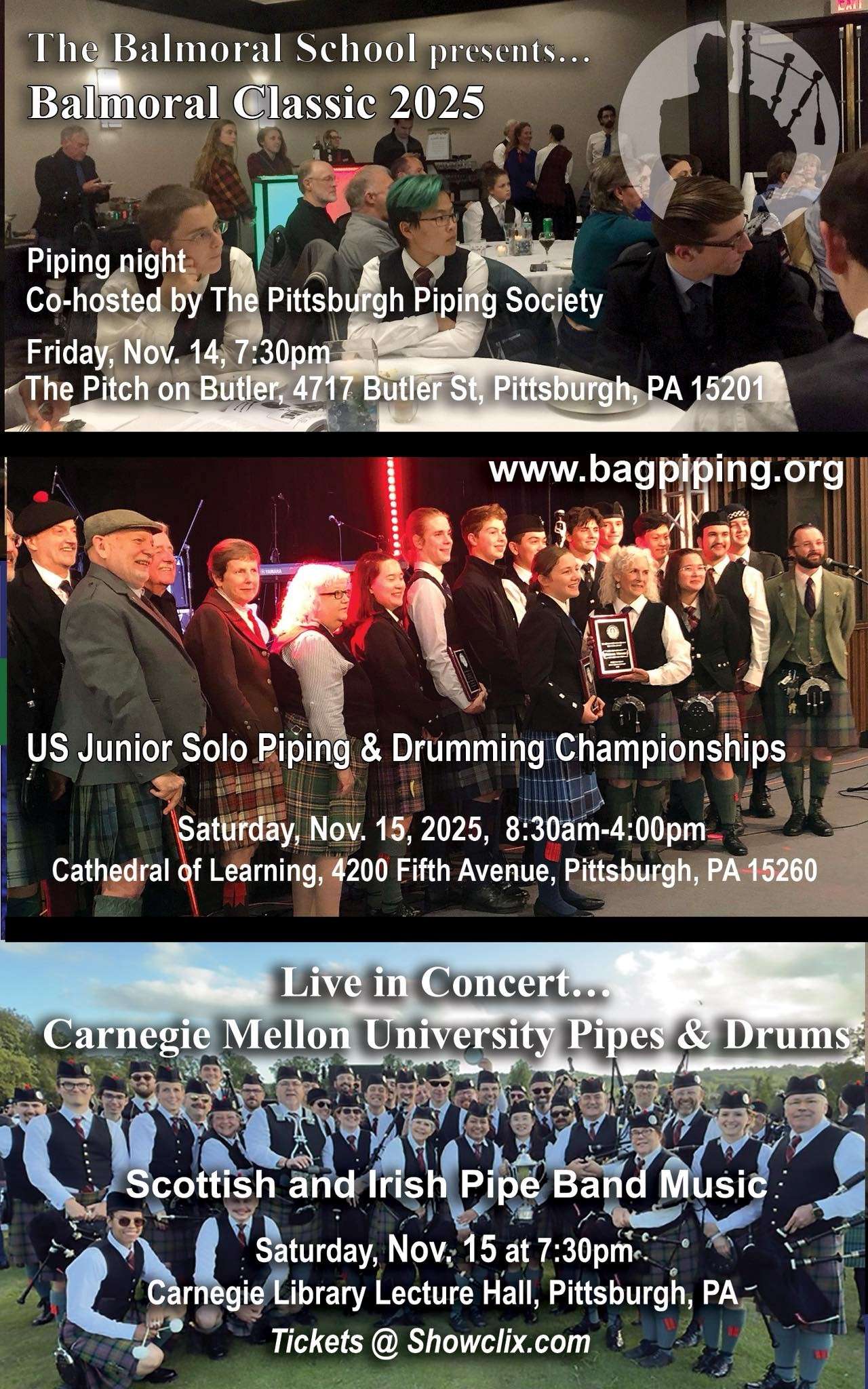
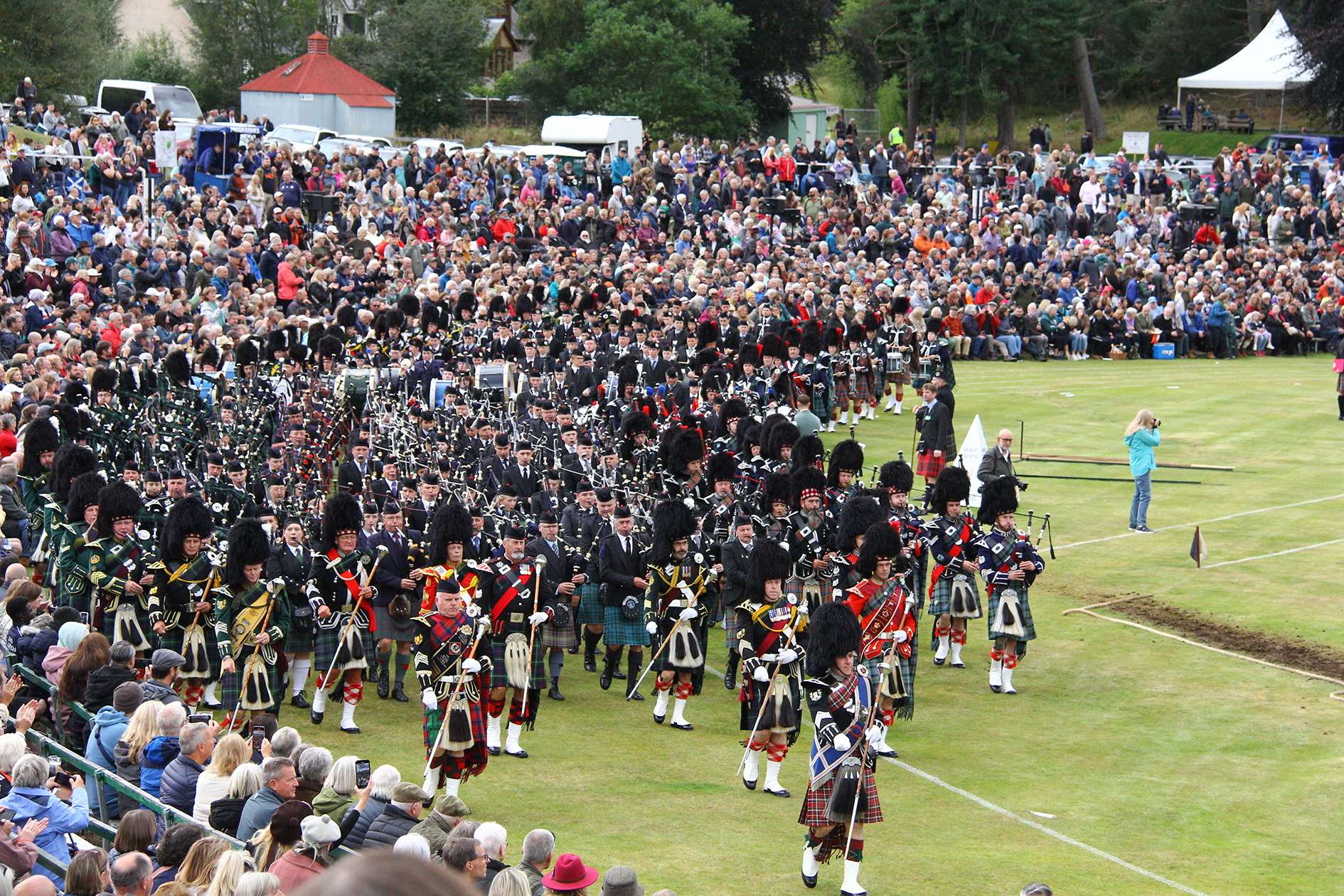
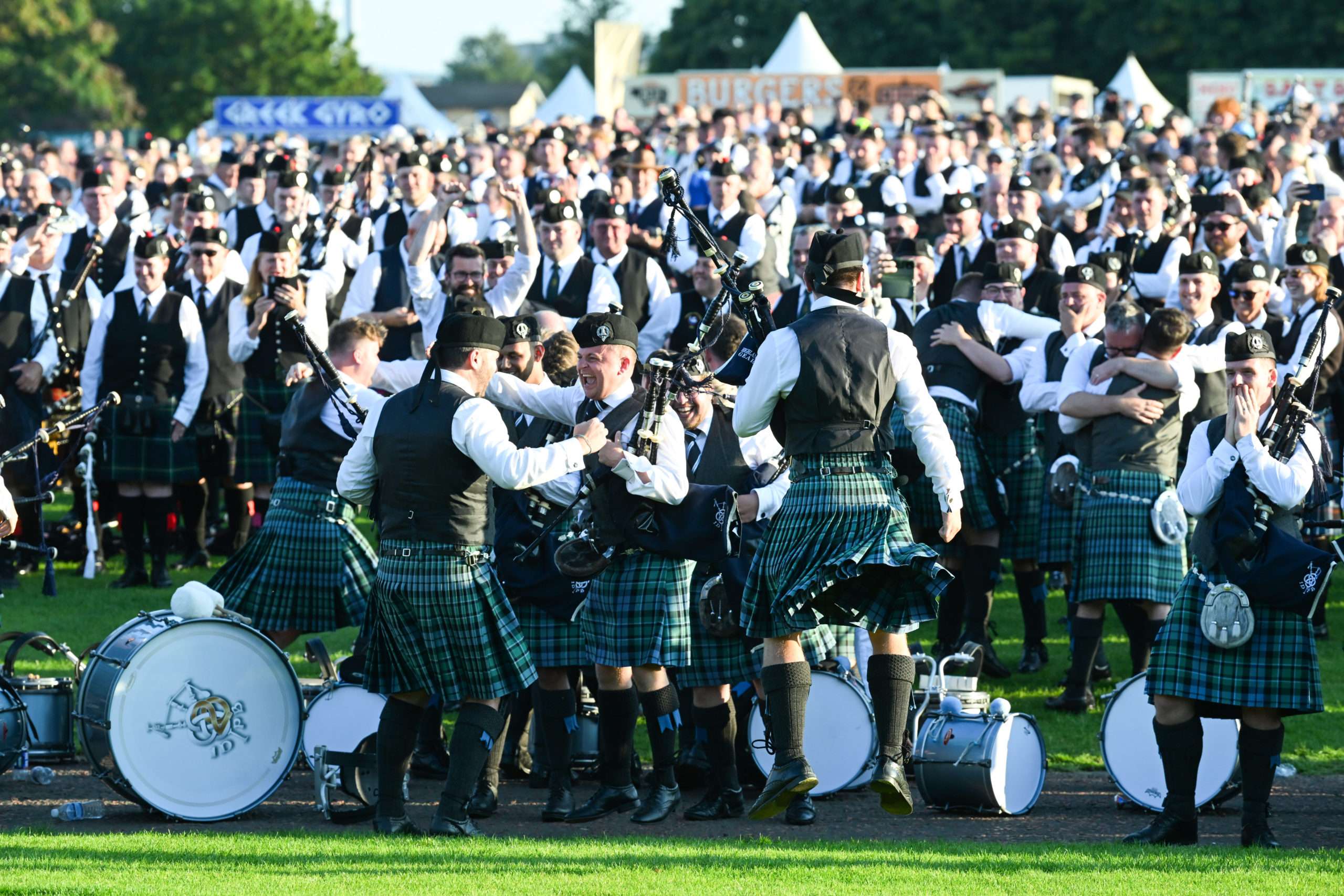
Gathering, Piping & Drumming Competition, Concert, and Workshop.
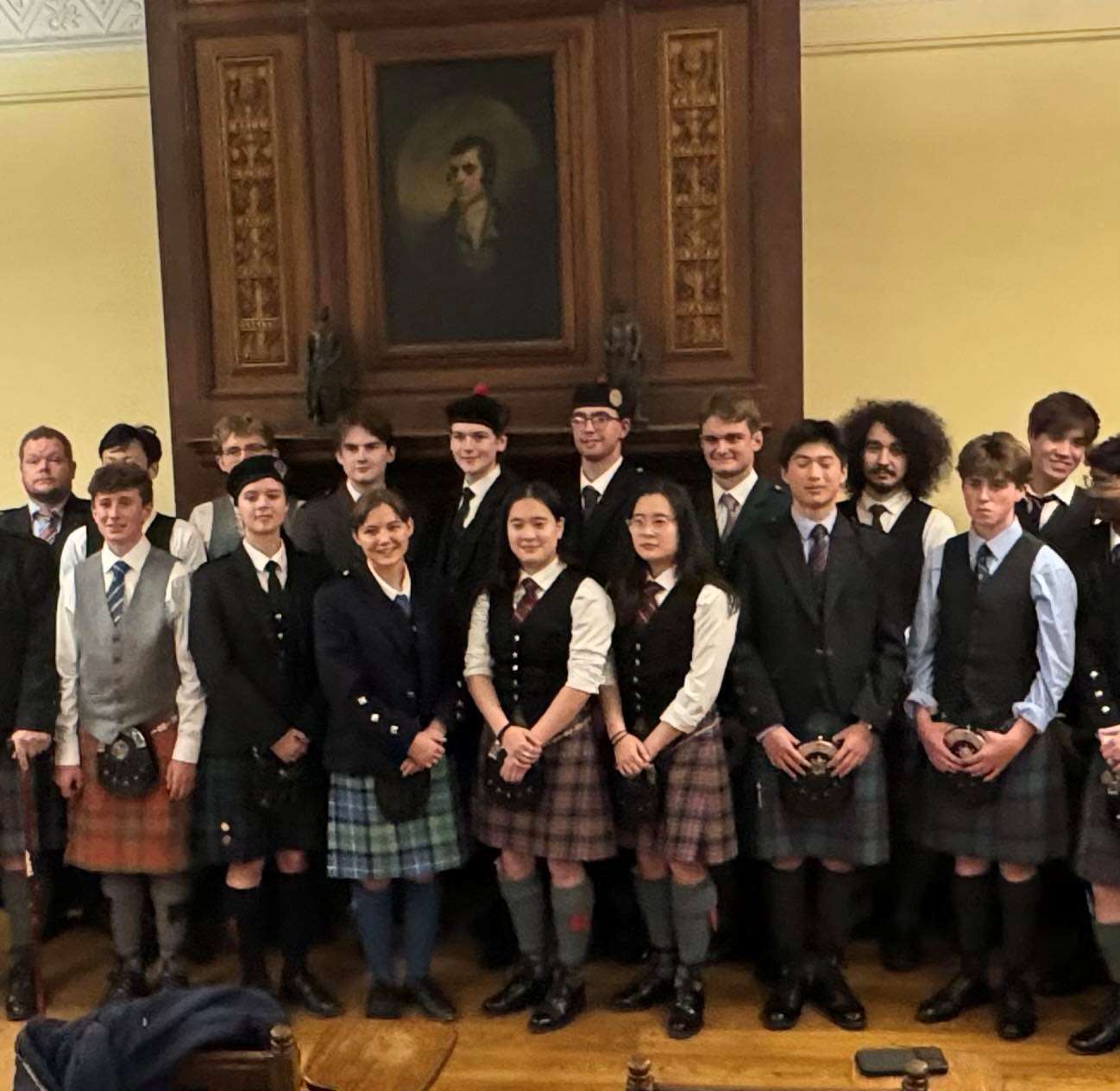
Friday, November 14, 7:30pm – Join in at the Pitch on Butler, 4717 Butler St, Pittsburgh, PA, for a celebration of piping while enjoying food and drinks. The Pittsburgh Piping Society is partnering with the Balmoral School of Piping & Drumming to host an Opening Gathering the evening before the competition. Pipers of all levels play their tunes before an enthusiastic, and supportive audience. The evening will finish with tunes and a piobaireachd from our piping judges.
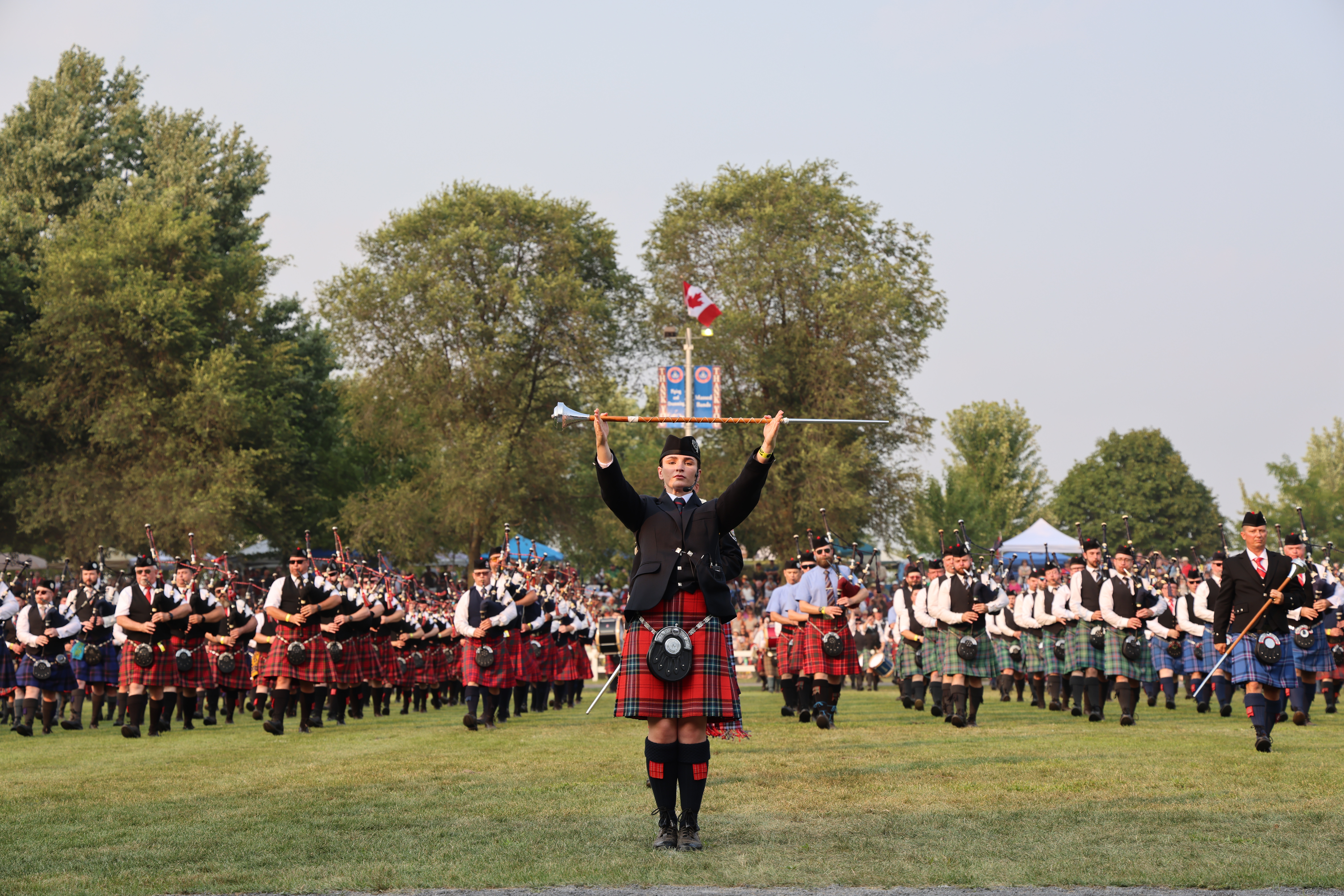
Saturday, Nov. 15, 8:30am to 4:00pm – The Balmoral Classic: US Junior Solo Bagpiping & Drumming Championships, will be held at the CRC Understory, Cathedral of Learning, 4200 Fifth Avenue, Pittsburgh, PA 15260. Pipers will compete in MSR and Pìobaireachd events, with the Overall prize decided by a combination of scores from the two competitions. The overall piping winner will receive a set of MacRae bagpipes donated by McCallum Bagpipes. Additional prizes, trophies, medals, and scholarships will go to the top five winners. Drumming trophies will be awarded for MSR, Hornpipe/Jig, and Overall winners. Prizes for the Overall Winner of the Drumming contest and all other prizes to be announced. Drumming judges, Gordon Bell and Miles Bennington, join piping judges Bruce Gandy, Lezlie Webster and Glenna Mackay-Johnstone. The awards ceremony in the Scottish Nationality Room would follow at about 5:15pm. These events are free to the public.
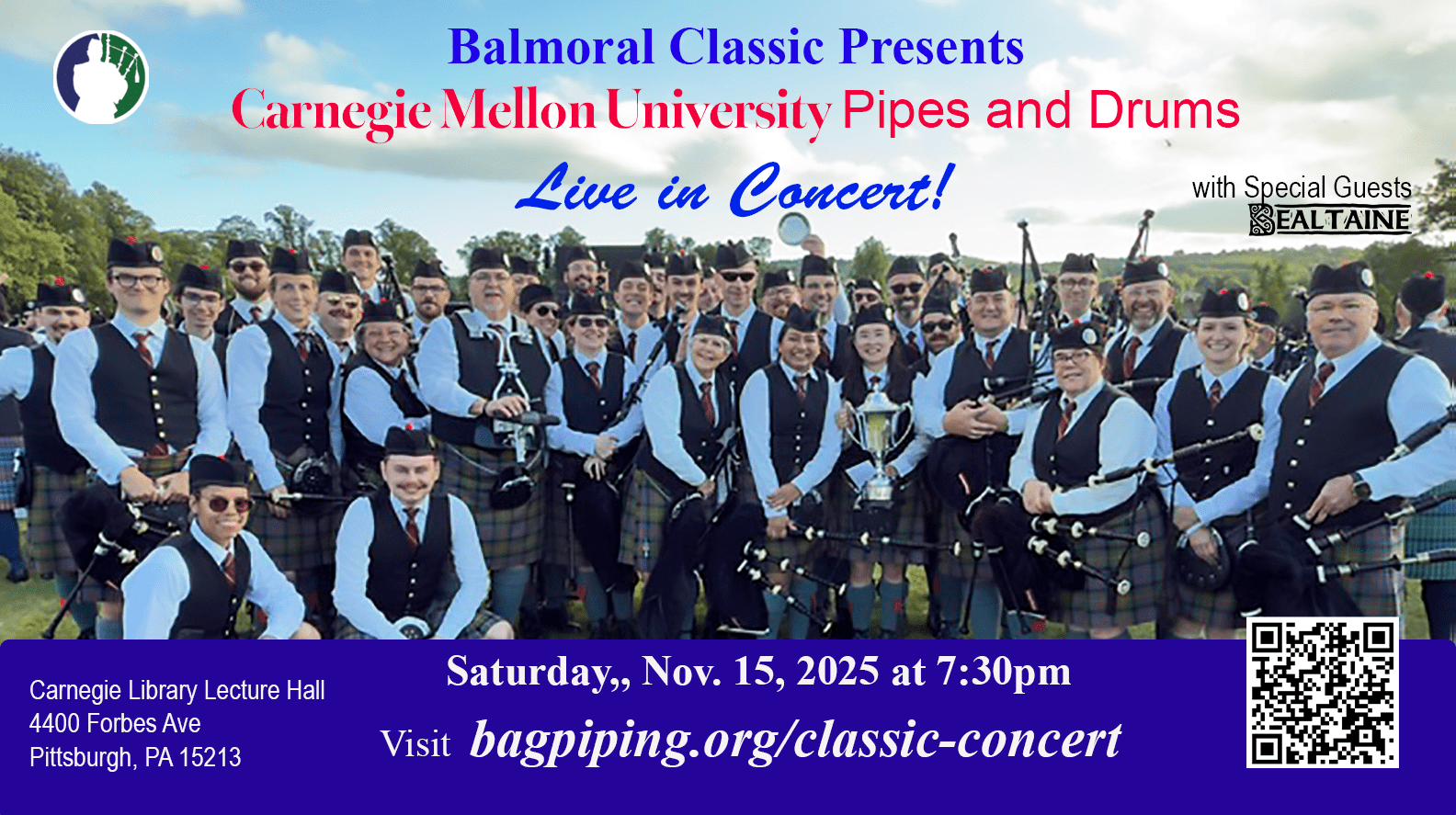
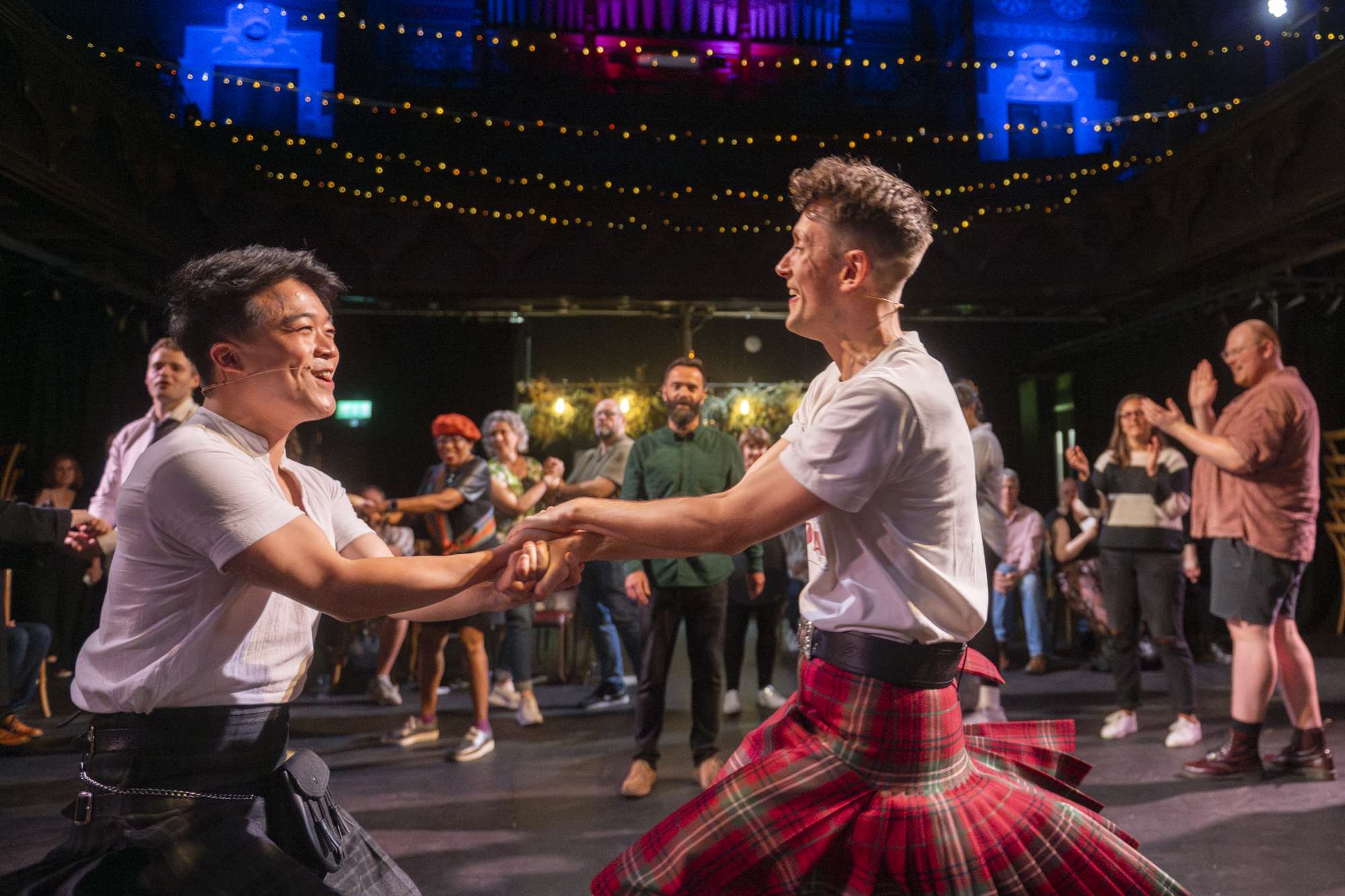
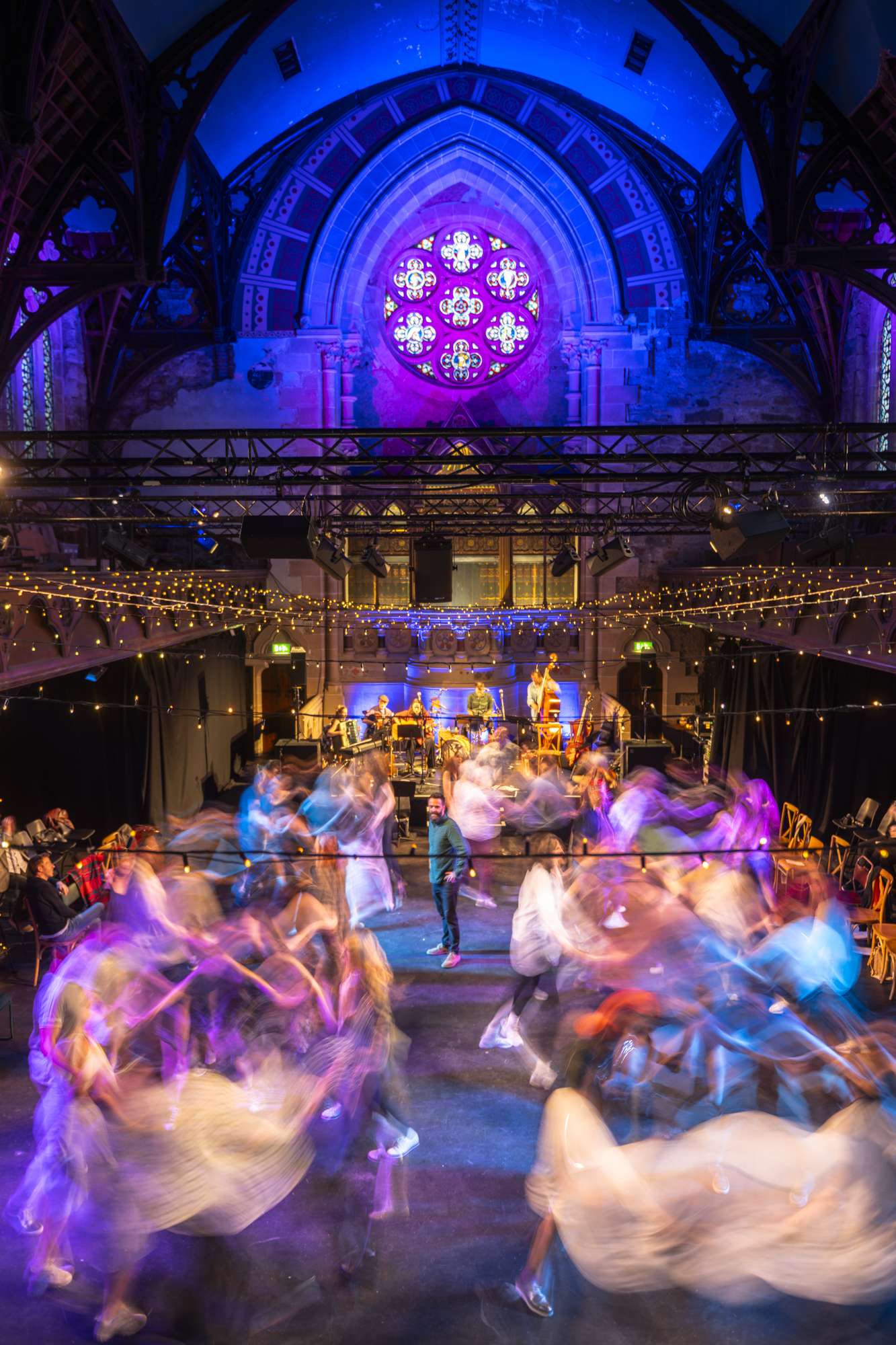
Saturday, Nov. 15, 7:30pm – On Saturday evening we are presenting Carnegie Mellon University Pipes and Drums, Live in Concert at the Carnegie Library Lecture Hall, 4400 Forbes Avenue, Pittsburgh, PA 15213. Pipe Major Andrew Carlisle and Drum Sergeant Miles Bennington will lead the band in an evening of Scottish and Irish music on bagpipes and drums joined by special guests Bealtaine, and Scottish and Irish dancers. Don’t miss this unforgettable performance! Tickets may be purchased at Showclix.com/event/cmupipes-classic-concert
Saturday, Nov. 16, 10:00am – There will be a free Piobaireachd workshop with Bruce Gandy —open to all 2025 applicants and former Classic competitors at the Courtyard by Marriott Pittsburgh University Center.
The Balmoral Classic Weekend is presented by the Balmoral School of Piping & Drumming. Established in 1979, the school celebrates and teaches traditional bagpipe music, as well as more recent compositions in the traditional style, including the competition repertoire.
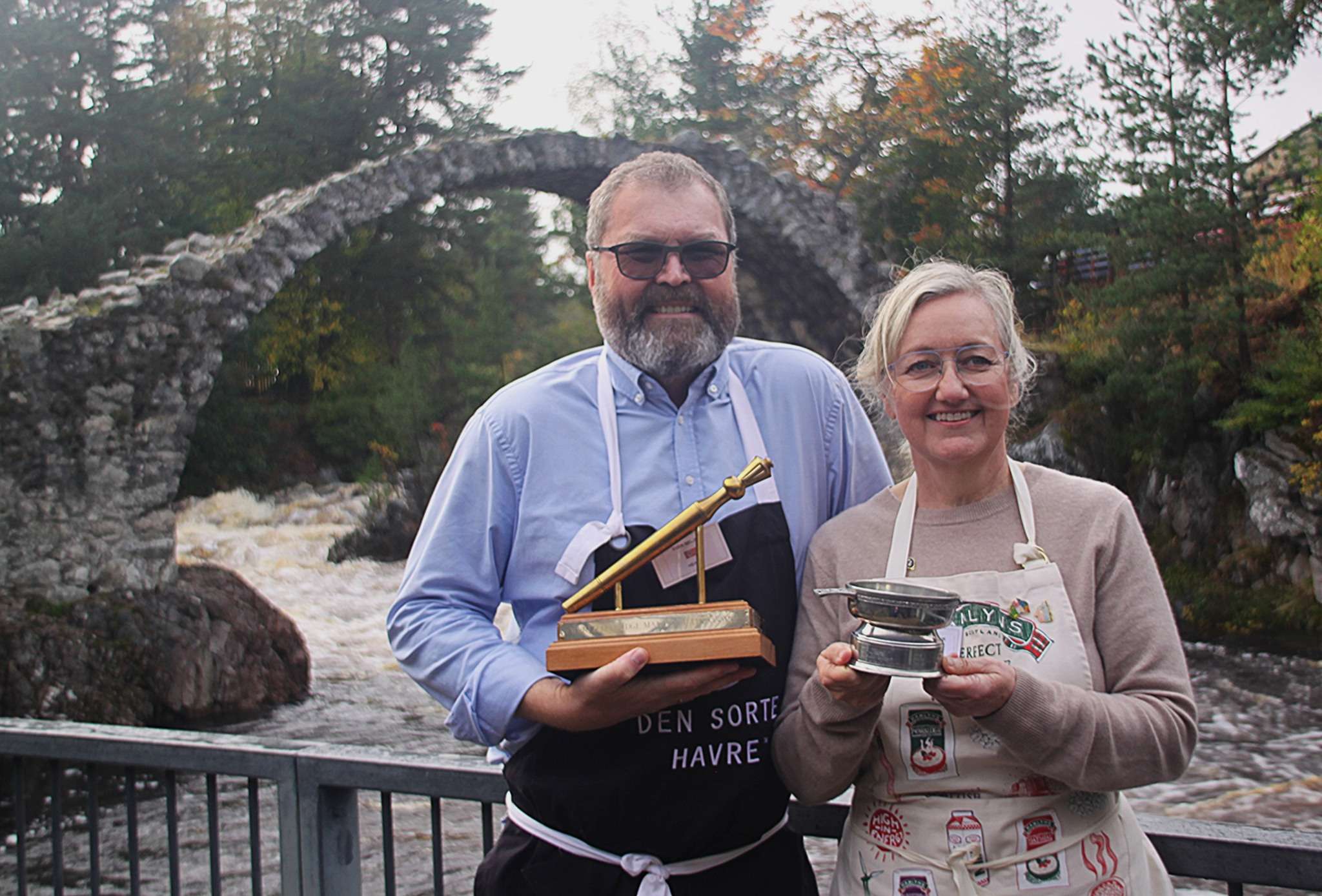
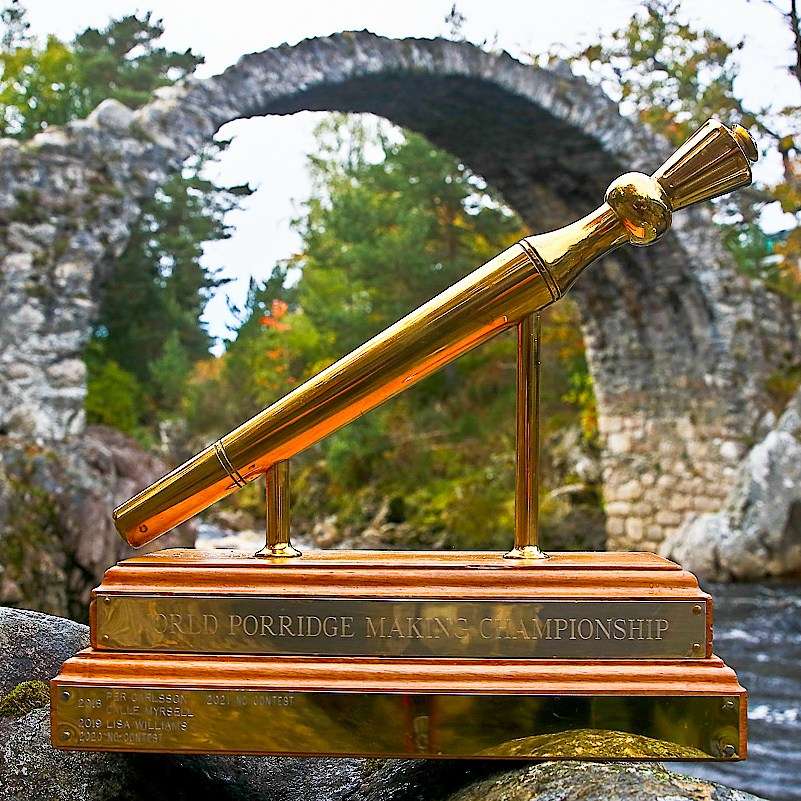
A care technology consultant from Norway has been crowned 2025 World Porridge Making Champion, following the competition held in Carrbridge in the Scottish Highlands. Sven Seljom from Mandal in Norway, made his porridge from Norwegian Black Oats, an ancient grain which used to be grown all over Europe, but disappeared in the 1800s, together with Norwegian sea salt, and water which he brought with him from home.
First time entrant, Sven, said: “It’s a great honour. I’m lost for words. It has been such great fun to be here – the welcome in the village, the hall arrangements, it’s just been tremendous. I heard about the World Porridge Making Championship many years ago on Norwegian radio and thought it sounded really different, and I’ve wanted to enter ever since. I started experimenting with different types of steel cut oats. I really love the texture. The oats I used came from an organic farm, and I soaked them for 24 hours before the competition.”
The very best in traditional porridge-making
Now in its 32nd year, the Championship celebrates the very best in traditional porridge-making, attracting contestants from around the world. Contestants prepare traditional porridge using only three ingredients – water, oatmeal and salt. This year, 30 competitors representing 14 countries including the USA, Canada, Norway, Australia, Pakistan, the Philippines and Finland took part.
Judges included Neil Mugg, former pastry chef at The Gleneagles Hotel, who now mentors the next generation of chefs at the University of the Highlands and Islands; award-winning chef, artisan baker, and author, KJ Gilmour; and Scotland’s best-selling cookery book writer, Coinneach Macleod, aka The Hebridean Baker. The judges scored each entry on taste, texture and colour.
Highly coveted title
The Championship welcomed its largest ever audience, with a packed Carrbridge Village Hall and other satellite venues around the village, and thousands more watching via livestream on Facebook and YouTube. In addition to the traditional World Porridge Making Champion title, a second award for ‘Best speciality dish’, which can include any recipe made with oatmeal, was presented to Australian food stylist, Caroline Velik. Caroline’s Porridge Jaffles, a yogurt flatbread, were filled with Caroline’s mother’s recipe for rum bananas, with Bundaberg banana toffee rum liqueur, bananas, oatmeal and waffle seeds, tossed in Davidson plum sugar.
Highlights of the day included clips from the recently released documentary film, The Golden Spurtle, guided tastings of local malt whiskies and gin and during the heats, and fun selfie photo opportunities with a giant 6-foot spurtle named Muckle Spurtle. Porridge Chieftain, Alan Rankin, said: “Congratulations to Sven on taking home the highly coveted title of World Porridge Making Champion and the Golden Spurtle trophy. The standard this year was exceptional, and it’s wonderful to see the event continuing to go from strength-to-strength. The event relies on spirited competitors, our sponsors and the legion of local residents who volunteer their time each year.
Support the Scottish Banner! To donate to assist with production of our publication and website visit: The Scottish Banner
Stirling Castle has all sorts of ghost stories to tell. Laurie Risk began working for Historic Environment Scotland (HES) as an Admissions Assistant at Stirling Castle and shares some of the castle’s spooky tales in the lead up to Halloween. As an evidence-based organisation HES cannot say if these tales are true, but if you like a good story this is the article is for you!
Nothing beats a ghost story from Stirling Castle, which is notorious for the tales of who – or what – haunts its walls! Castles are rich with the weight of history. After all they’ve witnessed warfare, murder, births and deaths. It’s no surprise these events should pass into the frightening folklore of our favourite places. I’m a bit of a sceptic when it comes to ghosts, but there is a type of phantom that fascinates me – the female ghost.
The figure of the female ghost has cropped up at historic sites across the world for centuries. Nearly every culture has its own legend of this irresistible maiden. She even comes in a handy array of colours to help us identify her! For instance, there is a ghost known as ‘The White Lady’. Typically, a destitute figure dressed in a flowing white gown, her afterlife activities have been reported all over the world.
In Medieval England she was seen as an omen of death. One of the most famous examples is Henry VIII’s wife Anne Boleyn, said to haunt the Tower of London. In Scotland, she has been seen as the desperate soul of a girl who threw herself from a tower. She’s even been spotted in Malta, where she is said to have thrown herself to her death to escape an unwanted marriage.
A ghost of many colours
Photo: Rob McDougall.
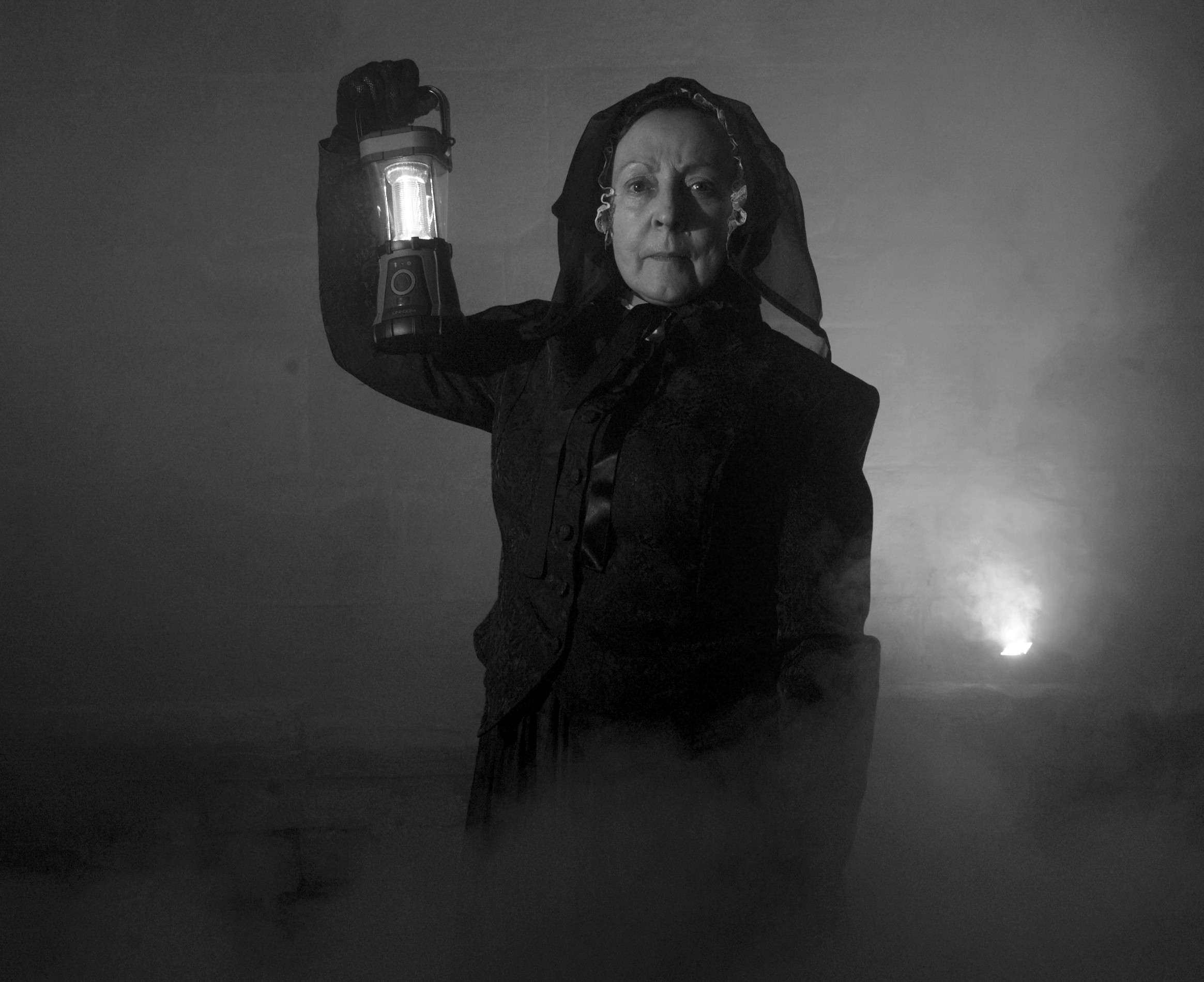
We don’t have any White Lady ghost stories at Stirling, but other phantoms are available. There is said to be a ‘Black Lady’ who haunts the back walk. We don’t know much about her, or why she lingers in this spot. However, it is said she creates a foreboding atmosphere for anyone wandering the path at night… We’ve also had reports of a ‘Pink Lady’ – or rather a ‘pink aura’ permeating the Kirkyards around the castle.
This lady manifests as a sense of longing or unrequited love felt by people walking there. Some think she was a woman whose sweetheart died prematurely in battle. The poor soul is now doomed to roam the earth full of all the passion unfulfilled in life. Our most notorious shade of female ghost though, is the infamous ‘Green Lady’.
Stirling’s Green Lady
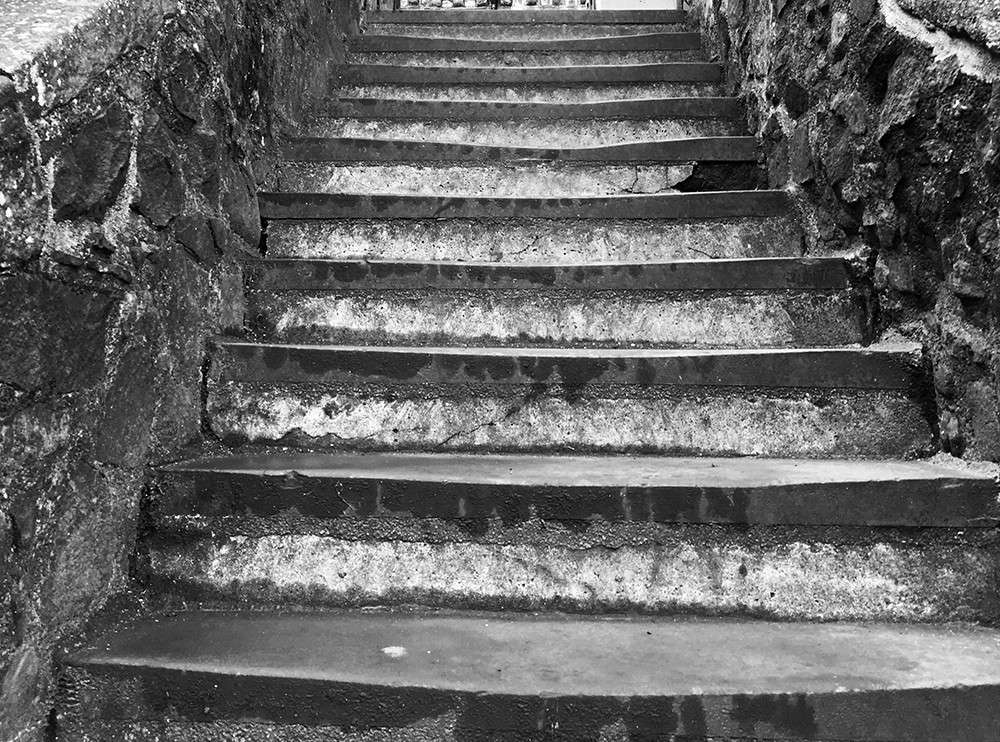
Stairs leading to the Princes Tower.
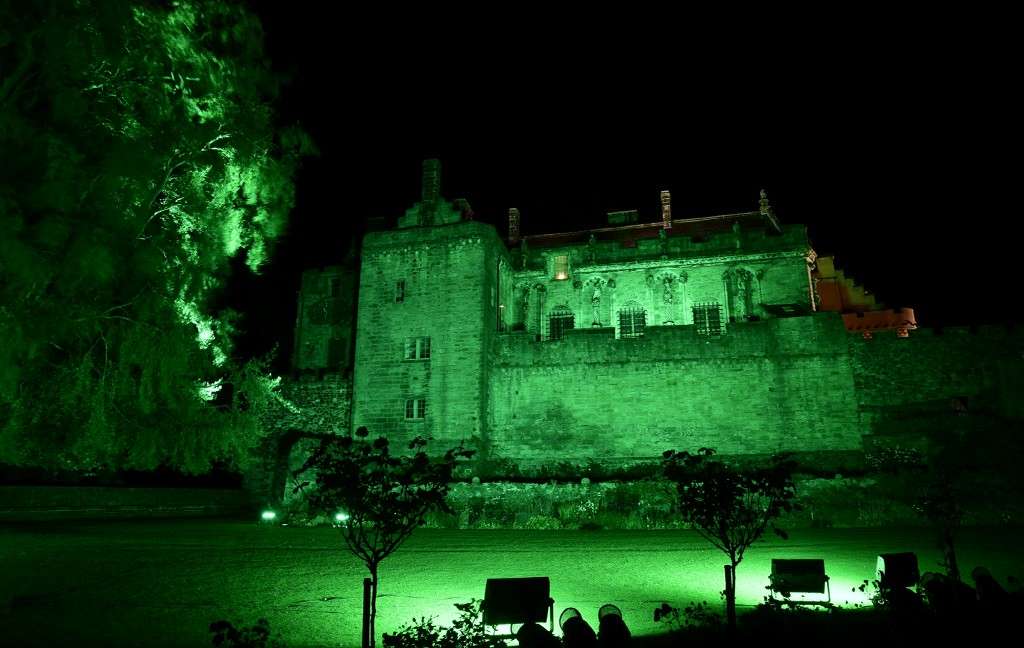
We’ve heard several versions of the ‘Green Lady’ ghost story at Stirling Castle. In one tale she appears at the top of the steps to what used to be the military base of the Argyll and Sutherland Highlanders. She was seen gliding down the steps in flowing green finery, devastatingly beautiful. Luckily she seems to have been in a benevolent mood that day, and simply passed through the young soldier who spotted her!
There are different tales of her origin, but the one that stems from some historical evidence is that she was a young Highland girl who attended the castle as a servant of Mary, Queen of Scots. She was said to be highly superstitious, and convinced that a terrible fate would befall Mary on the night of 13 September 1561.
The story goes that the girl was sure a terrible fire would break out in Mary’s room at the castle. She vowed to remain awake all night to guard the queen, but couldn’t quite manage it. In her drowsiness, she accidentally set fire to the queen’s bed-curtains with a candle. The queen survived, but the poor girl fell victim to her own vision and died that night in the fire.
We have records to show that this fire took place. But there is no written evidence of the existence of the girl, or her foretelling of her own terrible death. Still, her story has become legendary. Her tragic ghost is said to haunt the castle, a bitter spirit who brings misery and doom to those unlucky enough to find themselves in her company…
Dark and grisly past
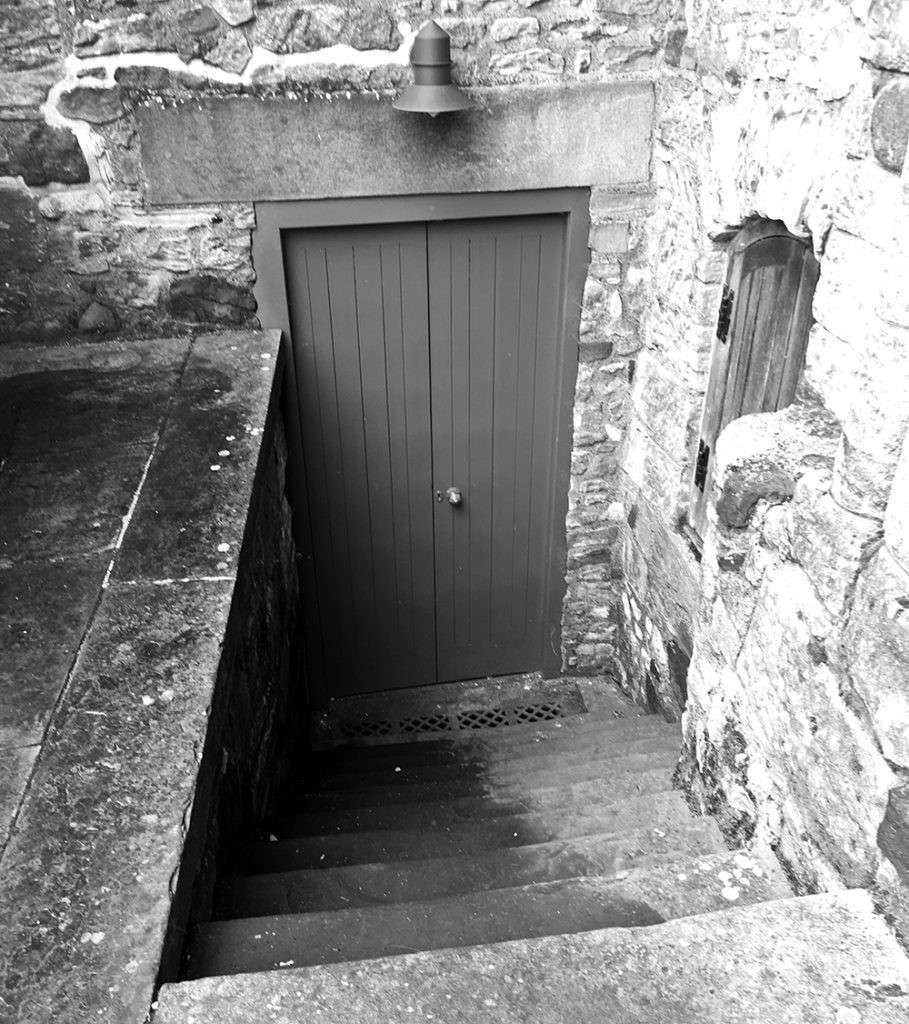
The door to the uniform room looks unassuming…
When I heard this tale from a colleague, I didn’t think I’d ever run into her. But one day I descended the stone steps towards the room at the base of the Prince’s Tower where he said she resides, and the door handle mysteriously turned by itself. A few months later, I returned to find some of our uniform rails had tipped over. When I went to investigate the windows began to rattle, which did make me wonder – albeit briefly – if I had overstayed my welcome in the Green Lady’s domain!
I suspect these female phantoms are simply the result of the dark and ghostly perceptions we all hold about castles. If a place has a dark and grisly past, our imaginations are bound to run wild. Who doesn’t love a romantic tale of the tormented figures who once stood between these ancient walls? For me, there is something irresistible about phantoms who don’t conform to our standard conventions of femininity by meekly going off to eternal rest. Perhaps they represent women who have been oppressed throughout history, only now able to express their rage of life’s restrictions? Perhaps death is their chance to finally make their stories heard.
In any case, the legend of the Green Lady and her colourful counterparts will continue to terrify and enthral us in castles, palaces and other historic nooks and crannies all over the world for years to come.
Do you have any favourite ghost stories, from Stirling or farther afield? Share your story with us!
Historic Environment Scotland is the lead public body established to investigate, care for and promote Scotland’s historic environment. For more details see: www.historicenvironment.scot
Text and images courtesy of Historic Environment Scotland.
Support the Scottish Banner! To donate to assist with production of our publication and website visit: The Scottish Banner
A former carer from Motherwell who once lived in his car with his dog is now body slamming his way to stardom in the United States. In a few short years Luke Scouler, better known to fans as Crixus, has gone from sleeping in a gym car park to cage fights and casket matches in the same wrestling promotion that launched the careers of John Cena and Batista.
The “Scottish War Machine” is now one of the breakout stars at Ohio Valley Wrestling (OVW), the cult American brand featured in the hit Netflix documentary Wrestlers. Luke was the first ever Scottish OVW champion.
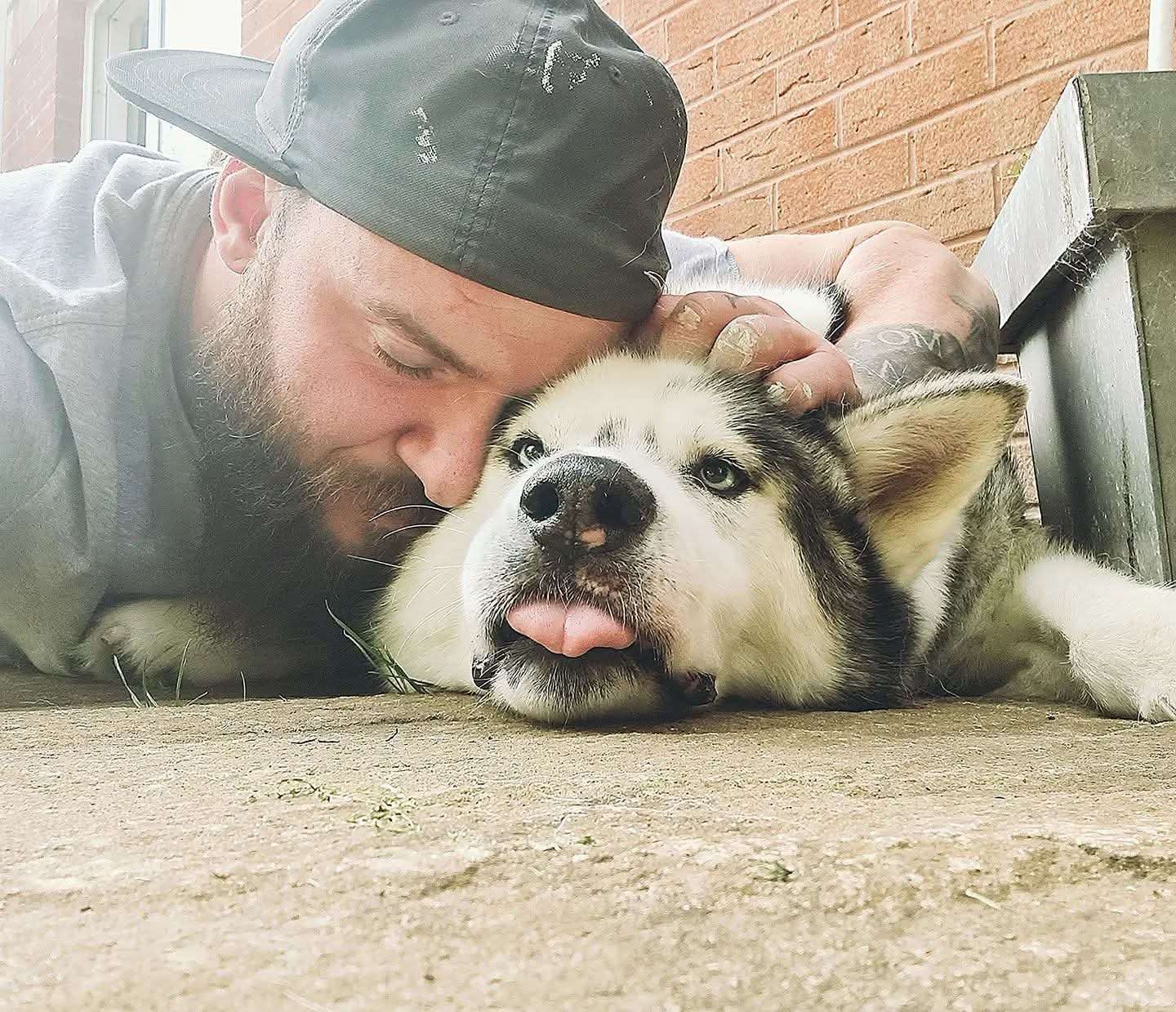
Luke and Odin.
Luke had previously been a fitness instructor before working in residential care with young people at Inspire Scotland, a social care organisation that supports children and young people. The 33-year-old said: “I really loved that job. But it was tough emotionally. I’ve always had a bit of a Batman complex – I thought I was going to save everybody. I was in a bad place with it. I knew it wasn’t for me and I was burned out. I was in a bad place and I remember sitting in my house in Newmains watching TV with my dog, Odin, when wrestling came on and I just thought: ‘Screw it. Let’s go. Scots have made it big in this business – why couldn’t I?”
That night, he jumped in his car to enroll in a wrestling academy in London run by former WWE star and current OVW head trainer Al Snow. The ‘Scottish War Machine’ continued: “I drove through the night with no plan and no place to stay. Me and the dog slept in the car for a bit. Eventually the guy who ran it asked if I was serious. I told him I’d already quit my job and left my house. That was it. We moved into the gym and didn’t go back.”
Battle-ready
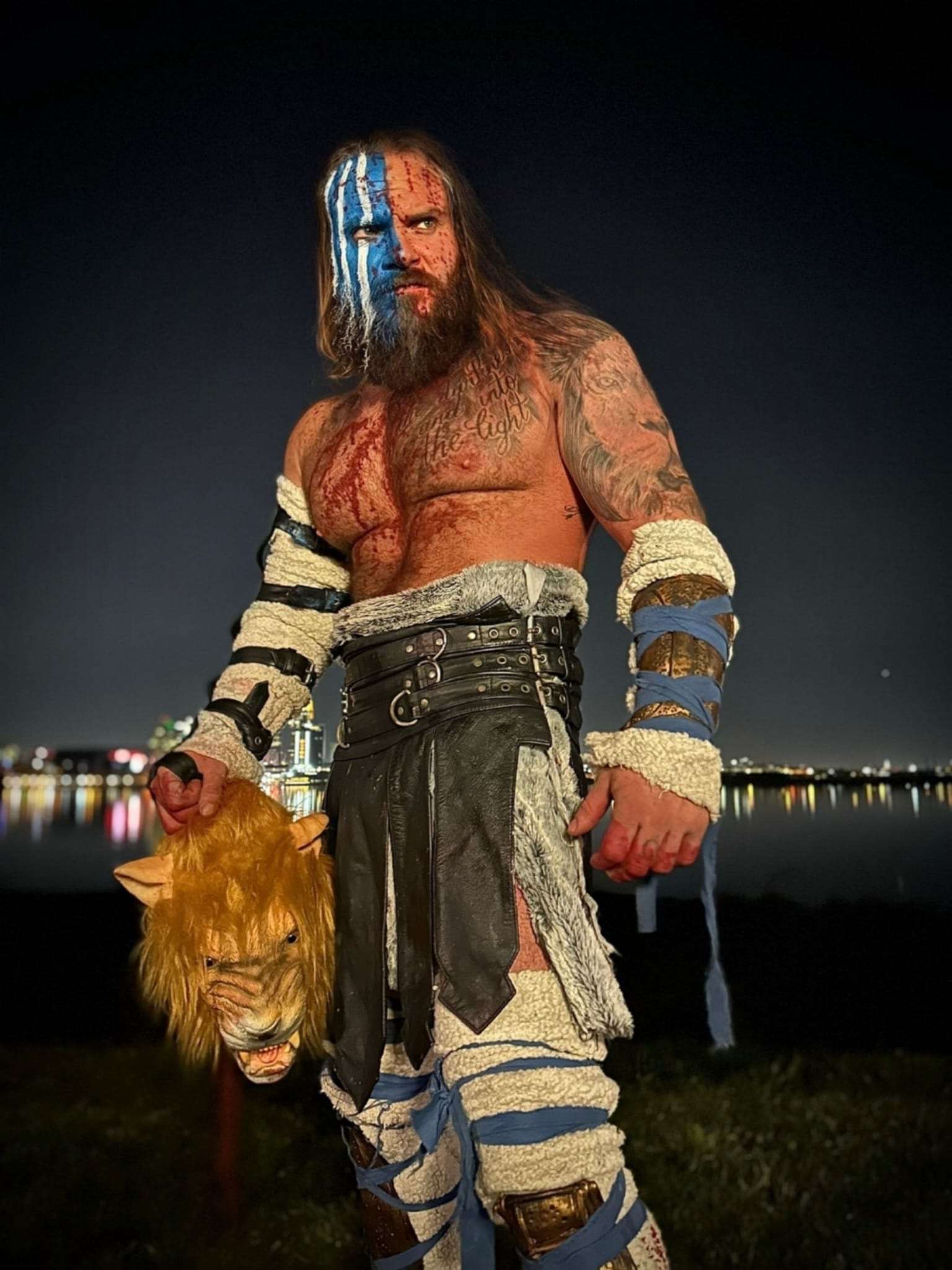
Crixus.
He first landed a place at OVW in 2019, after placing first at a 300-person wrestling combine. But just as things were taking off, COVID hit and he was stuck in the UK for two years. Now based in Kentucky full-time, he’s one of the promotion’s biggest stars – something which he thinks his upbringing prepared him well for. Luke commented “We’ve got thicker skin, especially in Glasgow. You’re battle-ready by the time you leave primary school, so wrestling comes naturally to us. I’m cheeky, and the accent helps too. Over here in the States, people already think we’re mental which helps. I just turned my personality up to 11. I wasn’t pretending to be someone else- just the version of me you probably wouldn’t want to sit next to in a pub. I get to act up and they still love me. They boo you, but they’re cheering underneath.”
His rise comes as Scots are “having a moment” in the world of wrestling according to Al Snow, who has shared a ring with the Rock and Stone Cold Steve Austin. Edinburgh’s Joe Hendry made his WrestleMania debut this year while Ayrshire’s Drew McIntyre – an OVW alumnus – became Scotland’s first WWE Champion in 2020.
Former WWE Hardcore and European champion Al Snow, who made his wrestling debut in 1982 against Kerry Von Erich, the wrestler portrayed by Zac Efron in the Hollywood movie The Iron Claw, commented: “With the success of Joe Hendry and Drew McIntyre, Scotland is increasingly a potential source of talent. ICW did amazing things. I know Grado – though don’t tell him I said this – but he’s incredibly charismatic and doing so well across TV, radio and stage. With Crixus, we may have another superstar on our hands. His dedication has been incredible. To make it in this business, you have to sacrifice and do things out of the ordinary. And that’s why I think he’s got what it takes.”
Crixus appears weekly on OVW TV. You can follow him at @war.crixus.
Support the Scottish Banner! To donate to assist with production of our publication and website visit: The Scottish Banner
As thoughts turn to Hallowe’en and all things spooky and supernatural, what could be more sinister than that horror movie favourite location – a graveyard? But while many of Scotland’s cemeteries and churchyards teem with ghosts and grisly tales, many are also places of beauty and tranquillity, reflecting the changing times of the country’s history in their tombs, carvings and mausoleums.
There’s no doubt though that some of the most chilling features of Scotland’s cemeteries, particularly those around Edinburgh, date from a dark period in its history. The body snatchers who dug up freshly deceased cadavers to sell to medical schools for anatomical study in the 18th and 19th centuries have left a physical mark on the cemeteries they tried to plunder.
Watch over the graves
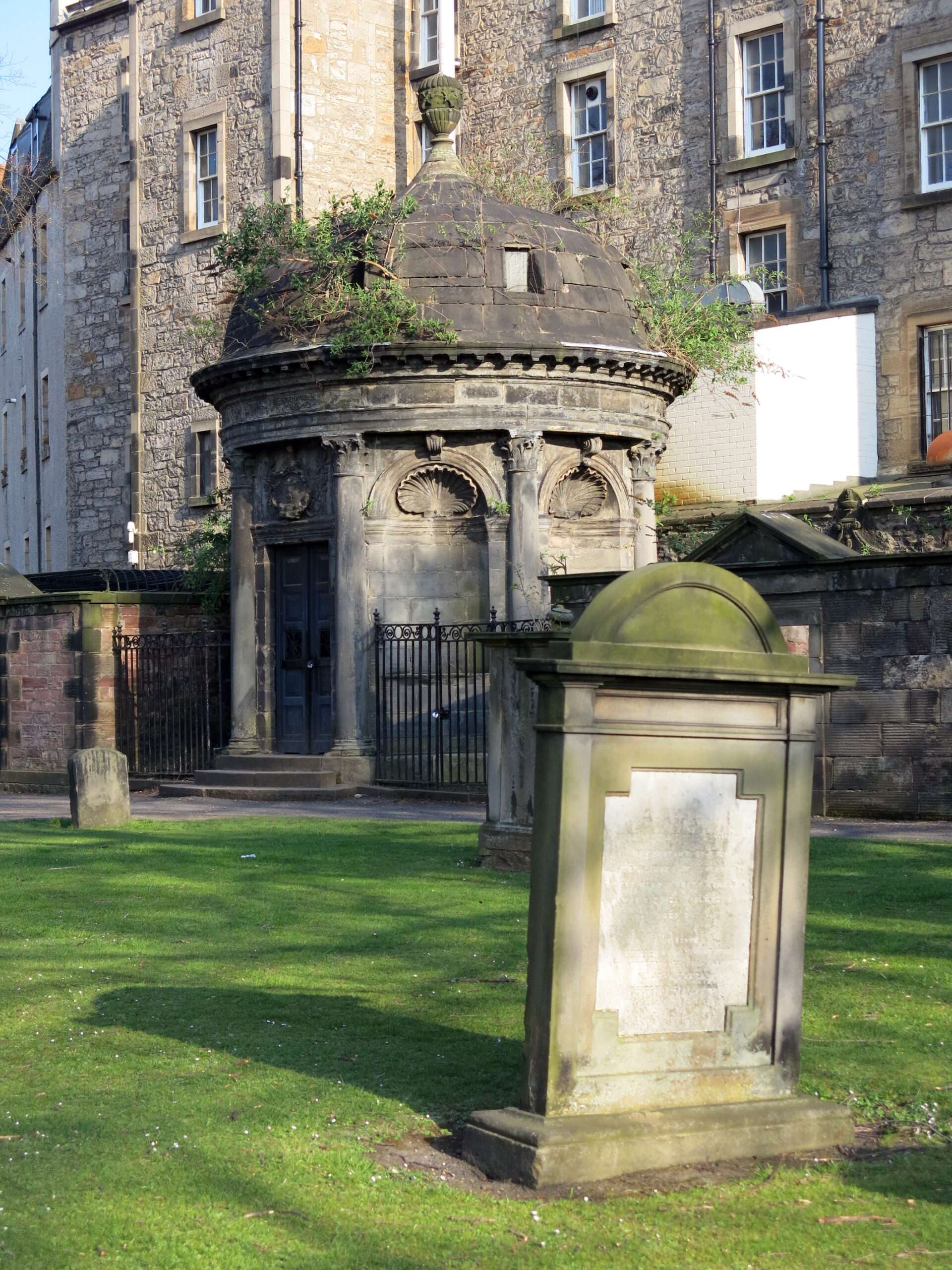
Black Mausoleum, Greyfriars Kirkyard. Photo: Enric, CC BY-SA 4.0, via Wikimedia Commons.
Watch houses were often erected either at the entrance or within the kirkyard, built for the family or the community to literally keep a watch over the graves at night when the graverobbers would be most likely to commit their illegal acts. Unsurprisingly Edinburgh, with its famous medical school, has several examples including the magnificent three-storey circular watch tower at New Calton Burial Ground in the city’s centre. Most watch houses are circular or square but there is a quirkier example at St Kessogs graveyard in Callander on the banks of the River Teith. The old medieval church that was the kirk for this kirkyard is long since gone but the picturesque cemetery – which has been restored over the summer by the community – has a small 19th century octagonal watch house.
Mort safes were another method of trying to thwart the body snatchers – metal cages put over the graves to stop them being dug up. As they were re-used once bodies were no longer fresh and therefore no use to the medics, or melted down for the metal at later dates, they are quite rare. Logierait Churchyard in Perthshire has three, two adult and one child, but the most famous are two in what is probably also Scotland’s most famous kirkyard, Greyfriars in Edinburgh. Located in the heart of the capital city’s Old Town, just yards from the National Museum, the churchyard is a favourite with tourists, mostly due to the grave of Greyfriars Bobby, the faithful dog who kept watch over his master’s grave for 14 years, and the tombstone of Thomas Riddell, supposedly the inspiration for the Harry Potter villain.
But deeper into the kirkyard is the site of the Covenantors Prison, a gated area, now lined with 18th century tombs, where hundreds of Covenantors – religious rebels – were kept prisoner after being defeated by the king’s forces in battle. For four months they were held without shelter and only a meagre ration of bread. Many died. The ghost of Lord Advocate George Mackenzie, the man responsible for the king’s policy of persecuting the Covenantors, is said to haunt the place, his poltergeist biting and scratching visitors – his grave, known as the Black Mausoleum, is one of the more ornate out of the 700 graves dating as far back as the 16th century.
Final resting place
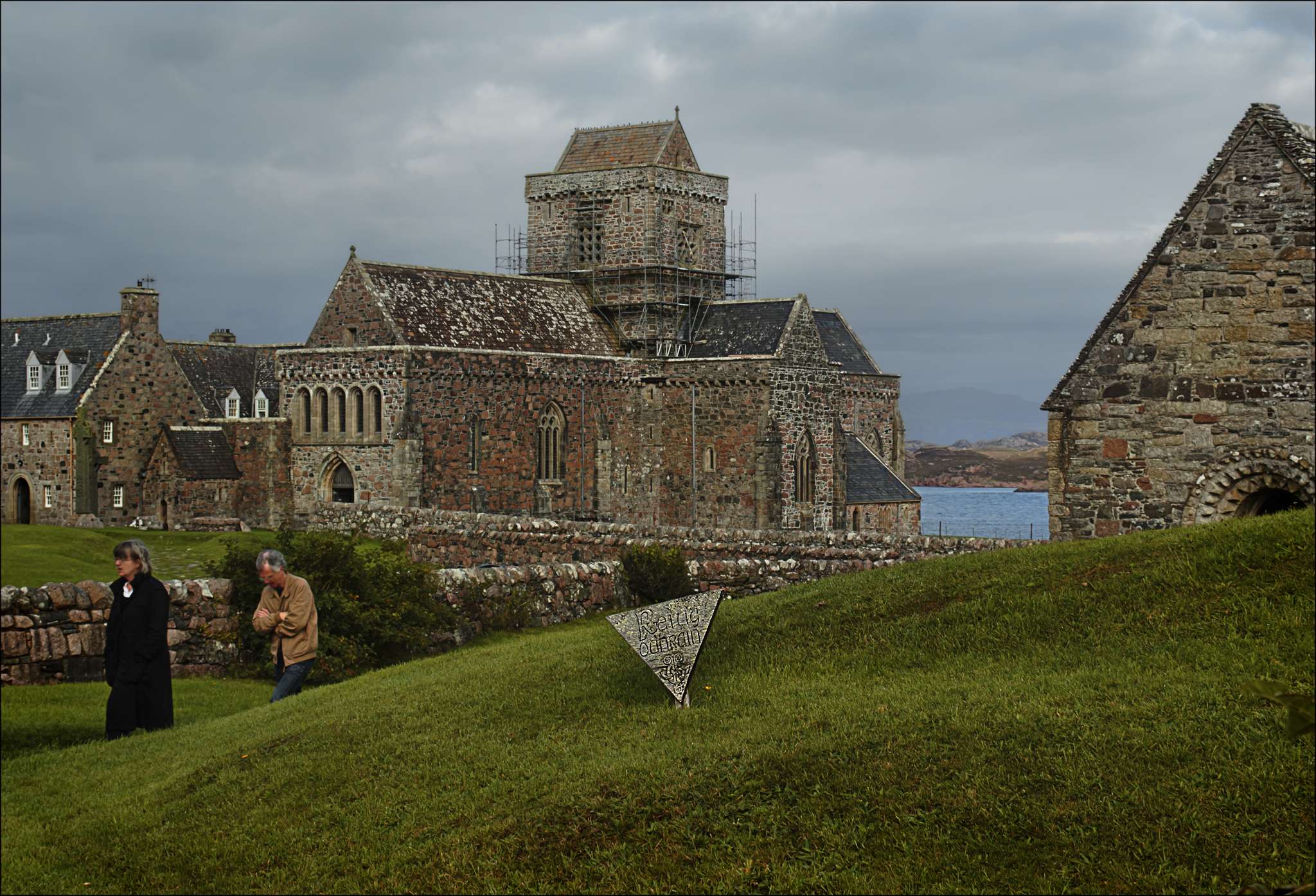
The Reilig Odhrain at Iona Abbey. Photo: dun_deagh, CC BY-SA 2.0, via Wikimedia Commons.
The most famous names associated with Scotland’s resurrectionists are William Burke and William Hare, although the pair bypassed the business of waiting for someone to die and digging them up by murdering their victims and selling their bodies to Edinburgh surgeon Dr Knox. When they were caught in 1828, Hare turned King’s evidence against his former partner – Burke was hanged while Hare went free, whisked out of the city by mail coach to Dumfries. There he was recognised – pamphlets with gory details of the case and sketches of the villains were best-sellers – and set on by a mob. He was extricated by the authorities but there the trail goes cold.
The most popular legend is that he ended up in London, was recognised again and quicklime thrown in his face, ending his days as a blind beggar. There are also stories that he sailed for Canada or Australia but one story has him living in the remote Applecross peninsula under the name William Maxwell. He is said to have appeared there in 1840 and lived in the hamlet of Camusteel, working as a weaver. His house became the local “ceilidh house” and he became known as breabadair teine or the fiery or fire weaver – perhaps because he was said to have burns from a work accident. He married a local woman and was said to be an upstanding member of the community. And when he died in 1864 he was buried in Clachan cemetery, next to a drowned tramp called Clochan. It would be fitting if was Hare who found refuge in Applecross as the church and graveyard are said to be on the site where Irish saint Maelrubha established a monastery in 673 AD and the six-mile area around the church became a holy sanctuary, safe for anyone fleeing from pursuit.
More noble notable figures have found their final resting place at Reilig Odhráin (St Oran’s Graveyard), the cemetery next to Iona Abbey on the sacred island off Mull. It is reputed to hold the bones of 60 kings, including the real MacBeth, and was a royal burial ground between the 9th and 11th centuries. While there are no markers for the kings’ graves, visitors can still walk along Sràid nam Marbh – the Street of the Dead – where the pallbearers would have processed with their royal burdens. Another sacred island is Eilean Munde in Loch Leven, where several Highland clans – Camerons of Callart, MacDonalds of Glencoe and Stewarts of Ballachulish and Ardsheal – buried their dead.
The island is uninhabited by the living; among its 300 or so deceased residents are Alastair MacIain, 12th Chief of Glencoe, who was killed during the massacre of 1692, and Big Duncan MacKenzie, a Jacobite fighter from Ballachulish. Each clan had its own “port of the dead” when they arrived with a body and legend has it that the island is guarded by the spirit of the last person buried there.
Symbols of eternal life
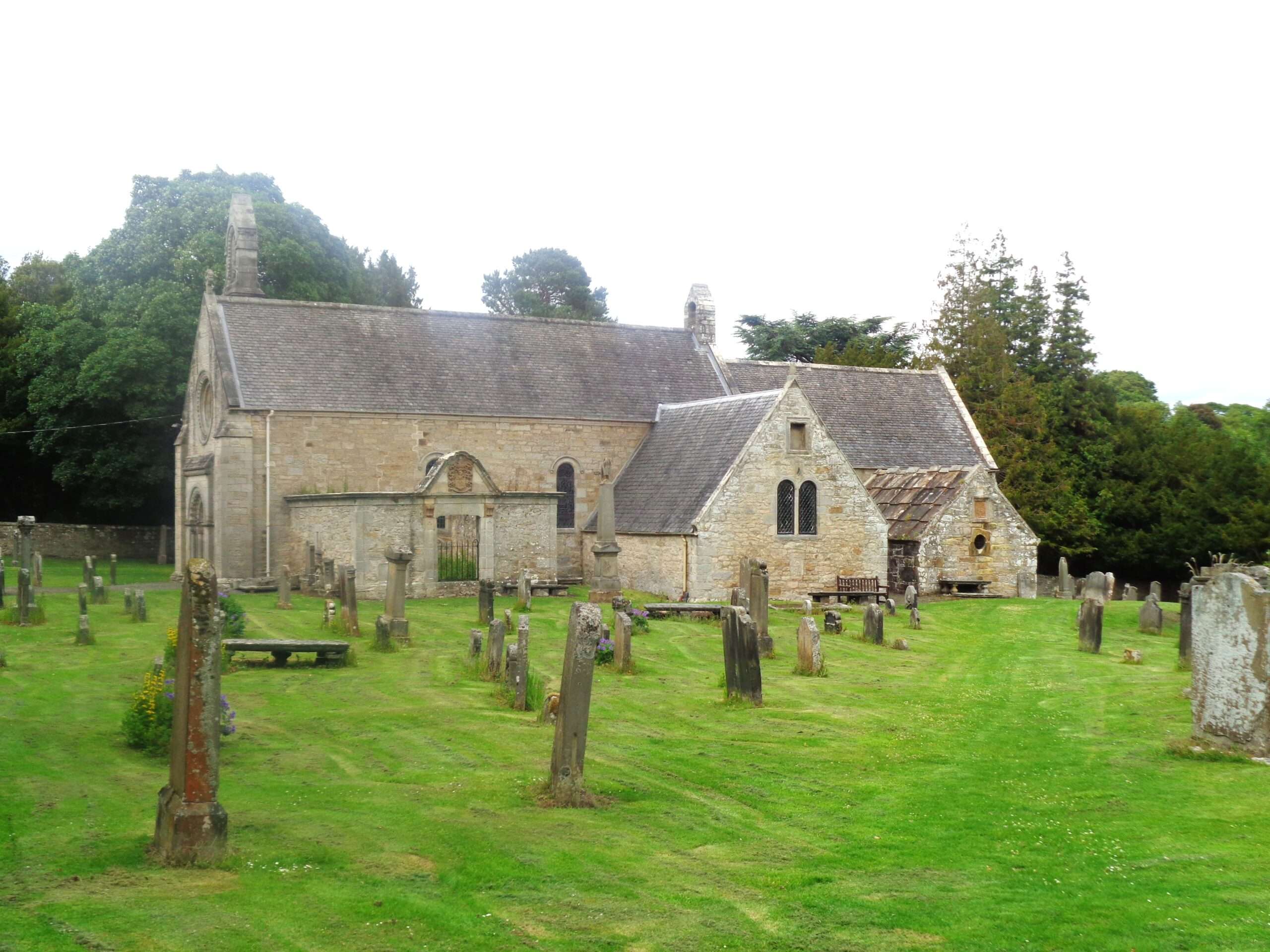
Abercorn Church Graveyard. Photo: Wilmm, CC BY-SA 4.0, via Wikimedia Commons.
And not all famous connections are real. Abercorn graveyard, near South Queensferry and just a mile from Midhope Castle which stood in for Lallybroch, featured in Outlander as the site of Frank Randall’s grave in season 4 of the hit show. You have to time travel a fair way further back to the origins of this beautiful spot – St Ninian is said to have visited in the 400s and a church was established on the spot sometimes afterwards.
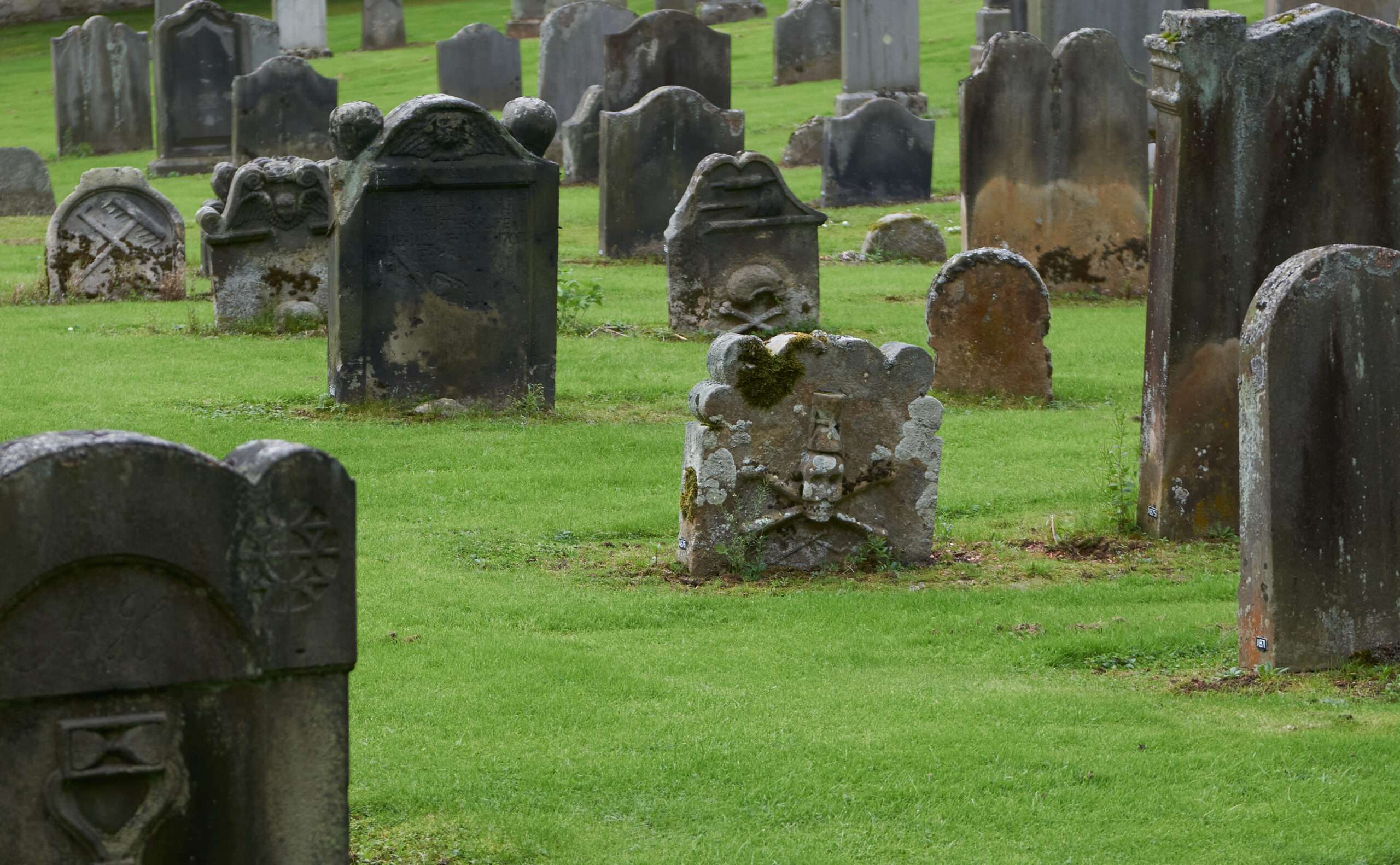
The gravestones date back to the 1600s and have some great examples of carvings, such as skull and crossbones, and hourglasses, reminding us that life is fleeting and death comes to us all. There are also yew trees in grounds, trees that, because of their longevity, became symbols of eternal life. They’re often found in graveyards, with the most famous in one of Scotland’s most beautiful churchyards at Fortingall in Perthshire. The yew tree there is believed to be between 3,000 and 8,000 years old and is one of the oldest living things in Europe.
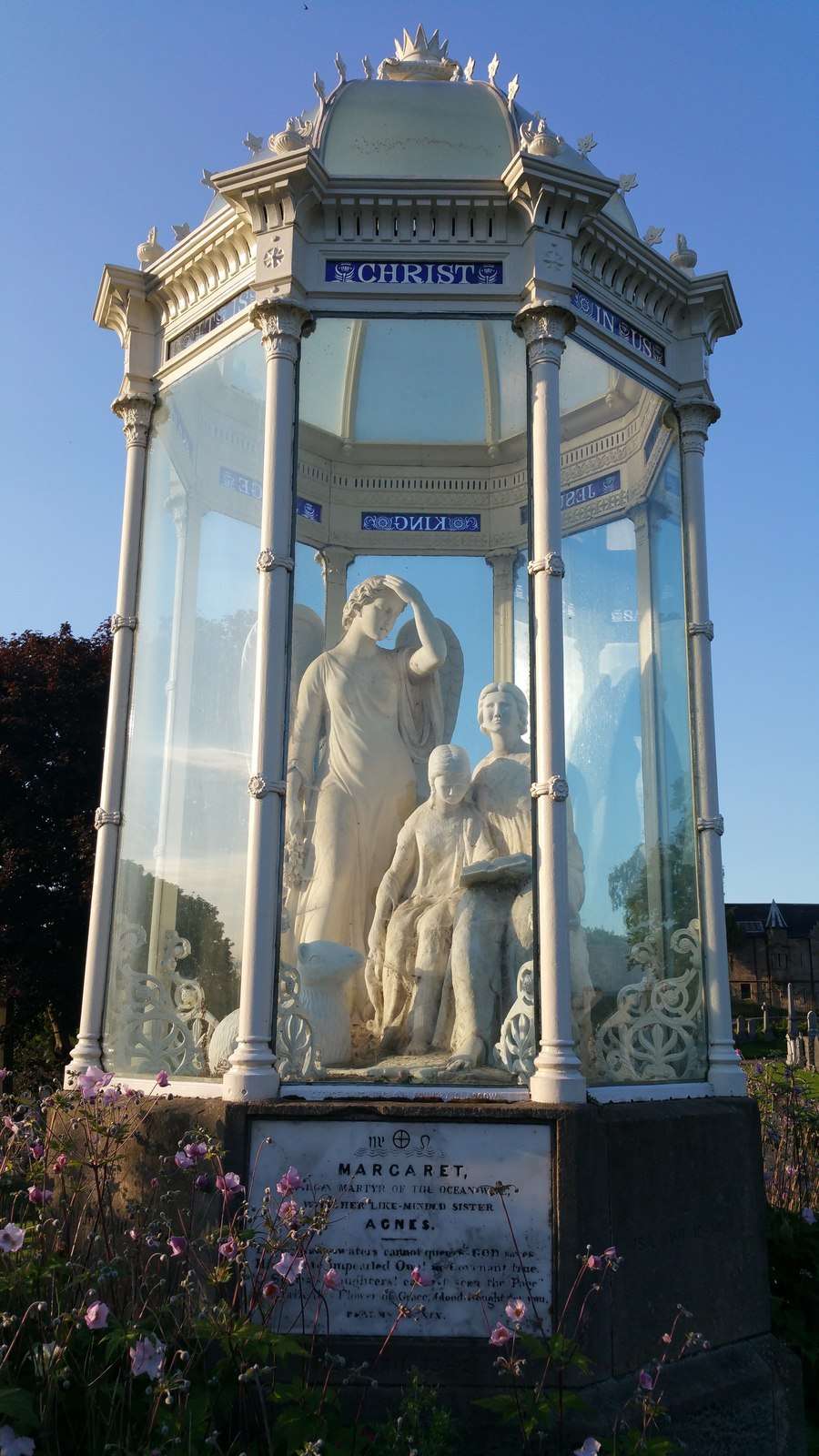
The Martyrs Monument, Stirling Old Town Cemetery. Photo: Colin Cheesman CC BY-SA 2.0, via Wikimedia Commons.
And for the plain and simply quirky, Old Town Cemetery in Stirling is hard to beat. The Star Pyramid, built in 1863, is a memorial to martyrs for civil or religious liberty and the Martyrs Monument contains an angel looking over two girls, Margaret and Agnes Wilson.
Both were arrested for their Covenantor beliefs and sentenced to death by drowning in 1685. Agnes was saved but Margaret died. The cemetery also contains the elaborately carved Service stone, dating from 1636 and complete with musket ball dents thanks to Cromwell, and the reinterred remains of a Dominican monk who died 700 years ago.
Text by: Judy Vickers.
Main photo: Abercorn Church Graveyard. Photo: Wilmm, CC BY-SA 4.0, via Wikimedia Commons.
Support the Scottish Banner! To donate to assist with production of our publication and website visit: The Scottish Banner
East Linton is an East Lothian village with a certain old-world appeal; picturesque cottages and town houses with distinctive orange-red pantiles, quiet corners, narrow wynds and open green spaces. It must be a great place to live; just off the A1, good local bus services and a new railway station which opened in 2023. It even has a small bookshop! But what really makes it stand out is a sense of history, both within the village and in its immediate surroundings.
I suspect that many people have visited East Linton without quite knowing it, for its visitor attractions tend to be very much on the periphery (unless, like me, you view bookshops as visitor attractions in themselves). There is one relatively recent tourist draw, though, that runs right through the village. The John Muir Way (JMW) is an increasingly popular long-distance walking trail that runs right across the waist of Scotland, from Helensburgh in the west to Dunbar in the east.
Dunbar is the usual starting-point as it was the birthplace and childhood home of the man it commemorates, the John Muir who emigrated to America and became a nature writer and early pioneer of conservation. If you’re walking east-to-west (towards the sunset), East Linton is the first refuelling stop after Dunbar. Just about the only thing the humdrum commuter village near Glasgow where I live has in common with East Linton is that the JMW goes through both!
Preston Mill
Preston Mill.
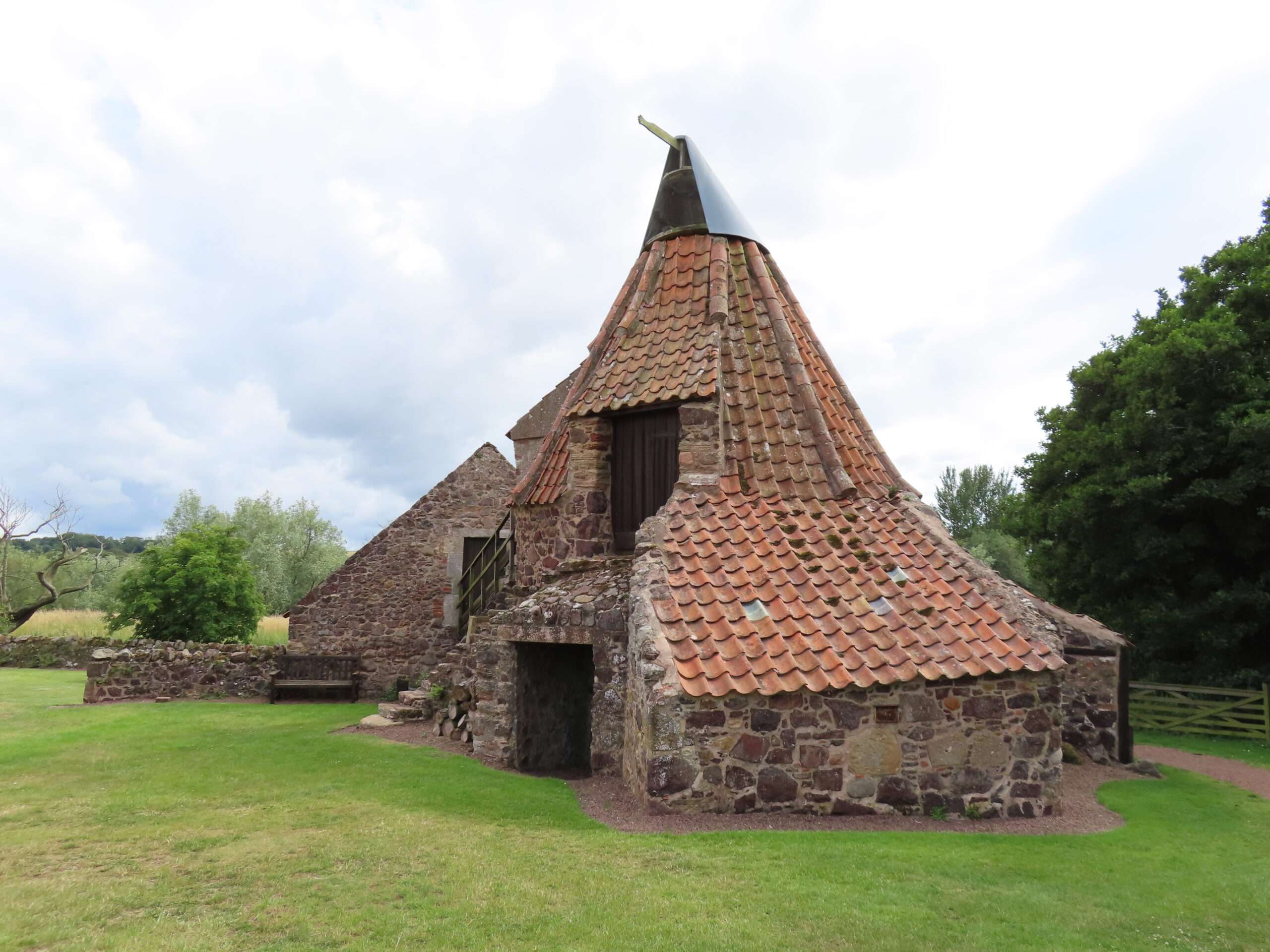
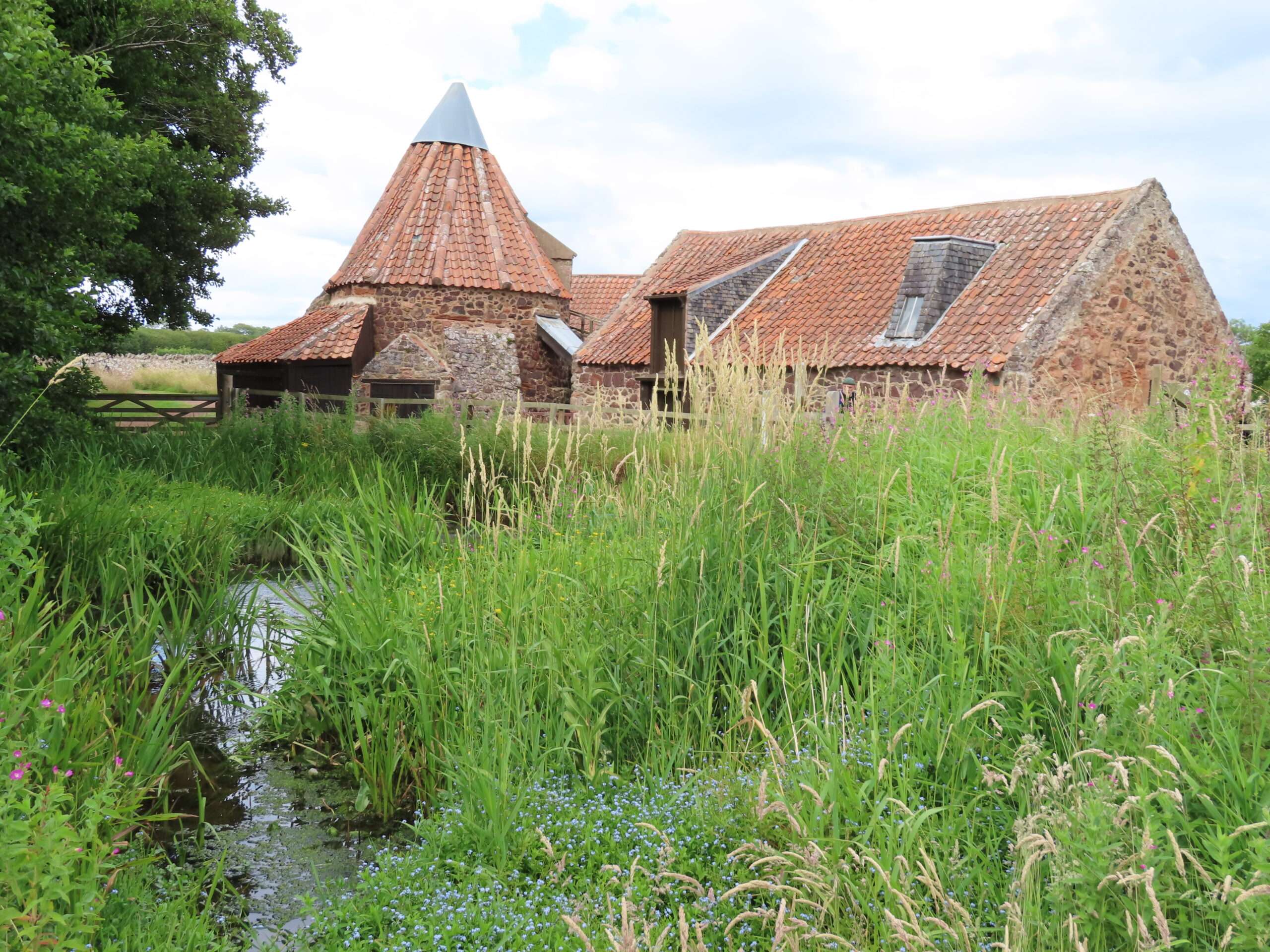
Perhaps the best-known local feature is Preston Mill. It sits by the River Tyne (a different, smaller river than the English one that runs through Newcastle) just north-east of the village and is run by the National Trust for Scotland (NTS); the JMW, following the Tyne, runs right by.
There’s been a mill on the site since the 1500s but the current buildings date from the 1700s. The mill operated commercially until 1959, but the buildings were restored to working order when the Trust took over in the 1960s. The buildings often feature on Scottish calendars, perhaps because of the eye-catching conical structure in the distinctive East Lothian pantiles. This is actually the kiln, where the grain – usually oats – was dried before milling. Visitors from Kent will spot the resemblance to their famous Oast Houses (unique agricultural buildings), which were, after all, designed for a similar purpose, drying hops. You can also see the mill pond, the wheel which powers the mill and there’s an informative display in the visitor centre.
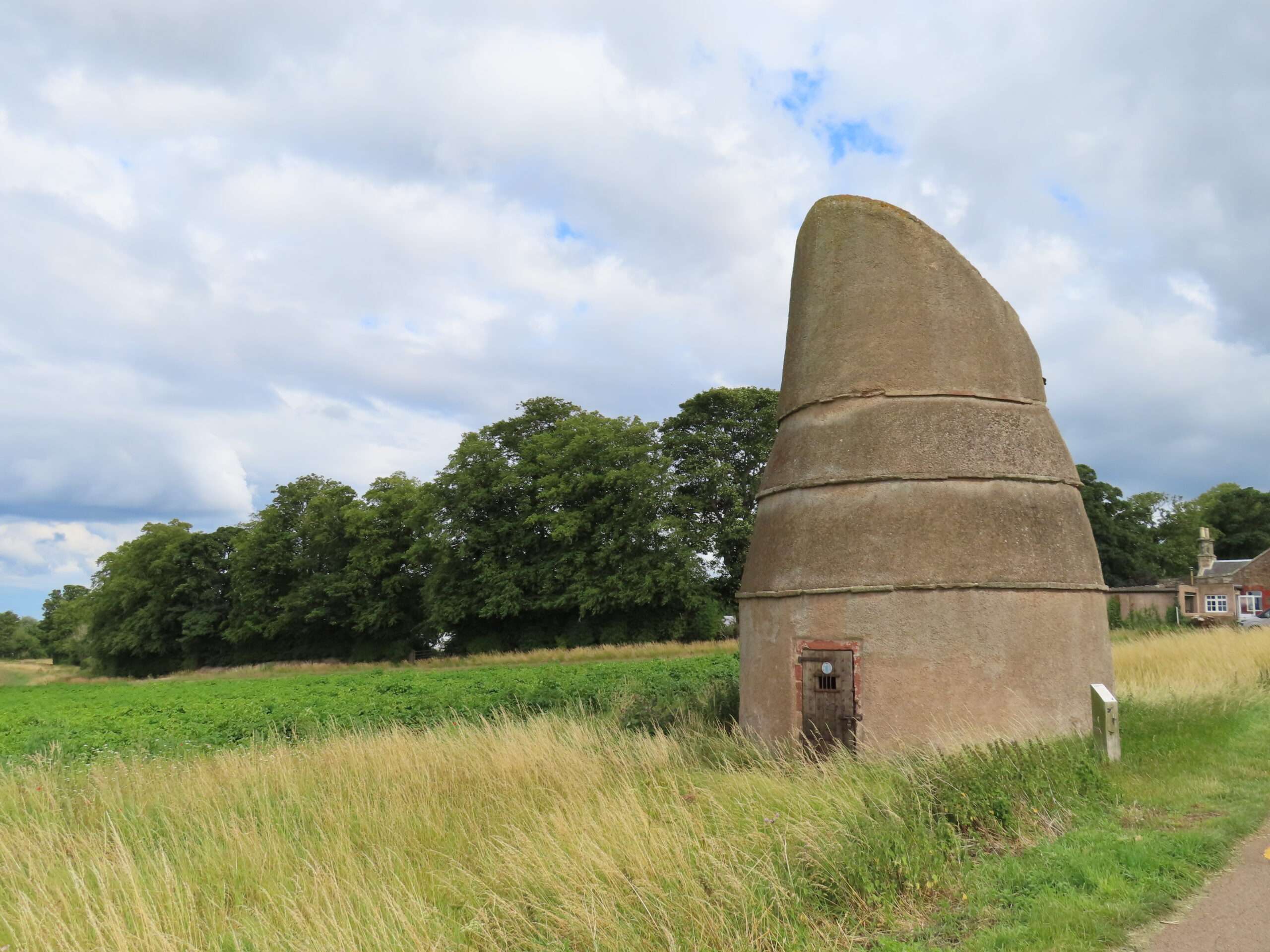
It’s an amazingly green, peaceful and scenic location for what is, after all, an industrial site. Various paths (including the JMW) offer pleasant, easy walking nearby but the most popular runs around 500m to Phantassie Doocot, an astonishing 16th century survival that is also preserved by the NTS. Shaped like a gigantic beehive, this dovecot is thought to have housed around 500 pigeons which were used as a cheap and convenient source of meat. The dovecot is not managed for this now, but apparently local pigeons do nest there, happy that they won’t end up as dinner; not for humans, anyway.
The remarkable and exotic name is supposed to be derived from the Gaelic fàn taise which means, unremarkably and very much not exotic, ‘damp slope’! The legendary Scottish engineer John Rennie was born at nearby Phantassie Farm so presumably was raised partly on pigeon-meat from the doocot.
You won’t be in East Linton long before you notice the frequent express trains hammering past on the East Coast Main Line. The railway arrived in the village in 1846 and enabled East Linton to become a centre of agricultural trade with an impressive hexagonal building being provided as a venue for auctions. The Mart, as it became known, continued in this role until the 1960s when the original East Linton Station closed. However, in recent years it has been repurposed as a community venue with shops, places to eat and event spaces. A Sunday market is also held there. The new East Linton Station is nearby and brings central Edinburgh within around twenty minutes of the village.
History doesn’t stop
Phantassie Doocot.
The history doesn’t stop. Just upstream from the village, on the banks of the Tyne is Hailes Castle. Based around a 13th century tower with later additions, the castle is associated with the Hepburn family, but has been in ruins since the 17th century. It’s cared for by Historic Environment Scotland (HES) and is normally open to the public However, HES has been conducting a programme of safety surveys on its properties. At the time of my visit, it was Hailes’ turn and it was closed, so if you want to visit, check HES’s website in advance.
A couple of miles south of East Linton is Traprain Law, a northern outlier of the Lammermuir Hills, which reaches 221m/725ft. That isn’t high, even by the standards of the Lammermuirs, but it’s a short, sharp climb on steep paths, and the views to the Forth over East Lothian are astonishing. A really active walker could walk from East Linton to the summit of Traprain Law by way of Hailes Castle using footpaths and quiet roads. Even if you just start from the car park at the foot of the hill, stick to the path; the slopes on the south (crags) and east (quarrying) should be avoided. However, Traprain Law isn’t just about walking and the outdoors. Here’s where The History Village moves into prehistory.
Traprain Law has a number of archaeological features and may have been an occupied site from the Bronze Age until Roman times. The later dwellers seem to have come to some arrangement with the Romans, co-existing and trading with them. In 2019 the Traprain Hoard, a cache of Roman silver, was found there. You can see it at the National Museum of Scotland in Edinburgh.
If you have travelled between Edinburgh and London by train you have probably sped through East Linton at 100mph. Or you may have driven past on the A1, in neither case giving it a second thought. It’s worth slowing down, though, and taking time to explore in and around ‘The History Village’.
Text and photos by David McVey.
Support the Scottish Banner! To donate to assist with production of our publication and website visit: The Scottish Banner
Many people who live in houses today may not be aware that they inhabit the same space that prehistoric peoples once inhabited. Two new publications reveal that archaeology that spanned over 10,000 years, from traces of Late Upper Palaeolithic and Mesolithic hunter gatherers, to Neolithic farmers, Bronze Age metalworkers, Iron Age Fort dwellers and medieval kiln burners, once lay where new houses now stand.
The discovery was made by GUARD Archaeology during archaeological excavations between 2017 and 2021 commissioned by Persimmon Homes North Scotland prior to construction of new houses at Guardbridge, located just outside St Andrews. Before the excavation began, the ditches of a fort in the north-east corner of the site had already been identified on aerial photographs.
Bronze Age
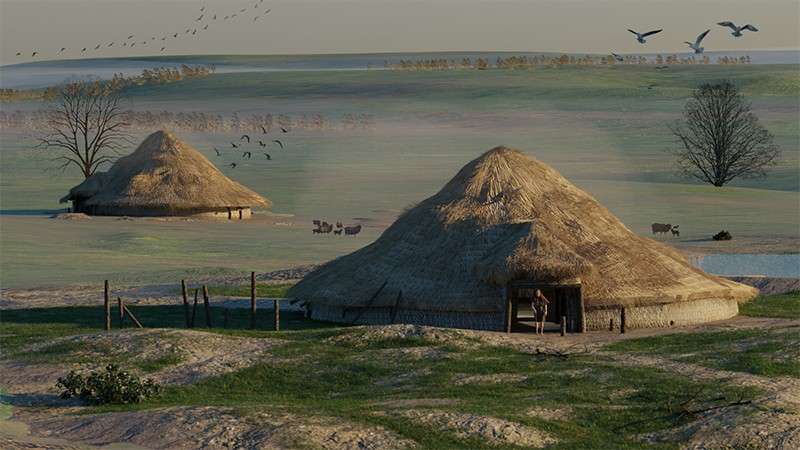
Artist’s impressions of the area.
While most of this fort was left intact, the excavation revealed that it likely originated during the Late Bronze Age and continued through much of the Iron Age until the early centuries AD. Spindle whorls and loom weights attest to the weaving of woollen cloth by the fort’s inhabitants while fragments of shale bracelets demonstrate personal adornment. But what was really surprising about this site was all the other archaeology found outwith the fort, not just Iron Age but much earlier too.
From earlier in the Bronze Age, the remains of substantial roundhouses were discovered, from which an assemblage of pottery sherds and animal bones were recovered. Metalworking was also carried out here during the late Bronze Age as rare casting moulds for a sword blade and a socketed gouge – a tool used in carpentry – were found. From the porch of one of the roundhouses was found evidence that one of its occupants had once sat there knapping flint for tools.
The earliest occupation of Scotland
The site was also used before this, during the Neolithic by some of the first farmers of Fife who left many pits across this site, containing burnt cereal grains, saddle querns and pottery sherds but no trace of their houses. And before even this, were traces of a temporary Mesolithic campsite. A fire-pit, radiocarbon dated to around 4320-4051 BC, was associated with a cluster of burnt lithics arranged in a distinctive star-shaped pattern, indicative of a tent or shelter, where a small group of hunter gatherers once camped to hunt and fish in the nearby estuary. And below this was a scatter of flints from around 10,000 BC during the Late Upper Palaeolithic period where some of the very earliest inhabitants of Fife once sat knapping flint tools.
While settlement at this site seems to have drawn to a close around the end of the Iron Age, several medieval corn-drying kilns were also found, dating to between AD 900 and 1300. These kilns were presumably worked by labourers of ‘Segy’ farm. The different construction techniques apparent shows how these kilns changed over time, improving in design and size to meet the growing demand from the growing medieval population of Fife. These were the last traces of archaeology with origins stretching back in some form or another to some of the earliest occupation of Scotland.
Support the Scottish Banner! To donate to assist with production of our publication and website visit: The Scottish Banner
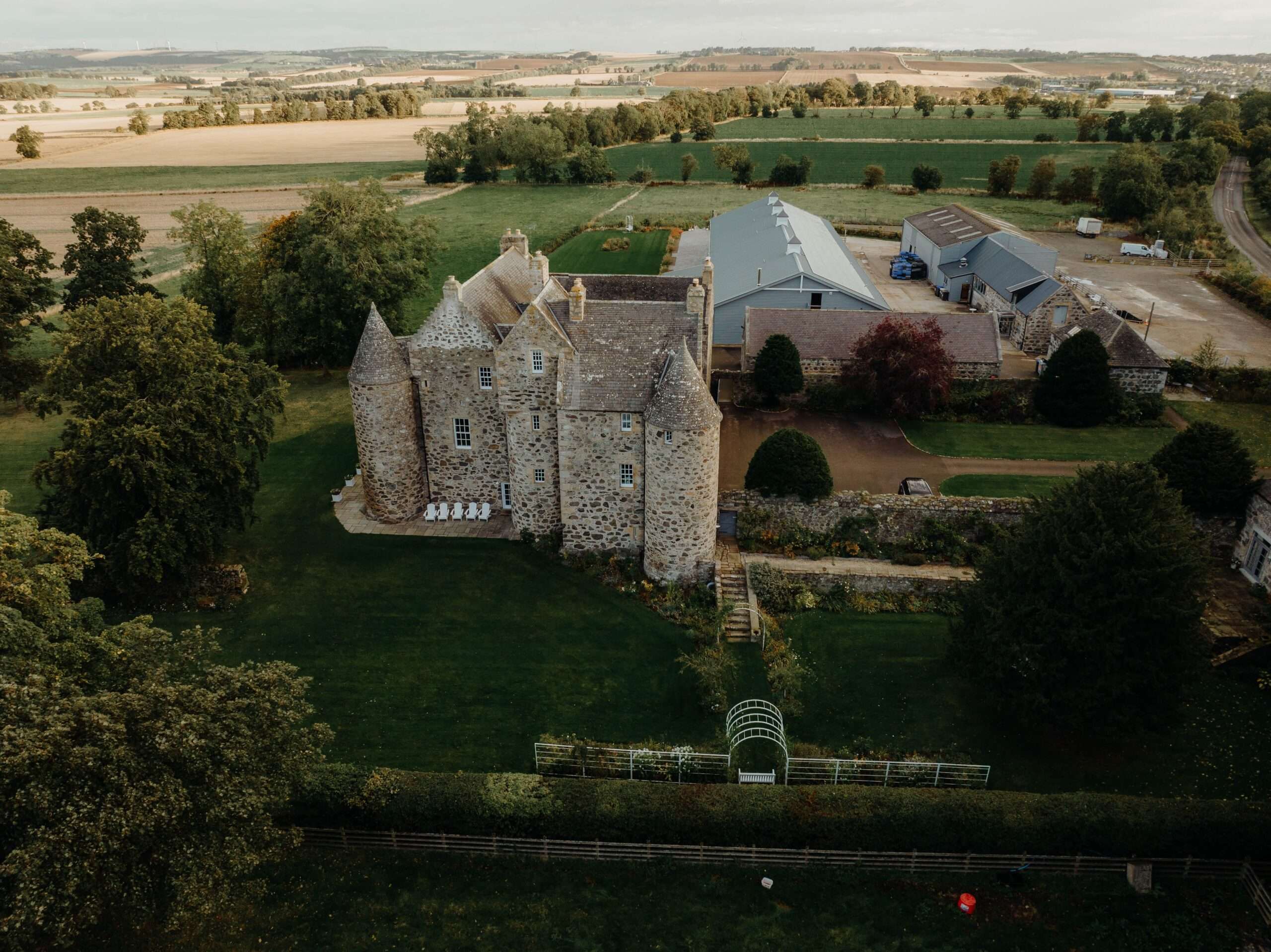
Barra Castle is located in the Garioch district of Aberdeenshire beside B9170 road that leads from Inverurie to Meldrum. It is about two miles, or three kilometres, south of the village of Meldrum (called Oldmeldrum on modern maps but “Meldrum” to its inhabitants). Although called a castle, correctly Barra Castle is a fortalice or fortified house. It was built originally in the early 1200s and was then the seat of the King family who served as lairds of the surrounding Barra Estate. It served that purpose until 1596, when the Kings were forced to leave.
Since 1600 the castle has been home to several families, recently the Ramsay family whose later generations the Bogdans made major renovations in the 1970s. The current owners are Sir David and Lady Sarah Stephen, who live in the castle and operate a produce shop and a wedding venue onsite. The Stephens also renovated the castle more recently.
A Scottish fortified house
The castle has been renovated several times and stands now as a fine example of a Scottish fortified house, or fortalice. For defence, there are no windows or doors other than the main door at ground level. The plan of the castle is a variation on the L-plan, with the main block of the castle lying north to south. There is a circular tower at the south-west. A D-plan tower at the south-east, corbelled square at the top to give a watch room, links to a large square wing. At its north-west angle, this wing has a second circular tower. The castle’s entrance is in the main re-entrant angle: it contains the entrance door and main stair, which has a trip-step for defence. The towers have conical roofs. The main gables are crow stepped.
The buildings around the courtyard are three storeys high and built of pinned boulder rubble. This type of construction has stood the test of time. All additions made over the centuries have copied the original so that the castle today looks as if it was all built at the same time. The older parts of the structure date from the early 13th century, when Barra Castle was built to be the seat of the King family. These older parts include the kitchen which still has the large stone open fireplace at which the King ancestors would have warmed their hands in the 1200s.
Fine symbol of Scots history
Barra Castle has been acclaimed by many historians and architects. Nigel Tranter, the Scottish historian of the twentieth century, wrote in his book on Scottish fortified houses, “Barra is assuredly one of the most attractive of the lesser castles of this great country”. From the 1940s on, Mrs. Mhaire Bogdan (née Ramsay) lived in Barra Castle. Her eldest son Nicholas was an architect and he lived in Barra Castle all his life, from 1947 until 2002. Nicholas undertook extensive restoration of the castle to make it a comfortable family home.
Sir David and Lady Sarah Stephen who live there now renovated the castle further when they took over and they developed the barn as a glamorous wedding venue with B&B accommodation. Thanks to their care, Barra Castle will go into the 21st and succeeding centuries as the fine symbol of Scots history that it is.
Text by: Wade King
Support the Scottish Banner! To donate to assist with production of our publication and website visit: The Scottish Banner
Inverness, the capital of the Scottish Highlands, offers the visitor a captivating blend of history, nature, and charm that makes it a must-visit destination. The neighbouring waters of Loch Ness are world famous for not just a monster but also incredible beauty. The Scottish Banner’s Sean Cairney recently visited both and shares just some of the many highlights this Scottish must-see travel destination offers.
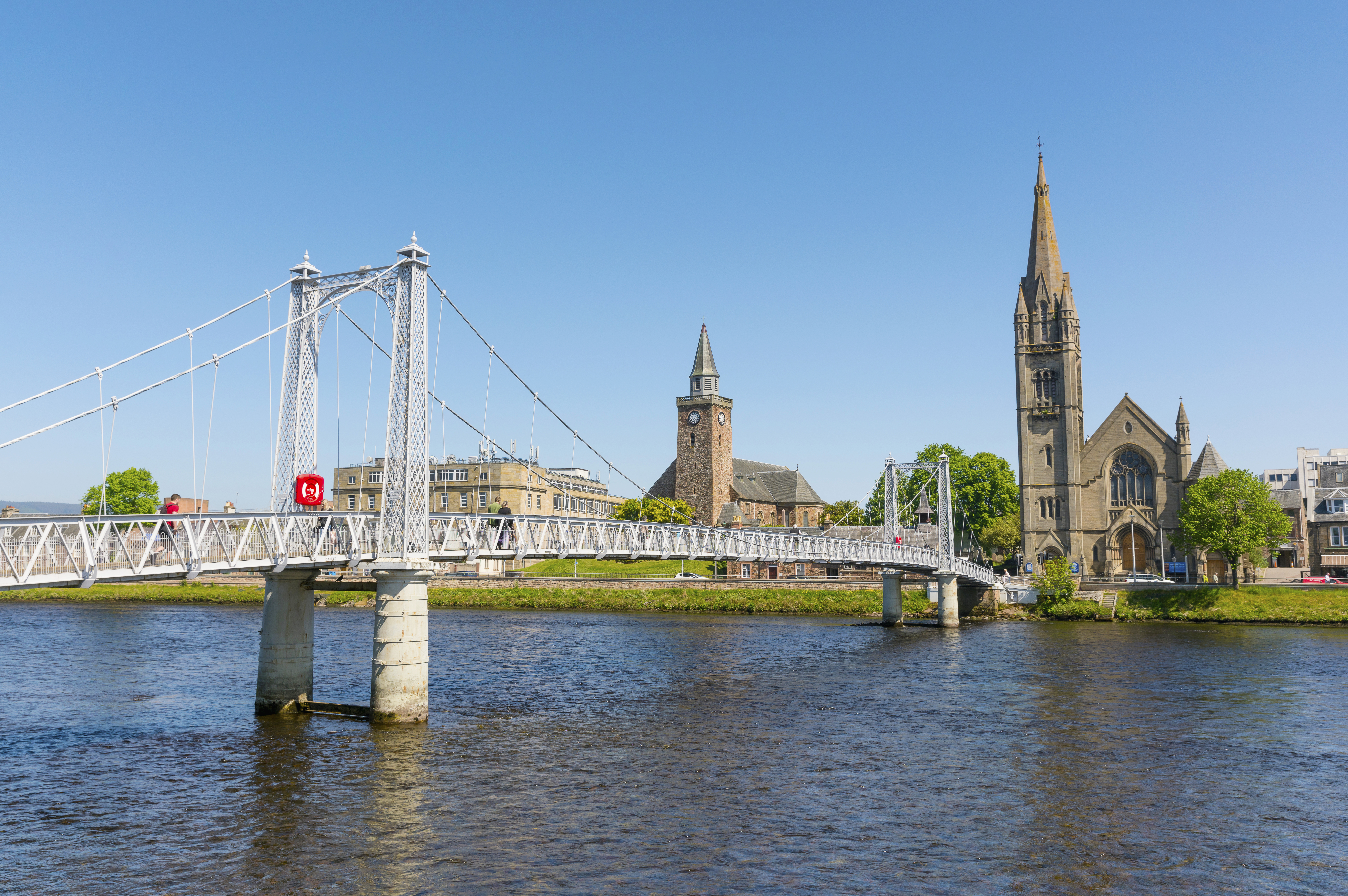
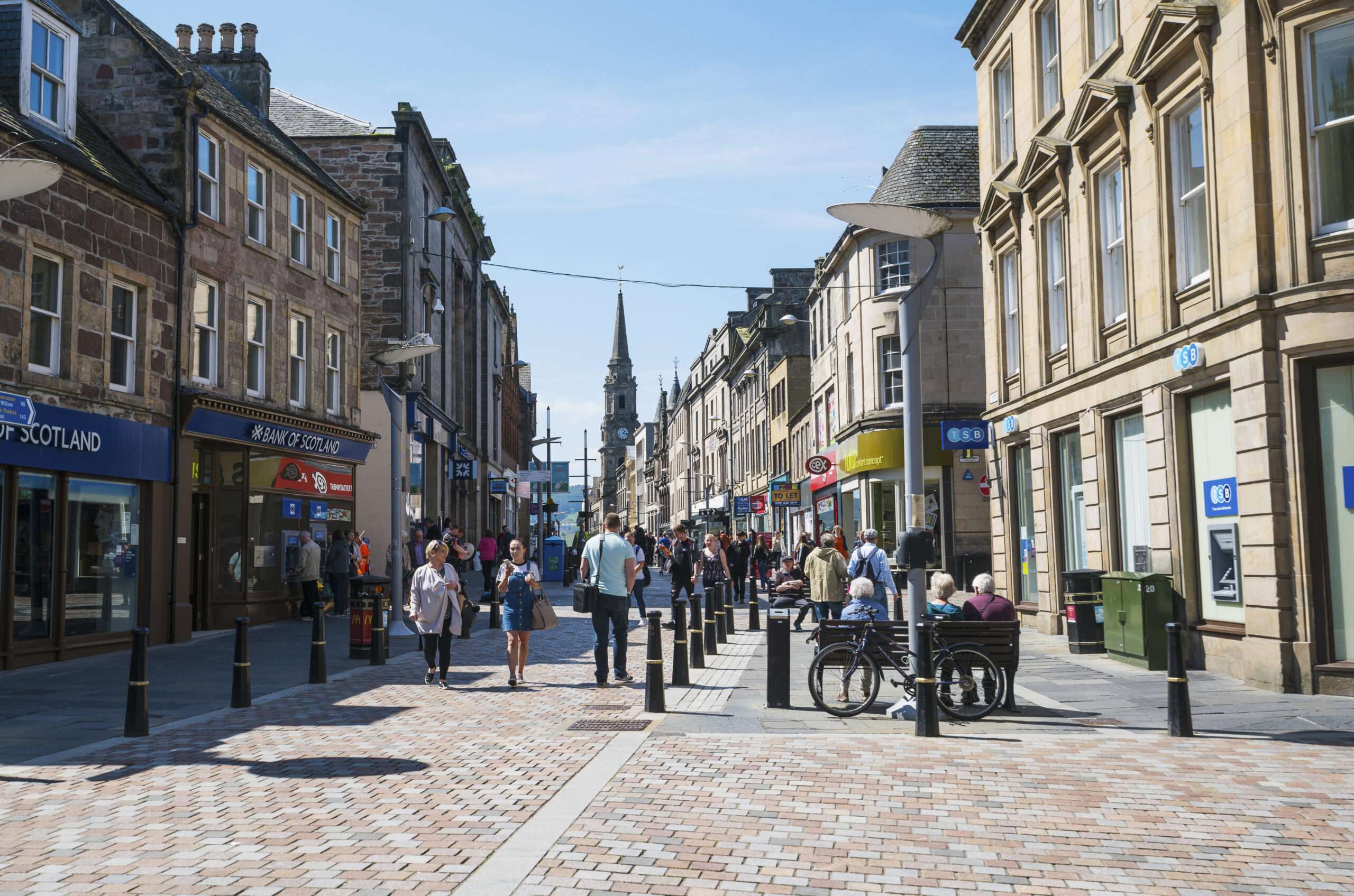
I recently had the opportunity to revisit one of my favourite parts of Scotland and jumped at the chance to again visit Inverness, the northernmost city in the United Kingdom. Inverness began as a Pictish stronghold in the 6th century and is today one of Europe’s fastest growing cities.
Nestled along the banks of the River Ness, this compact city which has been named as one of the ‘50 Best Places to Travel in 2025’ offers a walkable centre filled with cozy cafés, lively pubs, and independent shops, all set against a backdrop of Highland beauty.
Inverness Castle
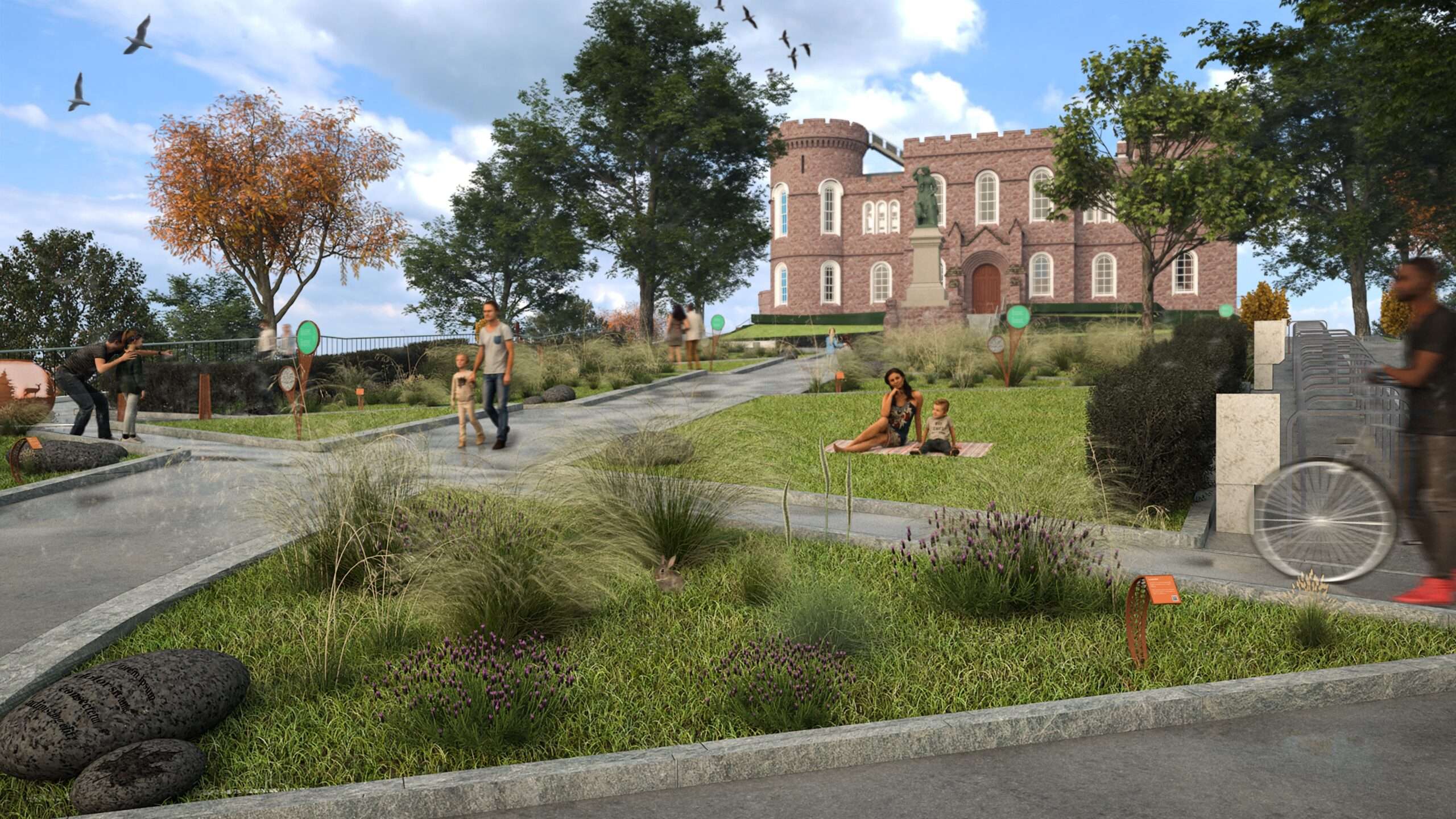
One of the biggest attractions for the city this year will no doubt be the opening of the Inverness Castle Experience. Inverness Castle is set to reopen this year with a transformative visitor attraction, celebrating the spirit and stories of the Scottish Highlands.
Once a courthouse and prison, the castle’s red sandstone towers are being reimagined into a vibrant cultural hub that blends history, storytelling, and immersive design. I managed to get a sneak peek tour of the castle and really got to see how the unique blend of historic architecture, with creative modern building techniques, interactive spaces and innovative exhibits are being blended.
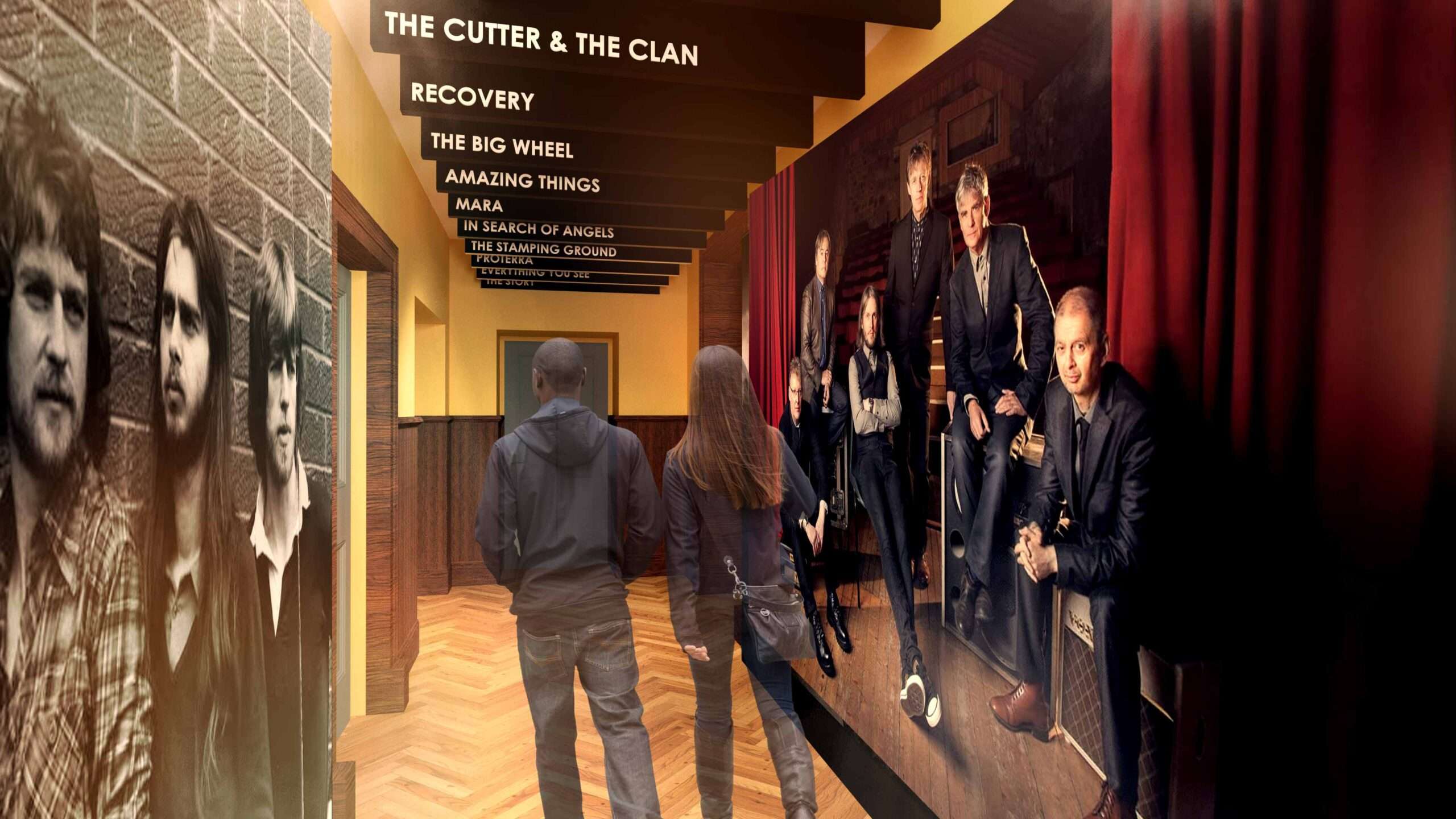
Artist’s impression the Runrig exhibit at the new Inverness Castle Experience.
The castle will open with an exhibition on Scottish super group Runrig, which looks at their incredible career and developed, and designed alongside the band members themselves. The castle sits prominently above the city and River Ness and will become a year-round visitor experience for the city and region and it so great to see what they have done with this iconic space. Inverness Castle is getting ready to open and it should be on your list on your next visit to Scotland.
Loch Ness
A view from Jacobite Loch Ness Cruises. Photo: Paul Campbell
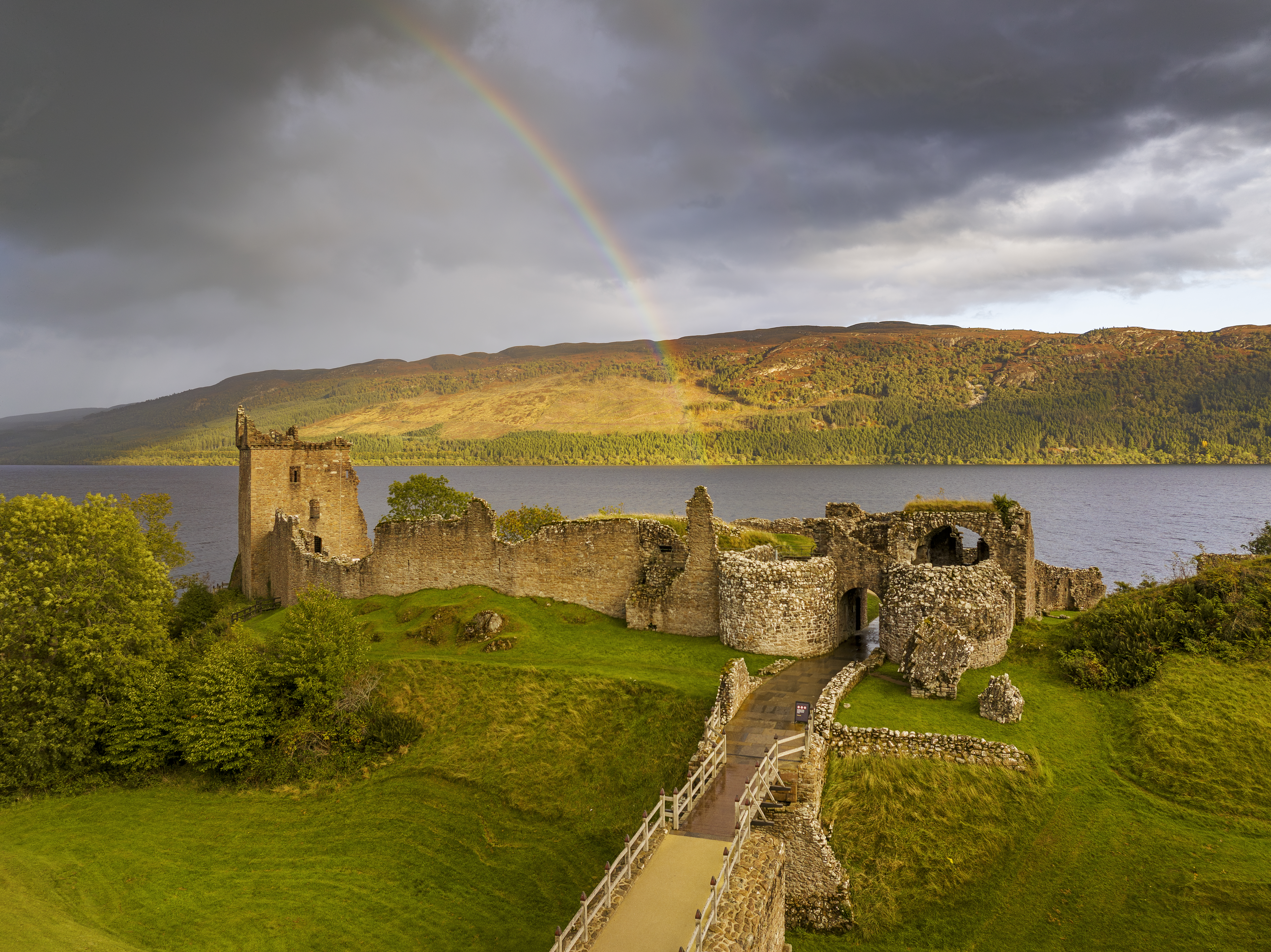
One of Inverness’s greatest draws is its proximity to the legendary and world-famous Loch Ness. Whether you’re chasing the myth of Nessie or simply soaking in the tranquil scenery, the loch offers boat tours, castle ruins like Urquhart Castle, and stunning photo opportunities. Urquhart Castle is one of Scotland’s most iconic ruins, perched dramatically on the banks of Loch Ness. Its strategic location made it a key stronghold during the Wars of Scottish Independence, changing hands between English and Scottish forces, including Robert the Bruce.
The castle’s turbulent history includes raids by the MacDonald Lords of the Isles and its eventual destruction in 1692 to prevent Jacobite use. Despite its ruinous state, Urquhart’s silhouette against the loch evokes centuries of conflict, resilience, and mystery. The castle is also linked to the legend of the Loch Ness Monster, adding a layer of folklore to its allure. You can get to the castle by road or boat, and the setting is the most famous on the loch.
Urquhart Castle on the shores of Loch Ness. Photo: VisitScotland/Stuart Brunton.
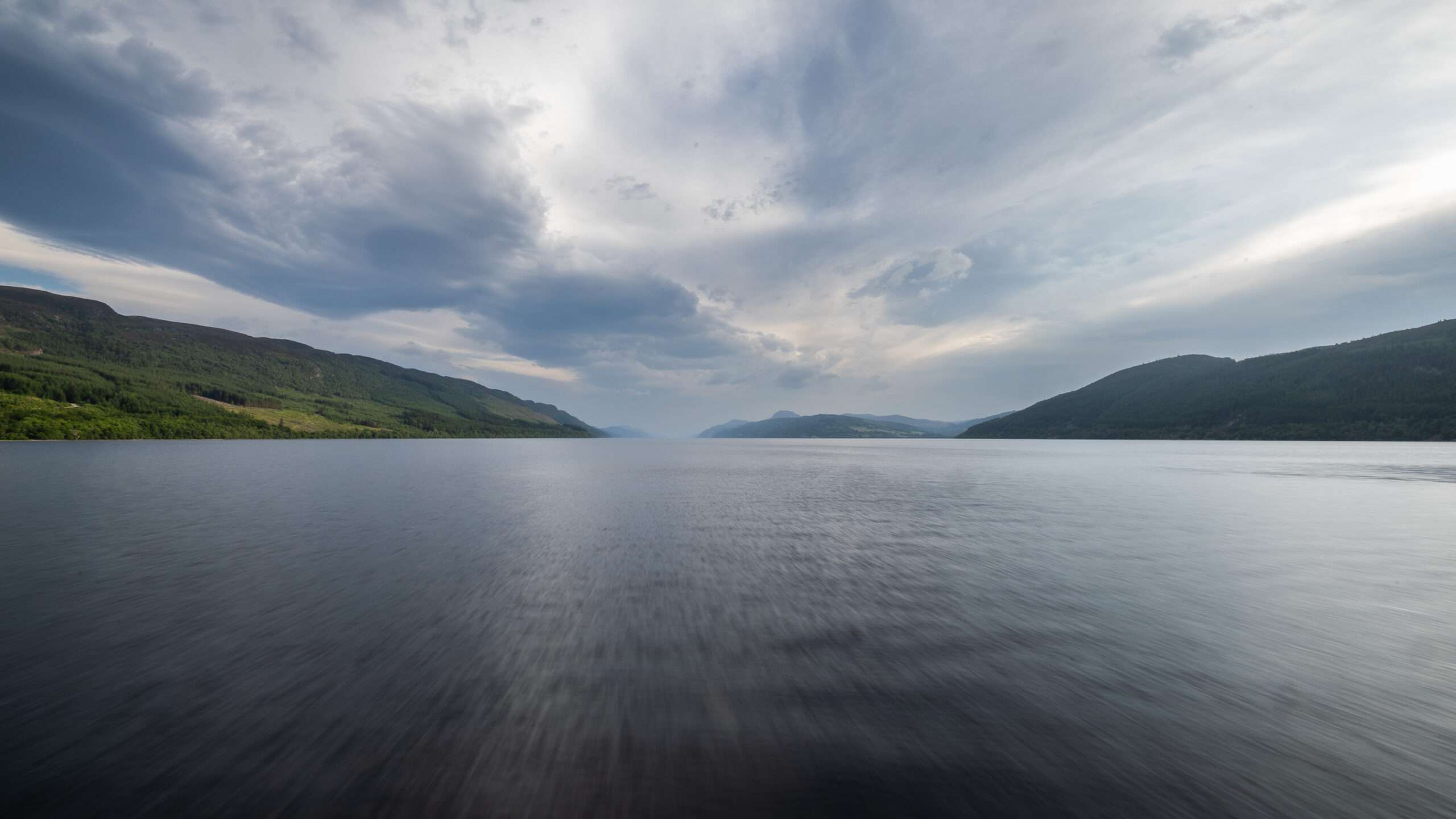
Nature is the star of Loch Ness, and the cold dark waters are not only the most famous in all of Scotland, but it is also the largest body of water in Scotland by volume and contains more water than all the lakes in England and Wales combined. The Loch Ness monster still holds the imagination of many around the world and there have been several reported sightings already in 2025. Many still come to the area just to see if they too can catch a glimpse.
Getting on the loch gives you a great perspective of the water and allows you to take in the surrounding nature. I hopped aboard a Jacobite Cruises vessel, who have been plying these waters for 50 years, and enjoyed the commentary about Loch Ness and watching the unfolding nature surround us, however I did not spot any famous residents!
Culloden Battlefield
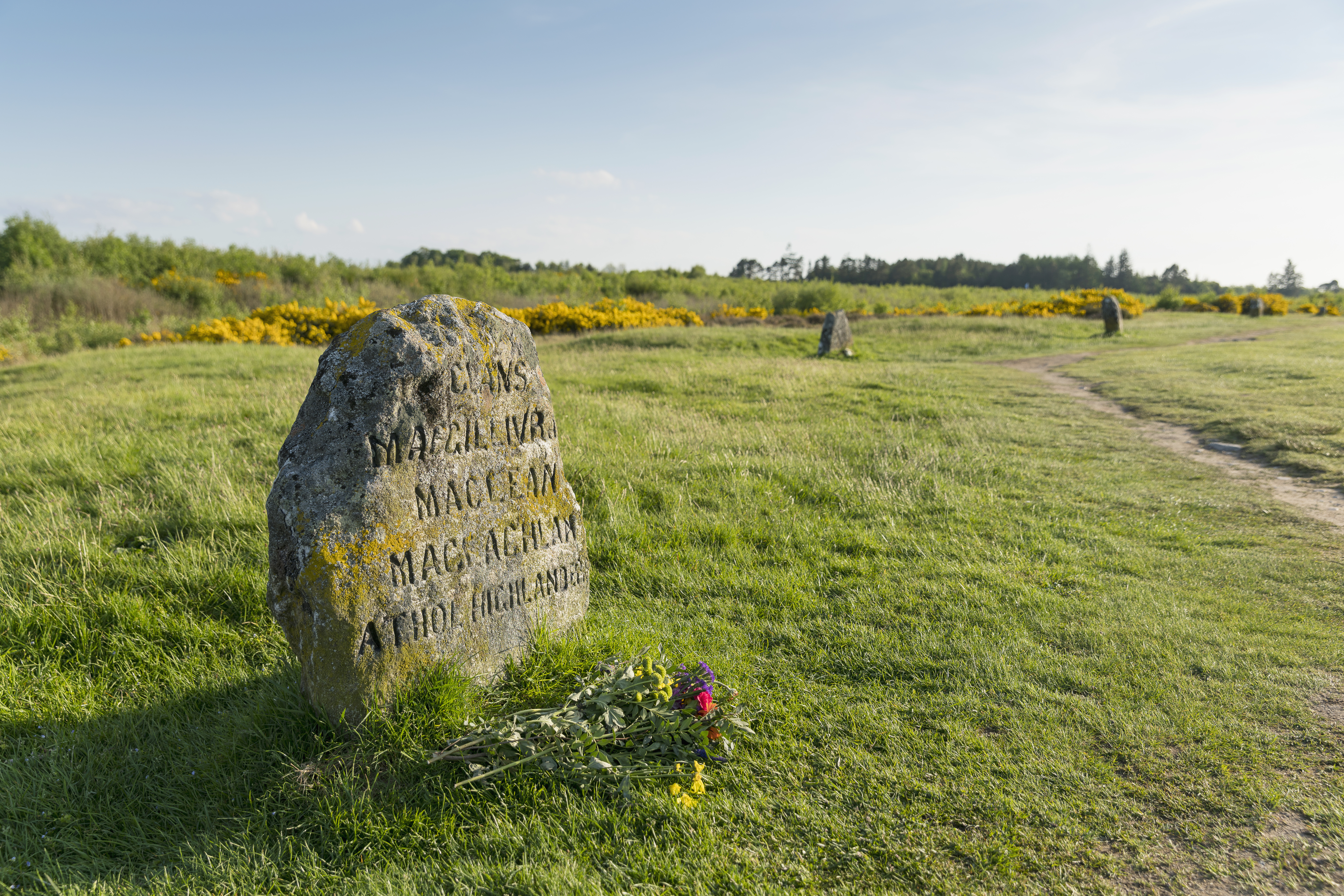
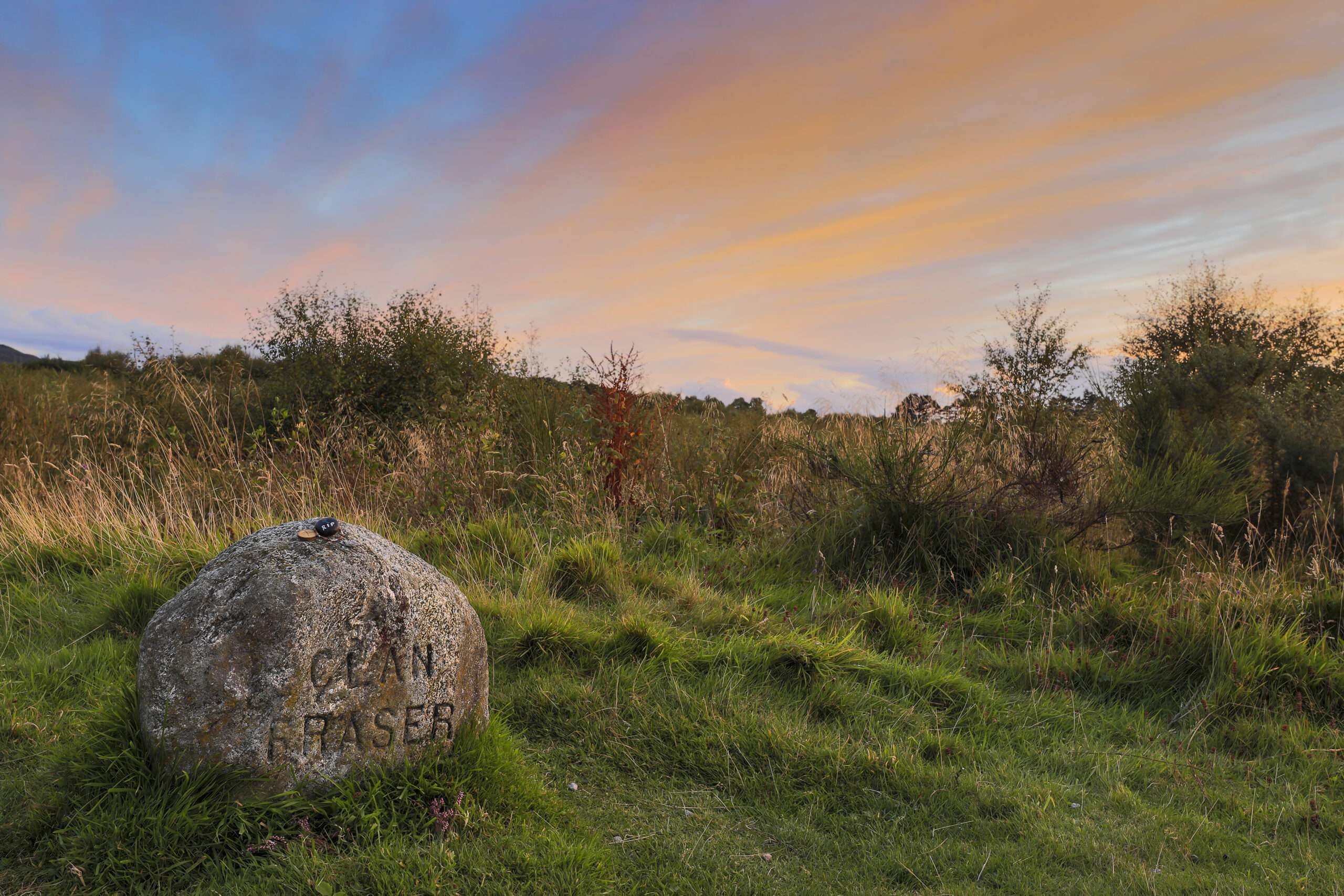
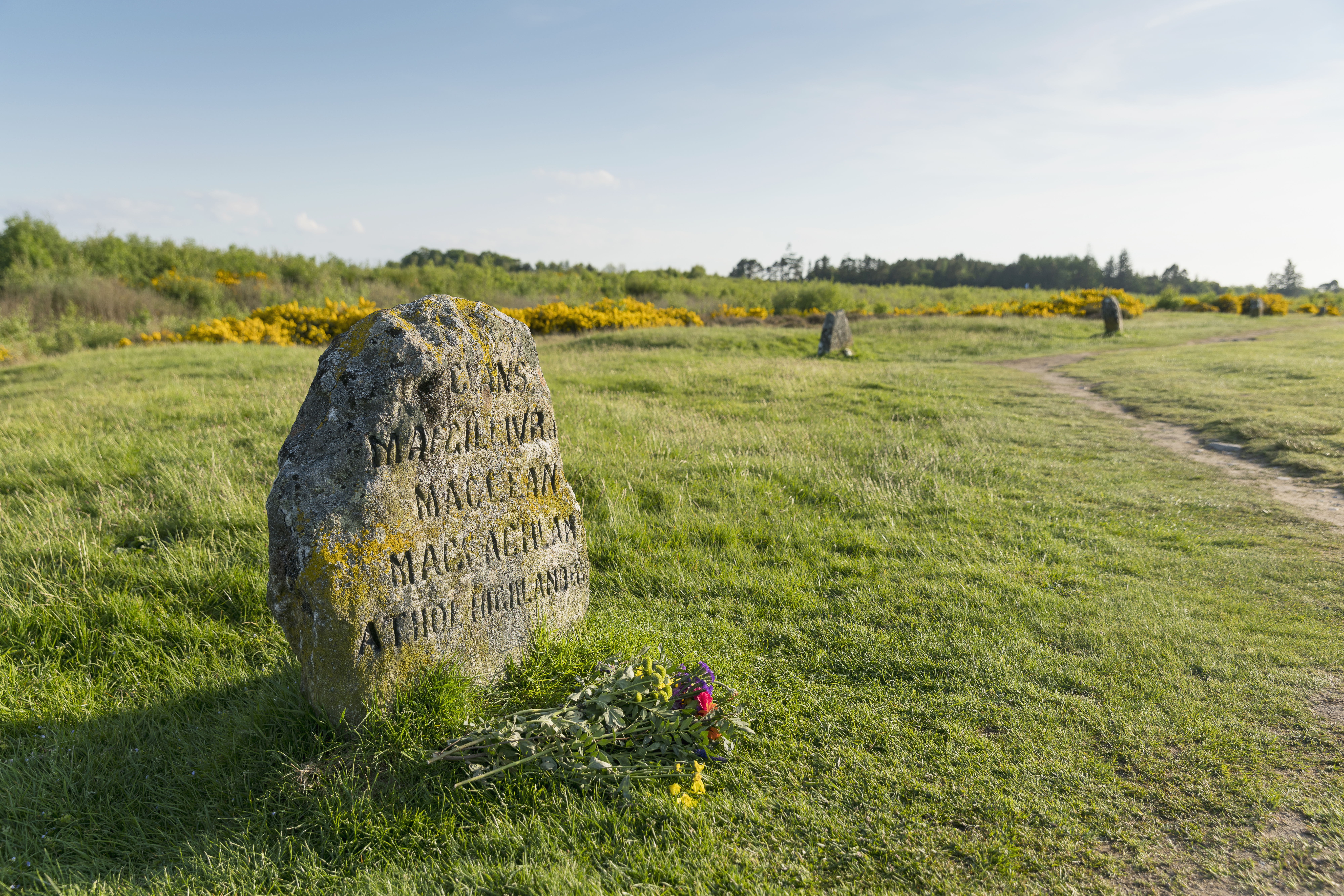
Clan grave marker at Culloden Battlefield. Photo: VisitScotland.
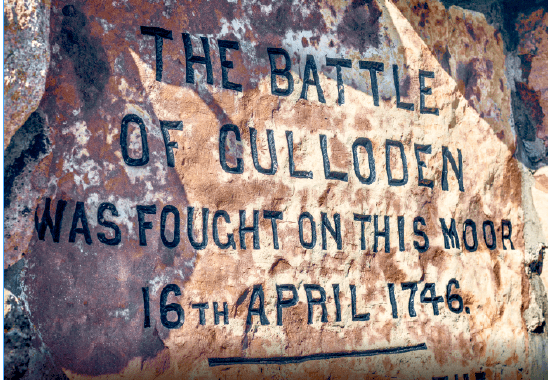
I was fortunate to spend the day with Grant Driving Tours whose local knowledge helped to create a great day in the region. We started at Culloden Battlefield a sombre and historic location which marks the site of the final pitched battle fought on British soil, on 16 April 1746. It was the brutal end of the Jacobite Rising, where Bonnie Prince Charlie’s forces, largely Highland Scots, were crushed by the government army led by the Duke of Cumberland. The defeat not only dashed hopes of restoring the exiled Stuart monarchy but triggered sweeping changes across Scotland. In its aftermath, the British government imposed harsh laws to dismantle clan culture: banning tartan, Gaelic, and Highland dress, and disarming the clans.
Culloden is an active war grave and anyone who visits will be moved by the experience which is so well told by the team at the National Trust for Scotland who manage the site. It was slightly odd to see the clan stone for Clan Fraser now has to be roped off for protection due to the popularity of the main character in Outlander. Culloden today stands as a solemn reminder of Scotland’s struggle for identity, faith, and sovereignty. The battlefield’s haunting silence and preserved landscape offer a powerful space for reflection on the cost of rebellion and the resilience of Scottish heritage.
Clava Cairns
Prehistoric Burial Cairns of Bulnuaran of Clava or Clava Cairns. Photo: VisitScotland.
Just outside of Inverness are the Clava Cairns which is an interesting Bronze Age burial site near Inverness, dating back over 4,000 years. The complex includes passage graves, a ring cairn, and standing stones, all carefully aligned with the midwinter sunset.
These cairns were likely built for elite individuals, reflecting deep ritual significance and astronomical awareness. The site’s layout and solar alignment hint at a sophisticated understanding of time and cosmology. Clava Cairns remain a powerful testament and link to ancient Scottish people’s and beliefs, and the fact you can freely walk amongst them is something special.
The centre of Inverness. Photo: VisitScotland.
It has been a few years since I have walked the streets of Inverness and I was so glad to have returned. Inverness is such a walkable city and a stroll along the river is a must. I was fortunate to also be able to spend some time in MacGregor’s Bar where traditional music blends with friendly locals and where some may already check in with their live-streaming traditional music sessions which take place each week and have a large international following of Celtic music lovers.
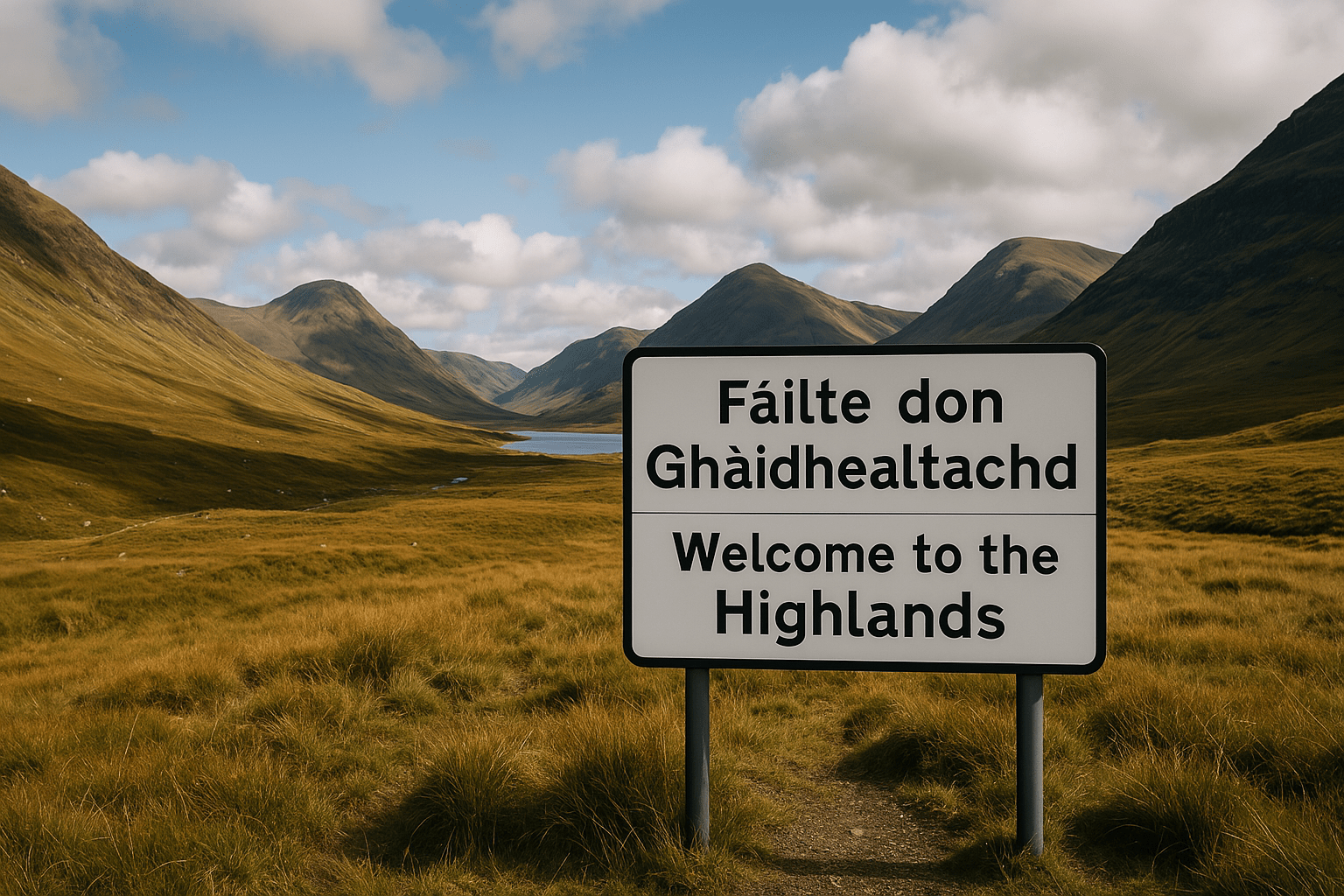
Inverness and Loch Ness have much to offer the visitor with natural beauty, incredible history and Highland culture. The surrounding country side is beautiful and if like me you are lucky you may just get up close and personal with Highland Coo, or two…
I visited in late July and the area was busy with people from all over the world, the heather was just coming out and the nights were long. However, the area can be enjoyed year-round and a visit here is a must, or as it was for me a must come back…
VisitScotland can help you plan your trip to Inverness and Loch Ness at: www.visitscotland.com
Plan your Inverness trip:
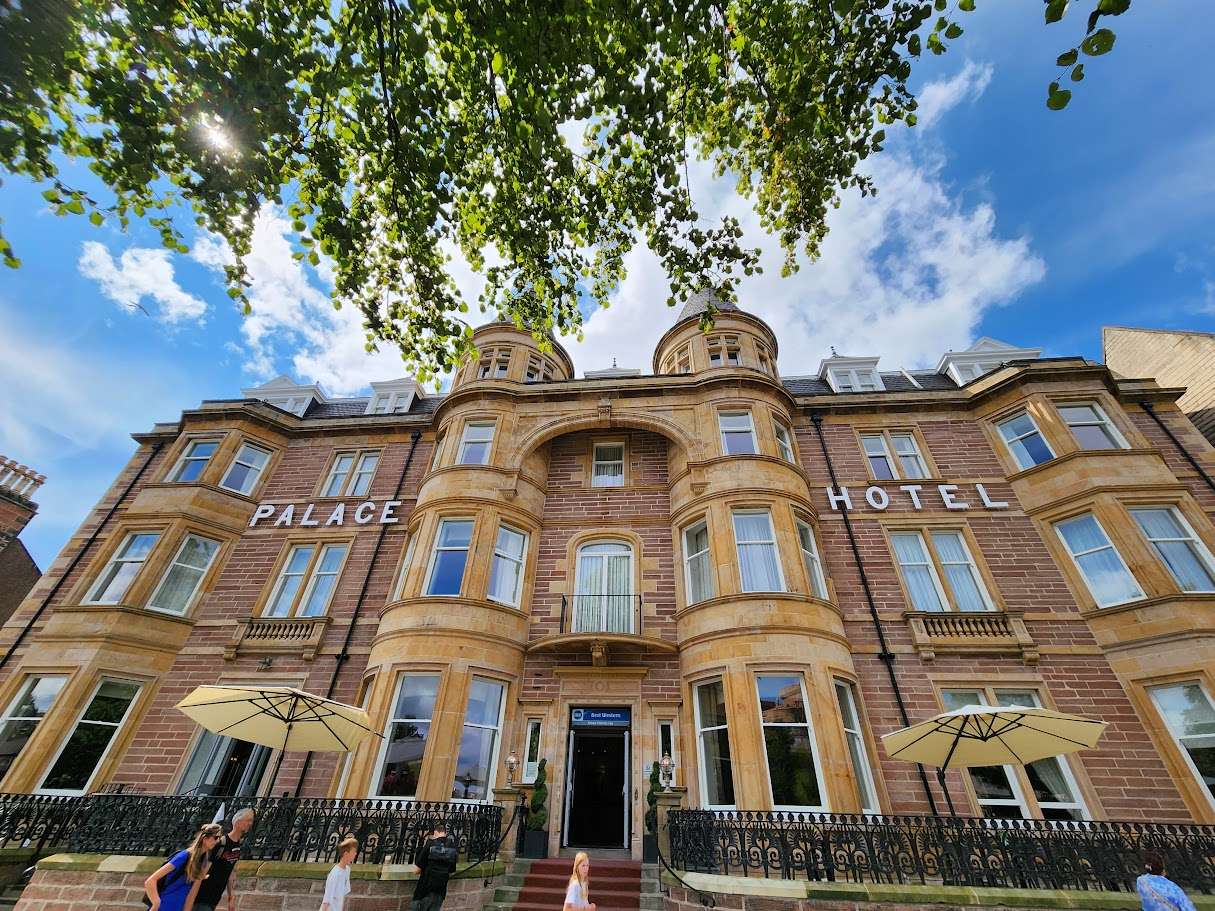
Best Western Inverness Palace Hotel & Spa offers a relaxing break in Inverness city centre on the banks of the River Ness, opposite the Castle, with a lovely selection of rooms. www.invernesspalacehotel.co.uk
Grant Driving Tours offers great tours from Inverness filled with detailed knowledge and passion for the area. www.grantdrivingtours.scot
Jacobite Loch Ness Cruises is celebrating 50 years of taking passengers out onto the world’s most famous loch. They offer a range of cruises at: www.jacobite.co.uk
The Inverness Castle Experience will be a new visitor attraction in the centre of Inverness, celebrating the ‘Spirit of the Highlands’ through its stories of past, present and future and is due to open this year. www.invernesscastle.scot
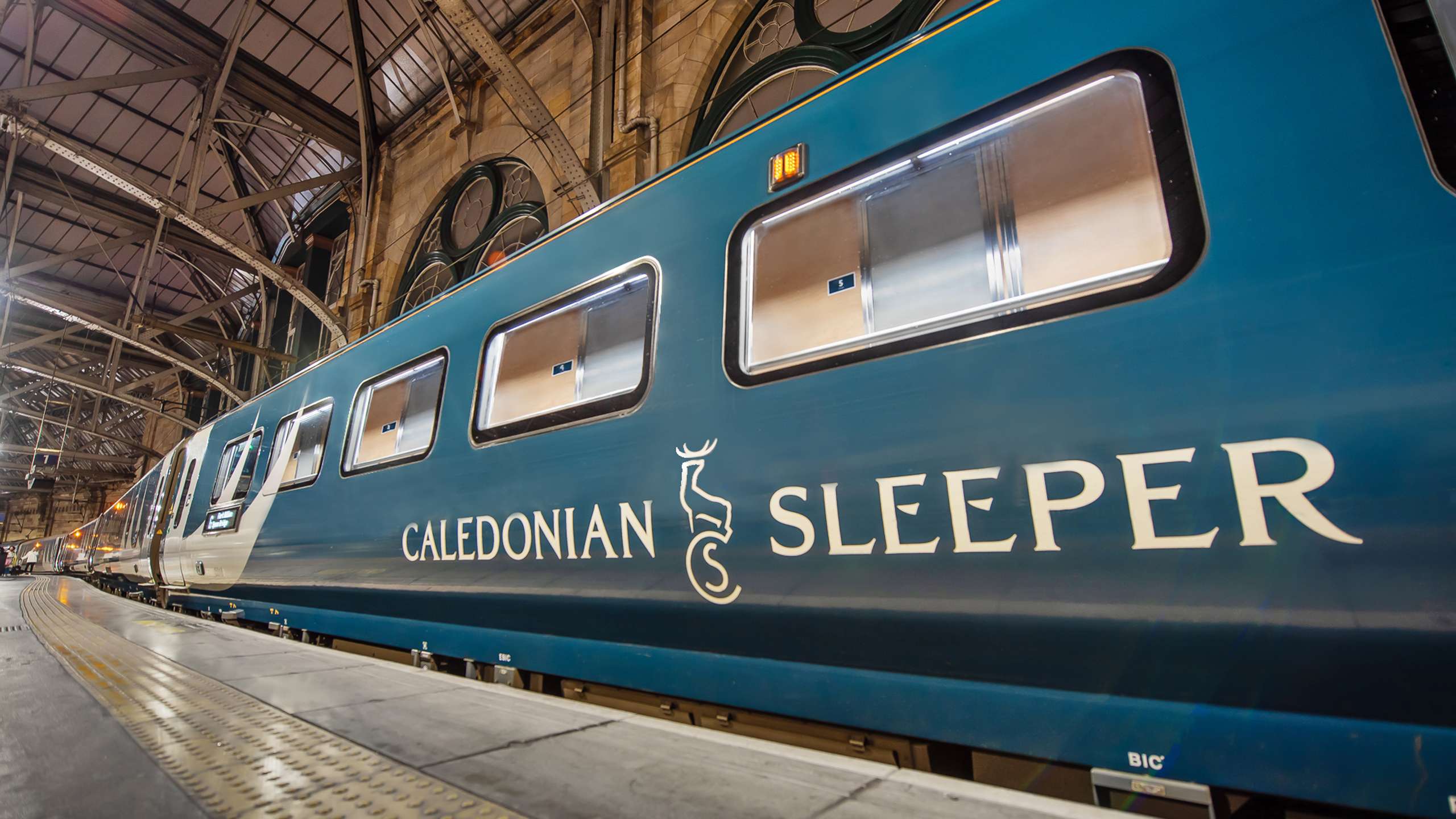
This year marks the 200th anniversary of the birth of the modern railway. If you are combining your next visit to Scotland with a stop in London, the Caledonian Sleeper is a unique travel experience. The Caledonian Sleeper is a luxurious overnight train connecting London with destinations across Scotland, including Edinburgh, Glasgow, Inverness, and Fort William.
Club Car, Lounge.
The Scottish Banner recommends the private en-suite rooms, which includes comfortable handcrafted mattresses, private en-suite with shower and Club Car access which allows you to meet fellow travellers and serves Scottish cuisine. Guests enjoy priority boarding, exclusive lounges and a very warm welcome from staff. Whether travelling for business or leisure, the service transforms travel and lets passengers sleep through the journey and wake in the heart of the Highlands or London. With sustainability at its core, it’s a romantic, efficient, and distinctly Scottish way to explore the country.
An online dictionary which has rediscovered lost Gaelic phrases and word meanings is one of 12 projects set to benefit from Scottish Government funding. Faclair na Gàidhlig (the Historical Dictionary of Scottish Gaelic) seeks to provide a better understanding of Gaelic’s history and culture. It is the first dictionary of the language which aims to detail the origins and meanings of every known Gaelic word. Compilers expect that it will contain more than 100,000 entries.
As part of the initiative, researchers have investigated historical manuscripts dating back to the 12th century.
Rediscovered phrases and word meanings include:
-The phrase “Ciod fo na rionnagan” (“what under the stars”), which was used in the early 1900s to emphasise a point similar to “what on earth”.
-The Gaelic word for prickly pear fruit, “peur stobach”, was first used in a letter documenting a visit to Saint Helena in 1900.
-“uircean”, which is the Gaelic word for “piglet”, also used to mean “whale calf” in the 1800s.
Gaelic is a core part of Scotland’s culture
The investment will build on 20 years of work by helping Faclair na Gàidhlig to reach new audiences including learners, researchers, writers and speakers of Gaelic. Deputy First Minister and Cabinet Secretary for Economy and Gaelic Kate Forbes announced the funding as part of a wider £500,000 package to support the language’s growth across Scotland. The investment will also support the publication of Gaelic language books, local mòd events throughout Scotland and Gaelic cultural activities including a summer school and musical events.
Ms Forbes said: “The dictionary initiative is providing researchers, writers, speakers and learners of Gaelic with new insight into the language and it will be a valuable resource for future generations. Gaelic is a core part of Scotland’s culture, heritage and history. To support the language’s growth across Scotland, I am announcing funding for a range of Gaelic publishing, education, arts and community projects today. This will build on measures set out in the Scottish Languages Bill to strengthen Gaelic education provision and our investment of £35.7 million in initiatives to promote the language in 2025-26.”
Ola Szczesnowicz, Senior Editor of Faclair na Gàidhlig, said: “Faclair na Gàidhlig will be the most comprehensive dictionary of Scottish Gaelic compiled on historical principles, similar to the Oxford English Dictionary. This is a big undertaking, and we welcome the Scottish Government’s funding to help continue our work. Our dictionary entries are already going online, freely available to Gaelic speakers and everyone interested in the language.”
Faclair na Gàidhlig is available to read online at: www.faclair.ac.uk
Support the Scottish Banner! To donate to assist with production of our publication and website visit: The Scottish Banner
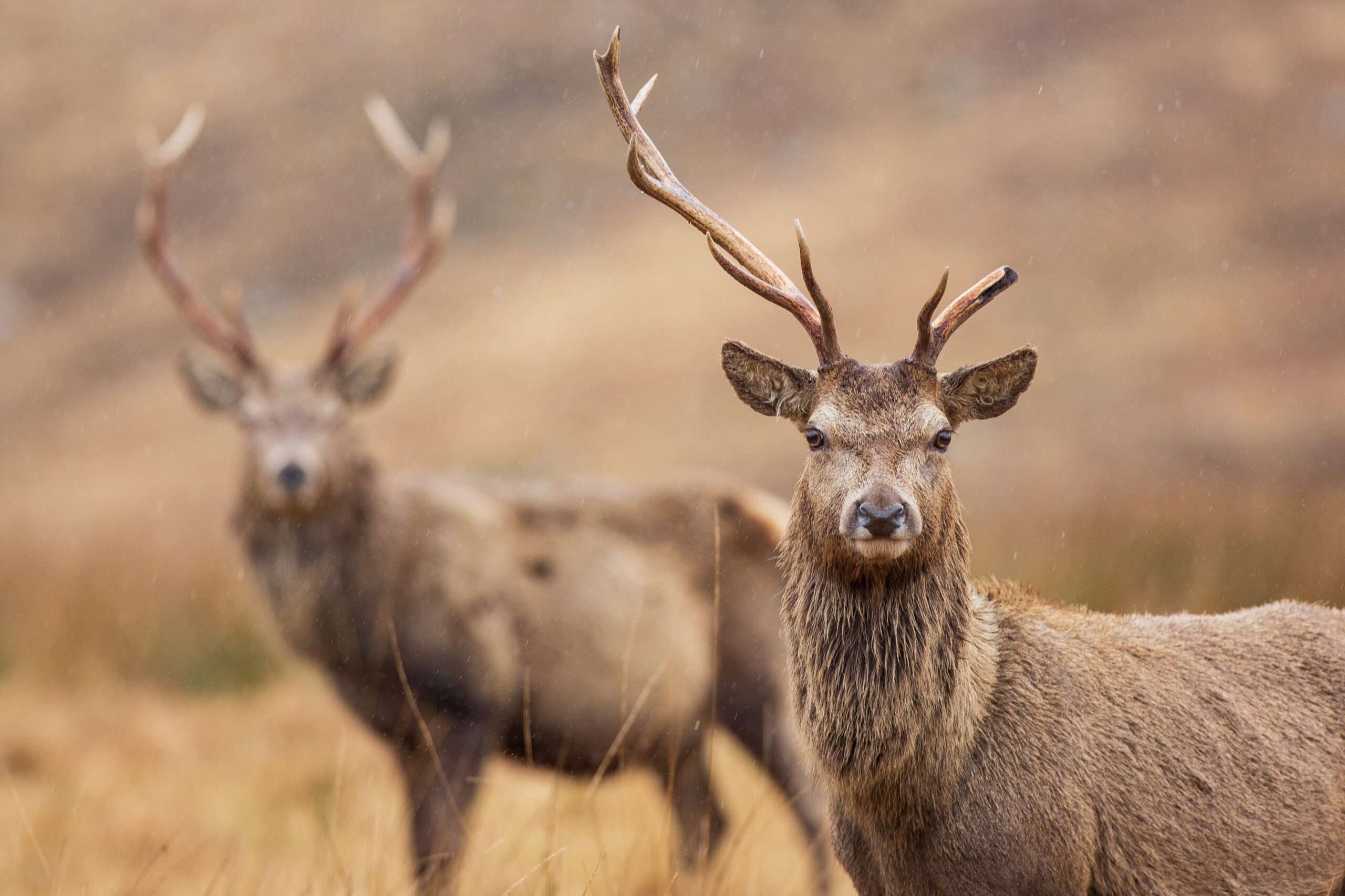
A pioneering scientific research project using GPS collars has been launched to track red deer movement and behaviour in the west Highlands to help land managers take informed decisions about how to manage deer health, numbers and habitats.
The study is a partnership project between charity Affric Highlands and Durham University, supported by the Association of Deer Management Groups. The study area includes a diverse network of landowners with different land management practices, such as sporting estates and conservation organisations.
Iconic and ecologically important animals
By strengthening understanding of how red deer move through and use the landscape, the initiative will provide scientific evidence to support future decisions and collaboration between landholdings on managing deer densities and restoring habitats such as native woodlands and peatlands.
“Red deer are a vital part of Scotland’s upland landscapes and rural economies – but increased populations have led to challenges in balancing ecological health, biodiversity, and land management objectives,” said Nicola Williamson, field officer for Affric Highlands. “Strengthening our understanding of how these iconic and ecologically important animals move across estates and habitats is key to recovering ecosystems and improving deer health. This in turn supports rural economies and livelihoods through skilled deer management, and sustainable sport and nature-based tourism.”
Innovative research
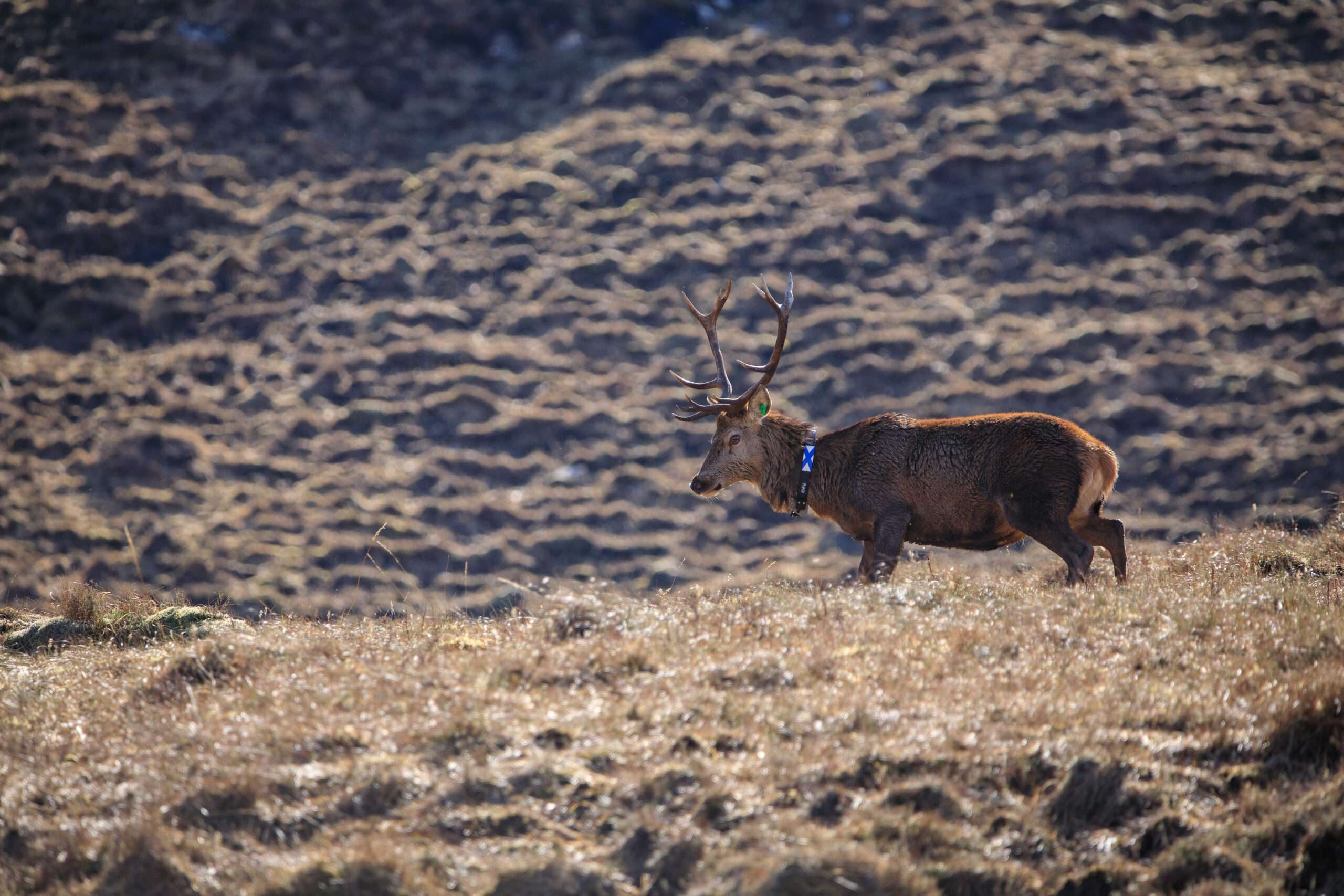
Collared stag. Photo: Siân Addison.
While deer management is a much-debated topic in Scotland, limited scientific data is available to help inform and support approaches to practical management and achieve biodiversity goals at landscape-scale. The research in the South Ross Deer Management Group area will deploy GPS collars on 22 stags from Glen Affric to the west coast. Twelve stags have already been collared, to be followed by a further 10 this winter. Six GPS ear tags have been deployed on deer calves to provide data on hind movements, with a plan to tag more calves next spring. The collars allow researchers to analyse where red deer prefer to be, and how they interact with the environment, including their habitat preferences during rutting, calving and foraging. Data will be stored on the collars, but also sent via satellite to EarthRanger – an app which allows deer stalkers to view deer movements and manually add their own observations.
Researcher Dr Eilidh Smith from Durham University said: “Through this innovative research, we’ll be tracking and mapping red deer movements to assess their seasonal migrations, home range sizes, and responses to human activities such as fencing, culling and commercial stalking. We’ll also conduct habitat surveys in areas where the GPS data reveal that deer have been foraging or sheltering, to analyse their environmental impacts.”
Scotland’s largest surviving terrestrial mammal
The project team will work closely with landowners and deer managers to support collaboration across landholdings for better-informed and sustainable deer management. So far, 18 deer stalkers from 14 sporting estates are involved, bringing invaluable knowledge of deer behaviour, built over decades of experience. The team at Affric Highlands is currently working to secure additional funding for the initiative, to enable more GPS collars to be deployed and to fund the collation of the two years’ worth of data for use by land managers.
The red deer (Cervus elaphus) is Scotland’s largest surviving terrestrial mammal, and a keystone species that plays a crucial role in natural processes, shaping the landscape by grazing grasses and sedges, browsing tree shoots and shrubs, and trampling and wallowing. But high red deer populations are a major barrier to the large-scale natural regeneration of native woodlands – continuing centuries of human-driven deforestation and negatively affecting deer health and welfare. Including roe deer and non-native sika, it is estimated there are around one million wild deer in Scotland, up from around 500,000 in 1990. Deer populations can range in densities, sometimes exceeding 40 deer per square km. Deer management is the UK’s single largest terrestrial wildlife management operation.
Support the Scottish Banner! To donate to assist with production of our publication and website visit: The Scottish Banner
Come to Salado the second weekend in November and step back in time to discover the world of ancient Scotland. Listen to the bagpipes play. See athletes Toss the Caber. Watch graceful Highland dancers. Hear a fiddler play and voices raised in ancient Scottish song.
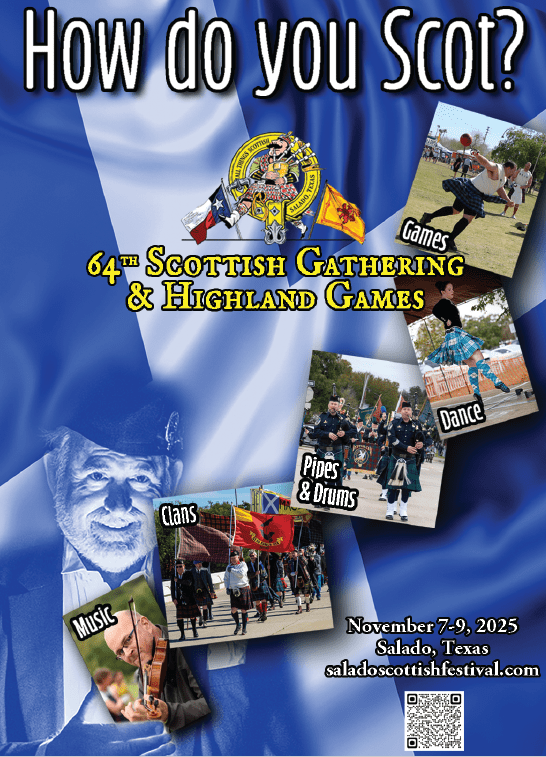
The Salado Scottish Gathering and Highland Games, a 3-day, family-friendly event, has been held the second weekend in November since 1961 and sponsored continuously by the Salado Museum and College Park. The 64th Scottish Gathering will be held November 7-9 on a beautifully wooded property beginning at 108 Royal Street.
Oldest Scottish festival in Texas
The Salado Scottish Gathering is unique in three ways: it’s the oldest Scottish festival in Texas; all its competitive events are internationally sanctioned; and all proceeds from the entire three-day event benefit the Salado Museum and College Park, a 501(c)(3) non-profit organization.
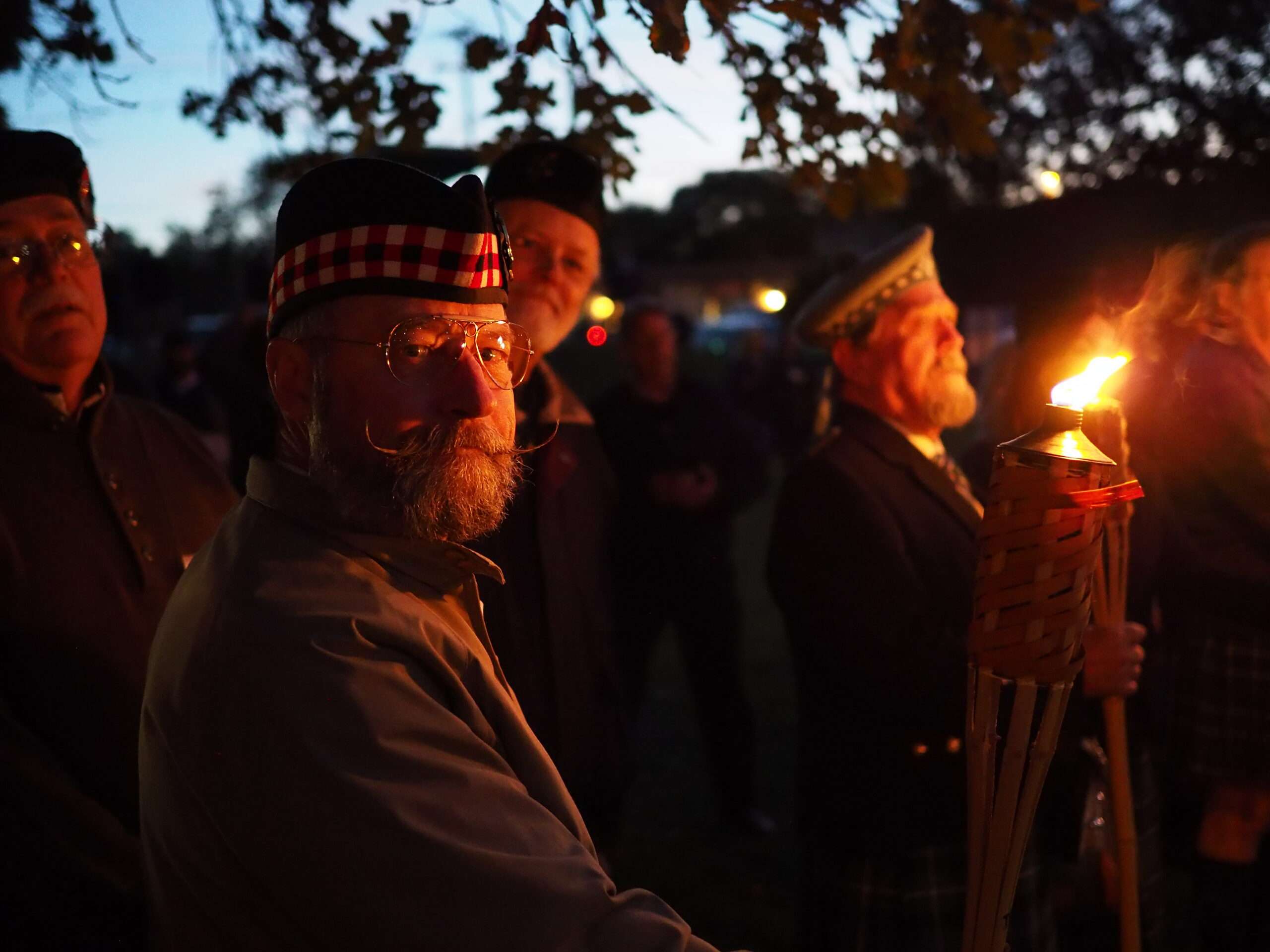
Events begin on Friday afternoon, with a live presentation in the Salado Museum on the history and music of Scotland. That evening the Calling of the Clans takes place at dusk on the banks of Salado Creek…a solemn torchlight ceremony that recreates the coming together of the ancient Scottish clans at Bannockburn in 1314 to fight with Robert the Bruce for Scotland’s freedom.
On Saturday morning, everyone gathers at the festival grounds for a day of Scottish history, heritage, music and merriment. You can visit the Clan Village, the largest gathering of Scottish Clan members in Texas, to find out how Scottish you may be.
Sound of bagpipes
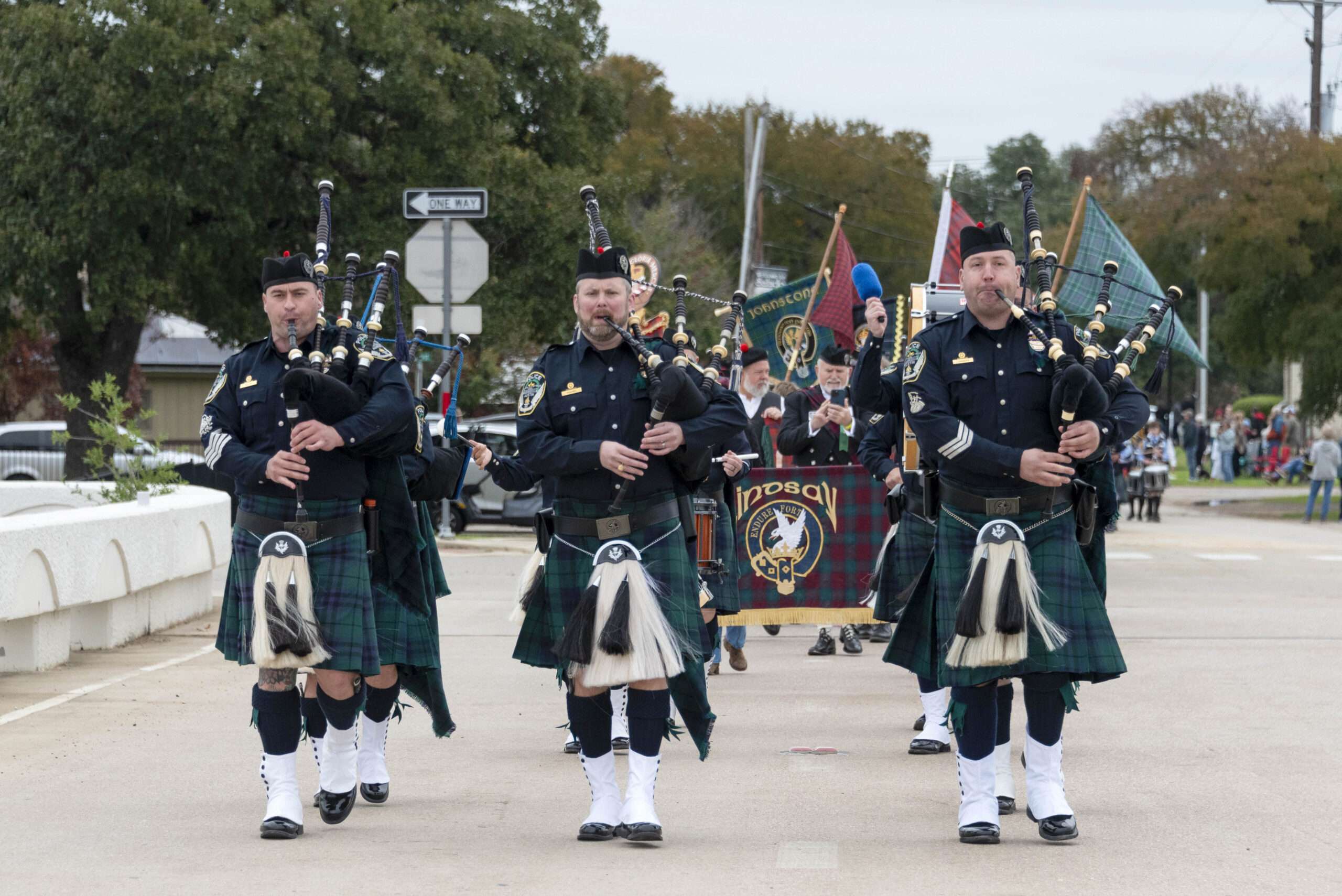
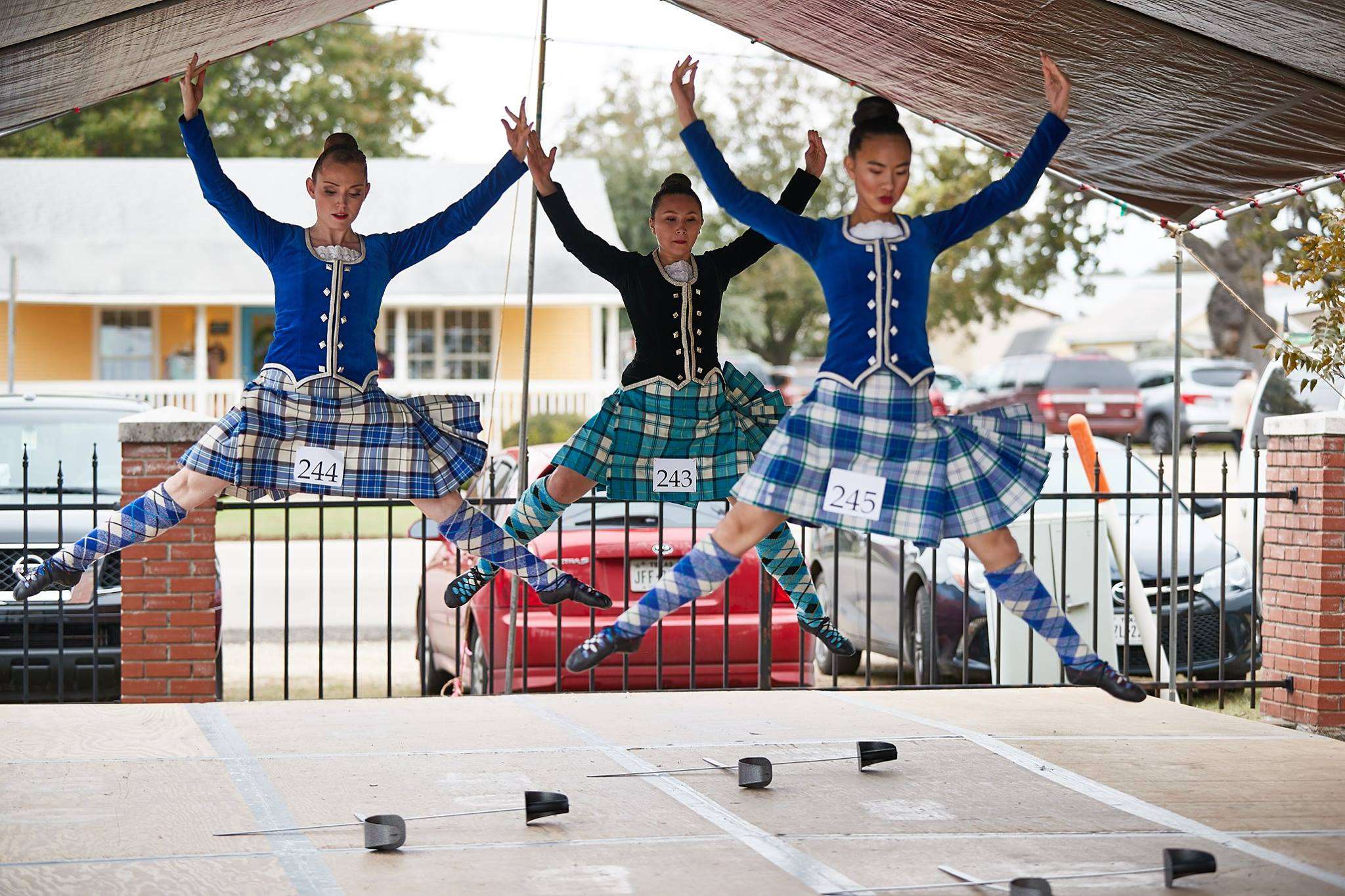
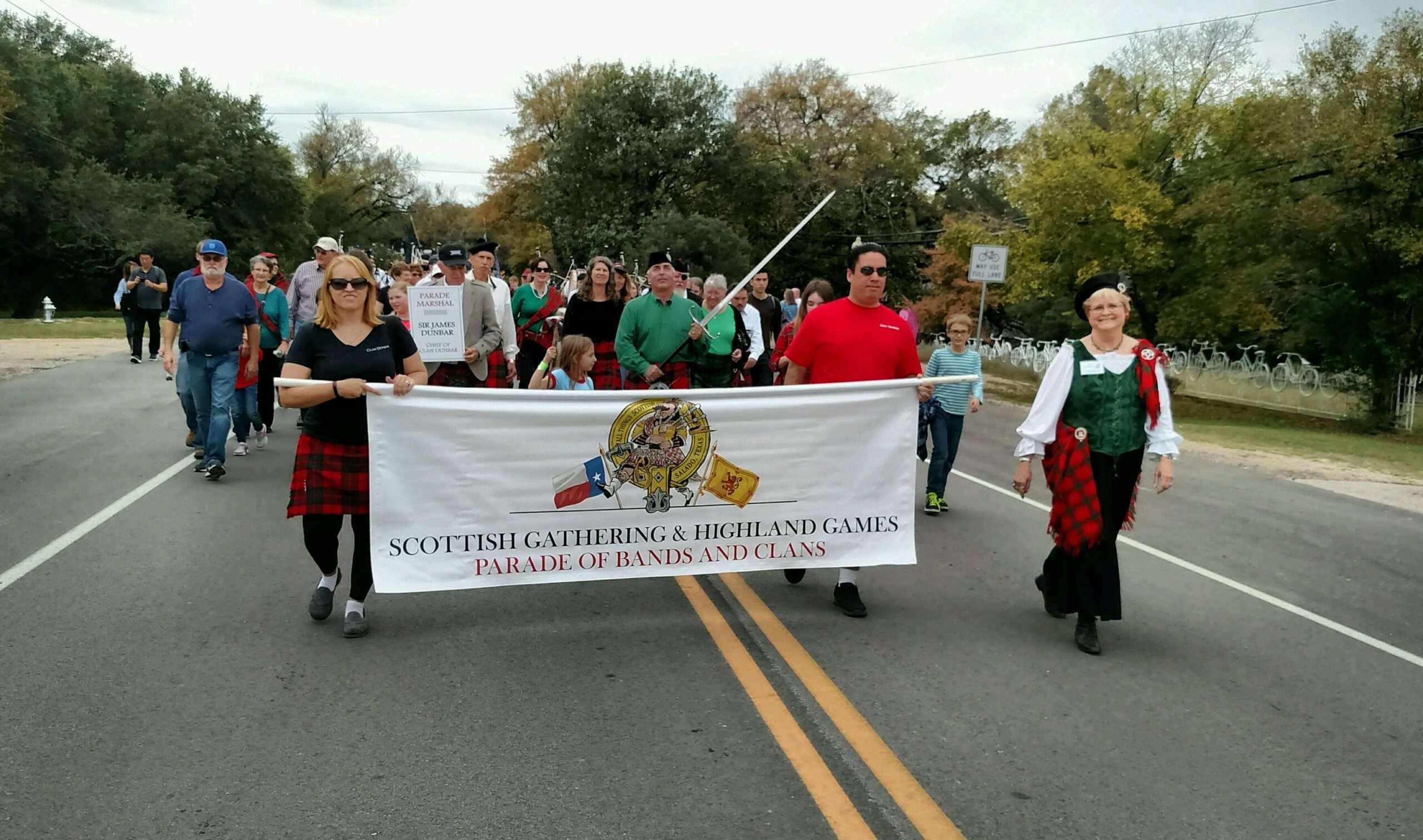
You can watch heavy athletics just as they were played in Scotland in ancient times. Enjoy the graceful movements of Highland dancers. Listen to pipers and drummers playing in competition. Or join in the fun of the rousing Bonniest Knees contest. At high noon bagpipe bands and clans with banners flying parade the streets of Salado from Main Street and South Pace Park Road to the festival grounds for the official opening ceremonies which includes the stirring sounds of the massed pipe and drum bands.
Saturday activities also include live Scottish singers and musicians, the traditional Scottish shortbread contest, local and Scottish food vendors, and everywhere…the sound of bagpipes and those men in kilts! Sunday starts quietly with the Kirkin’ o’ the Tartan, a traditional devotional service in which people carry tartan banners and ask blessings on their families. Activities continue till early afternoon with more bagpipers, dancers, musicians, shopping, a delightful Dog Costume contest and parade, and new this year, dog sheepherding demonstrations. There’s nothing else like it in Texas! If you’ve never been, make this your year.
For complete details and ticket prices, go to saladoscottishfestival.com or contact the Salado Museum at 254-947-5232.
By: Liz Houston Patranella
Support the Scottish Banner! To donate to assist with production of our publication and website visit: The Scottish Banner
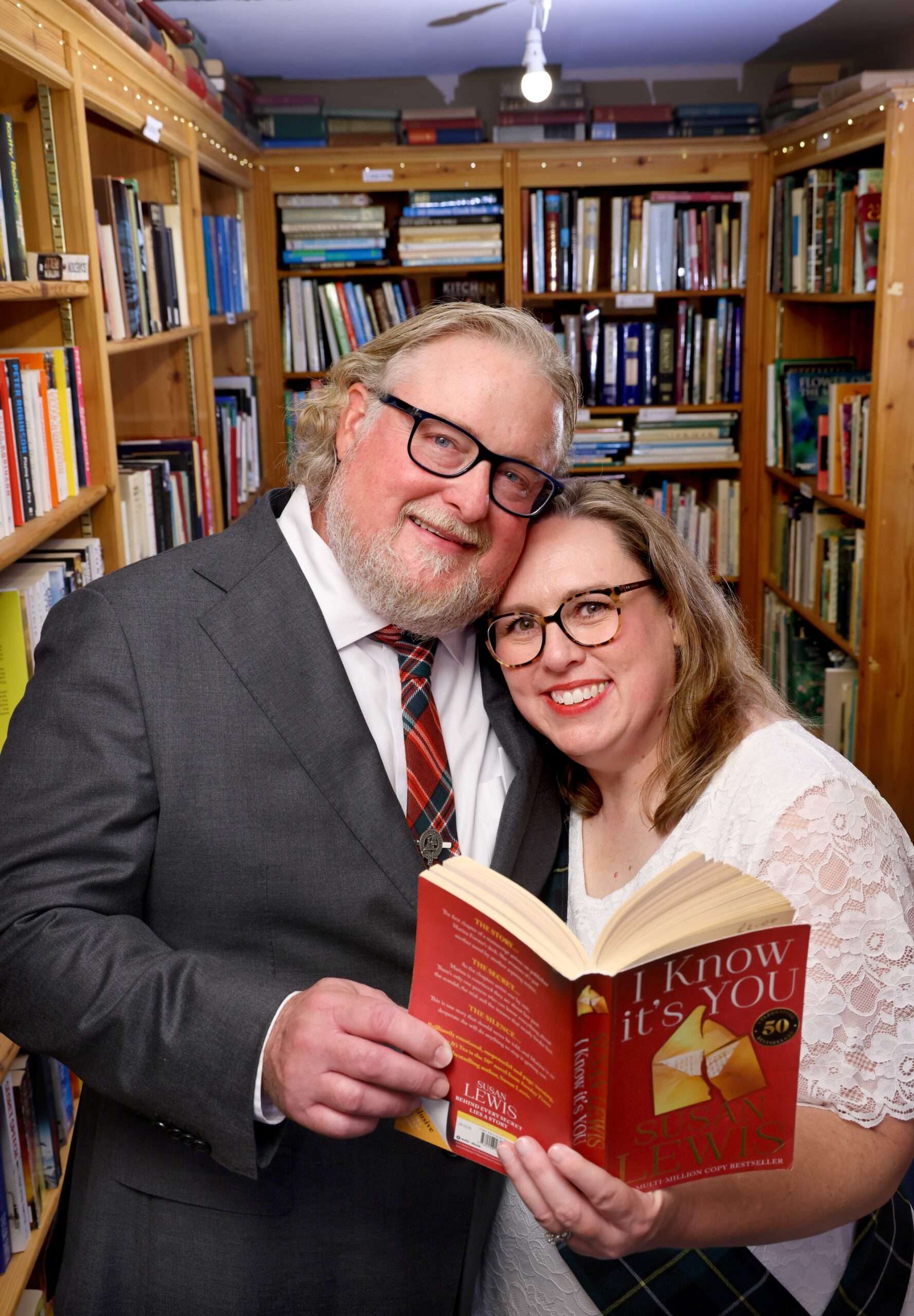
In a tale worthy of a romantic fiction bestseller the first ever wedding has taken place at the Open Book Airbnb bookshop. Located in Wigtown, Scotland’s National Book Town and home to its world-famous annual festival, the Open Book is rented to people who adore the idea of spending their holiday running a bookshop. But recently it had a very different role, becoming the focus for the fulfilment of a love story that stretches back over the decades and which crosses continents.
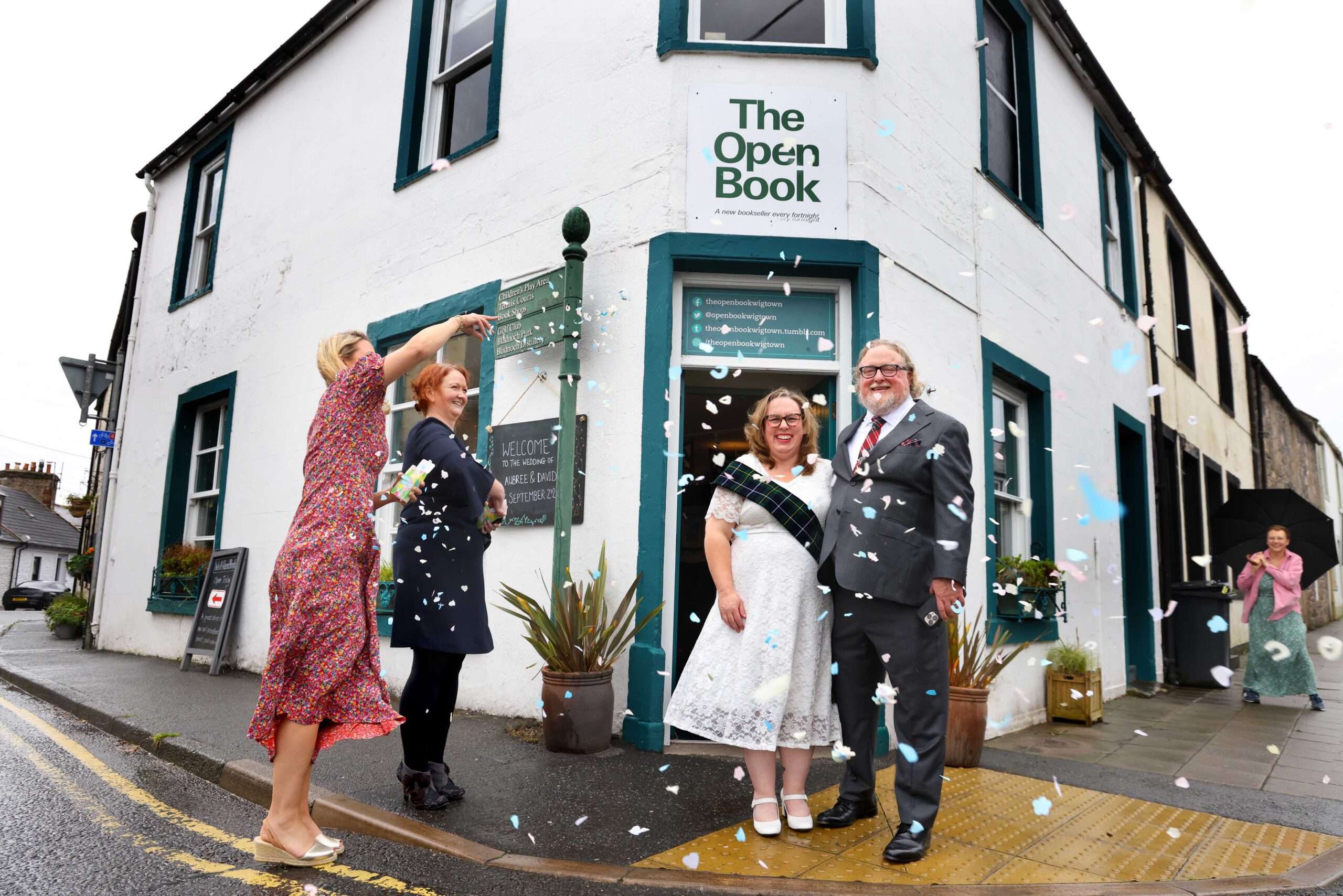
During a small and intimate ceremony in the heart of the tiny rural Galloway town Aubree Williams and David Casey from the USA finally became husband and wife – 35 years after first meeting in Norman, Oklahoma, and falling in love. David was a 23-year-old from Texas, attending the University of Oklahoma, and Aubree was 18 and came from Norman. Aubree said: “We met 35 years ago, it was our first proper adult relationship. But after a while we realised we were in over our heads. It was just too much for a couple of young kids, so we went our separate ways.”
Both married other people, with David returning to his home town of El Paso, Texas while Aubree stayed in Oklahoma where she has a career in marketing. The pair reconnected through social media after 20 years but the connection was distant for a long time, simply exchanging birthday and Christmas greetings.
The Scottish town where the bride feels part of her soul resides
Photos: Colin Hattersley.
But later, when going through a divorce, Aubree found she needed someone outside her family and social circle – with a fresh perspective – to talk to and the friendship with David was truly rekindled. “It was so good to have someone to really talk to again,” she said. In 2024 Aubree, an avid reader since the age of three with a particular taste for books about human endurance, found another, very different love – The Open Book.
She says: “It had always been my dream to run a dusty little bookshop, to not have to care about making a ton of money, but just to share my love of books and reading. And there it was, this Airbnb that let you do that, and in my favourite country in the world. I followed what people said about it on Facebook and couldn’t believe it. No place could be that lovely, that magical. My sister and I booked it in 2022 and came over in March of 2024. When we arrived we found it was true. I just fell in love with the people and the place, and I left part of my soul there.”
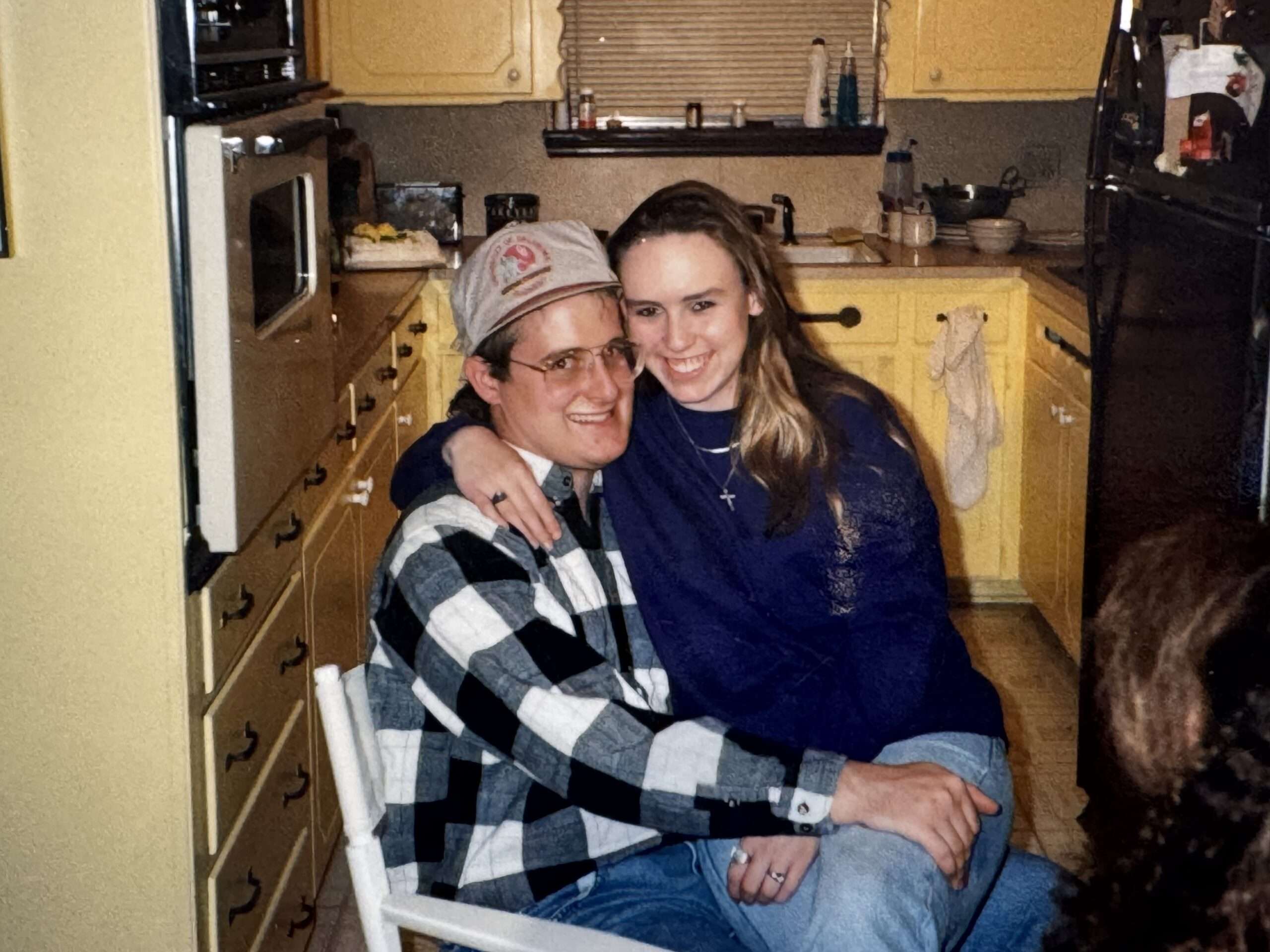
David and Aubrey in the 1990s.
When Aubree and David (a keen fantasy and sci fi reader) decided to wed the question came up of where to have the ceremony and David had a great idea. He said: “We had thought about just a register office, or perhaps Las Vegas, but I knew she felt that part of her soul is in Wigtown so that seemed the obvious place – I want to marry Aubree in her entirety.” They contacted Wigtown Festival Company (WFC), which runs the Open Book (established more than a decade ago as the world’s first Airbnb bookshop), to ask if it would be possible. Because the Open Book is booked up for a long time in advance, the company contacted the people who were due to be the tenants at the time the couple wanted to wed and asked if they minded hosting the special event.
Anne Barclay, WFC operations director and one of the bride and groom’s witnesses, said: “The Open Book has a very special magic and has become the bookshop at the heart of stories rather than just selling them. It simply couldn’t be more romantic – a teenage couple who were too young to make it work coming back together after decades and travelling thousands of miles to wed in the Scottish town where the bride feels part of her soul resides. It’s a wonderful love story and we were delighted to be able to help Aubree and David fulfil their dream. We all wish them every happiness for the future and hope they will return to visit us again in the future.”
Support the Scottish Banner! To donate to assist with production of our publication and website visit: The Scottish Banner
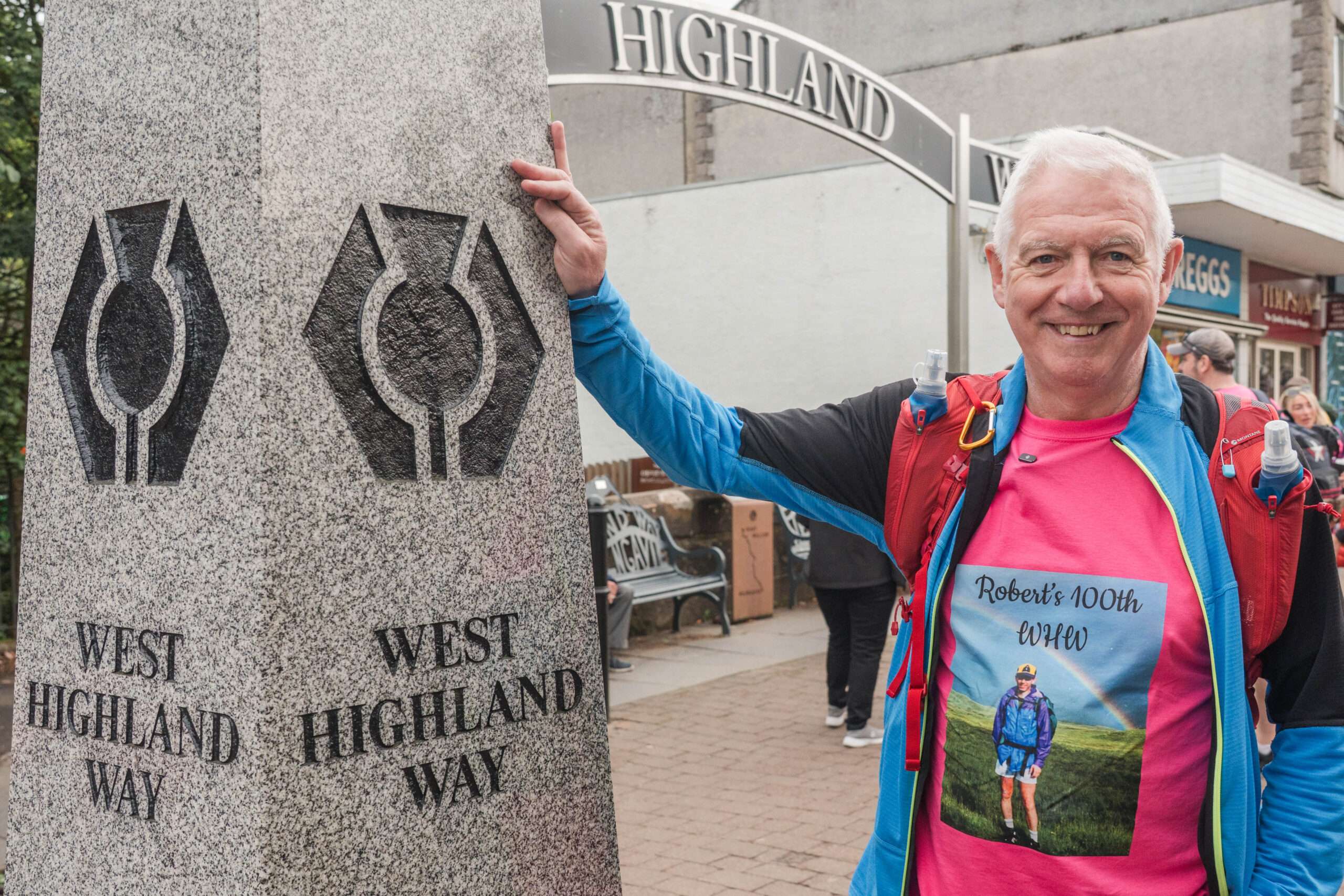
Robert Marshall completes his 100th walk – championing the future of the West Highland Way.
Robert Marshall made history recently by becoming the first person to complete the full 96-mile West Highland Way 100 times. What began as a personal challenge over 30 years ago has evolved into a lifelong passion.
Robert first attempted the 96-mile route in 1993, abandoning the walk at Rowardennan on the first day due to heavy gear and unsuitable footwear. Just weeks later, he returned, determined to succeed, and completed the route in three days with only trainers and a lighter pack. Since then, the West Highland Way has become his “keep fit walk,” keeping him healthy both physically and mentally.
Landmark achievement
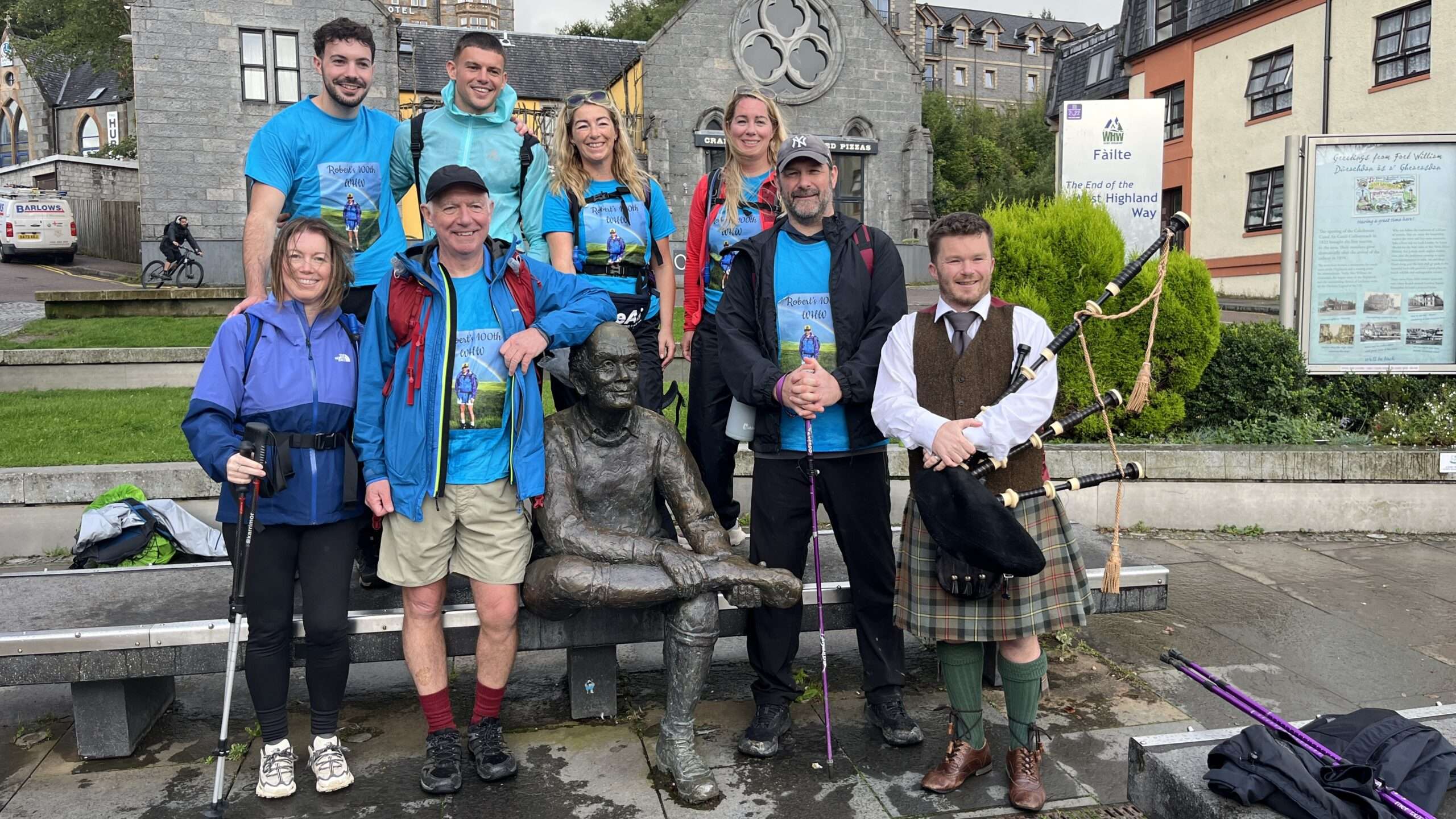
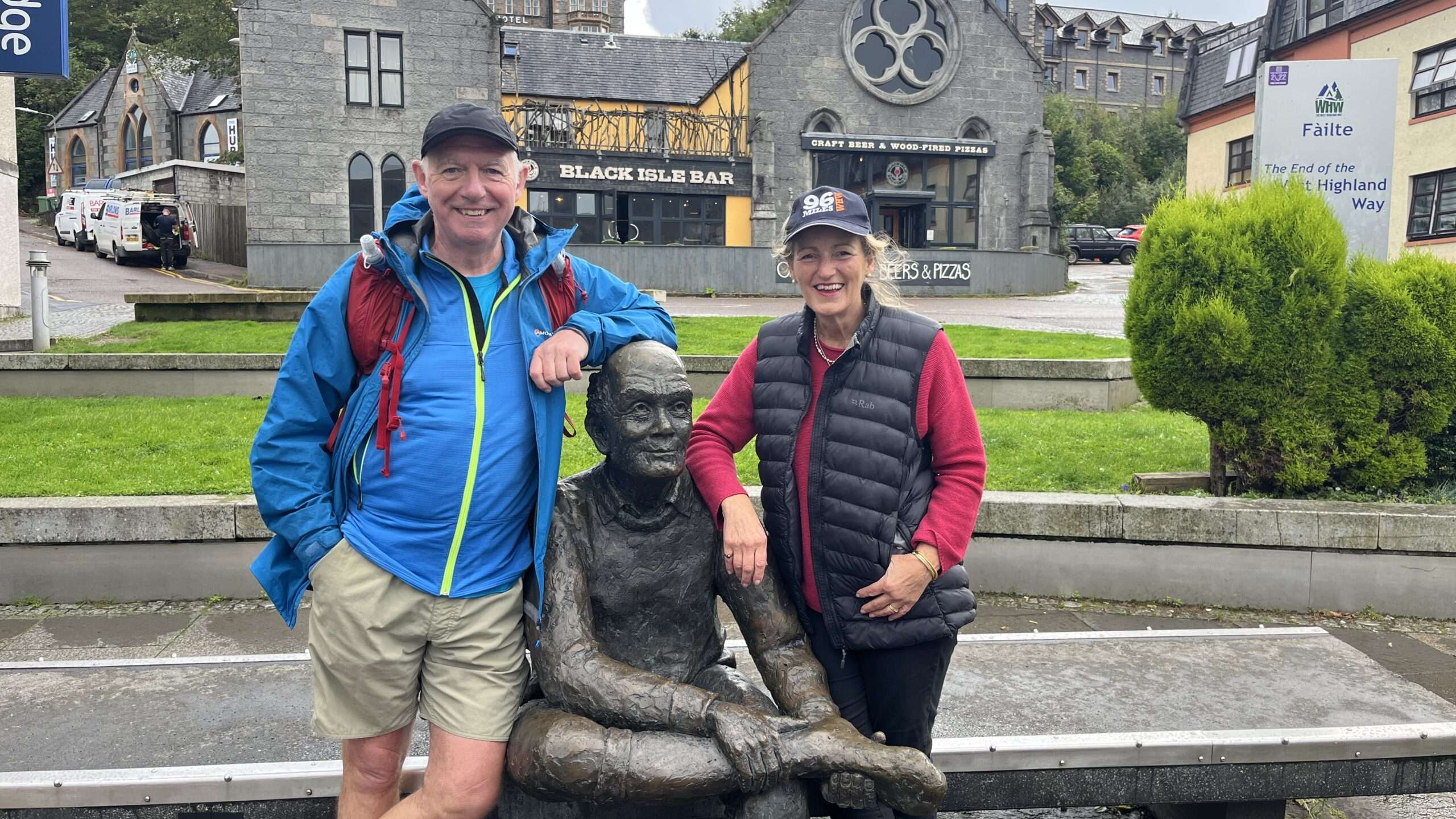
Robert Marshall at the ‘Man with Sore Feet’ statue at the end of the West Highland Way at Fort William with his six children and The Munro Bagpiper, who piped them across the finish line.
Over the years, Robert has walked the trail in all seasons, camping, bivvying, and sometimes using baggage transfer services. He has carried on despite health challenges, including two heart operations in 2017 and 2023. Now retired, he has been walking the route almost every month, determined to reach his 100th journey before his 70th birthday in November 2025. For his 100th walk, Robert was joined by his six children, Kirsty, 46, David, 43, Jennifer, 40, Yvonne, 40, Ciaran, 25 and Ross, 22, by his side. “I’ve had so many special moments on my walks. No two days or journeys are ever the same, but walking this time with all the family can’t be beaten. I’m pleased that this walk has helped raise attention to the need for all of us to support the maintenance along the 96 miles,” he said.
This landmark achievement is not just a personal triumph – it is also a fundraising mission. Robert has already raised thousands of pounds for the West Highland Way Trust, the new charity dedicated to protecting and maintaining the trail. Climate change and increasing visitor numbers are placing growing pressure on the route, making ongoing investment essential to keep it safe and accessible. Funds raised will support vital work, including drainage, signage, bridges, gates, vegetation management, and environmental care.
Scotland’s most loved trail
Robert Marshall with Carol Matthews, a trustee of the new West Highland Way charity.
Carol Matthews, a trustee of the new West Highland Way Trust, joined the crowd at Fort William to cheer Robert and his family across the finish line. She said: “Robert’s commitment is inspirational. We are so grateful that he has chosen to support the new West Highland Way Trust with this remarkable 100th walk. His efforts will help raise thousands of pounds to safeguard the future of Scotland’s most loved trail.” She added: “The West Highland Way is a global hiking icon, contributing around £20 million a year to Scotland’s rural economy. Its popularity brings huge benefits but also constant wear and tear. The Trust has been set up to fund the essential, often unseen work, renewing signs, maintaining drainage, repairing bridges, that keeps this 96-mile journey safe, sustainable and spectacular for the next generation.”
Opened in 1980, the West Highland Way stretches from Milngavie to Fort William, linking Scotland’s largest city to its highest mountain, via its largest loch. It is one of the UK’s best-loved trails, completed in full by over 45,000 people annually and enjoyed in sections by thousands more. On 6 October 2025, the West Highland Way celebrated its 45th anniversary.
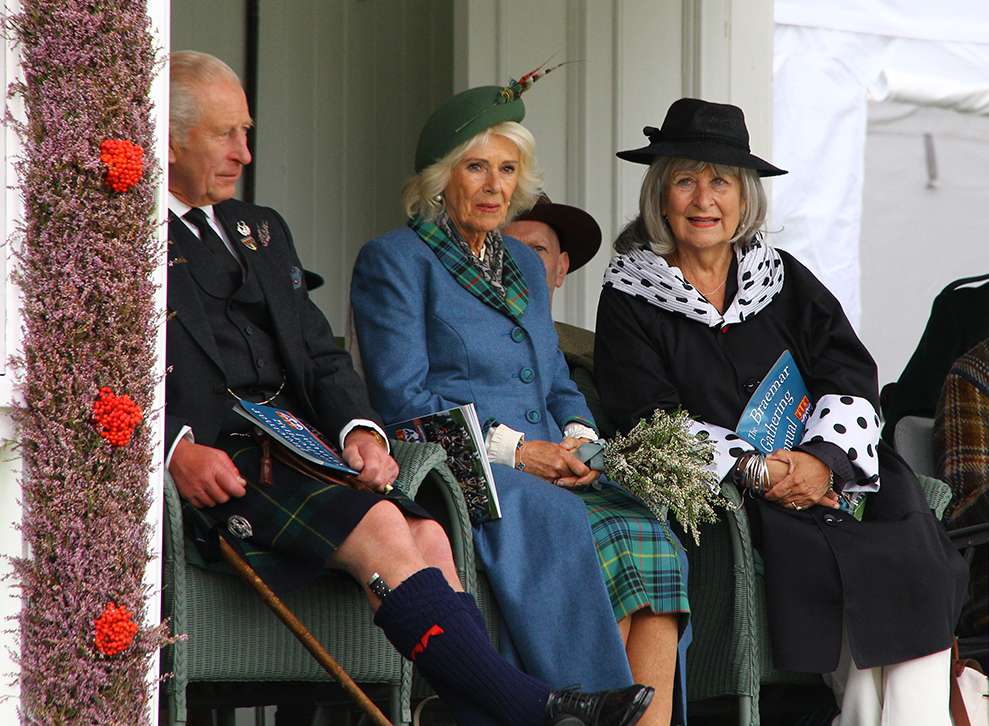
There were smiles from HRH King Charles III and Queen Camilla as the royal couple and their guests received a resounding welcome as they arrived at this year’s Braemar Gathering staged in the Princess Royal and Duke off Fife Memorial Park in the Highland village of Braemar.
King Charles was in kilt for the annual event, while Queen Camilla wore a blue coat with tartan collar. The Gathering was the third that the King has attended as monarch although he frequently attended while he was the Duke of Rothesay and with family as a youngster.
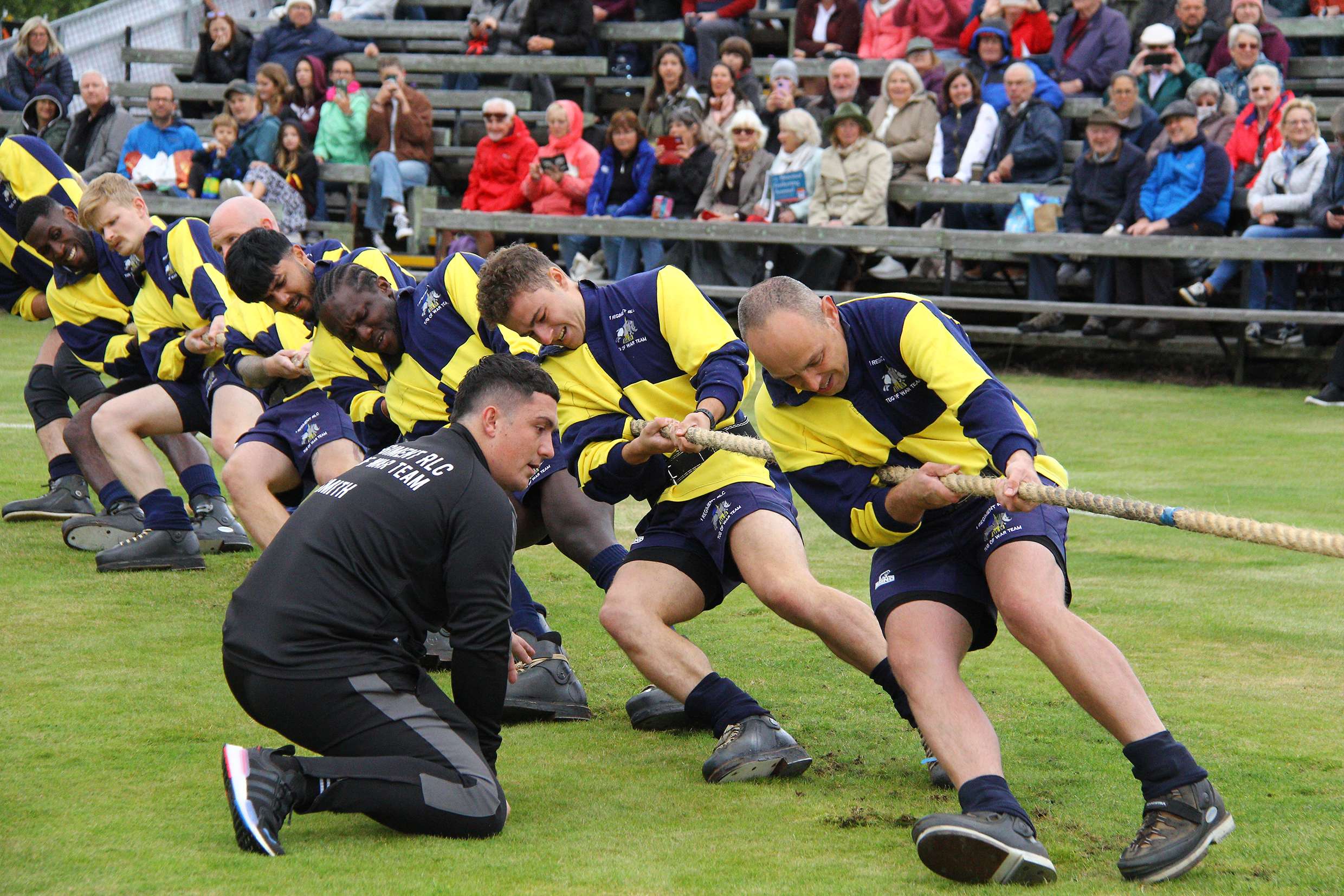
The Royal Logistics Corp. tug of war team.
Other guests alongside the Royal couple included Absolutely Fabulous actress Dame Joanna Lumley and her conductor husband Stephen Barlow as well as peer and human rights lawyer Helena Kennedy-Baroness Kennedy of The Shaws.
The Gathering is perhaps the most famous event on the Highland Games circuit. Held close to the Royal Highland residence, Balmoral, it takes place every year on the first Saturday in September.
Traditional Highland Games
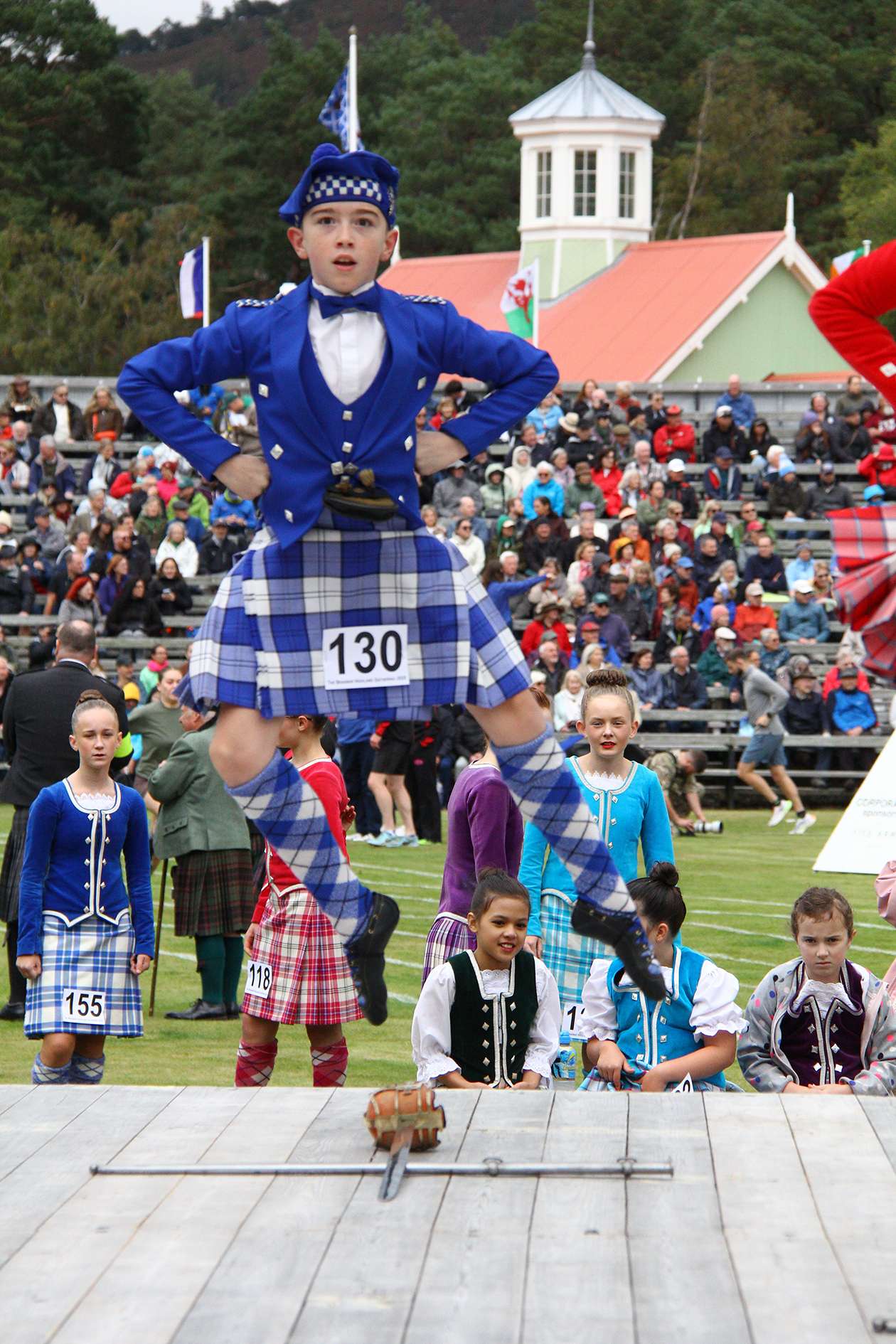
Highland dance on display.
The popular event has been running in its present form since 1832. It is believed to have originated from ancient games held by King Malcolm III. It has been attended regularly by the reigning monarch and other members of the royal family since 1848, when Queen Victoria was a guest. At that time, it was held at Invercauld estate and Balmoral castle on a rotational basis. In 1866, by command of Queen Victoria, Royal was added to Braemar Highland Society title and, in 1906, the Duke of Fife presented 12 acres of ground in the village to create the Princess Royal and Duke of Fife Memorial Park, the current home of the Braemar Gathering.
Massed bands in the arena.
The event features a host of traditional Highland Games contests, including tug-of-war and the caber toss, along with performances from pipe bands and Highland dancers. The programme this year featured more than 80 individual events. The reigning monarch is patron of the Gathering and takes on the title of Chieftain.
The next Braemar Gathering will take place Saturday 5th September 2026. For details see: www.braemargathering.org
Main photo: King Charles and Queen Camilla in the Patrons Pavilion with Baroness Kennedy of The Shaws.
All images courtesy of the Braemar Gathering Annual.
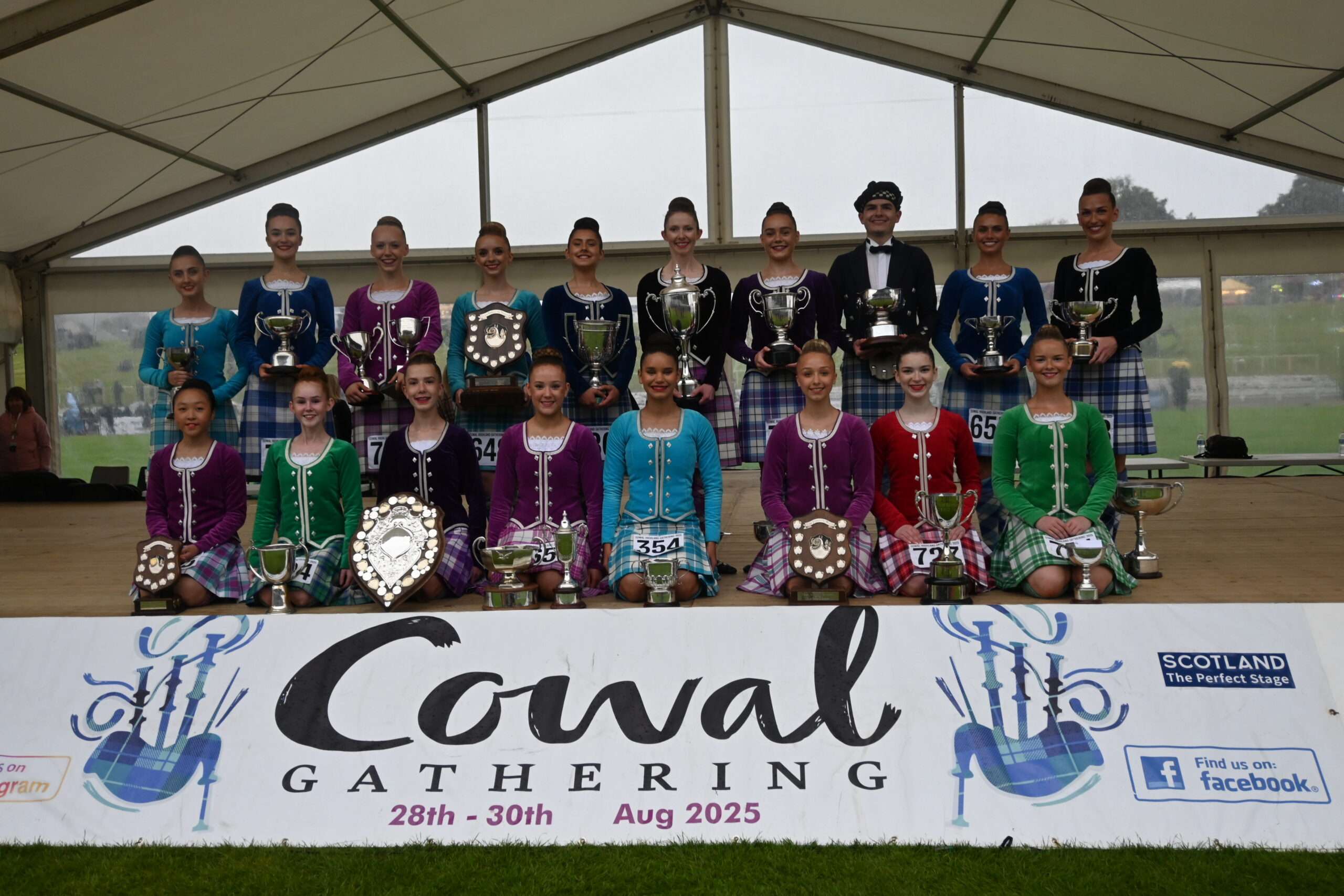
This year’s Cowal Gathering was again full of fierce competition, as thousands of spectators from across the globe descended on Dunoon to witness one of Scotland’s most iconic and family-friendly events. Regarded as one of the country’s best days out, the Gathering’s grand finale more than lived up to expectations. From Highland dancing and pipe bands to daredevil ducks, live music, and traditional heavy athletics, ‘Super Saturday’ delivered non-stop entertainment from early morning until nightfall.
More than 1,000 competitors showcased their skills, with dancers, pipers, wrestlers, and heavy athletes battling it out for coveted Cowal silverware. Adding to the excitement were this year’s Chieftains—renowned stars of STV News Sean Batty and Laura Boyd, who oversaw the day’s action. The event culminated in the World Highland Dancing Championship Finals—the largest competition of its kind globally. Dancers from the UK, Australia, Canada, and the USA competed for international glory.
World Juvenile Champion – Aisla Gocan-Wright from Ontario
2nd: Ellie Murgha from Queensland
3rd: Lucy McMaster from Carluke
Best Scottish Juvenile Dancer was Lucy McMaster
Best Overseas Juvenile Dancer was Aisla Gocan-Wright
World Junior Champion – Eilidh Gammons from Helensburgh
2nd: Katjana Bruinsma from Alberta
3rd: Maria Monk from Glasgow
Best Scottish Junior Dancer: Eilidh Gammons from Helensburgh
Best Overseas Junior Dancer: Katjana Bruinsma from Alberta
World Adult Champion – Marielle Lesperance from Nova Scotia
2nd: Rebecca Thow from Aberdeen
3rd: Rosey Watt from Macduff
Best Overseas Adult Dancer: Marielle Lesperance from Nova Scotia
Best Scottish Adult Dancer: Rebecca Thow from Aberdeen
Cowal Gathering Chairman David Mitchell MBE hailed the 2025 event as one of the most memorable yet: “We’ve just experienced a Cowal Gathering that will go down in history. From outstanding performances to electric crowds and family-friendly fun, it’s been a celebration of everything that makes this event so special. I want to thank the people of Dunoon and the wider Cowal community, as well as our fantastic competitors, sponsors, and visitors from around the world. This year’s event has been marked by world-class talent and incredible support, and we’re already looking forward to welcoming everyone back in 2026.”
Photo: This year’s World Highland Dancing Championships with World Juvenile World Champion Ailsa Gocan-Wright 5th from left back row, World Junior Champion Eilidh Gammons 6th from left and World Adult Champion Marielle Lesperance 7th from left.
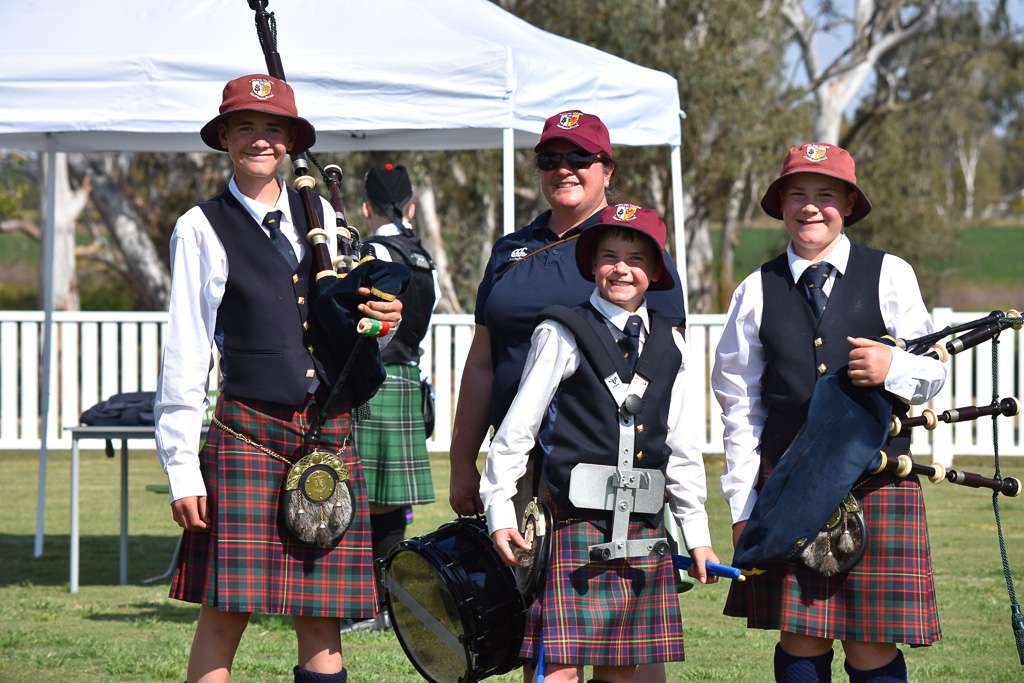
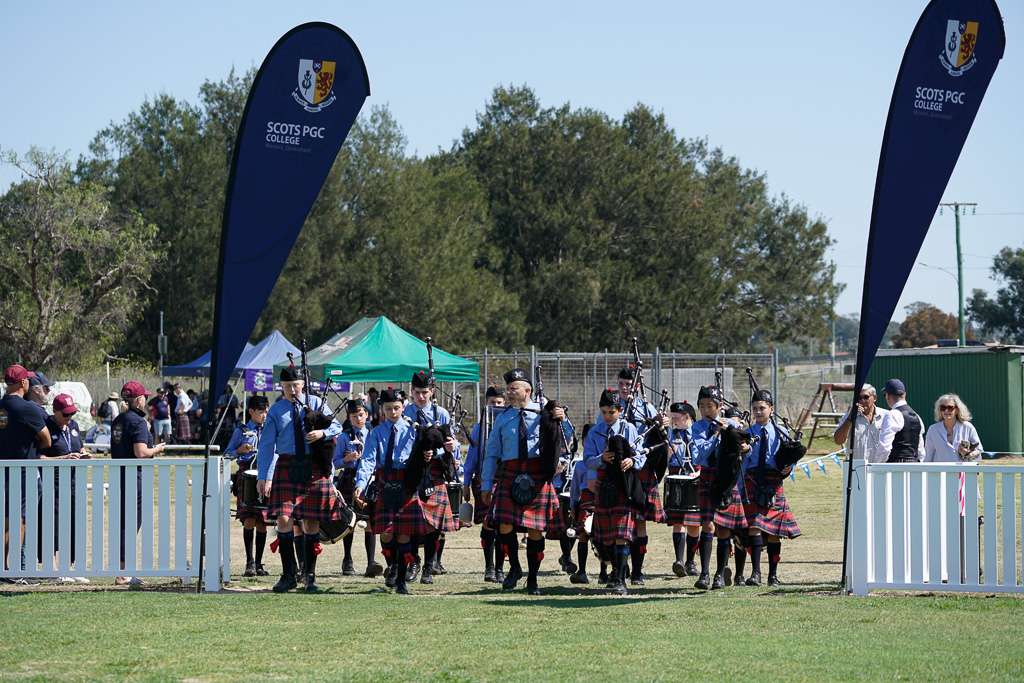
For the first time, two Australian national pipe band championships will be staged together in regional New South Wales, with the Australian Solo Championships and the Australian Juvenile Championships taking place from Friday 3 to Sunday 5 October 2025 at The Scots School, Albury.
The event will feature more than 300 performances across the weekend, as competitors aged from 12 through to over 70 take to the stage in a celebration of music, culture, and competition.
Australian Juvenile Championships
The Australian Juvenile Pipe Band Championships shine a spotlight on the next generation of pipers and drummers. Held every second year in rotation with the Australian Pipe Band Championships, the Juvenile Championships provide a stage for young musicians to perform in both solo and band settings, with opportunities that extend beyond traditional contest elements.
This year’s event continues that mission by creating a friendly, supportive environment for players who may be new to competition, while also showcasing the incredible talent and commitment of Australia’s youth pipe band community.
Australian Solo Championships
The Australian Solo Piping Championships have a proud history dating back to 1961, In 2025, the Championships return to New South Wales. Over three spectacular days, Australia’s top pipers and drummers will compete head-to-head for national titles across multiple disciplines; from marches, strathspeys and reels to hornpipes, jigs and the classical piobaireachd. This event represents the pinnacle of solo performance in Australia, crowning champions who are recognised as leaders of their craft worldwide with many performers either returning from or planning for competition in Scotland and Europe more broadly.
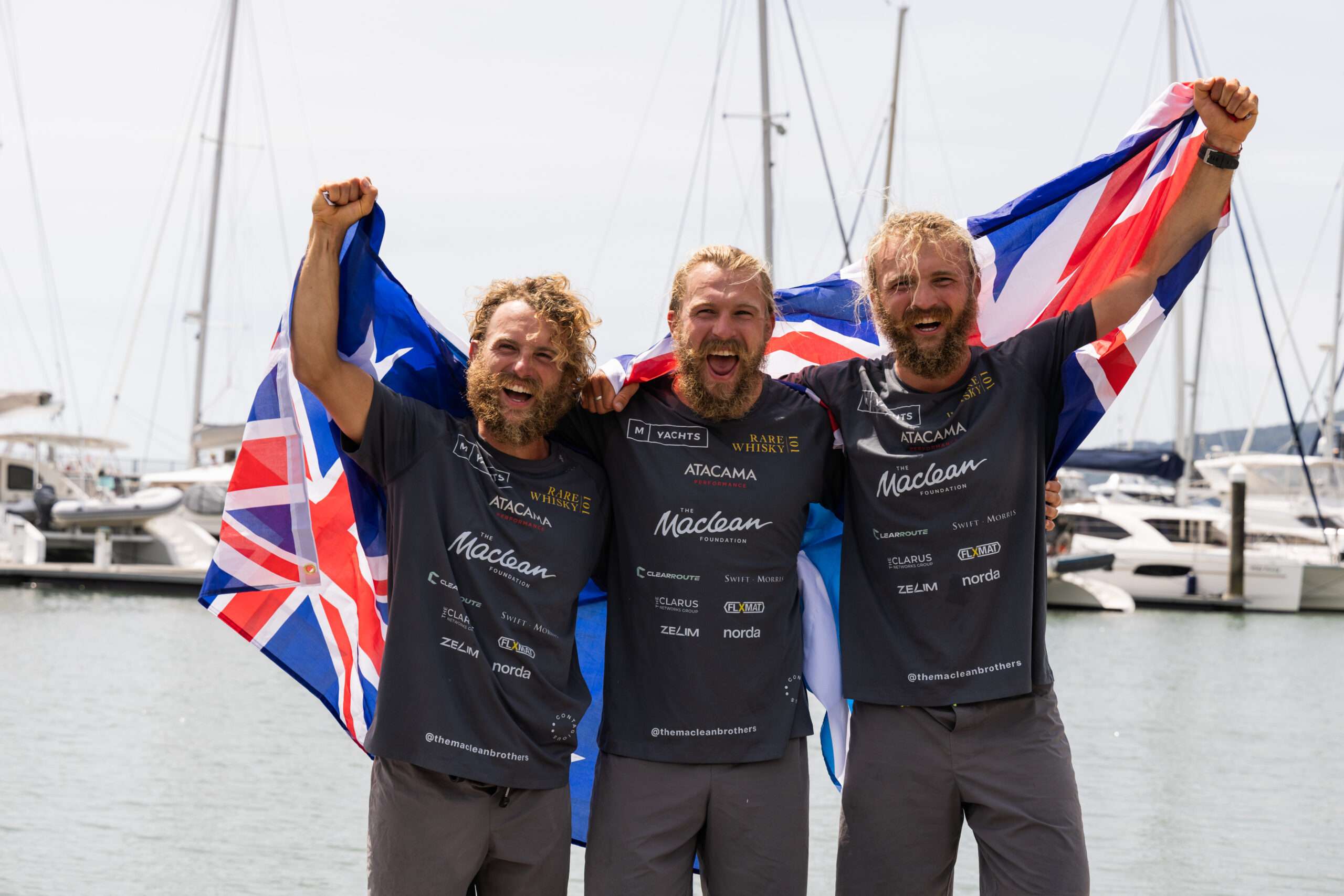
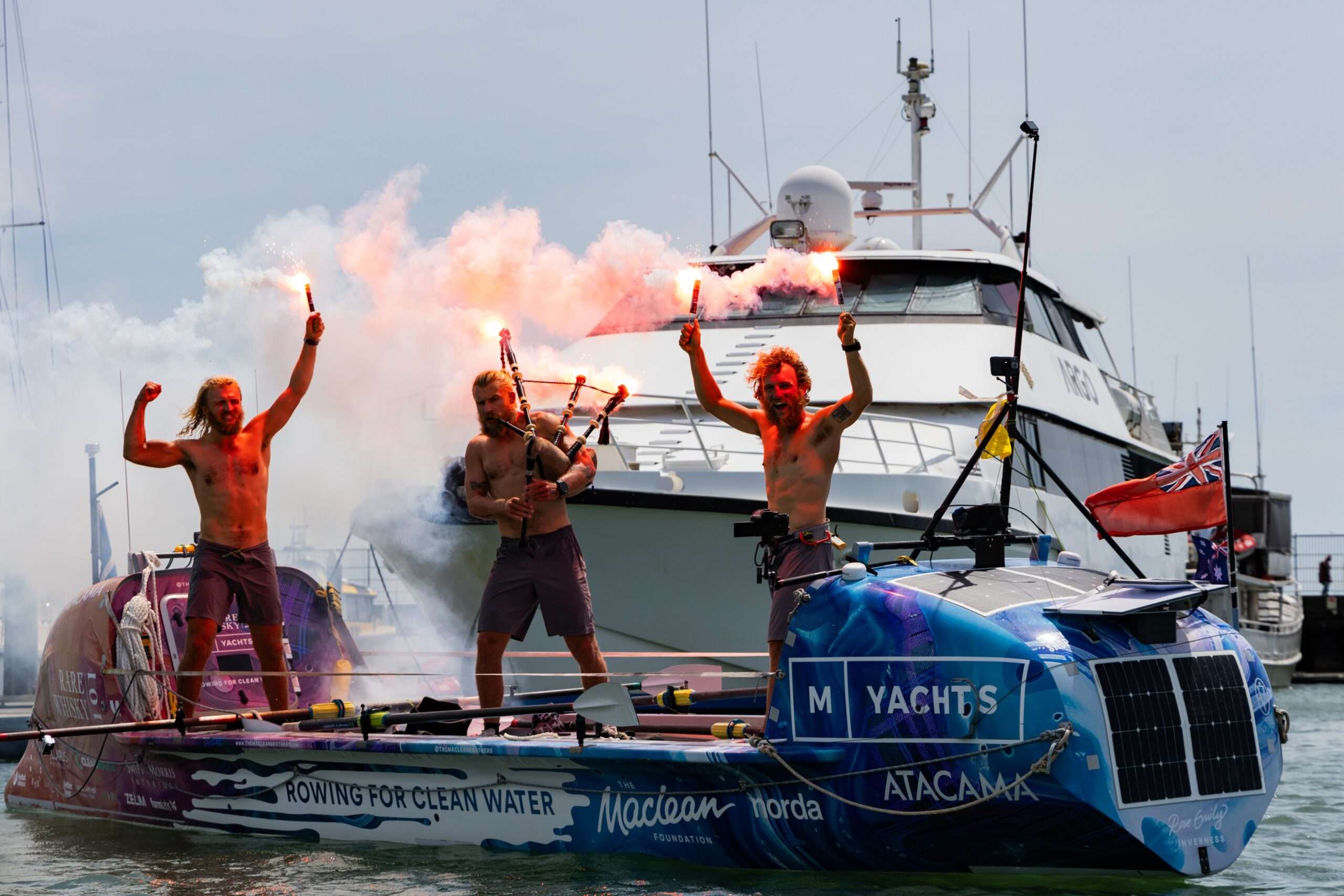
Three Scottish brothers have set a new world record after completing the fastest human-powered crossing of the full Pacific Ocean. Rowers Jamie, Ewan, and Lachlan Maclean arrived in Cairns, Australia on Saturday August 30 , following a mammoth 139 days 5 hours and 52 minutes at sea as they rowed 9,000 miles across the world’s largest ocean. The Edinburgh-born trio are the first team ever recorded to row from South America to Australia. The previous fastest time to cross the full Pacific Ocean was 159 days 16 hr 58 mins, achieved by Fedor Konyukhov (Russia), who rowed 7,393 miles (6,424 nautical miles; 11,897.9 km) from Chile, to Australia in 2014.
The trio took on the epic challenge to raise awareness and fund projects that provide clean water for life to people living in Madagascar through their Maclean Foundation, and have so far raised more than £1 million as supporters from around the globe – including megastars Ewan MacGregor, Mark Wahlberg, and Flea – rallied behind the campaign. The voyage, which began on April 12, threw significant challenges at the rowers, including Ewan and Jamie facing crippling seasickness for the first two weeks; a terrifying scare with Lachlan thrown overboard during a night shift only to be pulled back on the boat by his older brother Ewan; and a race against time to complete the row as extreme weather conditions stalled their progress, and caused a fast-depleting food supply to complete the row. The adventurers also had to deal with a broken water maker, faulty auto helm, and countless injuries as they spent up to 14 hours per day on the oars.
Once-in-a-lifetime adventure
The Scots were reunited with more than 50 friends and family who made the trip from the UK, including their mum, Sheila, as well as hundreds of fans at Cairns Marlin Marina. Middle brother Jamie (31) said: “Things got tough towards the end and we seriously thought we might run out of food. Despite how exhausted we were, we had to step up a gear and make it before supplies ran out, but now we get to eat proper food. Ocean rowing has given us newfound appreciation for things we used to take for granted – like going for a shower, lying in bed, or simply leaning on something stationary. It was the most incredible, relentless and often surreal experience of my life. While I might miss the routine, the solitude, the sunsets, and sunrises and so much more, right now I’m just very glad to be back on land with my friends and family who I’ve missed so much. The whole thing will take a while to sink in.”
While the mid-Pacific, from California to Hawaii, is well travelled, relatively few have attempted the full Pacific from South America to Australia. Earlier this year, Lithuanian solo rower Aurimas Mockus had to abandon his Pacific crossing attempt due to Tropical Cyclone Alfred. Ewan (33), who left his job as an engineer at Dyson to take on this once-in-a-lifetime adventure, added: “The days have been long and yet the weeks have flown past, it’s strange to think of the time that we’ve spent out here.This has been the hardest thing I’ve ever done, and I couldn’t have even contemplated it without my brothers. There have been countless setbacks to overcome, some leaving us lost, but we’ve always lifted each other up. We’ve shed tears of joy and laughed till our cheeks hurt. And at times we’ve cried with sadness and with fear, but our spirits have been lifted, time and time again, by the support of so many rallying behind us.”
Global attention
The row captured global attention, with Wahlberg – who said he wanted to play the trio in a movie – keeping especially close attention, even joining the brothers for an Instagram live to wish them luck in the others prior to arrival. Jamie played bagpipes to Ewan McGregor from the ocean, while Sam Heughan and Flea from the Red Hot Chilli Peppers were also among those calling in to the boat to show support. The All-American Rejects invited Jamie to join the band’s performance at Comic Con in San Diego live from sea, playing the intro to their hit Swing-Swing on the bagpipes. As well as online donations, many have been inspired to take on a charity challenge of their own, from Chamberlain Care Home’s weekly physio rowing sessions to a five-year-old running a mile every day of his school holidays.
Youngest brother Lachlan, who marked his 27th birthday during the five-month voyage, was inspired to support clean water projects in Madagascar after visiting the country following university. He said: “We’ve completed the row, but the journey isn’t over. We have a charity target of £1 million ($2.06m AUD) which will provide clean water for life to 40,000 people living in Madagascar, and we won’t stop until we get there. Clean water is the most basic of needs, and it’s too often taken for granted. While we’re looking forward to getting back to Scotland to see our dad, and to enjoy life back at our croft in Nedd in the Highlands, we’re also very excited to get back out to Madagascar as it’s a very special place for us.”
The brothers’ boat, Rose Emily, was named after the sister they never knew, as their parents lost her during pregnancy. The boat, which the brothers built alongside ocean rowing legend Mark Slats, is believed to be the fastest and lightest ocean rowing boat ever made. The brothers first caught the bug for ocean rowing in 2019 when they set out to row the Atlantic Ocean. Despite being relative novices to the sport, the trio broke three world records when they rowed from La Gomera in the Canary Islands to Antigua in 35 days.
The expedition was in support of The Maclean Foundation, which funds clean water projects in Madagascar and beyond. To donate and keep up with The Maclean Brothers, visit www.themacleanbrothers.com.
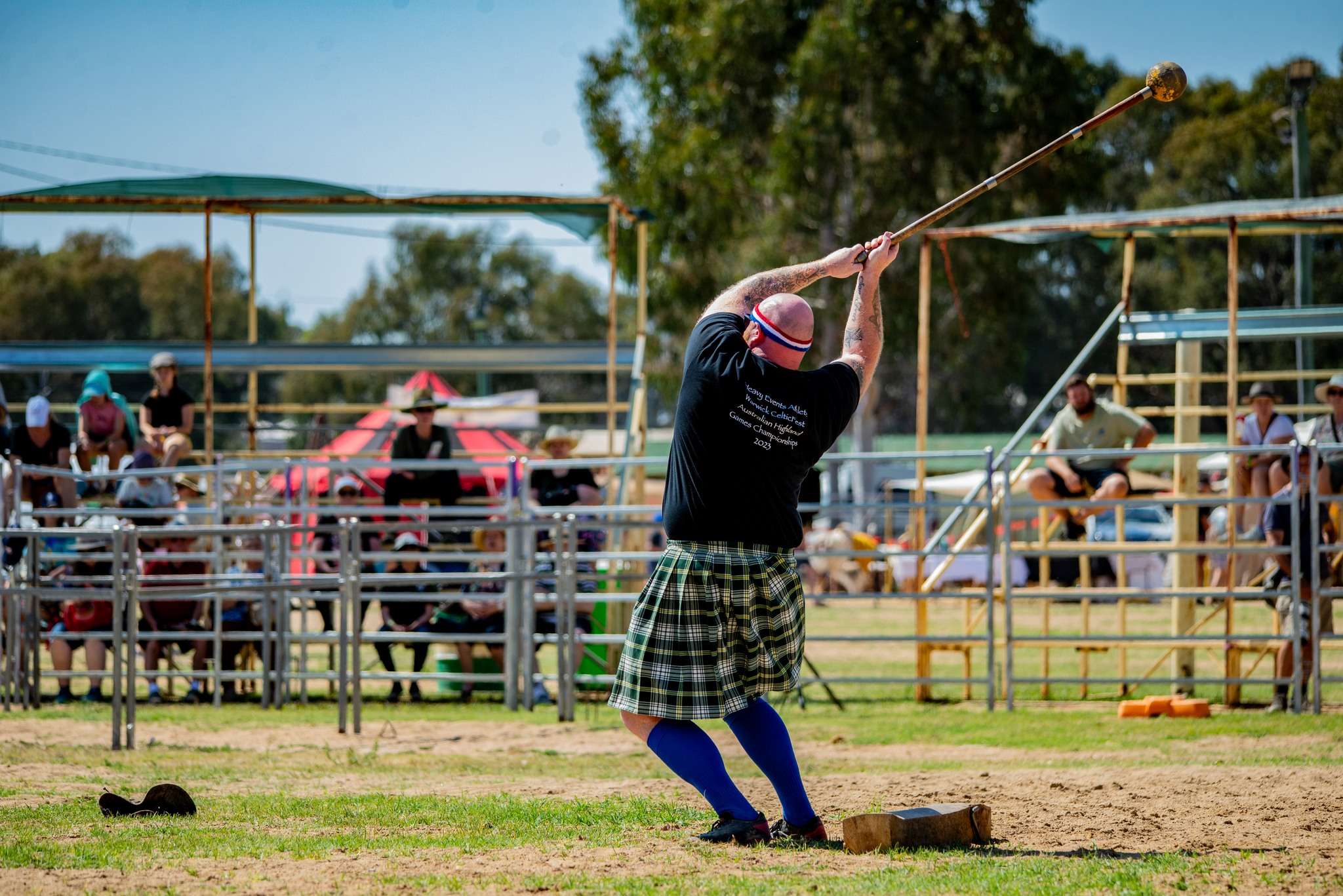
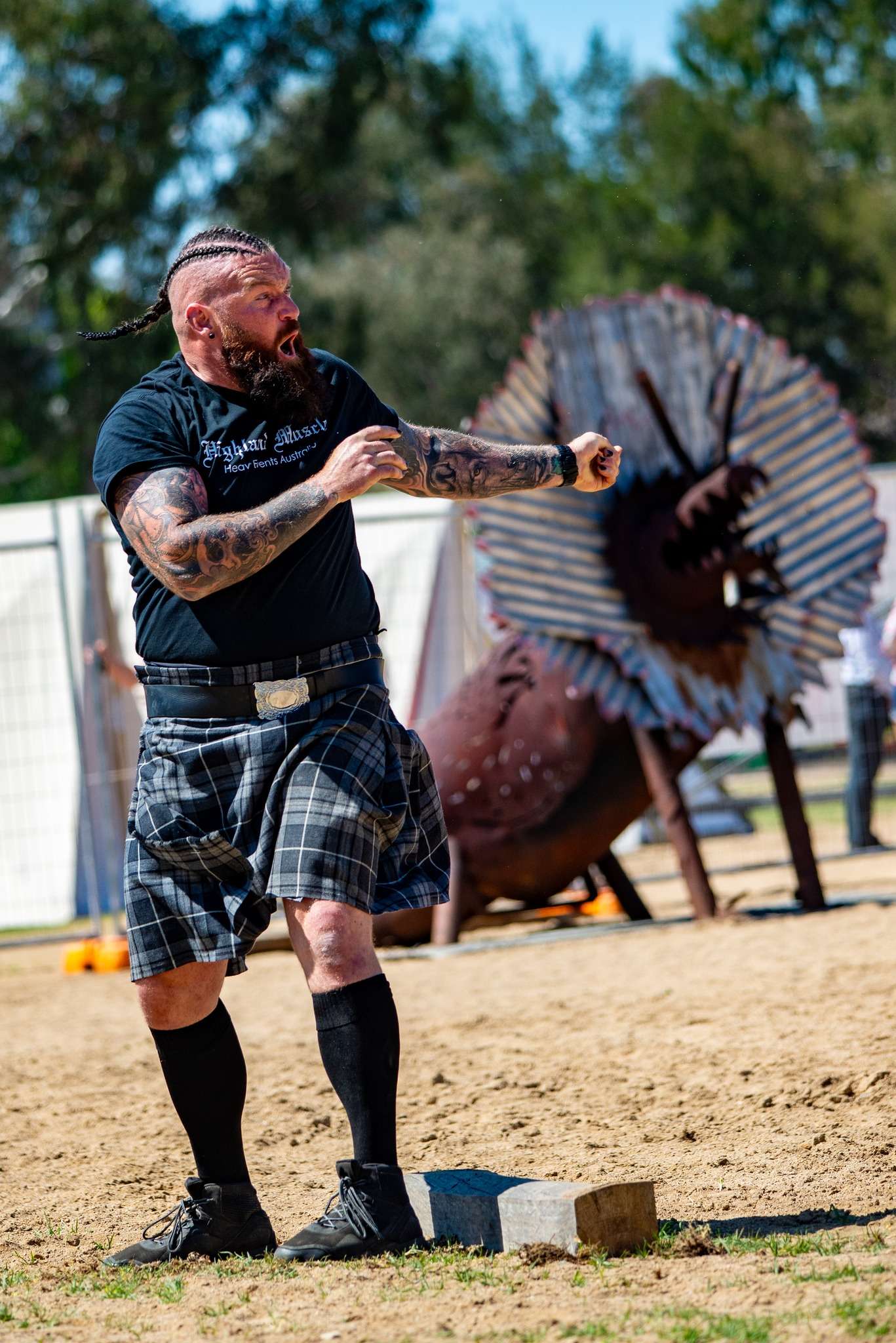
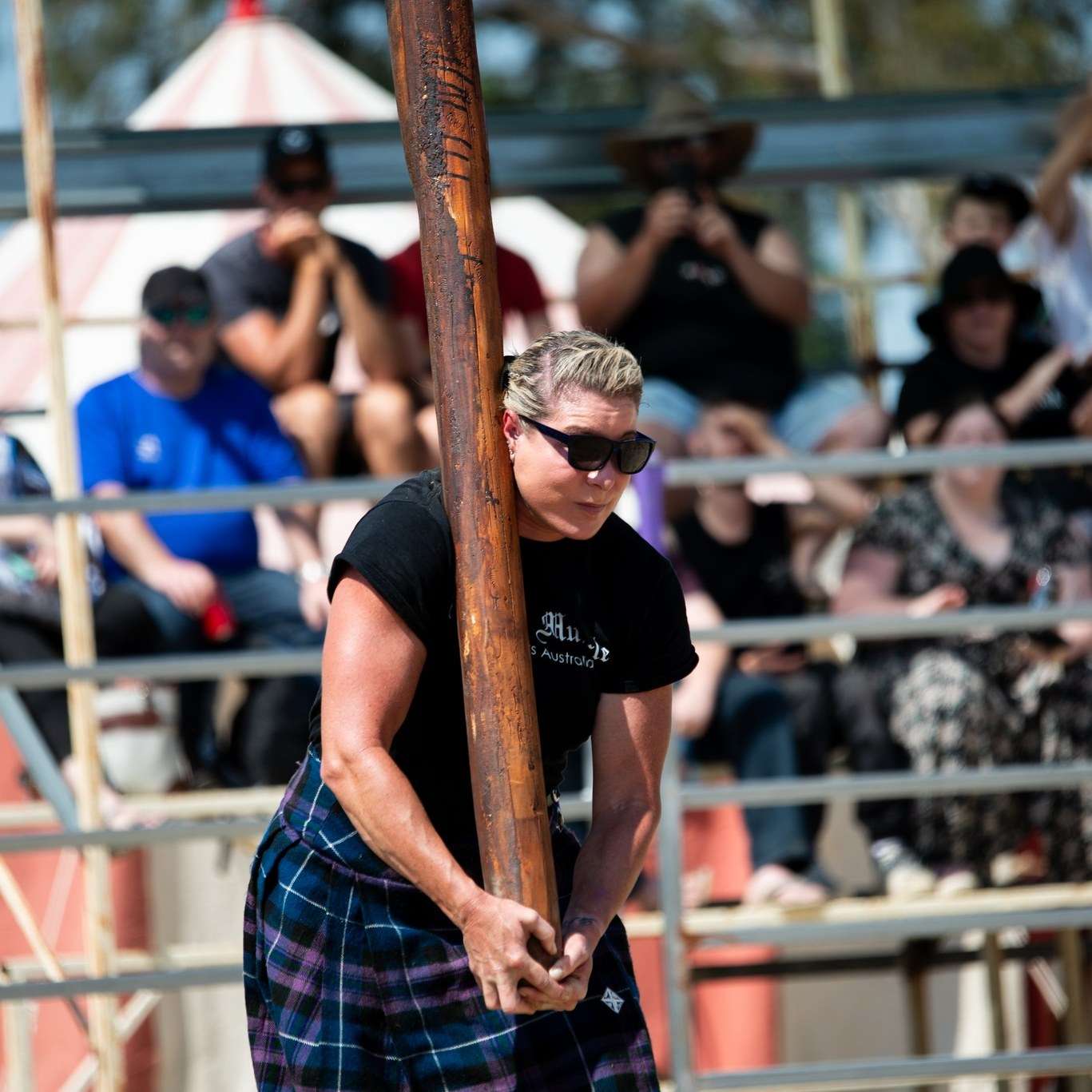
The Australian Highland Games Championships returns to CelticFest Warwick 2025, bringing world-class traditional strength events, cultural celebration and exciting international opportunities for athletes.
A future for Highland Games in Australia
Organised by Highland Muscle, Wollongong, this year’s championships will feature more than twenty athletes across men’s, women’s, masters and, for the first time, junior and teen divisions “This year is about growth,” said Rob Mitchell, Highland Muscle’s Australian representative. “From juniors through to masters, there are now clear pathways for Australian athletes to step onto the world stage. This event is not just about competition; it’s about building a future for Highland Games in Australia.”
The event serves as an official qualifier for the International Amateur Highland Games Championships in Norway, with winners of the open divisions receiving invitations and financial support to compete overseas.
Plans are also underway for Masters champions to qualify for the International Highland Games Federation Masters World Series in the United States in 2026. Juniors and teens will be part of the Australian Championships for the first time, marking a major milestone in the sport’s national growth. Australia’s top performers, such as Oceania champion Terry Sparkes and rising star Brock Ridsdale will compete alongside emerging talent. In the women’s field, Queenslander Lily Riley, and Red Windle are among the names to watch.
Traditional Scottish strength
CelticFest Warwick visitors can expect to see the full slate of traditional Scottish strength contests including putting the stone, hammer throw, caber toss, weight for distance and weight over the bar. This year also introduces the Manhood Stone Challenge, a historic test of strength adapted into a timed lifting and carrying event, offering both men and women the chance to qualify for future international competitions. The return of the championships follows the successful Melbourne International Highland Games earlier this year, which attracted 50 athletes from six countries.
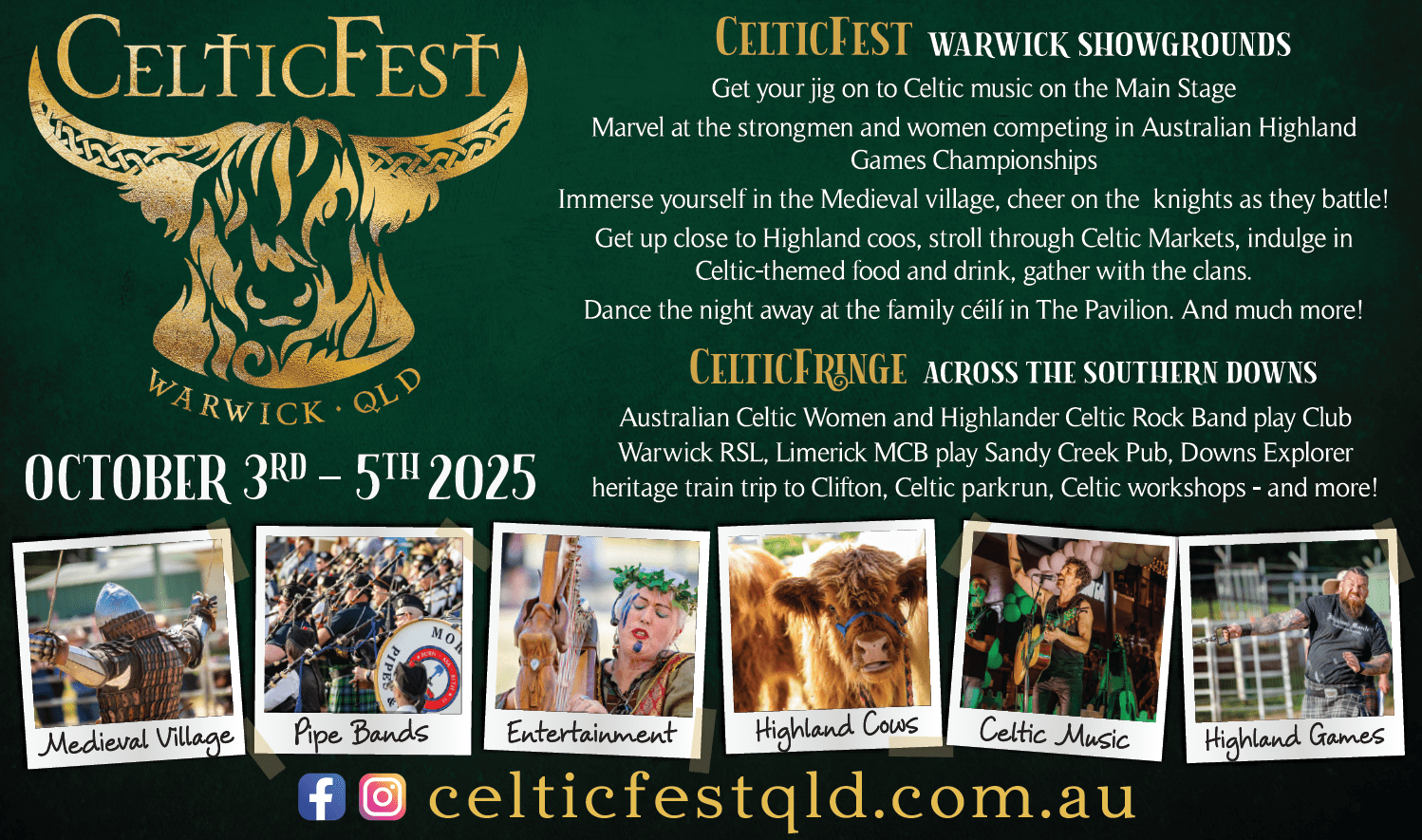
The Australian Highland Games Championships are a highlight of CelticFest Warwick, a vibrant celebration of Scottish and Irish heritage in Queensland’s Southern Downs. Alongside the Highland Games, festival-goers will enjoy Celtic music and dance, artisanal markets, medieval re-enactments, workshops, and animal encounters featuring Highland cows, Shetland ponies and Friesian horses, and Irish wolfhounds.
The Australian Highland Games Championships will be held during CelticFest Warwick 2025 at the Warwick Showgrounds on October 4–5, 2025. Tickets and further details are available at www.celticfestqld.com.au.
Highland Muscle is the official Australian representative of the International Highland Games Federation (IHGF), dedicated to reviving and expanding Highland Games nationally and creating opportunities for athletes to compete on the world stage.
Against the iconic backdrop of the Ross Fountain and Edinburgh Castle, The United States Old Guard Fife and Drum Corps enjoyed a tour of Edinburgh’s Princes Street Gardens during their recent performances at The Royal Edinburgh Military Tattoo.
Making their Tattoo debut in 2025, and wearing uniforms dating back to 1784, the United States Old Guard Fife and Drum Corps brought a wealth of history to help celebrate the 75th Anniversary Show this year.
The United States Old Guard Fife and Drum Corps brought a wealth of history to help celebrate the 75th Anniversary Show this year. As the U.S. Army’s oldest active infantry regiment, their performance paid a special tribute to the U.S. Army’s 250 years of service, proudly honouring the traditions that accompanied the birth of the United States of America.
The United States Army Old Guard Fife and Drum Corps is the only unit of its kind in the US Military, and is part of the 3rd U.S. Infantry Regiment (The Old Guard). They have performed at key events across the USA from sporting to the Olympics and have also performed at the arrival ceremonies at the White House for foreign heads of state and have been a part of every Presidential Inauguration Parade since President John F. Kennedy. The Fife and Drum Corps is based at Joint Base Myer-Henderson Hall in Virginia.
The official mascot of the Glasgow 2026 Commonwealth Games has been revealed, as the countdown passed the one year mark until the most eagerly anticipated sporting event of 2026. Finnie – a proud Glaswegian unicorn – was spectacularly unveiled at dawn, appearing at the top of the city’s famous Finnieston Crane, which is also her namesake.
The ‘hooved-hypemaster’ was seen flying a special banner on top of the Clydeside landmark to announce her arrival. The magical mascot was imagined with the help of 76 children from 24 schools from communities across Glasgow – known as Mascot Makers. ‘Fun, cool, and sassy’ Finnie’s signature feature is a horn inspired by the famous traffic cone on top of the Duke of Wellington statue outside Glasgow’s Gallery of Modern of Art (GOMA) – a nod to Glasgow’s renowned sense of humour.
Finnie represents everything Glasgow 2026 is about
Glasgow 2026 Chief Executive Phil Batty OBE, said: “Finnie represents everything Glasgow 2026 is about – fun, friendliness and of course that little bit of magic! She’ll be at the heart of everything that’s exciting about these Games, from building up the crowd to hyping the athletes. She’ll visit communities across Glasgow, Scotland and beyond, and bring them all together next summer. It means so much that she comes from the imaginations of Glasgow’s young people. They have all been fantastic throughout this process and introducing Finnie to the world is the perfect way to start the countdown to these altogether brilliant Games.”
Scotland is hosting the XXIII Commonwealth Games, Glasgow 2026, from July 23 to August 2, 2026. For more information see: www.glasgow2026.com
The pipes will call once again as the 14th Hororata Highland Games returns on Saturday 8th November 2025 – a full-day celebration of Scottish culture with a uniquely Kiwi twist.
More than 11,000 people are expected to gather at the Hororata Domain for a vibrant celebration that brings the traditions of Scotland to life in the heart of rural Waikirikiri Selwyn, just 45 minutes from Christchurch Airport.
This year introduces an exciting new feature – a Bagpipe Tune Writing Competition, honouring the Chieftain and the spirit of this rural community. Anyone can enter, and the competition will be judged by past Chieftain and renowned musician Kyle Warren from Scotland.
“Each year we evolve while staying true to our Highland spirit,” says Cindy Driscoll of the Hororata Community Trust. “The tune competition adds something fresh and creative – it’s another way people can connect with the Games, beyond spectating.” Entries need to be submitted by the 22nd of September – full details are on the website.
A true family festival
At its heart, the Hororata Highland Games is a true family festival – a place where everyone, from toddlers to grandparents, can find something to enjoy. Whether watching the spectacle of the Heavies, discovering your Scottish ancestry with the Clans, having a go at tossing a caber or running the Kilted Mile, there’s something to delight, challenge, and inspire every age.
The Games hosts the largest one-day outdoor Highland Dancing competition in the country, with several South Island Championships contested. It also welcomes an international field of athletes competing in traditional strength events, including the Oceania Heavyweight Championship. With more than 20 Pipe Bands, solo pipers and drummers in attendance, the Massed Bands performance during the Chieftain’s welcome is truly unforgettable. Anyone pining for Scotland will have their hearts filled.
Beyond the arena, the festival offers a Scottish farmyard, medieval knight demonstrations and crafts, sheep shearing, live music, have-a-go activities, a fairground, and over 120 market stalls. It’s a day to be fully immersed in Scottish culture, with a twist of unmistakable Kiwi flavour.
“The Games is powered by and for our rural community. It’s run by the Hororata Community Trust, with the support of hundreds of volunteers, community groups, and businesses who proudly bring the event to life. All profits are reinvested into projects that support the wellbeing and resilience of our community,” said Cindy. “We encourage people to not only come to the Games but plan a holiday and explore the Selwyn district while they are here.”
The Hororata Highland Games will be held at the Hororata Domain, with gates open from 9am to 4.30pm. Tickets are on sale now – and numbers are limited. There will be no gate sales. Children under 16 are free, and all profits support community initiatives through the Hororata Community Trust. For tickets and more info, visit: www.hororatahighlandgames.org.nz
Six months after teetering on the brink of being lost forever, Auchindrain, the only genuine Highland township to survive the Scottish Clearances, is back in business. The historic 22-acre site in mid-Argyll is as important to Scottish history as Stirling Castle, the Stone Age village of Skara Brae or the battlefield of Bannockburn.
For almost 2,000 years people have lived off the land which lies just six miles from Inveraray. At one time there were around 5,000 such faming townships throughout the Highlands of Scotland – now there is just one. Improvements to farming techniques, changes in land use and the decimation of the infamous clearances destroyed all the other similar communities. Only Auchindrain, or Bail’ Ach’ an Droighinn as it’s known in Gaelic, survived intact. Incredibly, families still occupied the site up until the 1960s. They lived and worked in buildings largely unchanged since the 18th century. When the last person moved out the township was preserved for posterity by The Auchindrain Trust, a registered Scottish charity.
However, in December 2024 it was announced that due to cuts in funding the ancient township would be forced to shut its gates for good. Horrified at the loss of such a unique link to the history of ordinary Highlanders a number of local residents banded together to save the township. Now, with a whole new board of trustees and an army of volunteers committed to the cause, the fight to save Auchindrain is on!
The only genuine survivor of its type
Restored cottages, Auchindrain. Kim Traynor, CC BY-SA 4.0.
In recognition of their efforts so far, and their detailed planning for the future of the township, officials from Museums Galleries Scotland have awarded the township the coveted status of Provisional Accreditation for the next 12 months. In a letter conferring the honour Victoria Hawkins, Museum Development Manager – Accreditation, acknowledged the work of the board, staff and volunteers battling to save the site. She said: “Congratulations on maintaining Provisional Accreditation for Bail’ Ach’ an Droighinn during difficult circumstances.”
The Accreditation Scheme is the UK industry standard for museums and galleries. It helps everyone involved with a museum to do the right things, helping people to access and engage with collections, and protect them for future generations. It is administered north of the border by Museums Galleries Scotland on behalf of Arts Council England.
As one of only 257 institutions in Scotland to hold the Accreditation Standard the charity will be able to call on advice from experts in a range of skills and disciplines to help make Auchindrain an internationally recognised museum.
“Being awarded Provisional Accreditation is a major step forward for us,” said Jan Brown, Chair of the Auchindrain Trust. “Just a few short months ago the future looked really bleak for the township. I am proud of the way local people, and many others from around the world, have rallied round to try and prevent the loss of such a historic site. As the only genuine survivor of its type, it is a living memorial to all those communities and families devastated by the Scottish Clearances. Getting this provisional accreditation is recognition that we mean business. Auchindrain is a physical link to how thousands of ordinary Scots lived before they were forced from the land. Like the eternal flame it is a symbol of remembrance that should never be extinguished.”
Main photo: Bell Pol’s House, Auchindrain. David Hawgood, CC BY-SA 2.0.
The Board of Directors of the American Scottish Foundation (ASF) announce the ASF Annual Dinner and 2025 Wallace Awards, will take place in New York City on November 7. The evening will be co-chaired by Viscount Dunrossil, David Disi, Jenny Du Pont, and Olivia Fussell.
The Wallace Awards will be presented to: Dr. Joseph Morrow, Lord Lyon, King of Arms for his Leadership of the Lyon Court and its role in Scotland today and A. Wright Post Palmer of Beekman Estates in recognition of his outstanding charitable work in regard to New York’s history, arts, culture, and education. A direct descendant of early Scottish, Dutch, and British settlers which includes descent from the Beekman/Livingston family—early founders of New Amsterdam (New York City) in the 17th century—and to the Lindsay (Sanders) family of Scottish descent, among the founders of Albany and Schenectady, New York, also in the 17th century.
The Lord Lyon.
The Wallace is awarded this year to two leading figures of our international community – The Lord Lyon of the Lyon Court in Scotland and A Wright Post Palmer through the legacy of the Beekman Post Palmer Livingston family in the US.
“When most Americans think of America’s founding fathers, they immediately reference Washington, Jefferson and Hamilton. Prior to them are the Colonial founders, of Dutch and British – many being Scots – that were the first Europeans to settle in this country, Wright’s family were one of the leading families of the Colonial era. Wright has ensured the family legacy and leadership of philanthropy and community service continues today.” noted Ken Donnelly, Chairman of the American-Scottish Foundation.
A. Wright Post Palmer.
Shared love of Scotland
Scott Gilmore and Claire Mackenzie of Noisemaker.
“We recognize The Lord Lyon for his outstanding leadership of the Lyon Court, as he has brought the traditions of his role forward to today. Most recently as King Charles III received the Honours of Scotland, Lyon devised inclusion through ‘the People’s Procession’. His tireless work especially with the Scottish American community has done more to help promote Scottish Heritage in the United States than any other individual I have known,” The Rt. Hon. Viscount Dunrossil, Vice Convenor, Standing Council of Scottish Chiefs, noted.
The ASF Young Scot Wallace Award will also be presented that evening. ASF champions up and coming leaders of tomorrow from arts to literature to business, and this year will honour Claire Mackenzie and Scott Gilmore of Noisemaker – the award winning young musical theater producers.
Camilla G Hellman, MBE, President, American-Scottish Foundation said: “When I first met Noisemaker, they had recently graduated from the Royal Conservatoire of Scotland had just beaten our 900 other entries to bring their production of Forest Boy to the New York Music Festival. That was eight years ago, since which time the ASF has worked closely with them to showcase and promote their work, with them performing at many of our events. They are truly representative of Scotland’s musical theatre of today. All of our honorees this year have supported the American Scottish Foundation in various ways that have helped us share our love of Scotland – amplify our programs and partners’ messages for our diaspora at large.”
In a thrilling quest to uncover secrets from one of Scotland’s most significant historical sites, archaeologists and volunteers will again partake in a remarkable dig at Culloden Battlefield, where the course of British, European and world history changed dramatically nearly 280 years ago. Experts armed with both traditional archaeology tools and cutting-edge technology are peeling back layers of earth to reveal untold stories of the final clash of the Jacobite Rising in 1746, as Judy Vickers explains.
For hundreds, possibly thousands, of years Drummossie Moor was just a wind-swept, boggy moorland east of Inverness, used by nearby farmers for grazing their animals. Flints uncovered in archaeological digs in the area show that folk had been around the moor for at least 4,000 years but its history was fairly unexceptional until one bloody hour on an April day almost 280 years ago.
The Battle of Culloden in 1746 finally snuffed out the Jacobite cause – those who wished to restore the Stuart dynasty to the British throne – and put an end to more than 50 years of sporadic risings and rebellions. The battle, the last on British soil, was as brutal as it was short – one of the Government officers described it as “a general carnage” and said his men were splashing through the blood that covered the moor. Around 1,250 Jacobites were killed, the same number were wounded and 376 were taken prisoner – Government losses were just 50 with under 300 wounded.
The battle has become iconic for more than just its pivotal role in British political history, securing the protestant Hanoverian family on the throne. The romantic figure of Bonnie Prince Charlie who led the Jacobite army to a series of victories after he landed on Scottish soil in 1745 and raised his standard at Glenfinnan, his dramatic reversal of fortune at Culloden, his escape from the clutches of government forces after the battle and the brutal suppression of the Highland way of life in the days and years following have all helped to make this Scotland’s most famous battle
The battlefield is still giving up its secrets
Archaeology dig in progress at Culloden Battlefield.
Yet despite that spotlight, centuries on, the battlefield is still giving up its secrets. This October sees the fifth successive year of archaeological fieldwork and investigations at Culloden – and there will be open days with guided tours for members of the public to see the work going on and learn about what has been uncovered in previous years. This year’s dig will be again led by the National Trust for Scotland’s head of archaeology Derek Alexander, who explained: “This year we are looking for archaeological artefacts in the area to the north of the memorial cairn. This is an area where very little investigation has been undertaken before and was previously covered in a conifer plantation, which may have had an impact on the preservation of metal artefacts in this area. So, if we recover a similar number of artefacts to that found elsewhere we will be very excited.”
Those finds elsewhere include a large number of musket balls and grapeshot in a small 60 sq m area close to the Government frontline, vividly illustrating the intensity of the fighting on the Jacobite right wing and allowing battlefield experts to refine their understanding of the battle. “They have given a very detailed insight into the location of the hand to hand combat and have provided material evidence for the brutal nature of 18th century warfare” explains Derek.
Clan grave marker at Culloden Battlefield and Visitor Centre. Photo: VisitScotland/Kenny Lam.
The most significant find – so far – was a shoe buckle believed to have belonged to Donald Cameron of Lochiel, who led the 400-strong Camerons regiment into the battle. A single piece of heavy lead grape shot, with a flattened side showing it had hit something with great force, and a highly decorated broken copper alloy buckle were found close to each other, just a few metres from the British Army frontline.
The finds fits perfectly with the story of the man known as “The Gentle Lochiel” that he was just drawing his sword as he reached the Redcoats’ frontline when he fell, wounded with grapeshot in both ankles. Lochiel, a leading Jacobite, survived Culloden and escaped to France with the prince. He was just one of many Jacobite casualties at the battle; Bonnie Prince Charlie’s forces, already hungry and tired, had been further exhausted by a night-time march to spring a surprise attack on the sleeping government troops.
That attack had been aborted and the weary troops had headed back to face a well-fed, well-equipped enemy in good spirits on the morning of April 16. Even the famed Highland charge was ably countered by the Duke of Cumberland’s soldiers who had been practising a counter-attack with bayonets.
The moor’s chequered history
The National Trust for Scotland’s head of archaeology Derek Alexander.
Part of the reason for the wealth of material still being uncovered at Culloden – the battle takes its name from a small village a few miles from the actual field – is the moor’s chequered history in the years following 1746. Farmland began to encroach around the edges, plantations of spruce trees were created and in 1835 a road was built right through the middle of the site. The open moorland of the battlefield was lost.
By the 1800s visitors beyond just friends and family of the fallen were arriving and interest in the site for its memorial and historical rather than commercial significance grew. Duncan Forbes, the laird of Culloden who owned the site, created the memorial cairn and put up headstones to mark the clan graves in the 1880s, and the Gaelic Society of Inverness raised funds to repair the thatched roofs of two old cottages on the battlefield, King’s Stables Cottage to the west and Leanach Cottage to the east.
But not all the tourist attention was beneficial – in the 1930s a tearoom and petrol pump were erected in the middle of the battlefield to serve the rising visitor numbers.
In 1937, the recently formed National Trust for Scotland was given its first two small parcels of the battlefield and slowly, over the decades, acquired more of the land. But it was only in the 1970s that the old tearoom was bought and demolished and the 1980s when the road was moved and the forestry felled, meaning visitors could again see the moor the way the combatants did back in 1746. As the site was opened up, more was learned about the battle – and in fact he NTS’s own 1970s’ visitor centre was discovered to have been built on the second line of the government army. A new, relocated centre was opened in 2007.
Even archaeologists’ views on the shape of the battlefield has changed in recent years with experts now believing that it stretched over a wider area than previously thought. As Derek says: “There is always more to learn about what happened on the day of the battle.”
This year’s dig takes place from 12-18 October. For more information, visit www.nts.org.uk
All images courtesy of the the National Trust for Scotland, unless noted otherwise.
Main photo: Culloden Battlefield the final Jacobite Rising. Photo: VisitScotland/Kenny Lam.
Get ready to put on your dancing shoes and tap your toes to a different kind of vibe on the King’s Birthday weekend in October, when Celtic bands take over town during CelticFest Warwick 2025! CelticFest Warwick is excited to release this year’s festival music program, with the core event held at the Warwick Showgrounds on Saturday 4 and Sunday 5 October, and it promises something for all ages. You can rock out to bands under the Main Stage Marquee or soak up the melodies of traditional and Celtic-inspired music in the intimate Meadows Marquee.
The kids can bounce around on the grass through the bubbles during the Celtic Kids show, the Royal Scottish Country Dance Society will teach you a dance or two at their workshops, and the Queensland Irish Choir will delight with their beautiful rendition of Irish tunes. Meanwhile everyone can have a go at group Celtic bush dances at the Saturday night ceili hosted by the Darling Downs Irish Club and called by The Scotsman, Graeme McColgan, with music by Kejafi.
CelticFringe
Australian Celtic Women open this year’s festival with a feature CelticFringe concert held in the historic King’s Theatre at Club Warwick RSL on the Friday evening. Their elegant show will take you on a mesmerizing journey through the rolling hills and misty moors of Ireland and Scotland, with heavenly voices, tantalizing harmonies, dazzling costumes and whirlwind fiddle playing – if you miss them on Friday night, you can catch them at CelticFest on Saturday and Sunday. Saturday night headliners, The Gathering ‘kick-arse Irish party band’ fronted by Dubliner Mick McHugh, will take over the Main Stage Marquee at the Showgrounds – they never fail to get the room rocking. The Gathering regularly plays packed-out venues such as Finn McCools and Irish Murphys in Brisbane and Gold Coast with everyone having a blast, Irish or not! Talented Mick McHugh, who recently recorded two albums with ABC Kids, will also share his Celtic Kids daytime show in the Meadows Marquee. The little ones can join in the best Irish toe-tapping, hand clapping, foot stomping energetic sing-a-longs this side of the Fairy Kingdom.
Limerick MCB will bring their passion for high-energy Celtic music back to the main stage after last joining the festival in 2022. The band has played alongside world renowned artists including Andrew Strong (The Commitments movie) and Irish fiddle player and banjoist Gerry O’Connor (Irish Rovers). The Shamrock Dancers will bring toe tapping Irish dance energy to the show on Limerick’s dance stage. You can also catch Limerick at the Sandy Creek Pub CelticFringe gig on Friday 3 October with a shuttle bus available from Warwick to the door and return.
A rollicking CelticFest
Kejafi.
New to CelticFest in 2025 is Sydney based Kejafi, a three-piece Celtic music band which performs traditional folk tunes from Scotland, Ireland and Australia, as well as their own compositions. Their second album ‘The Road’ was a finalist in the 2024 Australian Folk Album of the Year awards and they have toured widely, including performing at the Sydney Opera House and the Australian Celtic Festival. Beck Sian is making her CelticFest debut as well. Related to English singer Kate Bush, Melbourne based Beck Sian is an award-winning songwriter who has released four albums. This talented guitarist, harpist and vocalist was described by Judith Durham (The Seekers) as ‘a multi-layered unique artiste with a vocal gift to carry her anywhere’.
Graeme McColgan (aka The Scotsman) makes a welcome return to CelticFest from Glasgow via Sydney; he will perform on the Main Stage. With his guitar or 8-string ukulele in hand, The Scotsman blends evocative vocals with everything from 200-year-old Burns tales to modern upbeat folk tunes. On the Saturday evening The Scotsman will call the family fun of a ceili with ‘Celtic bush dances’ in the Doug Feez Pavilion. But that’s not all! Other confirmed music acts are Rebecca Wright and Donald McKay, Lorna Warne, and Kurrajong Song – all crowd-pleasing artists reprising their previous CelticFest appearances. To close out CelticFest Warwick 2025 with a bang, Highlander, the Scottish Celtic Rock Band from down-under will rock King’s Theatre at Club Warwick RSL with heart stomping bagpipes, fiddle and rocking rhythm, while Limerick MCB will host a rollicking CelticFest after-party at the Warwick Hotel on Sunday 5 October. These CelticFringe gigs are the perfect way to continue rocking on Sunday night, as the long weekend allows for recovery on Monday.
Adult weekend tickets are available from www.celticfestqld.com.au, where you will also find tickets for the separately organised CelticFringe events. Online tickets for Saturday, Sunday, and Saturday night only (CelticFest Party Night) have also been released.
New research has revealed details of two air assaults on East Fortune Airfield that were kept secret during the Second World War. The historic airfield in East Lothian is now home to the National Museum of Flight, which opened 50 years ago in July 1975.
A discreet, handwritten note on an archived document led curators from the Museum to uncover the hidden details. In November 1940, three bombs were dropped on the airfield. Almost a year later in October 1941, enemy gunners attacked the site from the air. No casualties were recorded.
Arial photograph of East Fortune airfield.
Throughout the Second World War the airfield served as an operational training unit. In Scotland, direct hits were rarely reported publicly to prevent enemy forces identifying significant sites.
The Lothians were targeted by German bombers on several occasions, including attacks on a decoy airfield in nearby Drem, but until now this important part of the airfield’s history was unknown.
Scottish aviation history
Air raid shelter at the National Museum of Flight following conservation. Photo: Andy Catlin.
East Fortune is one of the UK’s best-preserved Second World War airfields. Air raid and blast shelters, that were likely used during the attacks, have recently been conserved and are now open to visitors to discover more about Scotland’s wartime heritage. Ian Brown, Curator at the National Museum of Flight, said: “Revealing these previously unknown events at East Fortune has taken some real detective work. The airfield has played a significant role in Scottish aviation history for over a century. Even in the museum’s 50th year we’re still discovering stories that can help us better understand the airfield’s past.”
The National Museum of Flight explores the history of aviation from the First World War to the present day through interactive galleries, historic aircraft and hangars. On display is one of Europe’s best collections of aircraft, including Scotland’s only Concorde, which visitors can board.
Main photo: Service personnel at East Fortune, c.1940s. Image National Museums Scotland.
Support the Scottish Banner! To donate to assist with production of our publication and website visit: The Scottish Banner
Lady MacGregor of MacGregor – otherwise known as British writer and broadcaster Fiona Armstrong – works for ITV news and current affairs. Fiona’s husband is the Chief of Clan Gregor, Sir Malcolm MacGregor of MacGregor. She is an active member of Clan Armstrong, so their lives are interwoven with all things tartan. The couple live in the Scottish Borderlands, although filming and writing takes Fiona all over Scotland.
Lady Fiona with Charles Vandervaart.
Greetings! Not from Scotland this time – but from across the pond… The MacGregor and I are in Canada and guests at the country’s biggest clan gathering. 58 clans are represented. It is a sell-out crowd. What a weekend! This is the 80th Fergus Scottish Festival & Highland Games, and it has it all. Heavy event athletes, Highland dancers, pipe bands, tartan and kilts… As they say: ‘80 years of Scotland without the airfare.’
It is a milestone anniversary and the weather is hot. How apt then that the Red Hot Chilli Pipers are among those topping the bill. Bagpipes with attitude, as they say. There is a blast from the past with Scotland’s original boy band. It is the Bay City Rollers, complete with songs like Bye Bye Baby and Shang a Lang – and still going strong fifty years on.
Then the past is all around. Not least with the re-enactment group, the Atholl Brigade Recreated. These are Jacobite soldiers, and whilst they look somewhat scary, they are most hospitable. Their womenfolk invite visiting chiefs into their tent to eat cheese and biscuits and drink lemonade and whisky. The fare is delicious, yet they apologise for its simplicity. On another day they would be roasting a hog on a fire, but this year flames are not allowed because of the fear of wildfires.
Official guests
Richard Baird, Sir Alexander Matheson of Matheson, Robert Currie, John Cochran, Vice President of Council of Scottish Clans & Associations, Sir Malcolm MacGregor of MacGregor, Lady Saltoun, Viscount Dunrossil and the Master of Saltoun.
But who are these guest chiefs? The MacGregor is there as Convenor of the Standing Council of Scottish Chiefs. Then there is the Fraser Chief, Lady Saltoun, and her son, Alexander Fraser, the Master of Saltoun. Sir Alexander Matheson of Matheson is present. Steven MacTavish of Dunadry is there, too. As is the Vice Convenor of the Standing Council of Scottish Chiefs, Viscount Andrew Morrison. Yes, there’s no shortage of chiefs, and feathers further abound, with Commanders Robert Currie, Richard Baird of Riccarton and Michael McAlpin.
With time to explore, we make our way through the festival grounds. Past the whisky village and the tea tent. Past the Sugar Shack and the British Baked Goods vans. Flags fly, bonnets abound. Then there is another journey back in time with the Outlander tent. One of the series stars, the actor who plays William Ransom is there and he is utterly charming. Charles Vandervaart is a local lad, and I confess I am a wee bit starstruck. It seems I am not alone. The ladies queue up to have their picture taken with him – whilst others vie to be seen with another famous face.
Atholl Brigade Recreated.
The Lord Lyon King of Arms is the Chieftain of the games. He is the person who officially opens the festival, and he does it in style. Dr Joe Morrow is Scotland’s ultimate authority on coats of arms and heraldry. He is highly learned and amusing, and as such, is incredibly popular on the clan circuit.
Yes, Joe is always much in demand. Not least to judge the clan tents. After a visit to all 58, he decides the winning prize must go to the Frasers – with Clan Gregor a close runner-up. It is no surprise that we get a mention. Because our own tent is a tartan triumph. Inside tartan and heather abound, with an amazing timeline that shows our Scottish and Canadian clan histories. There is a team photo as clansmen and women arrive for a meet and greet breakfast.
Deep Scottish roots
Young piper Callum with Sir Malcolm MacGregor of MacGregor.
The Canadian chapter of the Clan Gregor Society was started more than a decade ago by Wayne MacGregor Parker, and under his guidance, it has truly blossomed. We exchange news and eat home-made scones and muffins. Then there is a delightful interlude. A nine-year-old boy in a Macgregor kilt approaches with his parents and asks to play for the MacGregor. His name is Callum, and he is the youngest piper in the Rob Roy Pipe Band from Kingston, Ontario and one of Canada’s oldest. The young man is loaned a chieftain’s bonnet for the occasion.
What a weekend! We are so warmly welcomed. Then the town of Fergus has deep Scottish roots. Indeed, it got its name from one of its Scottish founders, Adam Fergusson. From the memorable ride down St Andrew Street in a carriage pulled by Clydesdale horses, to the delicious dinner at the Breadalbane Inn. From the mass Highland dances performed by the young, to the pipe and drum bands that kept us utterly enthralled.
Thank you, Fergus, and thank you Canada! We would love to come back…
Support the Scottish Banner! To donate to assist with production of our publication and website visit: The Scottish Banner
A truly unique historic Highland church created from a son’s love for his mother and his love of architecture, has been awarded £1million to secure its future as a community hub and visitor attraction. Nestled on the banks of Loch Awe, St Conan’s Kirk brings together ecclesiastical architectural styles from across centuries. It should not work but it does, and spectacularly well. Like all old church buildings, St Conan’s Kirk is in need of some restoration and investment
Now St Conan’s Heritage Trust has been awarded £1,039,773 from The National Lottery Heritage Fund. St Conan’s already welcomes some 50,000 visitors a year, and plays host to a packed community programme, plus concerts, exhibitions and events. The Heritage Trust has bold plans for the future of St Conan’s. Plans that will protect the unique character of the building while equipping it for modern times. The National Lottery Heritage Fund support takes them well on the way to a £1.5million fundraising target to enable a major programme of conservation, accessibility improvements, and community engagement.
Joint Vice-Chair of the Heritage Trust, Peter Hennessy, said: “We get visitors from all over the world who are mesmerised by the unique character of St Conan’s. We know it has even more potential as a visitor attraction and we want to release that for the benefit of the community, but to do so sensitively to ensure we don’t lose the character of our hidden gem.”
Rosalyn Keppie, who is the second Vice Chair and who led the original Kirk Trust said, “Our work with the National Lottery Heritage Fund brought us to the decision to combine all our efforts, close the original Kirk Trust and transfer the building into the new Heritage Trust. Despite its unorthodox design St Conan’s takes a very traditional place at the heart of our village life. While we love to share it with visitors this project is just as much about making it work as a community hub.”
Part of Scotland’s heritage
The origins of the Kirk are far more recent than some of the medieval architectural features suggest. Walter Douglas Campbell, 8th child of Archibald Campbell of Blythswood began work on it in the 1880s. Initially building a small traditional Scottish kirk to save his mother Caroline a long carriage drive to church. Walter had a keen interest, and was not without some skill, in architecture and over the years the simple and traditional kirk was transformed into something quite unique. Following his death in1914, Walter’s sister Helen continued construction as laid out in his plans. And with Helen’s will passing care of the kirk to a community trust, they finally completed the project in 1929.
Caroline Clark, The National Lottery Heritage Fund Director for Scotland said; “This funding, made possible thanks to National Lottery players, will allow the Trust to carry out urgent repairs and unlock new spaces for public use, ensuring this wonderful landmark church continues to inspire and serve both locals and visitors for generations to come. St Conan’s Kirk is a unique and much-loved part of Scotland’s heritage. We’re delighted to support this ambitious project that will conserve the building, expand its community role, and enhance the visitor experience.”
The project will renew the roofs of three of the Kirk’s towers, repair leaking gutters and damaged masonry, and complete the ground floor lighting scheme with new LED lighting in the East End. These works will address long-standing water ingress issues and improve the overall visitor experience.
A key part of the project is the creation of visitor toilets, including an accessible facility — a much-needed addition in a rural area where no public toilets exist within 10 miles. Accessibility will also be improved through new level access points, hearing loops, and interpretation for areas not physically accessible, such as the stunning terraces overlooking Loch Awe. The Crypt will be opened to the public for the first time and will feature an interactive children’s exhibition and a small performance space for storytelling, music, and theatre. Beneath the Bruce Chapel, an unused double-height space will be converted into a two-level area for schools and community groups, creating a warm, flexible venue for learning and events. Work is set to begin later this year, with completion expected in 2027.
There is only one word that can sum up this year’s Glengarry Highland Games and that is “fantastic”. From the perfect weather to the hard-fought competitions to the thousands of people who came out to discover just what the Games are all about, it was one unforgettable experience of music, tradition and heritage all wrapped up in one of the most spectacular massed bands closing in years.
The pipe band competition with forty-three competing bands was one of the best with the 78th Fraser Highlanders from Milton, Ontario being crowned the Grade One North American Pipe Band Champions once again. In Grade Two the Ulster Scottish Pipe Band from Philadelphia took the honours with the City of Dunedin, Florida close behind. There were several pipe bands from the United States at this year’s Games from as far away as Utah and Florida all coming to show their love of Canada and their Scottish heritage. The Games crowds returned the sentiment with enthusiastic applause.
Finest of competitions
The Glengarry Highland Games’ own Juvenile Pipe Band came second in their level with their first entry into the competitive field. This band is relatively new with some players only a few months as members of the pipe band. In first place was the Capital District Youth Pipe Band from Albany, NY.
A big hit with the fans was the appearance of World Champion Drum Major Emma Barr who led the fifty-three massed bands at the Friday night Tattoo and the Saturday noon and evening massed bands. Just the sight of this slight woman from Ballygowan near Belfast, Ireland leading twelve hundred pipers and drummers across the field brought huge cheers from the thousands surrounding the infield.
Throughout the two days, the crowds displayed their love of the heavy events with cheers and sounds of encouragement as the athletes showed off their skills. In the Professionals division, Damien Fisher all the way from Ferndale in Washington State topped the field edging out Lorne Colthart from Ottawa. Local athlete Kyle Lalonde from Alexandria made a good showing in his first professional appearance in a field of eleven pros. In the Women’s Professionals, Liz King from Antigonish, NS amassed the top points to win first place while Alexandria’s Lisa MacDonald, a Games director, took third place in the Women’s Masters competition. Josee Morneau from Manitoba, a perennial Games favourite, easily won first. Again this year, even with several valiant efforts, no one was successful in tossing the Challenge Caber. The dancing competitions had new competitions added to their schedule this year to accommodate the interest in their event and results are still being compiled since there were 280 dancers who took to the stage. The dancing venue had an overflow audience both days to view the finest of competitions with dancers from around the world.
Scottish tradition, entertainment and pageantry
Not to be outdone, the Celtic musicians gave their all keeping the dance floors filled and everyone clapping along. The music venues were full starting off on Friday afternoon and finishing late Saturday evening. Over in the Arena, the hall was jammed with music lovers as the fiddlers gave an energetic performance starting on Friday with the Youth Fiddlers and then on Saturday with the Scottish fiddle workshop and finishing up with the afternoon concerts where Glengarry’s best fiddlers joined together to make beautiful music. The Canadian Armed Forces Primary Reserve tug of war was fiercely contended with the winning team being the 48th Highlanders of Canada from Toronto with the SD&G Highlanders taking second. The Wee Bairns area was wall-to-wall kids exploring the myriad of fun activities on offer. At last count, more than one thousand little ones took advantage of a different way to enjoy the Games.
All of the events report a very positive year with great competitions, participation and enjoyment, whether it was the kilt run, the whisky tasting, the British Car show, the Nate McRae Memorial Rugby Tournament, and of course, a crowd favourite, the colourful Clan Parade at noon on Saturday.
The Games social media channels and the local media have great coverage of the Games whether it’s articles, photos or video clips. Relive the Games or see what it’s all about by checking these out. For another year, the Games has surpassed the expectations of the organizing committee and the thousands of visitors who spent two full days making glorious memories. And now, the Games, like the fictional Scottish village of Brigadoon, has disappeared only to reappear next year at the same time for another two days of Scottish tradition, entertainment and pageantry. Join the Glengarry Highland Games next year at the Games on July 31 and August 1 and make your own memories!
Join the City of Armadale to celebrate all things Scottish at the largest Highland Gathering event held in Western Australia that has people saying things like…
“It’s different, the vibe is amazing, dogs are super cute, people are amazing and friendly to chat with, it’s a very unique event that really highlights a true highland gathering.”
“This event made a great day out for the family. I got to experience home away from home for a day! Such a connected and community vibe felt through the whole event. 10/10 would recommend and I will be back joining in again next year!”
“Come along for a fantastic day of fun with family and friends. The Armadale Highland Gathering is one of Perth’s best kept secrets for a wonderful immersion in all things Scottish.”
Scottish delights
The morning of Sunday 5 October begins with the fun and quirky Perth Kilt Run, the biggest and only fun run in Australia that’s done in a kilt! Run, walk, wheel, or dance a jig along the 2.5km Classic or 5km Warrior course – it’s a charity fun run with a difference and you’re guaranteed to have a good time. As you’d expect… the excitement doesn’t stop there.
Following the Perth Kilt Run, we roll straight into the Armadale Highland Gathering where you’ll have the rest of the day to experience Highland dancing, pipe bands and heavy event competitions, meet and greet Scottish dogs, explore Clan histories, watch friendly battles between the medieval groups in the arena, revel in live music, test your taste buds with the variety of Scottish delights, have a blether with a Highland cow, and lots more!
This is a family-friendly and smoke/vape free event hosted by the City of Armadale at Minnawarra Park, Perth, Western Australia. Further details are available at www.perthkiltrun.com.au.
Essential conservation works to the Great Hall at Kisimul Castle on Barra, have started Historic Environment Scotland (HES) has announced. The works will look to employ new interventions to address concerns with the concrete and its internal reinforcement bars. A secondary structure will be installed beneath the existing concrete, using non-ferrous materials, timber and blockwork, which will be more suited to the aggressive maritime environment. This will allow HES to safely carry out further necessary works to the interior of the Castle. It is estimated that the Great Hall works will take approximately three weeks to complete.
This follows an intricate operation to temporarily relocate historic objects from the Great Hall to ensure their protection while the works are underway. The artefacts, which are owned by The Macneil of Barra, include six muskets, two halberds and an impressive armorial. The muskets and halberds are stamped with dates from 1742 and 1743, dating them back to the time of the Jacobite Risings. The armorial, a metal coat of arms which has been painted and lacquered, includes depictions of a Lion Rampant, a masted ship and Kisimul Castle, and was presented to Clan Macneil in 1968. The relocation activity also allowed for the documentation of the objects to be updated with new photographs and measurements, with condition checks also taking place.
A key milestone
These works are the next stage in HES’s long-term goal to reopen Kisimul Castle to visitors once it is safe to do so. Last year, High-Level Masonry inspections and associated works took place to the exterior of the Castle. These works were the start of a programme to address concerns related to the Castle’s concrete and reinforcement bars following a major 20th century restoration, as well as the impacts of salt and moisture from Kisimul Castle’s coastal location.
In March this year, HES also carried out repairs to the slipway which will help to facilitate access for visitors once the Castle has reopened. James MacPherson, District Architect at HES, said: “We are delighted to be progressing works to the interior of the castle which is a key milestone in our programme of conservation work and is another step forward in our long-term plans to reopen Kisimul Castle to visitors. We appreciate that the communities of Barra and Vatersay are keen to showcase Kisimul Castle to visitors who arrive from all over the world, and we will continue to work closely with the local community. We are pleased to run free seasonal boat trips around the bay and Castle again this year and hope visitors enjoy exploring the wider area while access to the Castle is currently restricted.”
Kisimul Castle is closed until further notice to allow for conservation works.
The Scottish Banner speaks to Jacqueline McLaren, the Lord Provost of Glasgow.
Jacqueline McLaren, the Lord Provost of Glasgow.
The Lord Provost is Glasgow’s First Citizen and the position dates back hundreds of years. Can you briefly tell us about the role of the Lord Provost and just how proud you are to hold this historic title?
JM: It is a great honour to be singled out as the First Citizen of a city this size and the role itself goes back 550 years, and I am the sixth woman to hold this position. There will be more women to come after me of course and it is a 5-year term. The Lord Provost role is to meet and greet people who come from all over the world when they visit Glasgow. We have conferences, civic receptions, various birthdays and key events taking place year-round and we do a lot of engagement with the young people in the city about civic pride. We have thousands of young people here at the city chambers because they are the future of the city, so you need to try and get them involved in the process as early as possible.
I like also going into communities to meet people and local community groups. I am from the north of the city, and I know all the community groups in that area, but it’s great to try and touch base with other community groups that are doing similar work across the city. It inspires me and makes me want to do more. Glasgow is full of extraordinary people doing great things.
Glasgow is celebrating 850 incredible years in 2025. Can you tell us about the Glasgow 850 celebrations and how visitors can get involved?
JM: Anybody can become involved, it’s all on the Glasgow 850 website. There have been a lot of things that have happened this year so far, we did the Port Stones of the original medieval city which is a tourist point of interest, if people want to see how big the city was back in 1175, which was then only a small settlement of about 300 people, just off High Street at the Cathedral. That was the original settlement of Glasgow around that area.
We did the Port Stones for people to see what the city looked like then, and if you look at the city now and just how amazing it has become. Glasgow is now a booming city of nearly 1 million people and Glasgow 850 celebrates our story. There are lots of events happening and we invite everyone to come along and get involved.
The River Clyde. Photo: VisitScotland/Kenny Lam.
The phrase ‘People Make Glasgow’ is so much more than a marketing slogan, it is fact. What is it about the Glaswegian character, humour and spirit that inspires you?
JM: The straight talking, I love just been told by people and it’s just the straight talk. There is no hidden agenda with people in Glasgow. If you’re a tourist visiting and you have your guide book in your hand looking for somewhere, a Glaswegian will walk up and say, ‘can I help you?’. Glaswegians are very friendly, and they will often show you where to go or may even take you to your destination, and then you hear their life story and then they want to hear your life story.
Glaswegians are like that, you can stand at a bus stop and between waiting for the bus and the time the bus arrives, you know the person’s life story. And there’s always information sharing, Glaswegians are very good sharing information with each other. That is what’s great about us, we’re just lovely friendly people. The world needs to realise that when they come here that is what they will find. I think we are the friendliest place on the planet.
Glasgow University viewed from Kelvingrove Park. Photo: VisitScotland/Kenny Lam.
The city of Glasgow gets its name from the Gaelic translation of Glaschu meaning Green Glen. The city has affectionately been also dubbed the ‘Dear Green Place’ as it boasts an impressive range of vibrant green and open spaces. What do you feel makes Glasgow so special in terms of its incredible greenspace offerings?
JM: For me the parks really do make Glasgow. If you look at places like the Botanic Gardens, which houses the beautiful Victorian glass houses, which you don’t see very many of them in the world. For me, it’s just the tranquil places, the beautiful places, and the places full of running water. We have the River Clyde, Kelvin and the Forth and Clyde Canal. We are surrounded by blue and green places, which is really good for your mental health. Right now in Stockingfield Bridge in North Glasgow we are transforming a derelict landsite into Scotland’s largest ceramic art park. Once it is finished Bella the Beithir the mythical serpent will become one of the points of interest on the Forth and Clyde Canal.
Ruchill Park gives people a great view of the city, people have enjoyed the view of Glasgow from this park since Victorian times. The park also gets around one million daffodils growing in it every year. Queens Park and Kelvingrove are also jewels of the city and have wonderful bandstands with lots of events taking place and beautiful walks to be done. Glasgow is a beautiful city with beautiful places to visit.
Glasgow 2026 will host the 23rd edition of the Commonwealth Games next summer. What can visitors to the city look forward to in 2026 and what impact does hosting an event such as the Commonwealth Games have on the city’s brand?
JM: Next year is going to be really buzzing with people from all over the world descending on Glasgow. Athletes will be living in hotels, so if you are a visitor, you may even be in a hotel with a famous athlete. Visitors coming to Glasgow for the Games can look forward to the atmosphere, which I think will be quite electric.
Since the 2014 Games we have moved on quite a bit as a city, and we have a lot more venues and places for people to visit. I think there will be some real excitement here and visitors will be part of that. The Games are a great thing for us to again host and shows that Glasgow can host world class events and do it well.
The Barrowland Ballroom is a dance hall and music venue in Glasgow. Photo: VisitScotland/ Luigi Di Pasquale.
In 2008 Glasgow was named a UNESCO City of Music. The city hosts some incredible music events and has a diverse music offering. What do you feel about the city’s vibrant music scene that makes it the music capital of Scotland?
JM: I have been going to clubs and pubs since I was young. We had music festivals and concerts and when you grow up in the city you are going to have the amazing music scene part of your life. Today the music scene is even better and has evolved.
In Glasgow you could tap the table to join in with a folk band or singalong. So, you can actually join in and be part of that experience. That is what is great about Glasgow, you are invited to be involved, and you become Glaswegian as soon as you sit down.
Inside Glasgow City Chambers. Photo: The Scottish Banner.
Glasgow City Chambers was opened by Queen Victoria in 1888 and is still today one of Scotland’s most impressive buildings. Can you tell us a bit about the building and how visitors can include a visit on their next trip to Glasgow?
JM: The City Chambers is a marvellous jewel in the crown of Glasgow. The building was built in 1888 and it was opened by Queen Victoria. The chair the Lord Provost sits on is a massive wooden chair with red leather, this same chair Queen Victoria sat on which she convened the first meeting here and I sit on that every six weeks when I convene the full council and make sure everyone’s voices are heard.
The building itself has the largest white marble staircase in all of Europe, more than the Vatican. Visitors can take the free tours available and get an inside look at this incredible building. I try a couple of times a month to visit a tour and speak to visitors about the building and the city. There are tours twice a day Monday to Friday and I encourage everyone who comes to Glasgow to come into the City Chambers.
Your role as Lord Provost will take you all over Glasgow and have you meet so many unique people and places. Do you have tips for a visitor to Glasgow? Perhaps even some of your favourite hidden gems someone may wish to consider including on their visit to Glasgow?
JM: The tour buses are great because they will take you to all the gems in the city. My favourite place is the Kelvingrove Art Gallery and Museum and I have been going there since I was a child. I love the smell as soon as I walk in and it is a home from home for me.
I would suggest readers do some research about Glasgow and look at what they really want to experience. So much is also free in Glasgow, our museums are free and we just ask people to leave a small donation in the boxes to help run these special places. It is important people experience all our culture when here, our food, music and history.
American theatergoers are about to get an opportunity to experience a living Scottish tradition in a brand new, uplifting, exuberantly theatrical context, when Ceilidh, an original musical, arrives at the M&T Bank Exchange at the France-Merrick Performing Arts Center in Baltimore on Sept. 6.
A traditional Celtic gathering
A ceilidh (pronounced KAY-lee) is a traditional Celtic gathering that combines dancing, music and storytelling to emphasize human connection and community, with a “caller” spinning narratives that bring both friends and strangers together. For Ceilidh, acclaimed Scottish writers Scott Gilmour and Claire McKenzie have crafted a buoyant, boisterous score and a robust, heartwarming book that, as Gilmour tells it, weave “a generational tale, about a family that are linked together through ceilidh.”
Gilmour, who will play the role of the caller for the Baltimore run, explains that the musical—helmed by red-hot Broadway director and choreographer Sam Pinkleton, fresh off his Tony Award win for Oh, Mary!—“is, at its heart, a celebration of the power of tradition and heritage, but what interested us is physically connecting people now. It’s quite an ancient thing, ceilidh, but it has made its way through time by adapting to the people who are doing the dances.”
Immersive format
Scott Gilmour.
Those people will now include audience members: Ceilidh’s immersive format blurs the line between performance and party, inviting anyone to participate—if they wish. “You can join in the dances, or you can just sit and watch,” notes McKenzie, who met Gilmour when she was studying composing and he was an acting student at the Royal Conservatoire of Scotland. “Ceilidhs in Scotland are like that; I’ve been to one where there was an 80-year-old grandmother sitting on the side, having a great time.”
Gilmour adds, “You get up and give it a go if you fancy, or if you just want to sit on the side and enjoy it that way, that’s OK too.”
While Ceilidh relays a particular story involving a family—a journey of belonging, identity, and rediscovery through music and movement—Pinkleton notes, “The ensemble of performers can also put on characters and take them off, if that makes sense. It’s as if the audience is being hosted by this family, so there are specific characters with names, but they’re also just people we’re dancing with.”
Welcoming people
The director, whose credits also include choreographing the celebrated musical Natasha, Pierre & the Great Comet of 1812—for which Pinkleton earned his first Tony nomination—muses, “I’ve spent a lot of time making shows where the boundaries between actors and musicians and, frankly, performers and civilians are quite blurry. This is a very different show than Natasha, but what’s the same is that we want the audience to feel surrounded by the making of music and the telling of a story.”
Pinkleton adds, “I believe every act of theater is welcoming people into a thing, wanting them to have a nice time in our house. And I think Ceilidh, more than anything I’ve done before, essentializes that act of hosting strangers. I hope the magic of it is something that is much deeper and more ancient than us bickering at each other, as we love to do in 2025s, and simply asking, what do we share? How can I help you? Even if it’s as simple as looking at somebody and saying, ‘Can I have this dance?’”
Ceilidh the Musical is headed to Baltimore‘s M&T Bank Exchange at the France-Merrick Performing Arts Center 9/6-10/12! Visit: www.ceilidhmusical.com
The Royal Edinburgh Military Tattoo returned for its landmark 75th edition, honouring the heroes who have shaped its remarkable legacy. This year’s Show, The Heroes Who Made Us, blended military precision, cultural heritage, and artistic brilliance to celebrate the selflessness and dedication of those who have contributed to the Tattoo over the past seven decades. This special anniversary performance paid tribute to the Tattoo’s rich history while embracing its thrilling future.
The British Army took the Lead Service role this year, joined by a diverse international cast and anchored by the world-class Tattoo performers. With over 900 performers from across the globe, audiences were treated to an extraordinary journey through time and tradition, featuring talent from the Poland, Switzerland, United Kingdom, Ukraine, and the United States of America. Blending pageantry with theatrical flair, the 2025 Tattoo reaffirmed its position as a unique highlight of the world-renowned Edinburgh festivals. Celebrating values of connection, community, and shared heritage, this year’s performance reflects the enduring spirit that has defined the Tattoo for 75 years – while looking forward to its exciting future.
A performance unlike any other in the world
First across the drawbridge, as is tradition every year, The Massed Pipes and Drums once again filled the hallowed stage of the Edinburgh Castle Esplanade. Comprised of military and civilian pipe bands from across the globe, they set the tone for a performance unlike any other in the world. In a year dedicated to honouring heroes, The Orchestra of Naval Forces of the Armed Forces of Ukraine, travelled to Edinburgh, leaving Ukraine for the first time since 2018, due to the challenges of Covid and war to perform an unforgettable set for Tattoo audiences.
Making their Tattoo debut, the United States Army Old Guard Fife and Drum Corps will brought a slice of American history to Edinburgh with their iconic uniforms and stirring music. Also from America, the United States Air Force Honor Guard returned to showcase their unmatched precision and dedication. Adding further international flair, the Representative Band of the Polish Border Guard graced the Esplanade for the first time in 15 years.
Brisbane and Auckland
Adding something extra special this year, narration returned in the form of evocative storytelling performed by actor Terence Rae. Audiences were taken on a journey through the rich history of this iconic event, tracing its roots all the way back to its beginnings in 1950. Alan Lane, Creative Director at The Royal Edinburgh Military Tattoo, said: “We don’t talk about heroes enough in this country. Whether this is military service or volunteers within our society, it is these people that help make life tick along that little bit more smoothly and that deserves to be honoured and celebrated. We are in such a unique position that we get to do performances as grand as the Tattoo and that’s why this year, we’re embracing our position at the top of the Castle (quite literally) during the Edinburgh festivals. The Heroes Who Made Us, is a testimony to the artistic nature of the Tattoo and will come with all the bells and whistles that people know us for.”
Jason Barrett, Chief Executive of The Royal Edinburgh Military Tattoo added: “As we do every year, the Show features inspiring acts from around the world. This year we are especially privileged to welcome The Naval Orchestra of Ukraine, the first time they will have left their country since 2018. We couldn’t be more excited to celebrate our 75th, honouring our past while imagining our future. Early in 2026 we take the Show to Brisbane and Auckland – Tattoo 75 on tour bringing The Heroes Who Made Us halfway around the world.”
The 2025 World Pipe Band Championships concluded in Glasgow on August 16th with last year’s winners, Inveraray & District Pipe Band, retaining the top title. It is the fourth time the Scottish band, from Argyll and Bute, has been crowned World Pipe Band Champions.
George Watson’s College celebrate after winning the World Pipe Band Championships Juvenile Competition. Photo: Rob Casey/SNS Group.
In addition to lifting the 2024 trophy, it won the renowned contest in 2019 and 2017. Inveraray & District saw off stiff competition from runners-up, and 2022 champions, Field Marshal Montgomery Pipe Band of Lisburn, Northern Ireland, and North Lanarkshire’s Shotts & Dykehead Caledonia Pipe Band – the 2015 champions – who took third place.
Premier contest in the global piping competitive calendar
A general view as a pipe band performs during a World Pipe Band Championships Juvenile Competition at Glasgow Green. Photo by Rob Casey / SNS Group.
The ‘Worlds’ – the premier contest in the global piping competitive calendar – brings together the best pipers and drummers on the planet to compete in the ultimate ‘battle of the bands’. The event is delivered by culture and sport charity Glasgow Life on behalf of The Royal Pipe Band Association with support from EventScotland, part of VisitScotland’s Events Directorate.
This year’s spectacular showcase of skills and talent saw 15 countries represented by 207 bands, 53 of which were from overseas destinations including Australia, Canada, Ireland, New Zealand, Oman, the USA and Zimbabwe. Scotland entered the biggest national contingent – 122 bands. Northern Ireland had the second largest, with 25 bands, and next was the USA with 14 bands. ‘The Worlds’ attracts thousands of spectators to Glasgow every summer and attendance at this year’s exciting two-day contest was over 35,000. Audiences all over the world were also able to view highlights from the championships on both days via live streaming.
St John’s College Harare of Zimbabwe. Photo by Rob Casey / SNS Group.
This year the major event included, on Friday 15 August, a dedicated youth competition. More than 1,500 under 18s competed in this new feature of the ‘Worlds’ which celebrated and recognised young talent in piping and drumming, and showcased the incredible talent and skills of the next generation. The grade winners were: Juvenile – George Watson’s College; Novice Juvenile A – West Lothian Schools; Novice Juvenile B – St John’s College Harare of Zimbabwe. Saturday’s contest, focused on the senior bands, and saw over 6,000 band members compete across the Grade 1, Grade 2, Grades 3A and 3B, and Grades 4A and 4B categories.
A fiercely fought contest
Photo by Rob Casey / SNS Group.
Colin Mulhern, Chief Executive of The Royal Scottish Pipe Band Association, said: “We are grateful to all of the competing bands, supporters and spectators who joined us for our 2025 championships. This year’s ‘Worlds’ proved to be a fiercely fought contest and our 2025 World Pipe Band Champions Inveraray & District Pipe Band deserve huge congratulations for winning the global title for a second year running. Every one of the bands can take great pride in their wonderful performances. They gave us a splendid competition and demonstration of their dedication to excellence, and their outstanding skills and talent.”
A general view of drummers during a World Pipe Band Championships Juvenile Competition. Photo by Rob Casey / SNS Group.
Glasgow Life Chair Bailie Annette Christie said: “Glasgow is proud to host the global pinnacle of the competitive piping calendar, and of the city’s long association with ‘the Worlds. The championships are hugely valued by us as they shine an international spotlight on Glasgow as a fantastic and welcoming destination for events, attract visitors here from all over the world – boosting tourism and contributing greatly to the Scottish and city’s economy. We are grateful to all of this year’s fantastic competitors for playing their part in ensuring the great success of the 2025 ‘Worlds’ – and our congratulations go to Inveraray & District Pipe Band on retaining the World Champions title.”
A young Drum Major leads the pipe bands during a World Pipe Band Championships. Photo by Rob Casey/SNS Group.
Rob Dickson, Director of Industry and Events at VisitScotland, added: “The World Pipe Band Championships continue to be a spectacular celebration of Scotland’s rich cultural heritage, attracting thousands of talented musicians and enthusiastic spectators from across the globe. This year’s event once again showcased the incredible skill, passion, and camaraderie that define the piping community. Well done to all the bands who have taken part over the past two days, and congratulations to Inveraray & District Pipe Band on being crowned 2025 World Pipe Band Champions.”
The Highland Clearances are a pivotal moment is Scotland’s social, cultural and economic history. Karen Soutar, one of Historic Environment Scotland’s stewards at Doune Castle tells us what happened, when, and why.
There are few events in Scottish history more heartrending than the Highland Clearances. Songs have been sung about them, paintings created, poems written and plays performed. Most of you will have heard of them in one way or another. And their impact has left its mark on Scotland, even today. But what exactly happened, when, and why?
After the Jacobite Rising of 1745 ended at Culloden, an era of social, economic, and agricultural change began in the Scottish Highlands. Estates which had been forfeited by supporters of the Jacobite cause were taken over by new landowners. Up until then, the land had been divided into small townships or baile that people inhabited and farmed. These were overseen by someone known as a ‘tacksman’ who didn’t own the land themselves, but would sublet land to the tenants while making a profit. Flora MacDonald, who helped Bonnie Prince Charlie to escape after the Battle of Culloden, was a member of the tacksman class.
A change of land ownership was seen as an opportunity to change the approach to managing the land. Although changes had begun before the Jacobite Rising, the process increased in pace after 1746 as wealthy new landowners wanted to maximise their profits. Farms were consolidated into larger units, land was enclosed, and sheep were introduced, taking over from the more traditional stock of cattle. Rents were increased. Not only did the changes impact the landscape, but they displaced the people who lived there. All this is why, when we think of the clearances, we envision people being pushed off the land to make way for sheep.
While clearances took place on estates around Scotland, the Highland Clearances had the additional impact of devastating Gaelic-speaking communities. The combination of anti-Gaelic laws following Culloden, and then the Clearances destroying Gaelic-speaking communities, lead to a low point for Gaelic from which the language is arguably still trying to recover.
The first batch of clearances began in the 1750s and continued until after the Napoleonic Wars in 1815. Initially, most estate owners intended to redistribute the population to other parts of their lands, this tended to be coastal areas, which were not as agriculturally productive. There were some coastal crofts, but it was almost impossible for tenants to survive on these by farming alone. Some were encouraged to take up fishing or kelp farming. Kelp farming was big business from the mid-18th century as it was an important ingredient in the production of soap and glass. By the early 19th century, kelp manufacturing employed 60,000 people in Scotland.
However, in reality, many tenants were simply evicted with no intention of finding them a new location. In addition, those who were sent to the coast had no knowledge of this way of life, and they struggled to survive in their new situation. The end of the Napoleonic Wars brought economic problems and a series of disasters. Inflation soared, and the kelp industry floundered. In 1836-7 a potato blight hit the Highland region, and in 1846-8 there was a famine in the Highlands. Crofting rents collapsed, and some unscrupulous landowners saw this as an opportunity to get rid of their less profitable small tenantry once and for all. Some landowners even burnt down crofts to force the tenants out. All this resulted in the ‘second wave’ of clearances (1825-55), with the poorest tenants having their emigration out of the area arranged, and in some cases paid for. Although this would have been no consolation to the stricken people involved!
What happened to those who were evicted? Some did make a success of a new life on the coast or went to work on farms in the southern highlands and the lowlands. Others travelled to cities such as Glasgow and found employment in the factories there. But imagine what it must have been like, living one moment in the clean air and quiet of the Highlands, and the next working in a noisy, smelly city, surrounded by thousands of people.
Many Highlanders left Scotland altogether, and started a new life overseas. America, Canada and Australia were top destinations but Scots ended up all over the world. And sadly, many people starved to death or fell ill and died on the road, as they struggled to find somewhere to live and work after eviction. These Highlanders took their Gaelic with them to these countries. To this day, there are fluent Gaelic-speaking communities in Nova Scotia, and countries such as New Zealand have many Gaelic place names.
It’s hard to find reliable numbers for those evicted during the clearances, but estimates range between 70,000 and over 150,000 displaced people. Remember when we think of many parts of the Highlands as a deserted wilderness today, things were not always like that. The modern Highland landscape was manufactured by wealthy estate owners in their pursuit of more money, with no regard for the people who had worked the land for them for hundreds of years before.
But there was a glimmer of hope for those who remained crofters. In 1886, after many long years of poverty among remaining tenants, economic depression, and bad storms, the Crofters Holdings (Scotland) Act was passed. This came after a series of disputes and disorder, starting with the Bernera Riot in 1874 and culminated in a fierce battle, led by Skye crofting tenants, known as the Crofters’ War in 1882. A key figure of this Land Agitation movement was Màiri Mhòr nan Òran (‘Great Mary of the Songs’, or maybe more properly ‘Great Màiri, the Songstress’).
Renowned across Victorian Scotland and abroad, Màiri wrote many Gaelic songs now considered classics. Land agitation and Clearance was a key theme in her work. In perhaps her best-known song, Nuair Bha Mi Òg (When I Was Young), Màiri reflected on the changes that have taken place in Skye in her lifetime, and its many empty houses. ‘Nam faicinn sluagh, agus taighean suas ann / gum fàsainn suaimhneach mar bha mi òg’ (‘If I only saw people and houses there / I’d grow joyful, like I was when I was young’).
Crofters Holdings Act
In the aftermath of the Crofters’ War a commission was set up to look into the conditions the crofters were experiencing. This scrutiny did raise awareness of the terrible exploitation that the crofters were exposed to. While the recommendations of the commission were not enshrined in the Crofters Holdings Act, it did pave the way. The Act gave the remaining crofters security from eviction, the benefit of some improvements, and also introduced a court to set crofters’ rents, adjudicate on arrears and facilitate extensions to crofts. Although this was too late for many people, it significantly improved conditions for Highland crofters in the future.
Over the 20th century, land buyouts by local communities have taken place in several areas, giving control back to the people who live and work there. There were just three land buy outs between 1908 and 1971. But since the 1990s more and more of Scotland’s rural communities have been able to purchase the land they live on for the good of the people who live there. And in 2003, the Land Reform (Scotland) Act granted communities the right to buy land within their local area.
Living in one of the world’s most desirable and romanticised locations isn’t without its issues. Local communities are seeking to find the right balance when it comes to being a popular tourist destination. Many visitors to the Highlands are descended from the very people who left during the Clearances. A love of Scotland and the Highlands has been passed down through the generations, and descendants of the people who were expelled from their homes are keen to explore their roots. And Scotland is renowned for its warm hospitality, stunning landscapes and rich culture and history.
Local communities and businesses undoubtedly benefit from the tourism industry but it does bring its challenges – particularly around housing. Rural Gaelic communities are once again finding it challenging to make a life in the Scottish Highlands. The Highland Council’s Sustainable Tourism Strategy looks at the pressures and opportunities in detail. There are people leading the way in trying to find balance between the needs of local communities and visitors all over Scotland, not just in the Highlands. In 2017, Auchrannie resort on Arran became Scotland’s first employee-owned resort. Organisations like Scottish Community Tourism champion and support community tourism, which seeks to put communities and the environment first. And in the town of Kilmaronock, they’re exploring ways to repurpose their church for flexible community use, focusing on preserving its heritage for locals and visitors. This is a complex challenge with no simple answers but there are opportunities to share and learn as we go.
Historic Environment Scotland is the lead public body established to investigate, care for and promote Scotland’s historic environment. For more details see: www.historicenvironment.scot
The Ship Hector replica made a dramatic return to Pictou Harbour in Nova Scotia in July with a powerful side launch that sent waves across the water, an unforgettable moment witnessed by an estimated 12,000 people along the waterfront and thousands more tuning in via live broadcast.
The launch marked a major milestone in the multi-year restoration of the iconic tall ship, a symbol of courage, migration, and connection for generations. The Ship Hector Society also wrapped up a major modernization of the Hector Heritage Quay Interpretive Centre, which received a combined $4 million in funding from the Province of Nova Scotia and the Government of Canada.
Scottish settlers to Nova Scotia
The revitalized centre features new immersive exhibits and educational experiences focused on migration, resilience, and Mi’kmaw and Scottish cultural heritage. Gaelic culture was also woven into the day’s events, recognizing the language, music, and traditions carried to these shores by early Scottish settlers aboard the original Hector – milling frolic, a Gaelic song workshop, highland dancing, blacksmith workshops and descendant genealogy tracing took place following the launch.
Vern Shea, Ship Hector Project Manager, said: “This wasn’t just about launching a ship. It was about years of craftsmanship, community effort, and cultural responsibility. We’ve rebuilt something that carries real meaning, not only for those who came before us, but for those who will come after. I’m incredibly proud of what our team has accomplished.” The Ship Hector is a replica of the original 1773 vessel that brought the first wave of Scottish settlers to Nova Scotia.
Objects recovered from a mysterious 250-year-old burial on Arnish Moor on the Isle of Lewis, star in a new exhibition, on now. The exceptionally well-preserved knitted bonnet and personal belongings of a young man, on loan from National Museums Scotland, are displayed for the first time in a generation at Kinloch Historical Society. In 1964, the body of a young man was discovered on Arnish Moor, south of Stornoway. Forensic analysis at the time revealed that he was around 20 to 25 years old and identified a fracture on the back of his head that indicates he may have been murdered. The young man’s identity remains unknown, but his clothing and personal belongings provide a rare insight into life in the Outer Hebrides in the early 1700s.
The knitted bonnet is now a brownish green colour, but analysis has revealed traces of indigo typical of the traditional blue bonnets worn in the Scottish Highlands and Islands in the 18th century. It is displayed alongside other personal items that were found with him, including a wooden comb and quills. These suggest he was educated and was perhaps a scholar or an apprentice clerk. The young man’s clothing, including a stylish but well-worn jacket covered in intricate hand-stitched repairs, is too fragile to be displayed.
Murder on the moor
Long jacket discovered on Arnish Moor, Lewis, 18th century. Photo: National Museums Scotland.
Although the young man’s remains were not discovered until the 1960s, stories of a murder on the moor have been passed down through generations, becoming part of the lore and identity of the local community.
Dr Anna Groundwater, Principal Curator of Renaissance and Early Modern History at National Museums Scotland, said: “We don’t know who this person was, but the quality of his clothes and possessions paints a portrait of a learned young man who cared about how he looked, despite being of limited means. We do know that his life was cut tragically short. It has been a privilege to work with colleagues at the Kinloch Historical Society and with the local community in Lewis to bring his story to life and learn more about the historical context and oral traditions that surround the mystery of the Arnish Moor Man.”
Leggings discovered on Arnish Moor, Lewis, 18th century. Photo: National Museums Scotland.
Anna MacKenzie, Heritage Manager at Kinloch Historical Society, said: “The story of the Arnish Moor Man is one that appears regularly in our local Folk Lore. What happened to this young man is a mystery. By hosting this exhibition, we hope members of the public will be inspired to revisit the tales they grew up with and seek the answers of this 18th century murder. The Kinloch Historical society are very proud of the relationship we are building with National Museums Scotland. They have been a great source of support and it is a privilege to be displaying these items, that have never been shown locally before.”
Arnish Moor Man is on now at the Kinloch Historical Society, Lewis, and runs until March 2026. For details see: www.kinlochhistoricalsociety.co.uk
Main photo: Curators examine clothing discovered on Kinloch Moor, 18th century. Photo: Duncan McClean.
500 years ago this year, the Archbishop of Glasgow Gavin Dunbar issued the most extraordinary curse against the lawless reivers – the gangs who raided across the Scots/ English border and who wreaked havoc on the lives of ordinary folk. The 1069-word curse in Scots was designed to be read out by priests in churches in the border lands and is amazingly thorough, cursing everything from their body parts to their animals and vegetables, as Judy Vickers explains.
The early 16th century was not a good time to be living on the lands on either side of the Scottish-English border. True, there was no point in the previous few centuries – ever since the Scottish-English border had started to form its modern route in the 11th century – where life had exactly been easy. Murder, theft, rape, kidnap and blackmail were part and parcel of everyday life. Cattle raids across the border could involve anything from a handful of men to 3,000 – a mini army, all armed and in their “steel bonnets” or helmets.
Reivers ruled
Galashiels Reiver Statue. Reiver statue at Galashiels. Photo: Ad Meskens, CC BY-SA 4.0, via Wikimedia Commons.
Reivers ruled – clans with more loyalty to family than distant king or country – and their colourful nicknames reveal the brutality of their existence – such as Jock “Half-Lugs” (Half-ears) Elliot, “Fingerless” Will Nixon and “Nebless” (Noseless) Clem Crozier. Many were killed in these cross-border skirmishes, including children, and clergy on both sides were not immune – a fine price could be raised by holding a man of the cloth ransom. Perhaps understandable then that 500 years ago this year, in 1525, an exasperated Archbishop of Glasgow, Gavin Dunbar, lost all patience with the lawless gangs and issued a spectacular and remarkably thorough 1069-word curse in Scots designed to be read out by priests in churches in the border lands.
It starts with their body parts, moving from head to toe – “I curse thair heid and all the haris of thair heid [I curse their head and all the hairs on their head] . . . to the soill of their feit [sole of their feet]” – then curses them whatever they are doing – sleeping, walking, riding, sitting, standing, drinking and eating. It then includes their wives, children, servants, their pigs, hens and geese, their barns, stables, ploughs and even their cabbage patches.
He then calls for a range of Biblical horrors, including the flood of Noah, the fires of Sodom and Gomorra and the plagues of Egypt, to be rained down on them. “May the waters of the Tweed and other waters which they use, drown them, as the Red Sea drowned King Pharaoh and the people of Egypt . . . May the earth open, split and cleave, and swallow them straight to hell,” he went on, forbidding any Christian to have anything to do with them, and concluding: “And, finally, I condemn them perpetually to the deep pit of hell, to remain with Lucifer and all his fellows, and their bodies to the gallows of the Burrow moor, first to be hanged, then torn apart with dogs, swine, and other wild beasts, abominable to all the world.”
The growl of a toothless lion
The kind of leather jacket worn by Reivers. Photo: Kim Traynor, CC BY-SA 3.0, via Wikimedia Commons.
It is the longest recorded curse in the English language but sadly failed to have little effect. It was “the growl of a toothless lion” according to Robert Borland, a Borders minister, in his book about the raids written in 1898. This was an area semi-detached from the rule of law in either Scotland or England, ever since the border had started to form its modern route in the 11th century as Lothian – the area around and south of Edinburgh – was absorbed into the Scottish kingdom. Kings on both sides needed to keep Border lords sweet – they had a habit of changing side if they thought they could get a better deal. And government-appointed wardens were either ignored if they came from outside the area or stuck to family loyalties if local.
The border roughly followed the same line as it does now but there were many disputed sections – in the 13th century, six knights from Scotland and the same number from England attempted to walk the route but failed to agree, nor was a second attempt with double the number of knights any more successful. At the time of the curse, an area at the western end of the border was known as the Debatable Land – a lawless no man’s land, a haven for outlaws – with several other “disputed lands” along its length. At Ba’ Green, for instance, the land was said to be held for the year by whichever side – Scotland’s Coldstream or England’s Wark – won an annual game of football. Few places had such civilised contests though; Berwick on Tweed, at the east end of the border, changed hands several times over the centuries, often bloodily – in 1296 much of the town was destroyed and many inhabitants massacred by the English king Edward I.
The area even had its own special legislation. The Law of the Marches ran in the Borders, allowing for Days of Truce where each side was given safe conduct in a chosen town while wardens attempted to sort out murder, theft and other disputes. The unique border law also allowed for the “hot trod”, where wronged parties pursued cattle rustlers (complete with burning turf on the end of a lance) and executed summary justice if they came across the perpetrators red handed.
Notorious reiver families
Black Middens Bastle House, which were common on the English-Scottish border. Photo: wfmillar, CC BY-SA 2.0, via Wikimedia Commons.
And while the lives of the reivers (the name comes from the Old English meaning to rob) could sometimes be romanticised – the ballad of Johnnie Armstrong about the capture and execution of the leader of one of the most notorious reiver families has him squaring up bravely to the king – the preamble of the Archbishop’s curse or monition makes it clear how horrific times must have been for ordinary folk. “We hear how that men, wiffis and bairs, redeamed by the precious blood of our Saviour Jesus Christ, and living in his laws, are innocently part murdered, part slain, burned, hurt, spoiled and ripped, openly by daylight and under silence of the night, and their farms and lands laid waste, and their self banished therefor.”
Dunbar, a fierce opponent of the new Protestant religion who oversaw the burning of heretics, was from an influential figure. His uncle was Archbishop of Aberdeen, he was tutor to the young James V and was made Lord Chancellor in 1528. But he was cursing at a bad time – the Battle of Flodden just 12 years earlier in 1513 had seen the death of the Scottish king James IV and the political situation between the two nations was unstable and volatile.
The reivers continued in their lawless ways then – during the reign of the English queen Elizabeth I later in the century there was even talk of rebuilding Hadrian’s Wall to contain the violence. Bastle houses – with the living quarters on the upper floor with any attackers having to climb a single defendable staircase – were common on both sides of the border. But it was only when the Scottish king James VI also took the crown of England that the reivers’ days were numbered. No longer were there two sides to play off against each other and eventually the reivers were clamped down on with many hanged or banished to Ulster.
Main photo: Reivers raid on Gilnockie Tower. Credit: G Cattermole, Public domain, via Wikimedia Commons.
Support the Scottish Banner! To donate to assist with production of our publication and website visit: The Scottish Banner