
The late 18th century saw several talented poets emerge from the town of Paisley. Mostly they were working-class men, employed as weavers in what was becoming one of the great thread and fabric centres of the world.
The best-known of these was, of course, Robert Tannahill. Not only is his work still read and celebrated but his name lives on in the popular Scottish traditional music ensemble The Tannahill Weavers.
Alexander Wilson
However, there were others; Robert Allan, principally a songwriter, Ebenezer Picken and Alexander Wilson. Wilson would achieve some notoriety as a poet, fame in quite another field, yet he would die poor in a far distant country.
Wilson was born in 1766 in Paisley. His mother died when he was ten and he had to begin working on a farm in 1777 when his father married a widow with two children and there were three more mouths to feed. He began as a weaver in 1779, apprenticed to his brother-in-law William Duncan; he was 13.
Wilson had received some education but not much but this didn’t stop him growing and developing and acquiring an interest in poetry. This was especially fuelled by the publication of Burns’ Poems, Chiefly in the Scottish Dialect in 1786. Just as a generation of 60s youngsters heard The Beatles and picked up guitars, the emergence of Burns inspired many Scots to write imitative poetry. Wilson wasn’t the best such poet, but he certainly wasn’t the worst. He published a small collection (unimaginatively entitled Poems) in 1790. He published anonymously a long poem called Watty and Meg in 1792; some assumed it was by Burns himself. It opens as follows:
Keen the frosty winds were blawing,
Deep the snaw had wreathed the ploughs,
Watty, wearied a ‘ day sawing,
Daunert down to Mungo Blue’s,
Dryster Jock was sitting cracky,
Wi’ Pate Tamson o’ the Hill,
Come awa’, quo’ Johnny, ‘Watty Haith
we’se hae anither gill.’
Social justice
Like other Paisley poets, Wilson had a strong sense of social justice and often addressed the plight of working-class people. In 1794 he penned a poem called The Shark, or Lang Mills Detected which was a satirical attack on the Paisley mill owner William Sharp, whom he accused (disguised as ‘The Shark’) of using, no pun intended, sharp practices to exploit his weavers;
Think, thou unconscionable Shark!
For heaven’s sake bethink thee!
To what a depth of horrors dark
Sic wark will surely sink thee
Repent of sic enormous sins…
This poem was also published anonymously but Wilson unwisely tried to blackmail Sharp by offering to suppress the poem for five guineas. He was fined £60, couldn’t afford to pay, and so spent 14 days imprisoned in Paisley’s tolbooth in February 1793.
America
By 1794, Wilson was living in poverty. After being arrested again (for ‘political agitation’) he decided to emigrate to America at the age of 27. He landed in Delaware and walked to Philadelphia where he tried to make a living in his old trade but could find little work and so made the unusual, even for the time, switch into teaching. He taught for five years in Philadelphia before having to scamper off to New Jersey in 1801 after a scandalous affair. He taught for a while in Bloomfield, New Jersey before heading back to Pennsylvania. He taught at Union School near Gray’s Ferry from 1802 until 1806. A near-neighbour was the naturalist William Bartram.
Bartram seems to have identified Wilson’s enthusiasm for nature, especially bird life, a love that comes out clearly in a number of his poems. He encouraged Wilson’s growing interest in birds, and also his ambitions as a painter. Bartram’s niece gave Wilson lessons in draughtsmanship. By 1804 Wilson was expressing his ambition to publish a book recording all the known American species of bird. He started travelling, collecting, recording, observing, painting and acquiring subscribers to fund (‘crowdfund’ essentially) the work. He worked closely with Charles Willson Peale, the founder of the Peale Museum in Philadelphia (one of the first natural history museums in America) and used the ornithological collections there for reference.
He resigned his teaching job in 1806 to become editor of New Cyclopaedia, but the bird volumes were still his focus. Eventually, American Ornithology was published in nine volumes (by the publishers of New Cyclopaedia) between 1808 and 1814. It described 268 species of birds, 26 of which had not previously been recorded in print, and featured 76 plates drawn by Wilson.
The father of American ornithology
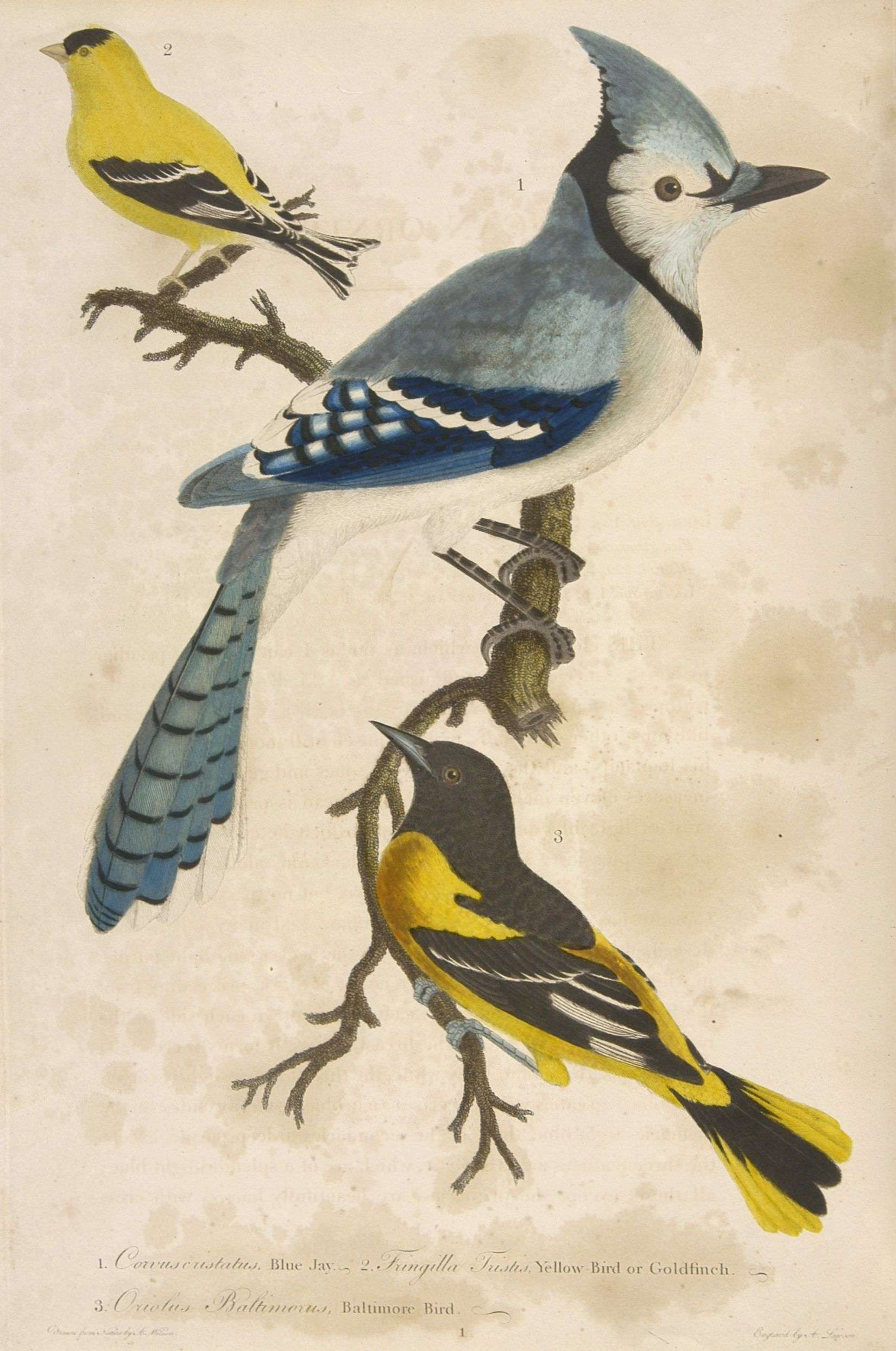
On a collecting expedition on the Ohio and Mississippi in 1810 (in his skiff, Ornithologist), Wilson reached Louisville, Kentucky. Here he met John James Audubon who would be inspired to improve upon Wilson’s work. Audubon’s Birds of America was published between 1827 and 1838 in Edinburgh and London. While Audubon was much the better artist, some argued that he plagiarised much of Wilson’s writing and that he had actively tried to suppress American Ornithology in order to promote his own work. Ironically, in Wilson’s home town, Paisley Museum and Art Gallery holds a copy of the four-volume edition of Audubon’s book.
Wilson had become an American citizen in 1804 and in 1812 he was elected a member of the Society of Artists of the United States. The following year he was welcomed into the American Philosophical Society. Yet when Wilson died that same year, he was living in poverty, his great project having taken its toll. His friend George Ord, himself a zoologist of some note, saw the final two volumes of American Ornithology through to publication. Ord also later wrote Wilson’s first biography. Wilson is buried in the graveyard of Gloria Dei Church in Philadelphia.
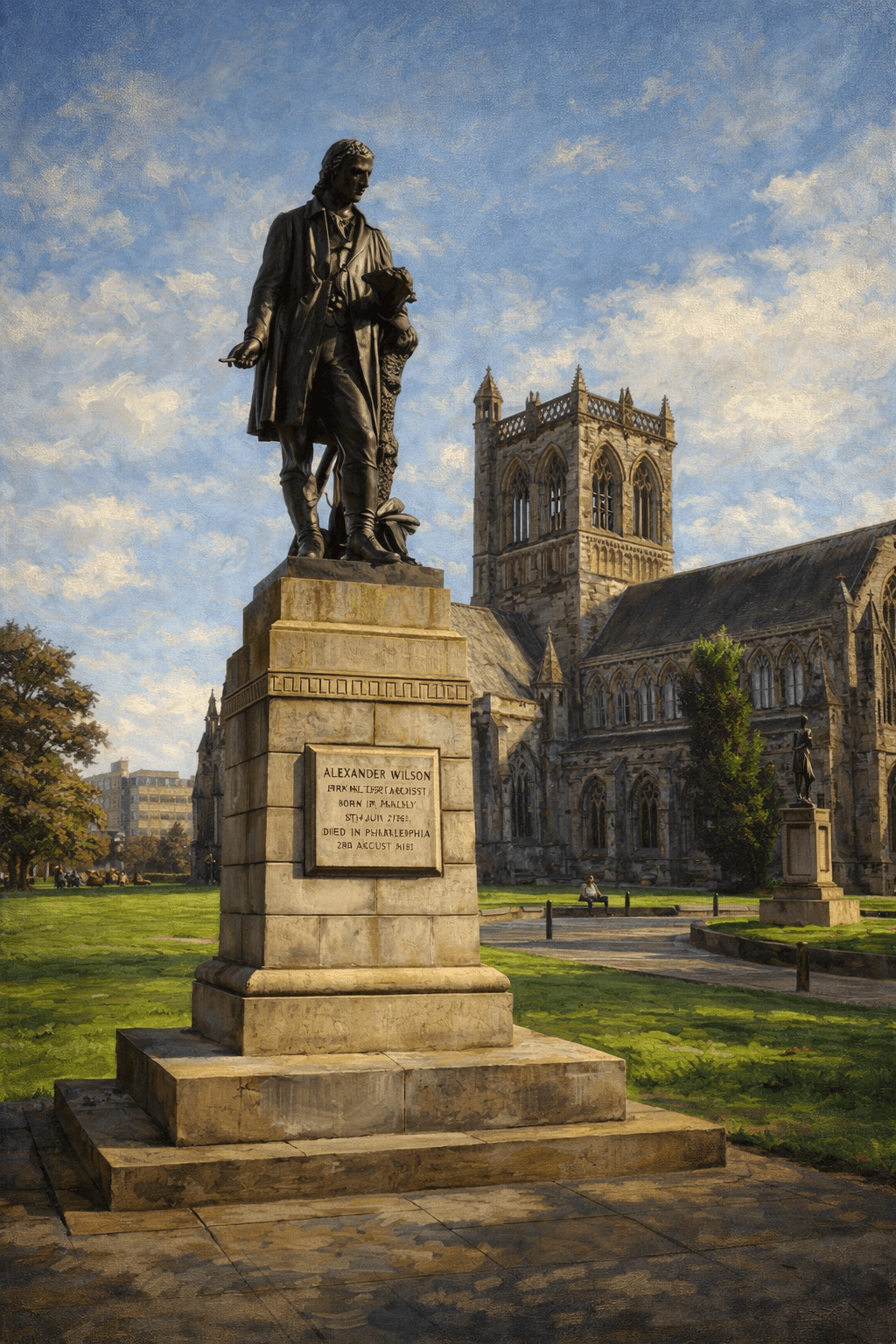
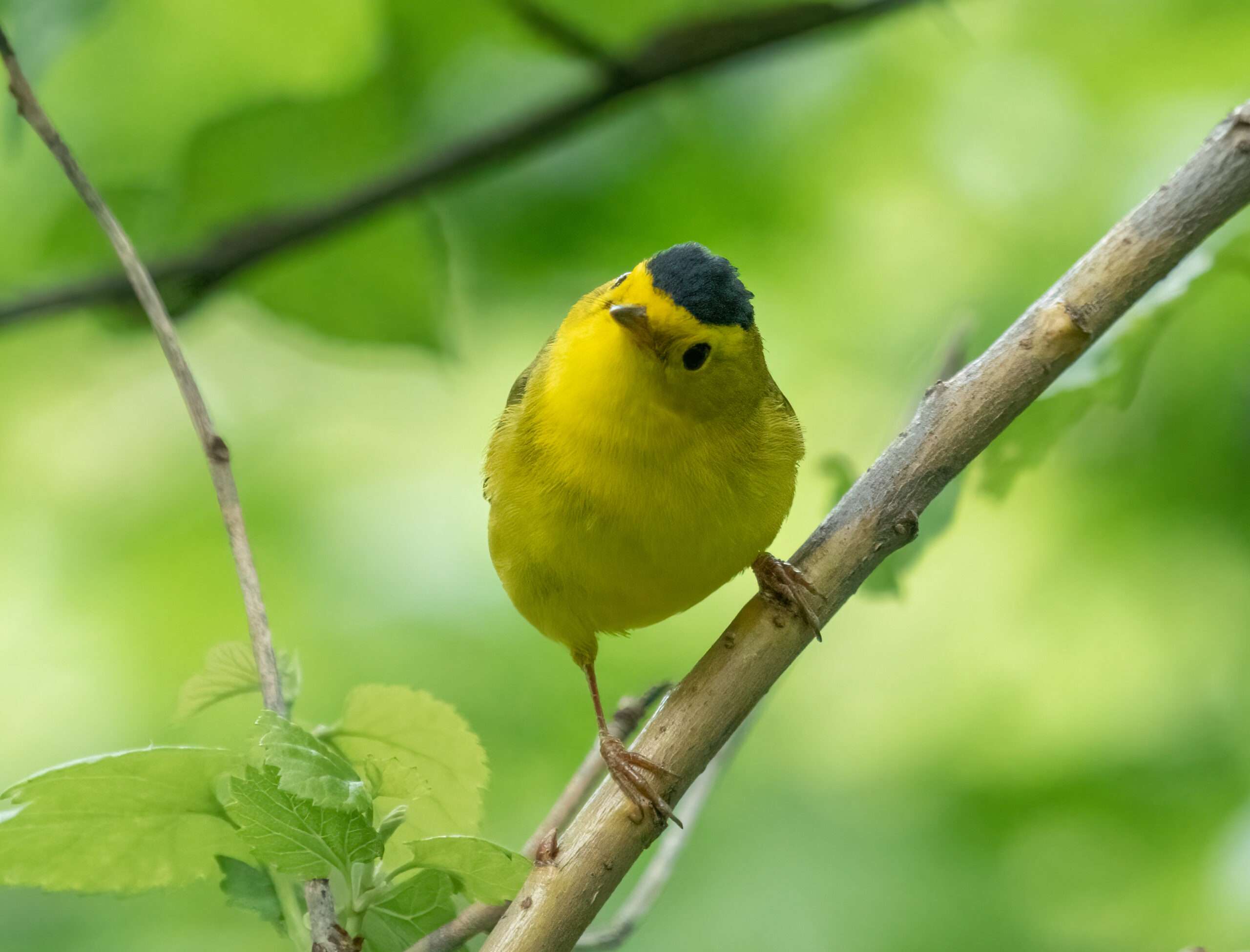
Wilson is not forgotten at home. His statue stands proudly outside Paisley Abbey while there is a plaque on the former Laigh Kirk (now the Paisley Arts Centre) where he was baptised. He is sometimes referred to as ‘the father of American ornithology’ and there were at one time several species of bird named after him. The American Ornithological society, however, is gradually renaming bird species named after individuals. Wilson’s Warbler, an attractive little yellow bird with a black cap, will be one of these. The bird serves as the logo of the Wilson Ornithological Society in the USA; it publishes the Wilson Bulletin. There is also a Wilson Journal of Ornithology.
Alexander Wilson travelled a long way from the weaving industry in Paisley. Poet, artist, ornithologist, teacher, he packed a great deal into 47 short years of life.
Main image: The statue of Alexander Wilson located in Paisley.
Do you enjoy our content?
Content on the Scottish Banner website remains free for users. Stories and events listed for the international Scottish community continue to be an important resource for many across the world. As advertising revenue remains a challenge, our readers can donate to help us produce unique Scottish content for global Scots. Every contribution counts and thank you for considering your support.
Support the Scottish Banner! To donate to assist with production of our publication and website visit: The Scottish Banner