
‘Time, the deer, is in the wood of Hallaig’. So begins perhaps the most enduring and resonant poem by Somhairle MacGill-Eain (Sorley MacLean), dwelling in a place lost to the Clearances. No other animal than the deer could have carried the weight of this vision.
For thousands of years in Scotland deer have been seen as a potent embodiment of the natural, and indeed the supernatural, world. They appear as heraldic emblems, millennia-old carvings, iconic paintings such as The Monarch of the Glen, and in countless folkloric tales of grand hunts and encounters with the unknowable. Even now, the vision of a deer appearing in a back garden or bounding in a field beside a motorway evokes a sense of calming wonder in many people.
Intertwined with deer
Some of the earliest people in Scotland to leave an archaeological record were intimately intertwined with deer. Deer bones and antlers are commonly found within Mesolithic middens, Neolithic chambered cairns, and Iron Age brochs. Not all can be explained by their utility as sources of protein and tools. Bones from 36 red deer were found within the Knowe of Yarso in Rousay, Orkney, where ancient tribes seem to have identified themselves in part by their affinity for certain animals. At Dun Mor Vaul, an Iron Age settlement in Tiree where there has never been a large deer population, a highly atypical proportion of deer remains were found, suggesting a possible special significance for local people which they expended great effort to maintain.
Deer are the only animal to appear on prehistoric decorated pottery from the Hebrides, where wolves, golden eagles, dolphins, and other suitably totemic animals roamed. Even more remarkable is their abundance in Neolithic rock art. There are only nine known examples of prehistoric figurative rock art depicting animals in Britain, and almost all of them include or exclusively feature deer. Clearly, these animals loomed very large in peoples’ imaginations and lived experiences.
Two of these depictions of deer are in or near to Kilmartin Glen in Argyll, a place I have explored in several past articles. Deep in Glen Domhain on a low stone beside a burn is a lightly carved image of an almost cartoonish deer, its pointed ears, big eyes, and tuft of a tail looking straight out of a Pixar animation. It likely dates from the Iron Age and is thought to mark the boundary between two kindreds, or possibly even between the Gaels of Argyll and the Picts of the central Highlands.
The Fabulous Stag
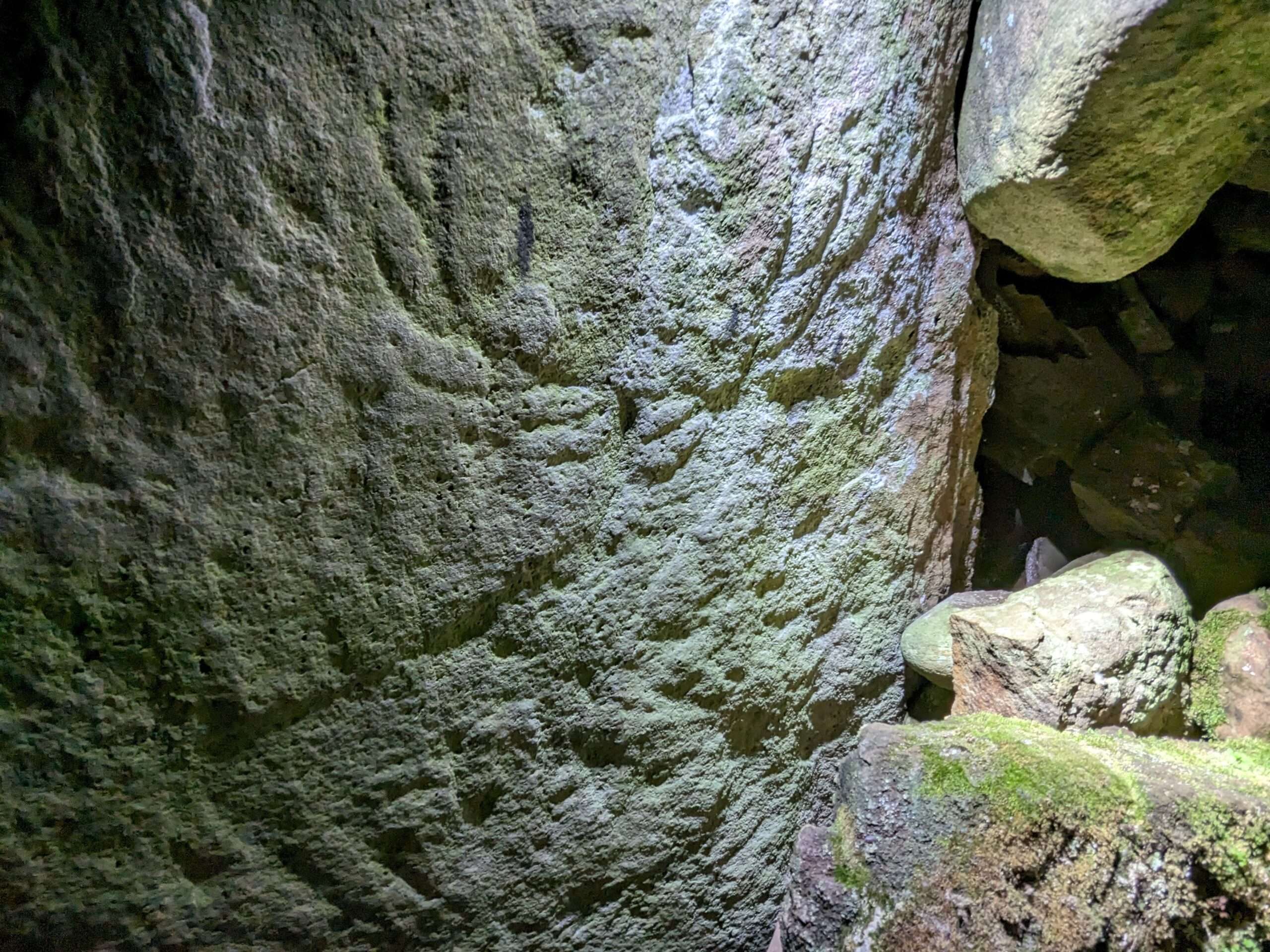
The other was discovered by chance in 2020 by Hamish Fenton on the underside of a capstone in Dunchraigaig Cairn, an Early Bronze Age burial chamber in Kilmartin Glen. There are five deer altogether, a pair and a trio, the most striking of which is the aptly named ‘Fabulous Stag’ with its massive antlers. Some of the deer appear to be in motion, as if climbing up a slope. The carvings were almost certainly made when the capstone was upright in the landscape, perhaps in the form of a standing stone which was then incorporated into a later funerary monument. Just like how people today display antiques in their homes, past peoples regularly incorporated older elements into their domestic and ritual spaces.
Of the nine known examples of deer in prehistoric British rock art, five are in Scotland. Besides Kilmartin Glen and Glen Domhain, they appear at Ballochmyle in Ayrshire, Eggerness in Dumfries & Galloway, and on the outer wall of a rock shelter on Blackford Hill in Edinburgh. Deer are pivotal in many of the oldest and best-known tales of the Celts, in which an encounter with a deer often heralds contact with the Otherworld. They are strongly associated with the Cailleach, a creation goddess in the folklore of Scotland, Ireland, and the Isle of Man who brings winter to the land and keeps nature in balance. Deer feature in many tales of the Fianna, which people across the Highlands and Islands held in great esteem. In one tale the deer-mother Saba mates with the great Finn mac Cumhaill (Finn MacCool) himself, bearing his two sons Oisín (Ossian) and Oscar. Oisín was the most gifted of all in the sacred art of poetry, a talent attributed to his unconventional parentage.
The appearance of a white hart – a deer with leucism – was a revered symbol in the Middle Ages. Catching sight of one could mean that the favour of God was upon the witness, or in the case of Arthurian lore that it was time to embark on a new quest. Thomas the Rhymer, the famed Borders prophet, was recalled into the land of the Elfen Queen beneath the Eildon Hills by the appearance of a white hart and hind in his village. Many pubs across Britain, including one in Edinburgh’s Grassmarket, are named ‘The White Hart’.
The location of Holyrood Abbey in Edinburgh is attributed to King David I’s pursuit of a white hart into Holyrood Park. Despite it being a Sunday feast day the king set out to capture it, but it charged him and threw him from his horse. As David I was about to be gored by the furious hart the Holy Rude (true cross) appeared in the sky, scaring the hart away. Later that night David I was visited in a dream by St Andrew who instructed him to build an abbey near that fateful spot as penance.
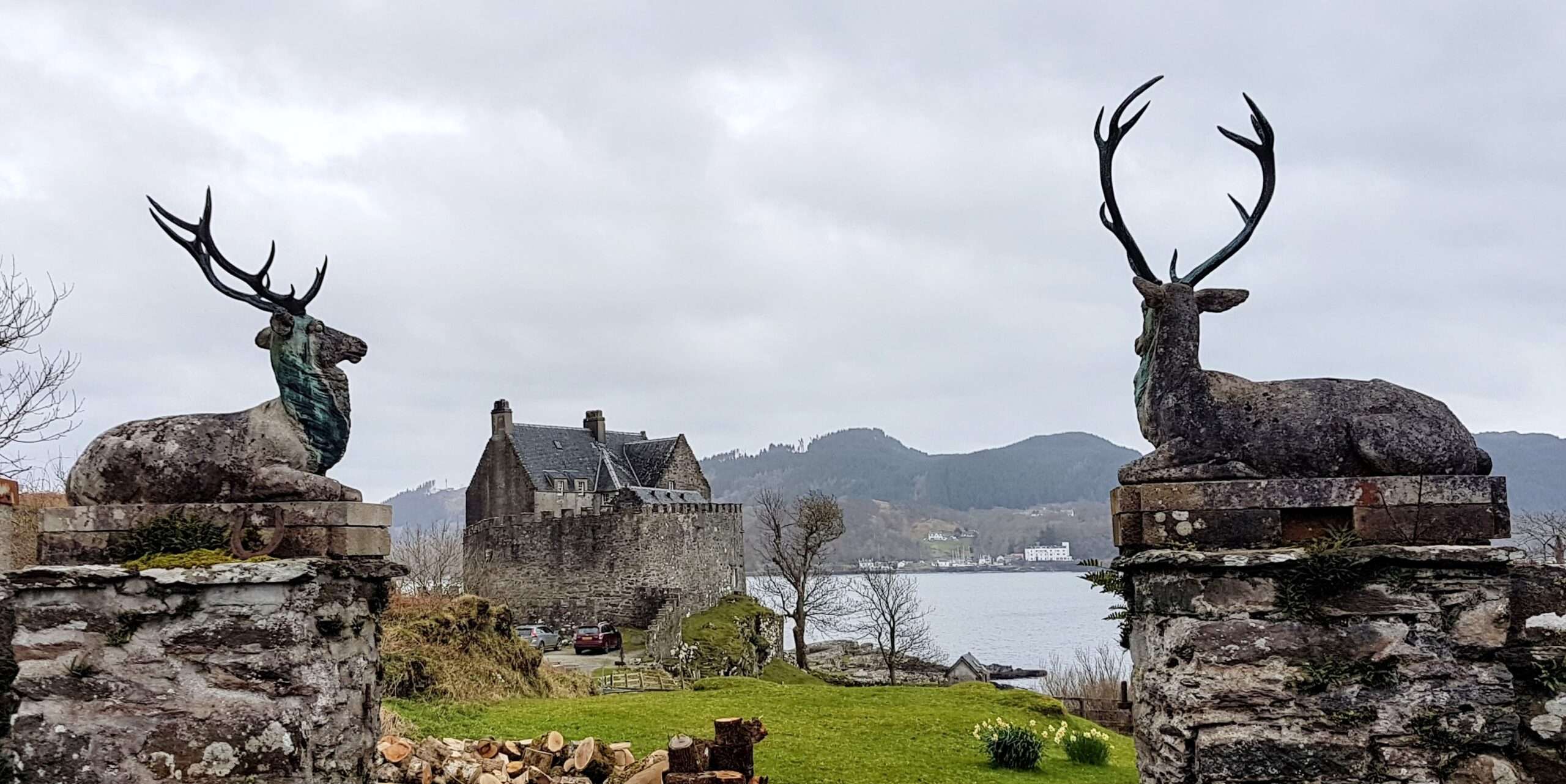
Many noble houses in the Middle Ages used deer – typically stags – in their heraldic emblems. Among them, to name but a few, are the crests of Fraser of Lovat, Clan Davidson, Clan Forbes, Clan Keith, and Clan Carruthers. Returning to Kilmartin Glen, the main landowners from the 18th century through today, the Malcolms of Poltalloch based at Duntrune Castle, use deer imagery on their crest, and the gate leading onto the castle grounds is adorned with
Deer forests
Our view of deer changed during the Industrial Revolution through Edwardian period when land previously used as commons were enclosed, people were evicted, and hunting estates were established. Deer, especially red deer, proliferated due to the extinction of large predators such as wolves in the 18th century, and many estates in the Highlands and Lowlands alike became ecological deserts given over entirely to hunting.
In 1811 there were only six ‘deer forests’ for hunting in Scotland; by 1912 there were over one hundred, covering a staggering 3.6 million acres. During this time, and still today, many people consider deer to be either a pest to be controlled or a product to be sold as part of the sporting estate package. No country house of this time was complete without a room displaying dozens, if not hundreds, of taxidermied specimens mounted on the walls attesting to our near-total domination of the countryside.
The history of peoples’ relationship with deer in Scotland can be read as shorthand for our changing views of the natural world. Prehistoric peoples saw great wonder in them, using deer totemically while also hunting them for meat and harvesting their sinews and antlers for daily tools and rituals. In the Middle Ages deer were often used in the foundational stories of saints and dynasties, becoming symbols connected with spiritual and secular power in an age of increasing hierarchies in society. In the age of enclosure and early modernity, deer lost much of their symbolic potency and became to many instead a mere resource to be exploited and profited from. Today, as the natural world is in dire peril and our connection to it weakens further still, deer are regaining some of their lost wonder – fleeting remnants of a world just beyond our own, sometimes fenced in but never fully domesticated. Next time you see one, ask what we might do to rebalance the scales.
Text by: David C. Weinczok
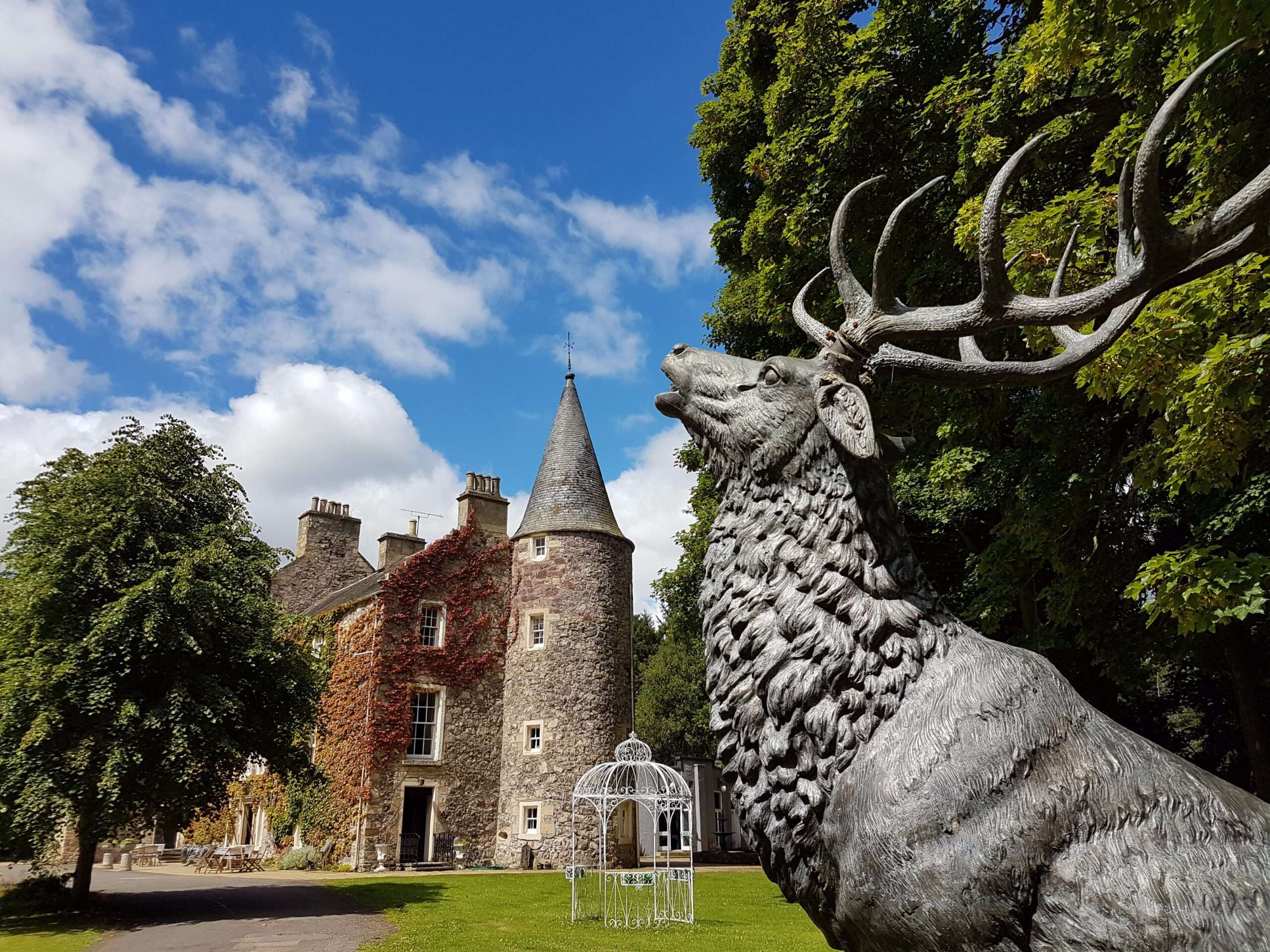
Main photo: A striking deer sculpture on the grounds of Fernie Castle in Fife. © David C Weinczok.
Do you enjoy our content?
Content on the Scottish Banner website remains free for users. Stories and events listed for the international Scottish community continue to be an important resource for many across the world. As advertising revenue remains a challenge, our readers can donate to help us produce unique Scottish content for global Scots. Every contribution counts and thank you for considering your support.
Support the Scottish Banner! To donate to assist with production of our publication and website visit: The Scottish Banner