
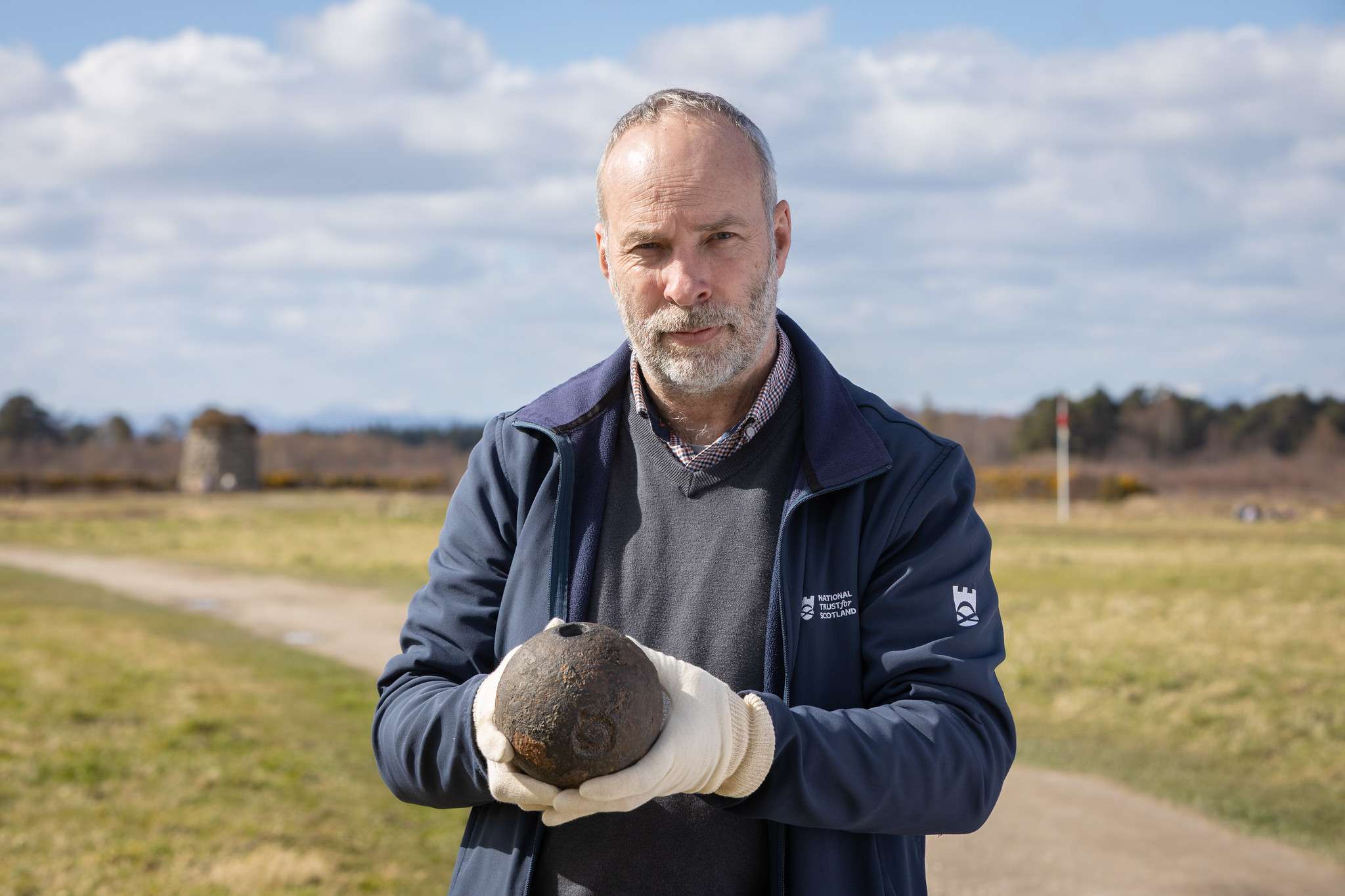
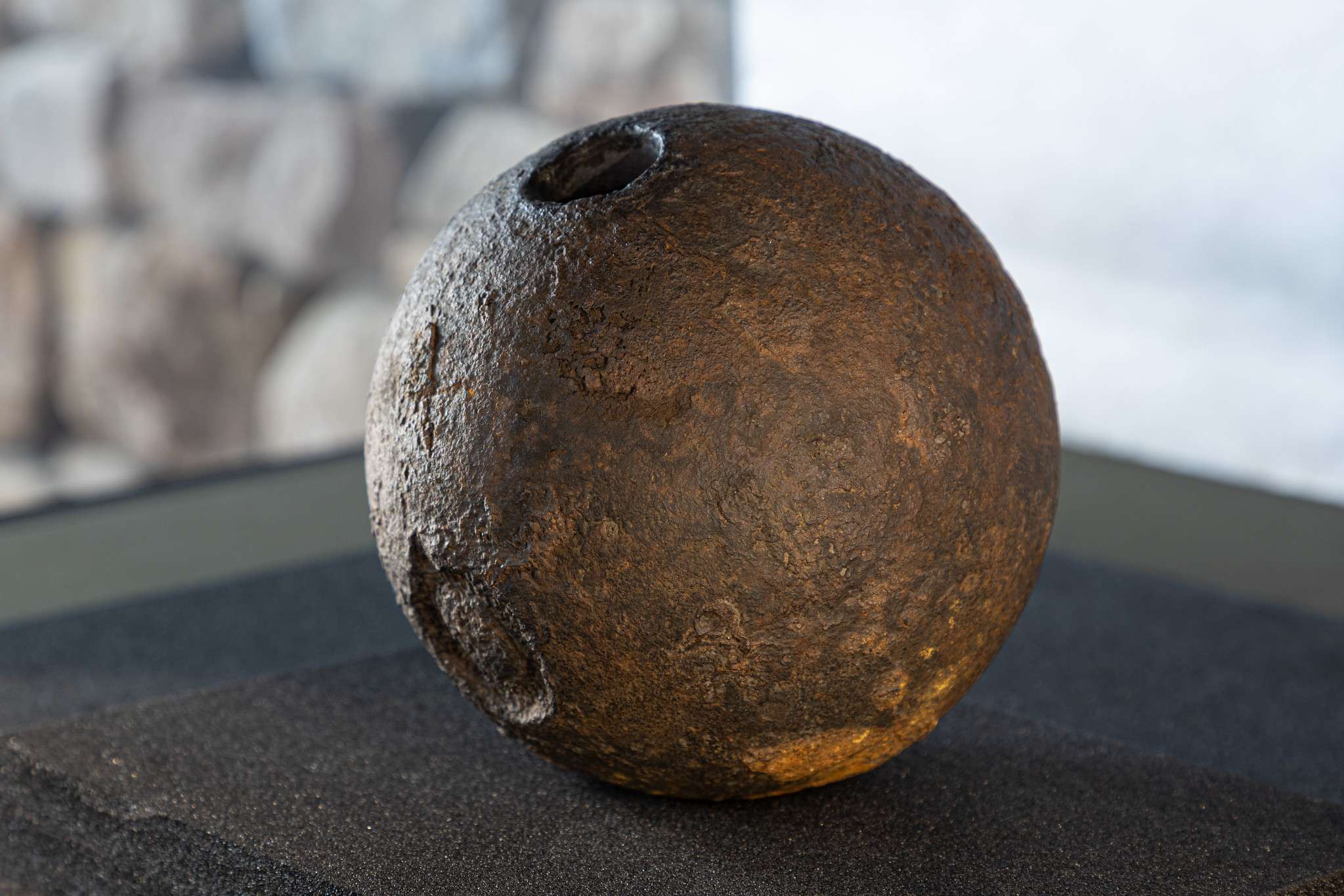
Archaeologists from the National Trust for Scotland have recovered an unexploded mortar shell, thought to have been fired by government artillery during the historic battle. The battle of Culloden on 16 April 1746 was a decisive defeat for the Jacobite army, led by Bonnie Prince Charlie, at the hands of the Duke of Cumberland’s government troops. Intact and gunpowder-packed when it was discovered, the 5.5-inch shell is the first piece of complete government ordnance found at Culloden battlefield and provides fresh evidence for the deployment and action of government and Jacobite forces at pivotal moments in the battle.
Many other projectiles, including cannon shot, musket balls and fragments of mortar shells, have been uncovered at Culloden, but never before has undetonated ordnance been found. Parts of the battlefield are on boggy ground, and it is thought the shell landed on wet ground and the fuse extinguished before it could ignite the powder. Weighing 8kg (17.5lb), heavier than the Jacobite’s three and four-pound cannonballs, the shell is thought to have been fired from one of the government army’s six Coehorn mortars. The Coehorn mortar was a lightweight, squat gun that shot explosive shells in high arcs over lines of troops. Fragments of other shells from Coehorn mortars have previously been found at Culloden and at Glen Shiel, where Coehorns were first used during a battle on British soil in June 1719, but the recent discovery is the first complete and unexploded example ever to have been recovered from a Jacobite battlefield.
The Culloden mortar shell was discovered in a field to the north-west of the Memorial Cairn by a team of archaeologists, metal-detectorists, and volunteers led by the National Trust for Scotland’s Head of Archaeology Derek Alexander and the University of Glasgow’s Professor Tony Pollard. The dig was part of a week-long programme of fieldwork, including digging test pits, machine trenching, metal detecting and mapping, at the Culloden Battlefield in October 2025. During the excavation, over 100 projectiles, including lead musket balls and pistol shot, were uncovered. Cleaning of the shell by conservator Will Murray at the Scottish Conservation Studio confirmed the presence of a bung, and digital x‑ray imaging demonstrated conclusively that the object was hollow with an internal chamber. The shell still retained part of its original plug, and plant fibres trapped in corrosion layers were also recovered for future analysis.
More secrets and stories to be uncovered at Culloden
Derek Alexander, The National Trust for Scotland’s Head of Archaeology, said: “This is a remarkable – dare I say, explosive – find of the kind archaeologists dream of, but never expect to encounter. Along with the other projectiles recovered, this discovery helps us better understand the formation of troops and concentration of fire during this brief, but brutal, battle. The mortars may have been aiming at the Jacobite artillery, so the place where the shell landed may mark the heart of the Culloden battlefield. The ground rises slightly in this area, providing a better vantage point, and it is adjacent to the old road along which artillery could’ve moved more easily, making it a plausible location for the Jacobite artillery positions. We have a more vivid image of how the battle played out, but the discovery also tells a human story. Mortar shells mark their path through the air with a smoke trail from the lit fuse, helping the government artillery officers to know how to adjust the length of the fuse to ensure maximum damage. This shell may have been a failed first shot. When it didn’t explode as expected, the Jacobite fighters standing nearby must have felt an immense relief. This is our fifth consecutive year of digging at Culloden, so it’s an ideal time to assess what we’ve found and consider how this work impacts on-site interpretation and the long-term management of the battlefield. We didn’t have high expectations for this previously unexplored area of the battlefield – acidic soil was thought to have impacted the preservation of artefacts, and the broken ground makes detecting difficult – so we’ve been invigorated by this unexpected discovery. It’s clear there are many more secrets and stories to be uncovered at Culloden. The mortar shell was found buried 30cm deep into the ground and items like these can only be found during professional excavations led by experienced archaeologists, so the battlefield remains safe to visitors. This shell has been cleaned and assessed now, making it safe to handle, and has ensured it is safe to go on display. These exciting finds are made possible by the work of our committed archaeology volunteers and team of local metal detectorists, and the continued generosity of our members and supporters. Professor Christopher Duffy not only made a lasting impact on the interpretation and protection of Culloden, but his hugely generous legacy donation has really expanded the range of our investigations.”
Cared for by the National Trust for Scotland, Culloden Battlefield was visited by over 366,000 people in 2025 and is a place of pilgrimage and remembrance for visitors from Scotland and beyond. The battlefield is central to Scotland’s cultural identity, and yet historic battlefields don’t enjoy the same protections as other historic sites, such as Scheduled Monuments or listed buildings. In its 2026 election manifesto, the Trust is calling for the next Scottish Government to commit to Conservation Management Plans that will give battlefields enforceable protection.
Derek Alexander added: “The importance of more rigorous protection for historic Scottish battlefields like Culloden and Bannockburn is underlined by finds like this one. Not only are such places symbolic of our national story, they also may hold many undiscovered artefacts that can tell us more.”
One of the most harrowing battles in British history
Professor Tony Pollard of the University of Glasgow said: “Artillery played a vital role at Culloden, particularly on Cumberland’s side, where the Royal Artillery’s cannon were well served by experienced gunners; after disabling the Jacobite guns in counter-battery fire, they delivered round shot, grape shot and canister shot at the Jacobite infantry, first as they were stationary and then as they charged across the wide expanse of open moor. “We have found evidence for all these types of shot, but our previous archaeological investigations have also recovered fragments from an exploded mortar shell. This was fired into the mass of Jacobites as they engaged in hand-to-hand fighting on Cumberland’s left, landing so close that their detonation risked friendly fire casualties. Their location is a clear indication that the impact of the Jacobite charge was taken extremely seriously and regarded as an immediate threat to Cumberland’s line.”
2026 marked the 280th anniversary of the Battle of Culloden. On 16 April 1746, the final Jacobite Rising came to a brutal head in one of the most harrowing battles in British history. Jacobite supporters, seeking to restore the Stuart monarchy to the British throne, gathered to fight the Duke of Cumberland’s government troops. It was the last pitched battle on British soil and, in less than an hour, around 1,600 men were slain – 1,500 of them Jacobites.
The National Trust for Scotland’s richly researched, stimulating and sensitive Culloden Visitor Centre stands beside the battlefield and features artefacts from both sides of the battle and interactive displays that reveal the background to the conflict. It is both a monument and a guide to a pivotal day in history. Culloden’s enduring legacy also persists in popular culture, including the book and television series, Outlander. Fans of the series are currently running a fundraiser in support of the Culloden Fighting Fund, which supports the Trust’s ongoing interpretation of the battle and enables it to create new displays, such as this one of the mortar shell. The fundraiser runs until 2 May 2026 and can be found online at www.justgiving.com/page/jesuisprest.
Main photo: Derek Alexander, The National Trust for Scotland’s Head of Archaeology. Images courtesy of the the National Trust for Scotland.
Do you enjoy our content?
Content on the Scottish Banner website remains free for users. Stories and events listed for the international Scottish community continue to be an important resource for many across the world. As advertising revenue remains a challenge, our readers can donate to help us produce unique Scottish content for global Scots. Every contribution counts and thank you for considering your support.
Support the Scottish Banner! To donate to assist with production of our publication and website visit: The Scottish Banner