
Jupiter Artland is an odd and intriguing name for one of the Edinburgh area’s oddest visitor destinations. You can get there by car or bus but however you do so it feels strangely like arriving at a safari park. But animals are not the main attraction here. Instead of giraffes and lions there are works of art. It’s Jupiter Artland, after all.
The story starts a long time ago. Bonnington House was originally built in 1622, in the last years of James VI. It was much altered over the years and completely refurbished in, ironically, a Jacobean style, in 1858. The house had been owned by various noble Scottish families but the present owners, Robert and Nicky Wilson, acquired the property in 1999.
They have since spent a great deal of money refurbishing and adding to the house. However, early in their acquisition they saw the potential of the fields, meadows and woodland surrounding the property as an open-air art and sculpture gallery. They started acquiring works and laying out the site. Jupiter Artland finally opened in 2009 and over a million people have now visited.
Artworks
Many of the artworks are big but some are quite enormous, features of the landscape rather than objects set there. Some you can’t miss; others are almost hidden and you have to really look for them. The souvenir map is an excellent guide, however, and with it you should be able to track down the 33 numbered artworks.
Some of the artworks you look at and study, like traditional exhibits in a gallery. Most you can touch. Some of them you actually interact with, and none more so than Cells of Life by Charles Jencks.
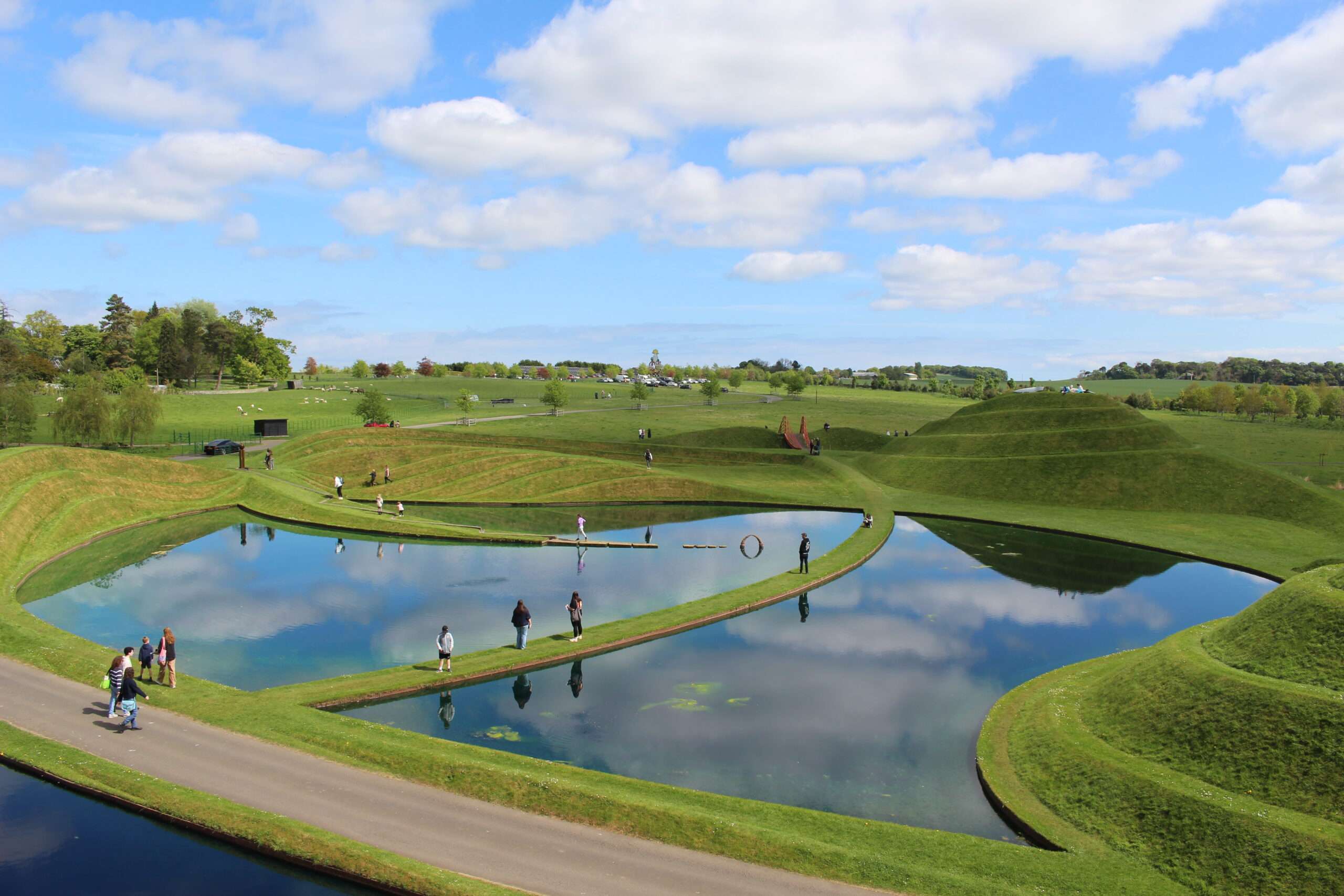
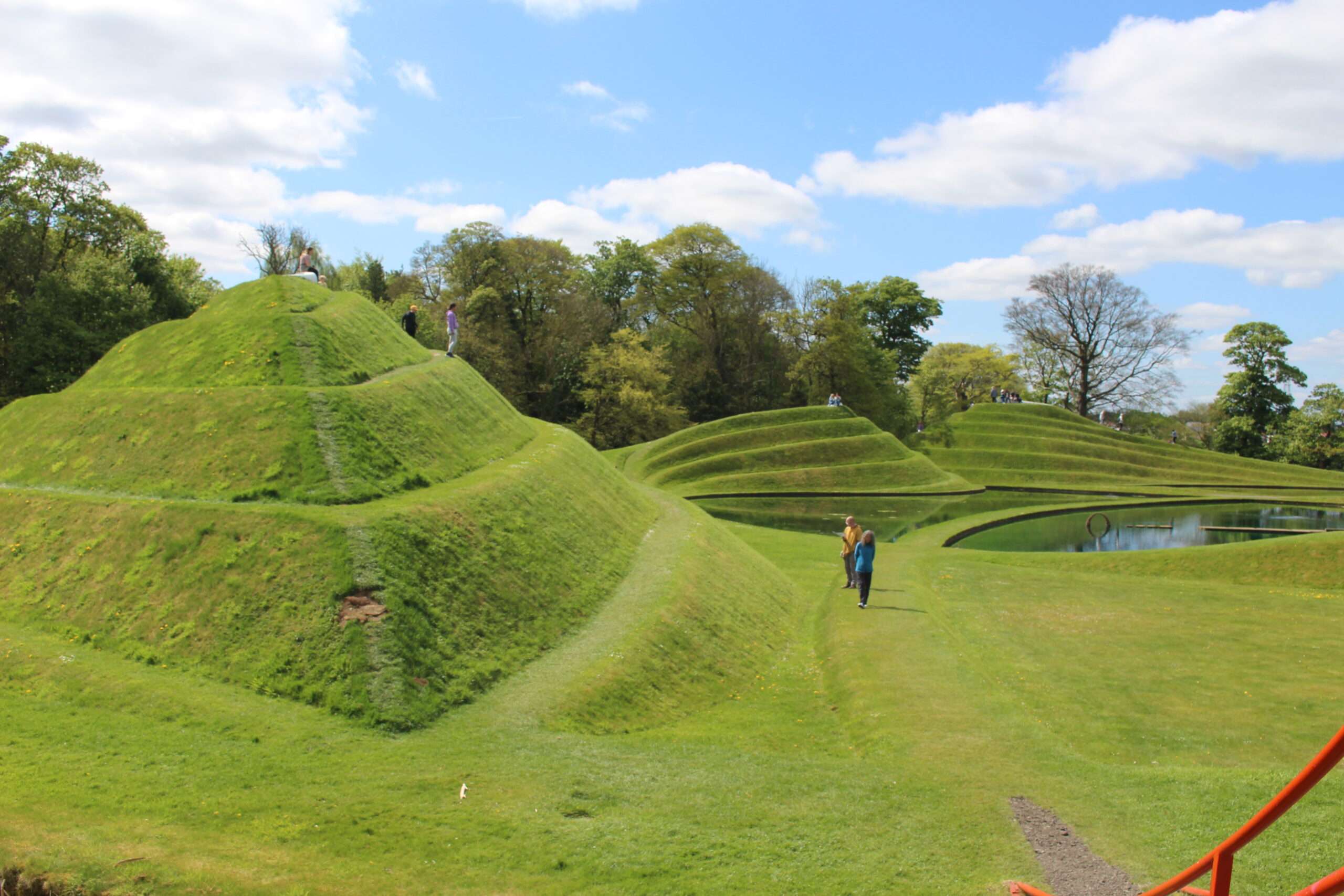
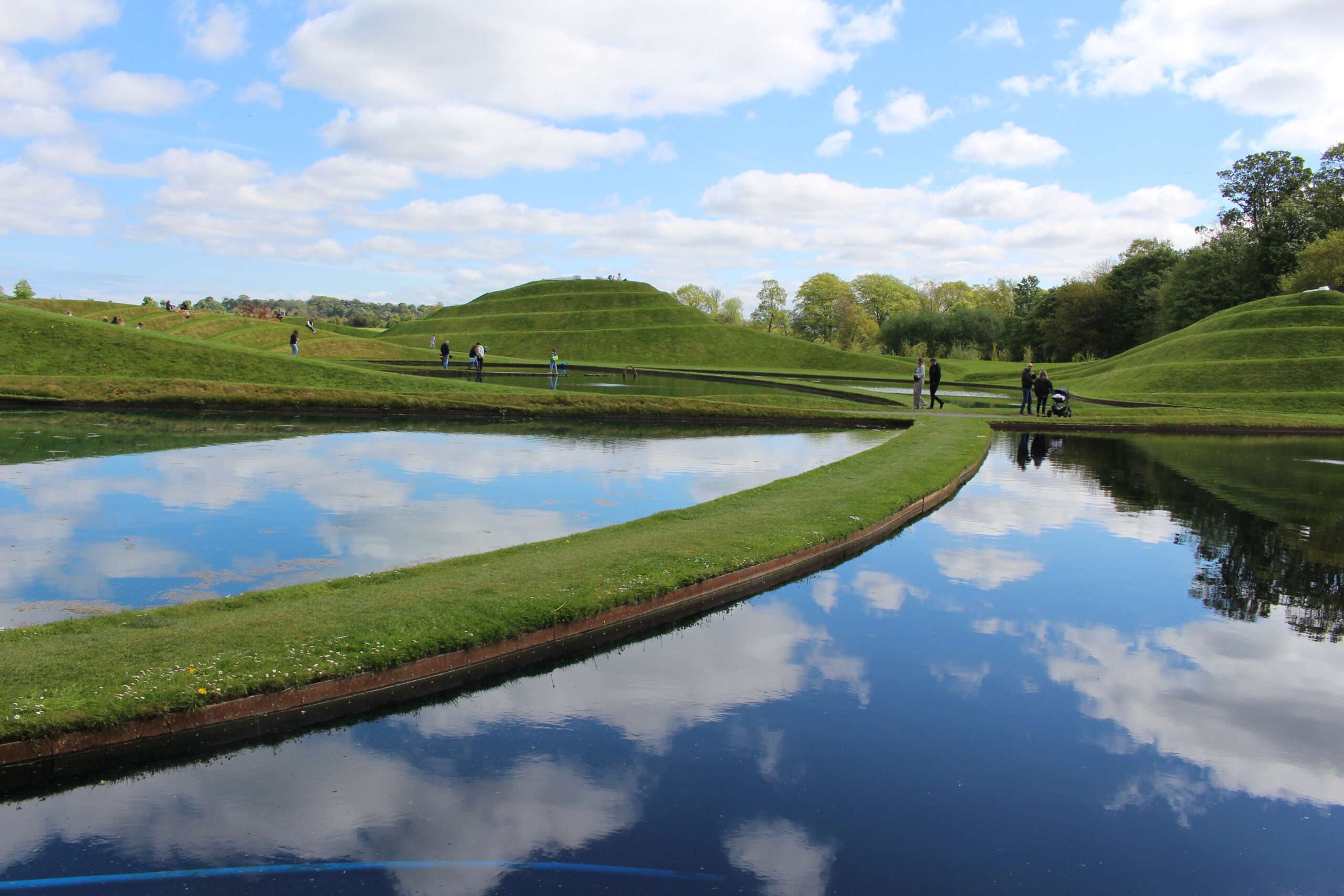
If you arrived by car you’ll have driven through Jencks’ work on your way to the car park. If you arrived on foot after getting off the bus, you’ll probably stop and explore as soon as you see it. It’s a substantial artificial landform composed of several terraced mounds, like the remains of Iron Age hillforts, with spiral paths that climb to their summits. Between the mounds are still, clear, sky-reflecting pools. It’s mesmerising to watch the shapes of the mounds change as you follow the paths and take pictures of the clouds mirrored in the water.
It’s supposed to be, as its name suggests, an artistic response to the cell, the very basis of life in all its forms. I have to confess I don’t quite get that: to me it comes across more as a stylised celebration of landscape, hill and loch, with nods to humankind’s impact on the environment. Go and see and interact for yourself. What do you think?
Better felt than tellt
Near Cells of Life there are some paddocks where you many find the likes of ponies and donkeys. They may give a break from the art, if you or the children need one. If this is a safari park for art, there are at least a few genuine animals around.
It’s tempting to describe lots of the other artworks but I’m going to limit myself as it’s much better to go and see and prepare to be surprised. As the Scottish phrase has it, Jupiter Artland is better felt than tellt. However, there is a corner of the park that I particularly enjoyed. It’s near the hub of the park, The Steadings, where you’ll find the café and shop and indoor gallery. It’s quite near the main car park. Just to the west of The Steadings is the area known as Gala Hill, a pleasant and airy woodland which has a surprising number of intriguing, sombre and sometimes funny artworks.
If you have children with you, I can confidently predict that their favourite will be Firmament by the legendary artist Antony Gormley of Angel of the North fame. Firmament is in stark contrast to his usual slightly eerie standing human figures. It’s inspired by an old star map and is like a giant Meccano set gone mad. In recreating the night sky, the metal links actually almost take the shape of a sinister monster. Gormley recommends looking at the sky through the artwork. It’s in an elevated space at the edge of the wood with a fine view over the Forth bridges.
Gala Hill also features three works by the late Scottish artist Ian Hamilton Finlay, who was a pioneer of art designed to be experienced in the landscape, as at his famous garden of Little Sparta at Dunsyre in the Pentlands. I still remember Finlay’s exhibit at the 1988 Glasgow Garden Festival and there’s a faint whiff of that event about Jupiter Artland.
Signpost to Jupiter
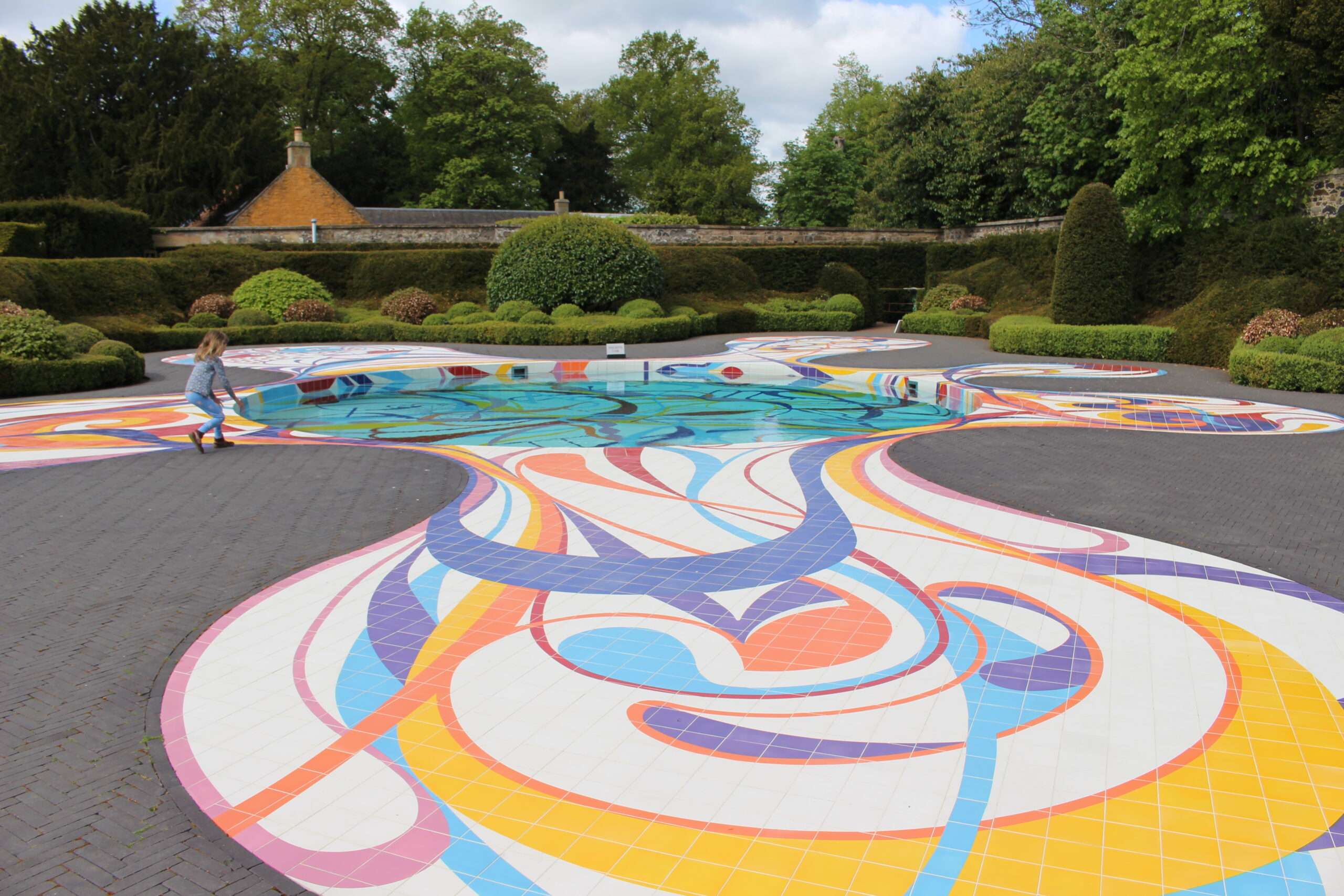
Bonnington House itself is not open to the public and is a private home, but it often provides an attractive background as you explore the sculptures. Joana Vasconselos’ Gateway is an ornamental pool set amongst thousands of Portuguese tiles, amongst beautiful gardens with Bonnington House as a backdrop.
Perhaps surprisingly, Bonnington House was bombed during the Second World War causing some minor damage. One of the artworks commemorates this event; Henry Castle’s Hare Hill models one of the bombs that fell as well as the aircraft itself, linking the spot to Hare Hill, some six miles away in the Pentlands. A Luftwaffe bomber crashed there during the war, and its wreckage can still be seen.
Other artists you’ll probably have heard of, and who are represented in the park, include Andy Goldsworthy and even Tracey Emin. The park supports educational visits to the park for young people; going to visit, and paying the entrance fee, helps to support this important work.
On our visit, in the spring of 2025, we spent a couple of hours at Jupiter Artland, yet there were not only some artworks, but entire areas of the park that we didn’t get to. So, there’s always a reason for another visit. However, you might ask, why the name. Why Jupiter Artland? The honest answer is that I don’t know! However, there is an artwork by Peter Liversidge entitled Signpost to Jupiter which is, indeed, a signpost pointing (up the way!) to Jupiter. The sign points out that, depending upon orbits, Jupiter is between 893 and 964 million kilometres away.
So, now you know.
Do you enjoy our content?
Content on the Scottish Banner website remains free for users. Stories and events listed for the international Scottish community continue to be an important resource for many across the world. As advertising revenue remains a challenge, our readers can donate to help us produce unique Scottish content for global Scots. Every contribution counts and thank you for considering your support.
Support the Scottish Banner! To donate to assist with production of our publication and website visit: The Scottish Banner