
April 2026 (Vol. 49, Number 10)
A tragedy at Glasgow’s beating heart
-
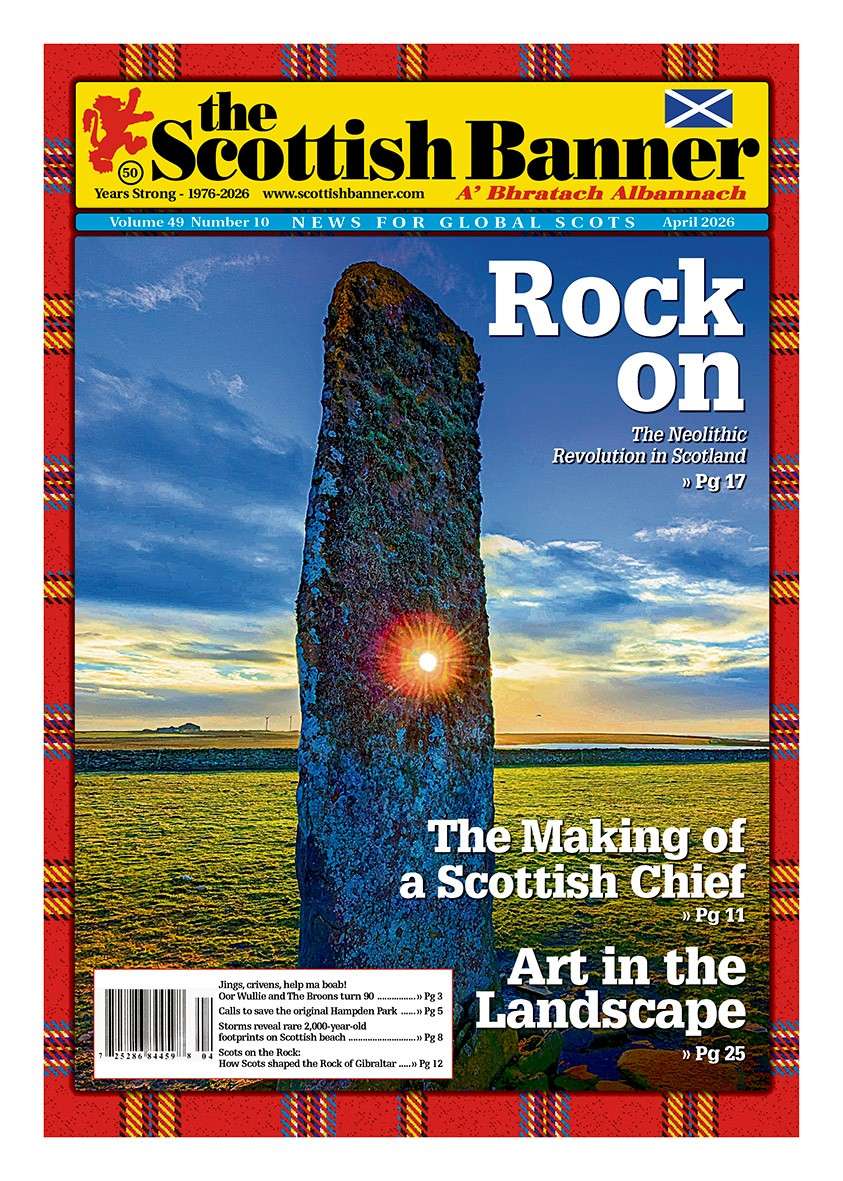
The setting sun shines through a preciselyplaced hole in a Neolithic standing stone in North Ronaldsay, Orkney. Photo: David C Weinczok.
Just prior to this issue being released some very tragic news came out of Scotland’s largest city. A major fire struck the area around Glasgow Central Station on March 8th, triggering one of the most disruptive incidents in the station’s long history.
Iconic building
The blaze began in a vape shop on Union Street, rapidly spreading through a connected 175-year-old Victorian-era commercial building. Flames climbed toward the roofline and reached the corner of Union Street and Gordon Street, where part of the historic structure—including a dome—partially collapsed under the intense heat. The building known as Union Corner, dates back to 1851, pre dating the station itself which opened in 1879.
The iconic building which was destroyed may be remembered by some readers for the adverts for Irn Bru and Bells Whisky that were displayed on its rooftop. More than 200 firefighters battled the inferno for hours, they even pumped water from the River Clyde to help battle the blaze, as thick smoke drifted across the city centre. Although Glasgow Central Station itself avoided major structural damage, the proximity of the blaze, falling debris, and the scale of the emergency response forced the complete closure of the high‑ level station, with all services suspended while safety inspections were carried out.
Sadly, council have decided that total demolition of what remains of the building must happen in the interests of public safety. The disruption brought Glasgow’s transport network to a standstill, affecting thousands of passengers. Thankfully no casualties have taken place during this tragic event, however most Glaswegians will now be coming to terms with the loss of such an iconic part of their city. There are businesses now lost and others who will be greatly impacted by the temporary closure of the station and surrounding streets. This is a hit to the city who is still getting over the catastrophic fires of the Glasgow School of Art and is preparing to welcome the world this summer for the Commonwealth Games.
Glasgow’s beating heart
Glasgow Central Station is not just Scotland’s busiest railway hub, but also the city’s beating heart. Its origins lie in the fierce railway rivalries of the 19th century. Before the station existed, Glasgow’s main rail terminus sat south of the River Clyde at Bridge Street and was opened in 1841 as Glasgow’s first purpose-built passenger railway jointly operated by the Glasgow, Paisley, Kilmarnock & Ayrshire Railway and the Glasgow, Paisley and Greenock Railway. As passenger numbers surged and Glasgow’s industrial power grew, it became clear that a larger, more centrally located station was essential.
The Caledonian Railway Company, eager to dominate routes into the city, secured permission to build a new station on the north bank of the Clyde. Construction began in the late 1870s, and Glasgow Central Station officially opened on 1 August 1879, serving as a grand terminus for trains arriving from the south and west. Its strategic location quickly made it indispensable.
Demand grew rapidly. To accommodate increasing traffic, a Low Level station was added beneath the main platforms in 1896, creating a vital cross‑ city link. The early 20th century brought even more ambitious expansion: between 1901 and 1905, chief engineer Donald A. Matheson and architect James Miller oversaw a major redevelopment. This project extended the station over Argyle Street, added new platforms, and introduced the iconic glassroofed train shed that still defines the station’s appearance. The result was a striking Edwardian structure which is still today widely regarded as one of Scotland’s grandest railway buildings.
Throughout the 20th century, Glasgow Central evolved with the times. The Low Level station closed in 1964 during widespread rail cutbacks but was revived in 1979 as part of the new Argyle Line, restoring vital east‑ west connectivity. Modernisation continued with resignalling in 1960 and major refurbishments between 1984–86 and 1998–2005, ensuring the station could meet the demands of a modern transport network.
Citizen Firefighter
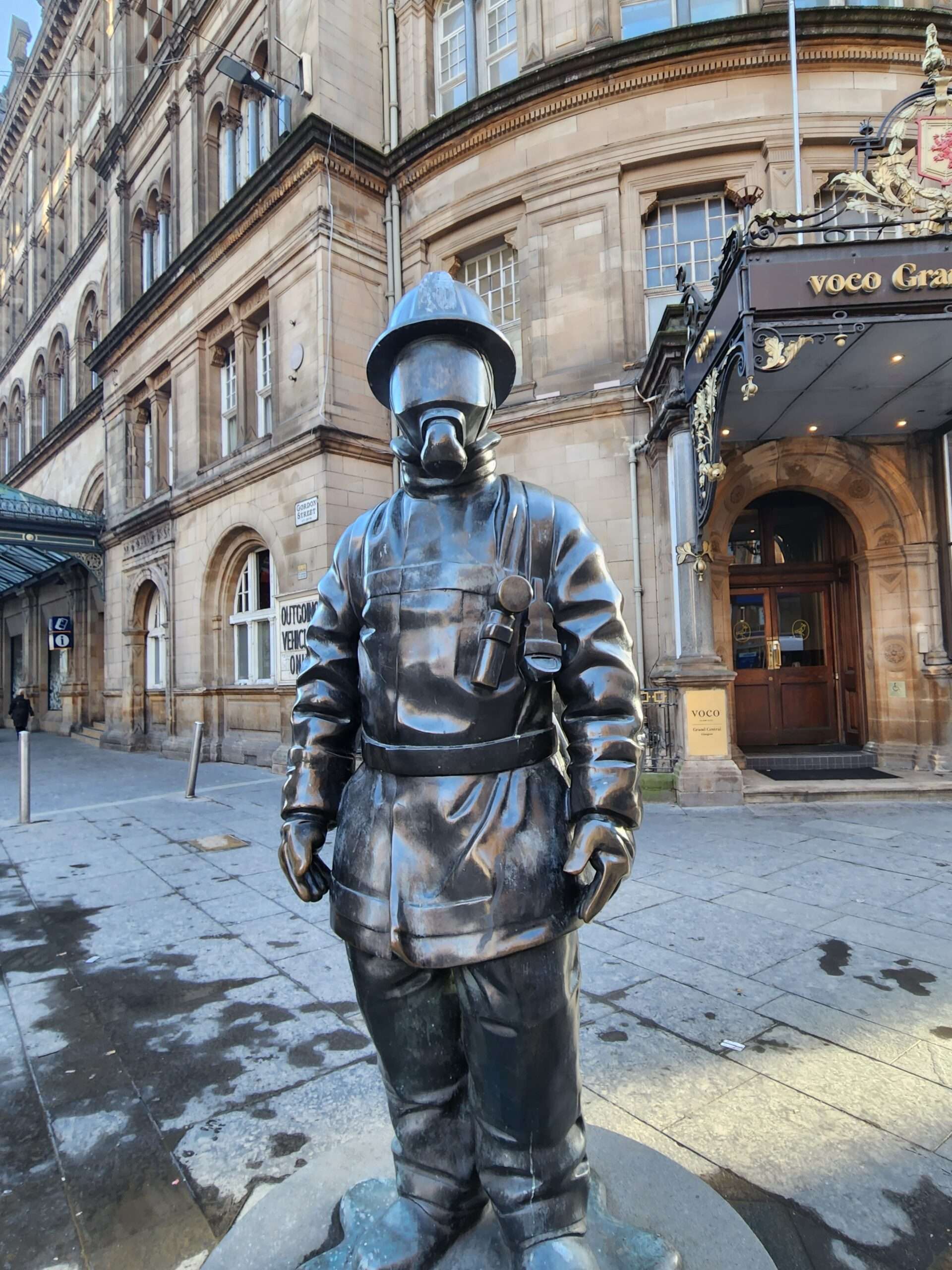
One of the both iconic and ironic images that was seen during the fire was the Citizen Firefighter statue which stands outside the station on the corner opposite to the fire. Created by Scottish artist Kenny Hunter and unveiled in 2001. The bronze figure honours firefighters past and present, depicting a responder in full gear returning from duty. The statue was not damaged and has become a symbolic tribute to bravery and public service of fire fighters and this was shown ten-fold on this sad occasion.
Glasgow Central is not just a train station to get somewhere from, it is celebrated not only for its architectural grandeur, but also for its role in the city’s social history. Its incredible marble floors, soaring glass roof, and bustling concourse have witnessed wartime departures, daily commutes, and countless personal stories.
The Glasgow spirit
Central Station is a special place, and I always go to the station on a visit to Glasgow, whether I am catching a train or not as I love the place. The station itself is my favourite in not just Scotland but all of the UK and it holds a special place for many. Now the 2026 fire will be added to its history. This station is so much more than a transport hub, it remains a living monument to Glasgow’s industrial heritage, civic ambition, and part of the Glasgow spirit.
That Glaswegian spirit will now be called upon to rebuild the adjoining Union Street building and showcase the city’s resilience, which unlike the fire cannot be extinguished.
Do you have you any comments from the content in this month’s edition? Share your story with us by email, post, social media or at: www.scottishbanner.com/contact-us
#ScottishBanner, #TheBanner #NewsForGlobalScots
The Scottish Banner is more reliant than ever on our readers helping us to provide you with our unique content by buying a copy of our publication, regardless if by print or digital subscription or at a retail outlet.
We appreciate your support and hope you enjoy this edition.
Support the Scottish Banner! To donate to assist with production of our publication and website visit: The Scottish Banner