
Kings, Castles & “Durty” Wee Rascals
Australian Jim Stoddart was born in a Glasgow Tenement and raised in a Glasgow Housing Scheme 1943-1965. Jim will be taking readers on a trip down memory lane, of a time and place that will never be the same again and hopes even if only a few people in the Scot’s Diaspora have a dormant folk memory awakened, then he shall be more than delighted.
A Paisley Poet
The broom, the briar, the birken bush, bloom bonnie o’er thy flow’ry lea;
And a’ the sweets that ane can wish, frae nature’s hand are strewd on thee.
When winter blows in sleety showers frae off the Norlan hills sae hie,
He lightly skiffs thy bonnie bow’rs as laith to harm a flower in thee.
Thou bonnie wood O’Craigielea, thou bonnie wood O’Craigielea,
Near thee I pass’d life’s early dayand won my Mary’s heart in thee.
Verses 1, 4 and chorus from Thou Bonnie Wood O’ Craigielea by Robert Tannahill.
Every present day Australian will tell you that nationalist and poet Andrew (Banjo) Paterson wrote the words to that wonderful and haunting tune Waltzing Matilda. Many might even recall that Christina Macpherson is said to have penned the music for him. That event supposedly happened whilst she was playing on her zither on a property in Queensland in 1895. A very much smaller number of ‘Aussies’ will know that Christina adapted that tune from an old Scottish Ballad, Thou Bonnie Wood O’ Craigielea written by the Paisley Poet, Robert Tannahill and his good friend James Barr. Both Christina MacPherson and Banjo Paterson were of Scots descent so it should not surprise us that they were already familiar with this very beautiful old tune.
With that said I was impressed a few years ago to discover that the American writer and raconteur, Bill Bryson, also knew where the tune had come from for he mentions it in his book Downunder. He was in fact taking a humerous swipe at Banjo’s choice of words for the song but says”…on the other hand it has a lovely tune, it’s borrowed from an old Scottish Air, Thou Bonnie Wood O’Craigielea…”
The weaver poet
There has been much written about the Australian version of this song analysing Banjo Paterson’s words, their intent and meaning especially for the non-Australian. And that includes Bill Bryson’s take on the matter. But I shall leave all that aside to look at Robert Tannahill who never came to Australia, yet gave this land ten thousand miles away a much loved song that has become so associated with Australia and its people throughout the world.
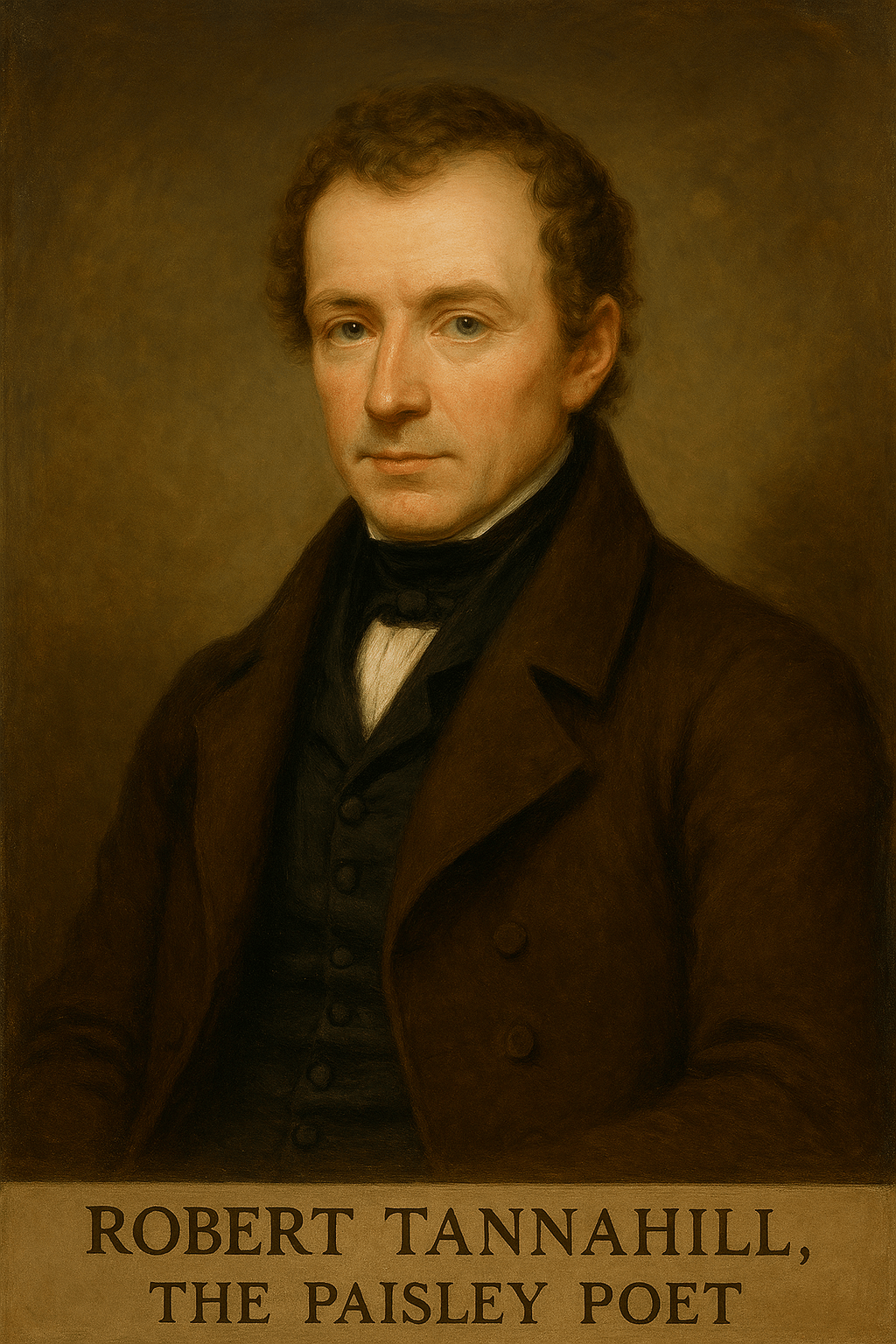
Robert Tannahill was known locally as the ‘weaver poet’. He was born in Castle Street, Paisley in June 1774, and fourth son of a family of seven. His father was James Tannahill from Kilmarnock and his mother Janet Pollock from Boghill Farm near Beith. Soon after Robert’s birth his family moved to a cottage in Queen Street, Paisley. Robert apparently had a delicate constitution and a limp due to a deformity in his right leg. After leaving school aged twelve he was apprenticed to his father as a handloom weaver. During this apprenticeship Robert began to show his talent for writing poetry and that interest in poetry and music were to fully blossom in adulthood.
His writings began to appear in such publications as The Scots Magazine which co-incidently is the oldest magazine in the world that is still in print today. His music and poetry was contemporaneous with that of fellow poet, Robert Burns, and for that reason he is today considered to have been undervalued in Scotland at that time simply because of the greater popularity of Burns.
An important Scottish poet
My interest in Tannahill began when I realised some of his poetry mentioned places such as Crookston Castle, the castle that featured so much in my childhood as a place to visit and play in during the 1940s and 1950s together with the Glennifer Braes where I once camped with my childhood friends. I was intrigued to realise that he was creating some of his poetic works upon seeing that same castle ruin in his own childhood as well as the slopes of the Glennifer Braes perhaps as early as 1780. Although the Bonnie Woods O’ Craigielea lay at Ferguslie to the north west of Paisley I have to admit that I was not familiar with the song or the place back then even though my wife and I had grown up only a few miles from there. And to some extent that is an indictment upon our otherwise very good schoolteachers at Crookston Castle Secondary who introduced us to Robert Burns and William Shakespeare among others but not Robert Tannahill, a poet and songwriter even closer to home.
Robert Tannahill tragically took his own life in 1810 apparently following the rejection of his work by an Edinburgh publisher. His grave is situated in Castlehead cemetary on Canal Street in Paisley and there is a well named after him at Glen Burn in the Glennifer Braes. Tannahill knew and loved the green hills of the Glennifer Braes and his memorial well is a place where ramblers and wildlife can quench their thirst. It’s dedicated in deference to the immortality of his verse about the places he knew well and that I had also come to know and love in my childhood.
“The Bonnie wee well on the breast o’ the brae,
Where the hare steals to drink in the gloamin’ sae grey.”
That’s not very much in memory of an important Scottish poet and song writer and the man who gifted to Australia its favourite song. And as far as I am aware there is nothing at all in Australia to remind us of who to thank for our tune. In 1973 Australian’s were asked by plebiscite to decide upon a new national anthem for up until then it remained God Save the Queen. The main contenders for the honour of becoming Australia’s National Anthem were Waltzing Matilda, Advance Australia Fair and the status quo choice of God Save the Queen.
There is little doubt that the ever popular tune of Waltzing Matilda would have won hands down if Banjo Paterson’s words had been suitable for an anthem meant to unite and describe something to represent Australia to the world, as well as to ourselves. Banjo Paterson’s words didn’t do that. And of course, the words of Thou Bonnie Wood O’ Craigielea were not suitable either. So Advance Australia Fair, first performed in 1878 became the winner. It waswritten by the Scottish–born composer Peter Dodds McCormack. But that’s another story.
Support the Scottish Banner! To donate to assist with production of our publication and website visit: The Scottish Banner