
Scotland offers some spectacular and dramatic railway journeys. It’s especially true in the Highlands, where the journeys from Inverness to Kyle of Lochalsh and Glasgow to Oban, Fort William and Mallaig are unforgettable – even if most of the trains are rather basic.
Then there’s the coastal stretch of the East Coast Main Line (ECML) between Edinburgh and Berwick-upon-Tweed, with its magnificent cliff scenery and much better trains. In the UK there has been a spate of TV series where a lucky celebrity gets to explore and praise these journeys. I wish I could get a job like that.
Scotland’s railway
I’m going to describe a less obvious rail journey that is uniquely sensational and exciting, and I’ll also try to suggest how to enjoy it for maximum comfort. Now, if I offer Dundee to Edinburgh by the ECML as a lesser-known Great Railway Journey you might think it a bit odd. After all, thousands of commuters, business travellers, trippers and tourists use it every day. What’s so special about it? Well, it combines two of the great features of Scotland’s railway right at the beginning, and right at the end of the journey.
To help appreciate how remarkable the trip really is, imagine making the same journey in 1726, not 2026. As soon as you leave Dundee, you’re faced with crossing the huge expanse of the Firth of Tay, over three kilometres, over to Fife. And even if you manage to procure a ferry – and you’ll probably want a ferry big enough to take your horse with you – once you’ve crossed Fife there’s another broad stretch of water, the Firth of Forth, to get over. Probably best to divert to the lowest bridging points of the Tay (Perth) and the Forth (Stirling), making a long journey that will probably take several days. If you were rich, you’d just take ship from Dundee to Leith.
How different now. Shortly after you leave Dundee, your train starts to curve onto the Tay Bridge, which runs for 3.2km, and rumbles across the firth. The bridge feels quite low above the water. Downriver the 1965 road bridge rises gently towards the Fife coast while upstream the gleaming waters of the firth reach towards the distant Perthshire hills. On my most recent visit I’d arrived over the road bridge by bus, and so crossing southbound on the train squared matters nicely.
It’s spectacular stuff but, of course, the history of rail crossings of the Firth of Tay includes tragedy. The first bridge, designed by Sir Thomas Bouch, was built between 1873 and 1878. When opened, it was then the longest bridge in the world. Queen Victoria crossed it on her way to Balmoral. But it didn’t last long. On 28th December 1879, a night of gales and rain, part of the bridge collapsed and a train was lost in the Tay, killing all 75 passengers and crew. A damning report said the bridge was ‘badly designed, badly constructed and badly maintained’; Bouch had not fully considered the effects of wind. We all know William McGonagall’s unintentionally hilarious verse in memory of the bridge, but it’s important to remember the real tragedy it represented. Its replacement was opened in 1887 and, if the new bridge isn’t the most imposing structure, it’s still doing a grand job nearly 140 years on. It was substantially refurbished and strengthened in 2003.
After your train makes landfall again, you can enjoy an hour or so of pleasant, green Fife countryside, with the Firth of Forth coming into view at Kirkcaldy and the sandy beaches of Kinghorn, Burntisland and Aberdour looking tempting. Your train swings south through Inverkeithing and North Queensferry before coming to the most spectacular two-and-a-half kilometres on the Scottish rail system.
The Forth Bridge
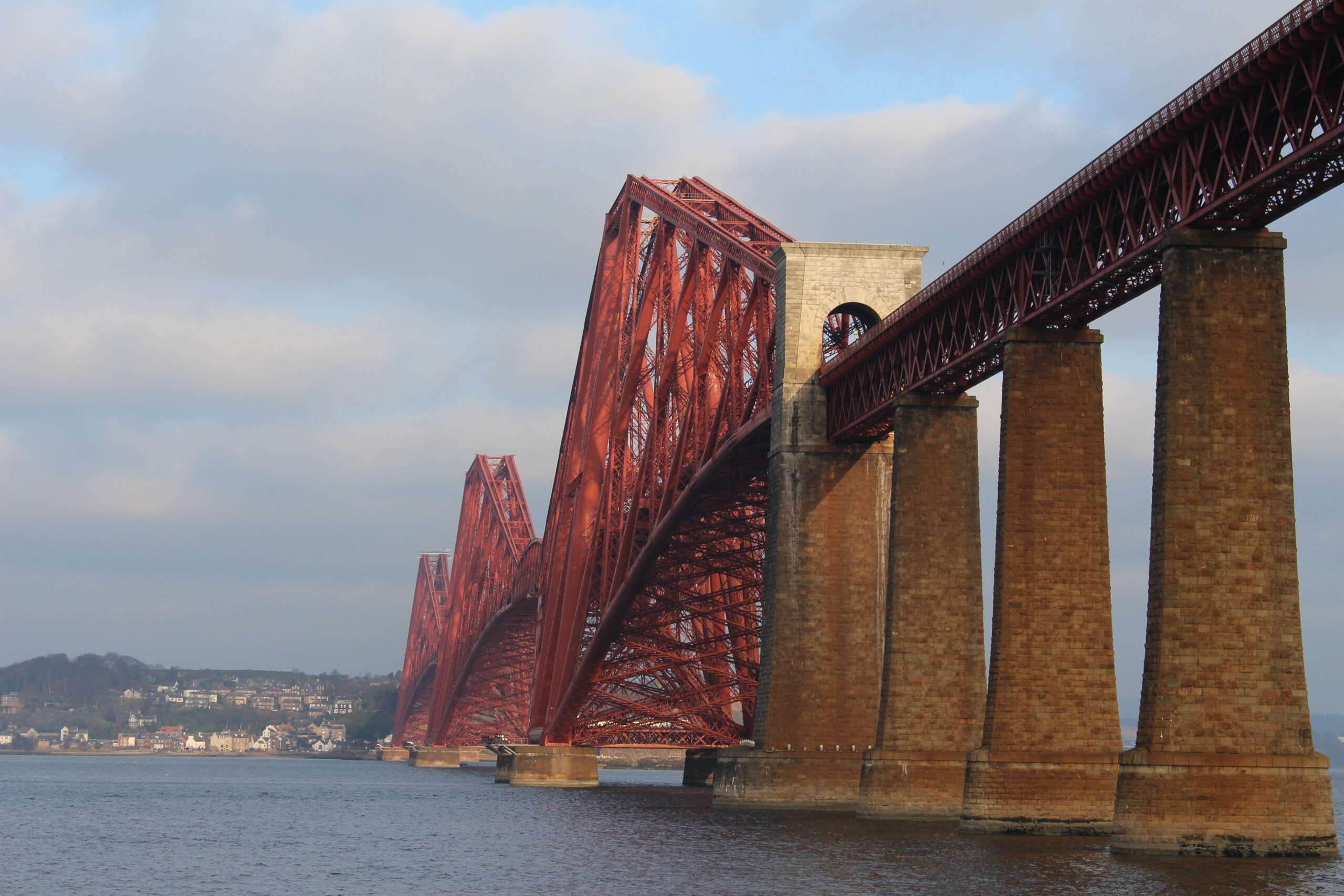
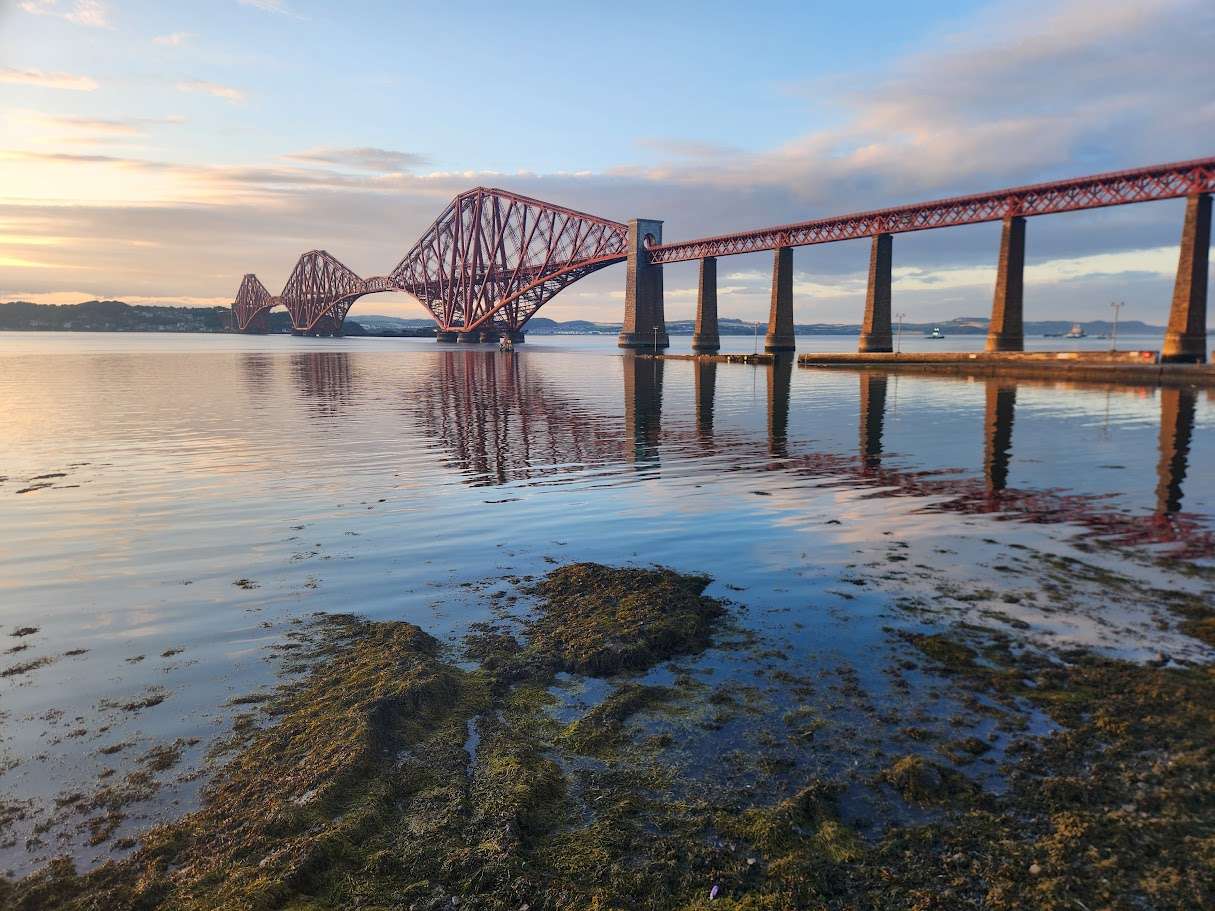
In the 1870s, Sir Thomas Bouch was involved in work to create a rail crossing of the Firth of Forth. He was, naturally, dropped after the Tay Bridge Disaster and it was John Fowler and Benjamin Baker who came up with the concept of a cantilever bridge made of steel; it was the first major project in the UK to focus on steel. The Forth Bridge (and it is the Forth Bridge – the two neighbouring bridges, the 1964 Forth Road Bridge and the 2017 Queensferry Crossing are pretty much like many other road bridges) is famously over-engineered but as such it’s utterly solid and of such spectacular design that it’s one of the most recognisable of Scottish landmarks. I’ve heard it described as Scotland’s Eiffel Tower and I wouldn’t argue. It was a target for the Luftwaffe in the Second World War, has featured on pound coins and banknotes, became a UNESCO World Heritage Site in 2016 and was voted as Scotland most spectacular man-made structure. Scotland is proud of the Forth Bridge and so we should be.
Yet it has a dark side: it’s estimated that more workers were killed during its construction than died in the Tay Bridge Disaster. In recent years historians have tried to identify those who died, tell their stories and memorialise them.
No matter how often I go across the Forth Bridge I never tire of it, peering out of the window like a 10-year-old seeing it for the first time. Oddly, I’ve been on trains where people are rather fazed by the bridge, perhaps by the height and the exposure. There’s no need for that. If there’s anything certain in Scotland, it’s that you’re safe on the Forth Bridge. Once you’re over you’ll be in Edinburgh in a quarter of an hour, but you’ll have crossed two mighty firths that used to be enormous barriers to travel, and have done so effortlessly.
ScotRail run two trains an hour for most of the day between Dundee and Edinburgh but I’d recommend checking timetables and trying to find a train operated by LNER. They run four return journeys a day linking Aberdeen, Dundee, Edinburgh with England on big, comfortable trains. If you book in advance, there may be good deals in First Class. So, you can sit in a comfy seat, be plied with food and drink, and speed across two giant firths in a way unimaginable to our distant ancestors.
By: David McVey.
Main photo: The Scottish Banner.
Support the Scottish Banner! To donate to assist with production of our publication and website visit: The Scottish Banner