
February 2026 (Vol. 49, Number 08)
Scotland’s City of Love
-
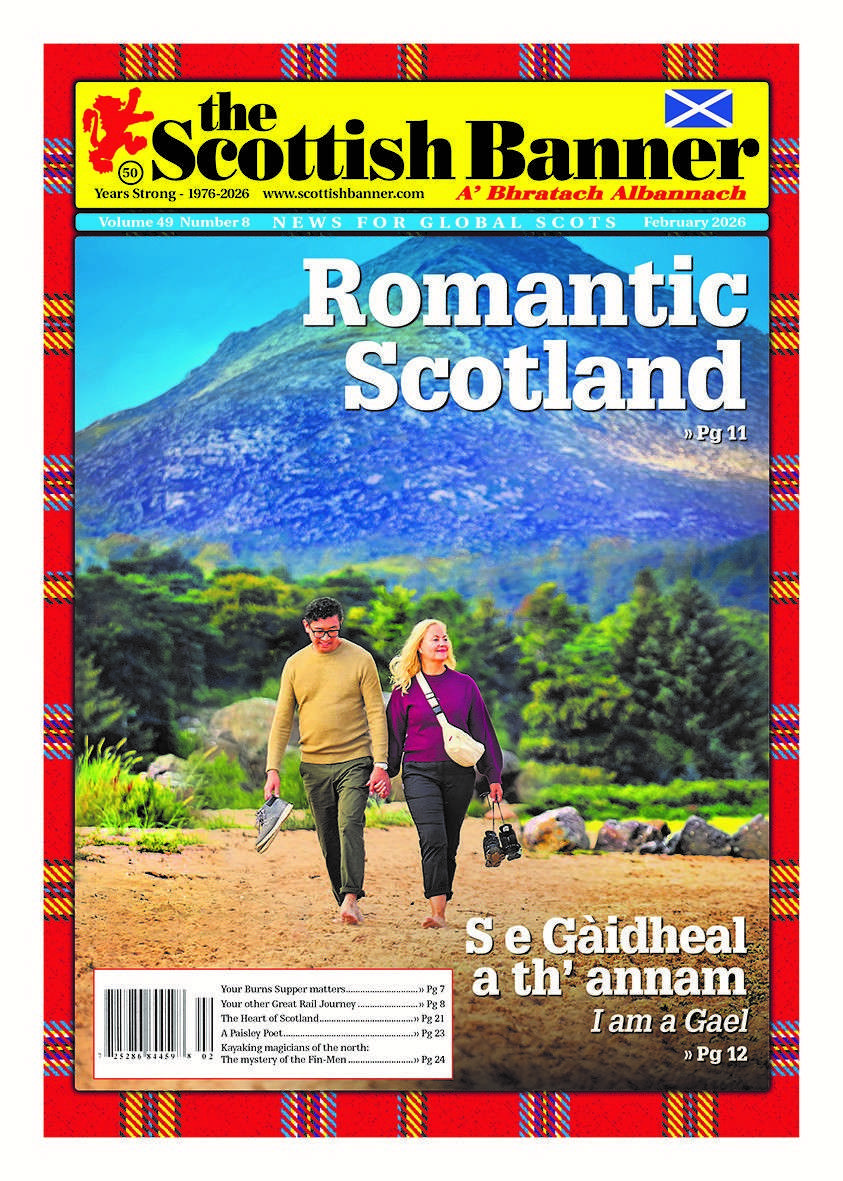
Exploring the natural beauty of the Isle of Arran with your special someone. Photo: VisitScotland/Allan Myles.
Some look at February not only as the shortest month of the year, but also a month of love. However, most would not connect the notion of love with the Glasgow suburb of the Gorbals. Glasgow’s connection to Valentine’s Day is one of those fantastic and unexpected pieces of history that gives Scotland’s largest city a unique claim to romance.
While Paris, Vienna and Venice may market themselves as capitals of love, Glasgow holds something far more tangible-some of the physical relics of Saint Valentine himself and it sits in one of the city’s most infamous suburbs. In the Gorbals, at the Blessed John Duns Scotus Church, a casket is believed to contain part of the martyr’s remains, specifically a forearm, making the city an unlikely pilgrimage site for lovers and the curious alike.
The story begins in 1868, when a wealthy French family donated a small wooden box, labelled ‘Corpus Valentini Martyris’ which translates to ‘the body of Saint Valentine’, to the Franciscan order in Glasgow. The relics were housed first in the early Franciscan chapel and later in the grander St Francis’ Church in the Gorbals, where they remained until 1999. Those remains rest today in the Blessed John Duns Scotus Church, where each 14 February the casket is adorned with flowers and a special Mass is held to honour the saint’s legacy.
Today couples from around the world visit the Glasgow relics of St Valentine, light candles, leave flowers, and take quiet moments to pray for their relationship or future together. Many also take photos beside the casket containing the saint’s forearm, treating the church as a small but meaningful pilgrimage of love.
Patron saint of lovers
The Gorbals, on Glasgow’s south bank, began as the small medieval settlement of Bridgend (named for a wooden bridge that linked the south to the city) and grew rapidly with industry in the 19th century to house the industrial workforce. It became known for dense housing, poverty, vibrant immigrant communities and was considered one of Europe’s worst slums. The Gorbals was not a place synonymous with St Valentine and love and most certainly was a place where a ‘Glasgow Kiss’ was not the meeting of lips but more of a strike to the face or nose using the forehead!
This unusual connection has led some to affectionately call Glasgow a “City of Love,” a playful counterpoint to its tougher reputation. Yet the presence of the relics of St Valentine has genuinely played its part in local tradition. Couples will no doubt again visit the church this month on Valentine’s Day to again light candles, offer prayers, or simply enjoy the symbolism of standing before the patron saint of lovers and maybe giving a card to their special someone signed “from your Valentine”.
There is some question of course if these remains are in fact those of St Valentine. Other locations also claim to have some of St Valentine’s body parts such as Rome and Venice, Italy; Birmingham, England; Roquemaure, France; Chełmno, Poland and Dublin in Ireland.
In this issue
Keeping with our Valentine’s theme this month we get the heart of some of Scotland’s history with how both literal and symbolic hearts are part of Scotland’s landscape and folklore today.
Scottish folklore is full of intriguing tales from across the country. The mysterious Fin Men in the Northern Isles are just one of these tales that has passed through generations of Scots. These sealskinwearing, small boat-paddling travellers were occasionally spotted off Scottish shores, with many theories abounding on their origins and intentions. In Orkney and Shetland these Fin Men became mystical and magical creatures and part of local history and storytelling.
I remember as a teenager one of my first overseas trips with friends to Scotland. It was a huge adventure, and we purchased our BritRail pass to get around. Today rail travel links communities across Scotland and takes both locals and visitors to all parts of the country. Scotland is full of great rail journey’s, including the less obvious ones which are highlighted this month, which still provide some adventure to those who are looking to ride the Scottish rails.
A real historical quirk
I have a strong family connection to Glasgow, I have lived there and it is a city I love. Glasgow is a city of many layers and scratch under the surface a bit and you will find an incredible spirit, people and history. Glasgow’s link to Valentine’s Day is not some marketing invention but a real historical quirk—one that blends faith, folklore, and is no doubt a source of pride to Glaswegians.
It’s a reminder that romance often appears in the most unexpected places, and that even a city famed for its grit can hold a tender secret at its heart. I wish your heart a wonderful month ahead.
Do you have you any comments from the content in this month’s edition? Share your story with us by email, post, social media or at: www.scottishbanner.com/contact-us
#ScottishBanner, #TheBanner #NewsForGlobalScots
The Scottish Banner is more reliant than ever on our readers helping us to provide you with our unique content by buying a copy of our publication, regardless if by print or digital subscription or at a retail outlet.
We appreciate your support and hope you enjoy this edition.
Support the Scottish Banner! To donate to assist with production of our publication and website visit: The Scottish Banner