
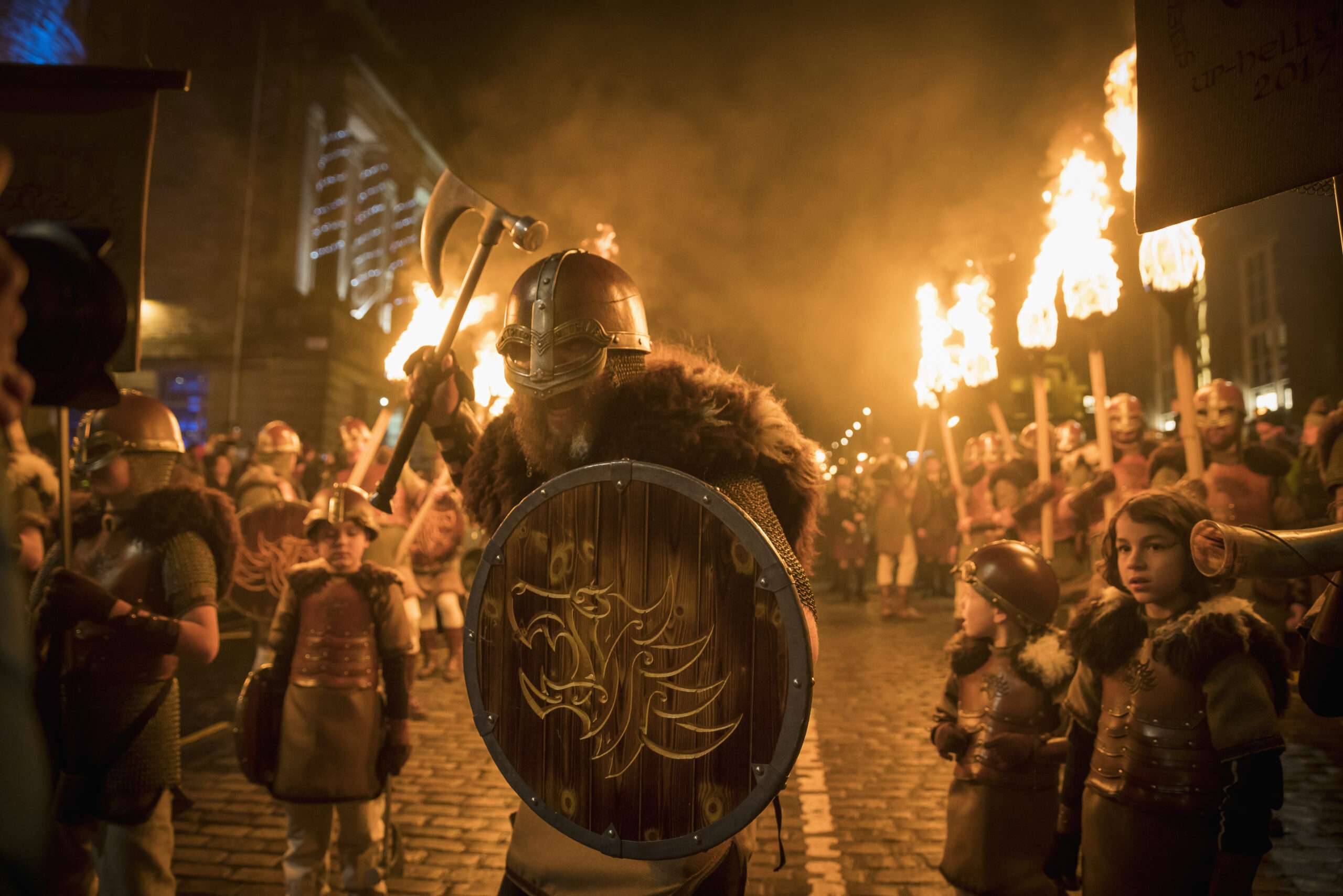
Up Helly Aa is a series of fire festivals held every winter in the Shetland Islands. January in Shetland means Vikings and one of the planet’s greatest winter fire festivals. Scotland meets Scandinavia in Shetland with this Norse enriched event which lights up the dark Shetland lights and heralds soon a closing of winters door as Elsie Maclean from Tobar an Dualchais/Kist o Riches explains.
The origin of the name ‘Up Helly Aa’ is uncertain, but we think it refers to a celebration of the last day of Christmas festivities: a day of fire, feasting and fun. The festival’s roots date back to the early 1800s. Groups of young men in disguise would drag barrels of lighted tar on sledges through the streets of the islands’ capital, Lerwick. Burning tar often spilled as the men tried to navigate sledges along the narrow streets, causing damage to properties. Tar-barrelling was banned in 1874 in an attempt to stop such practices. The young men refined their activities, resulting in the first Up Helly Aa torchlight procession in 1881.
Other elements have been added to the festival over the years, becoming an integral part of the traditions celebrated today. Some of these elements incorporate Norse traditions and celebrate Shetland’s Viking heritage.
Up Helly Aas
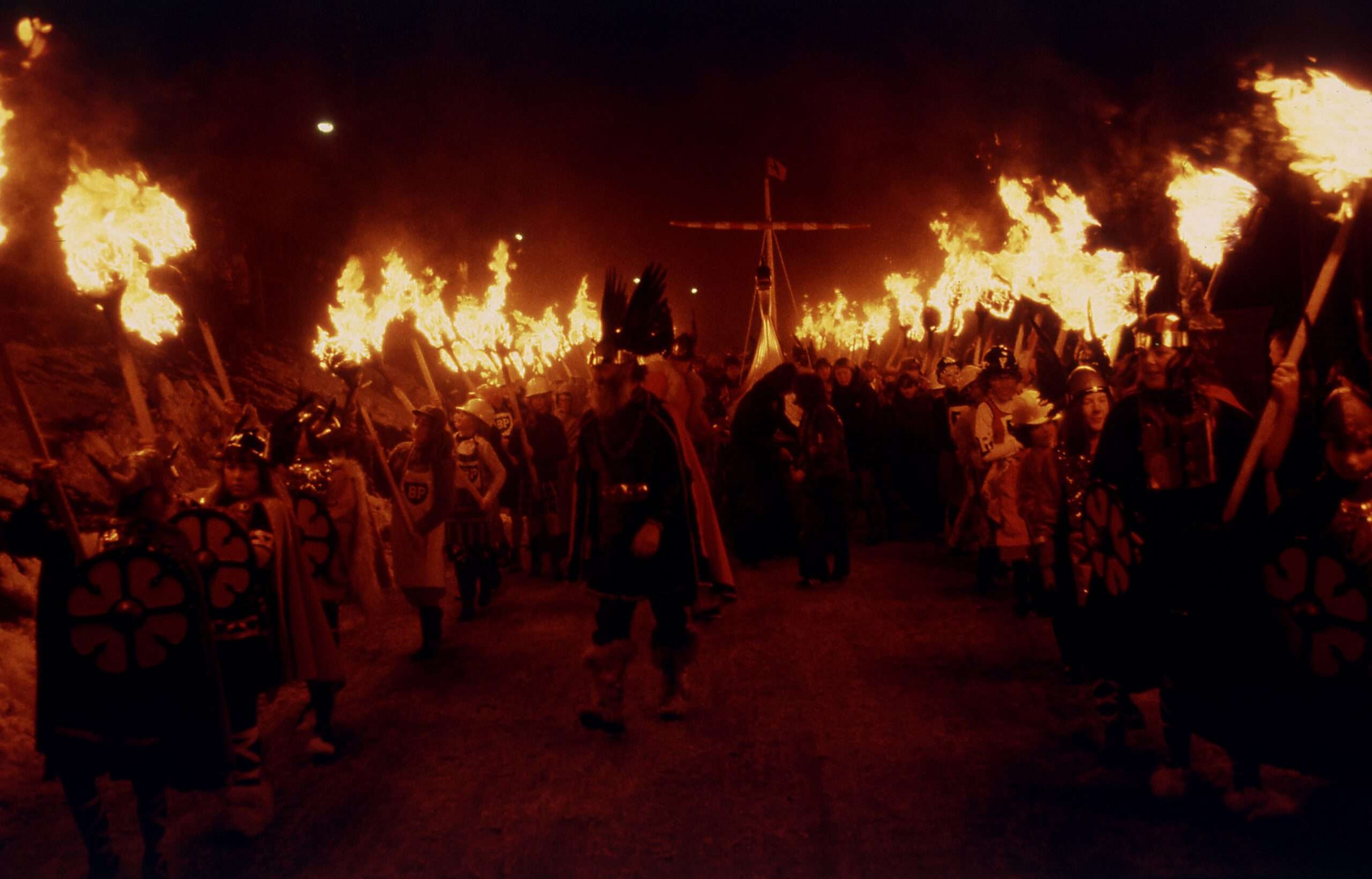
Up Helly Aa festivals are also organised in areas outwith Lerwick. These are referred to as ‘country Up Helly Aas’. Although smaller in size than the Lerwick Up Helly Aa, they are nonetheless very impressive. For many people in Shetland, the Up Helly Aa festivals are the highlight of the year. Participating communities spend hundreds of hours planning and organising them.
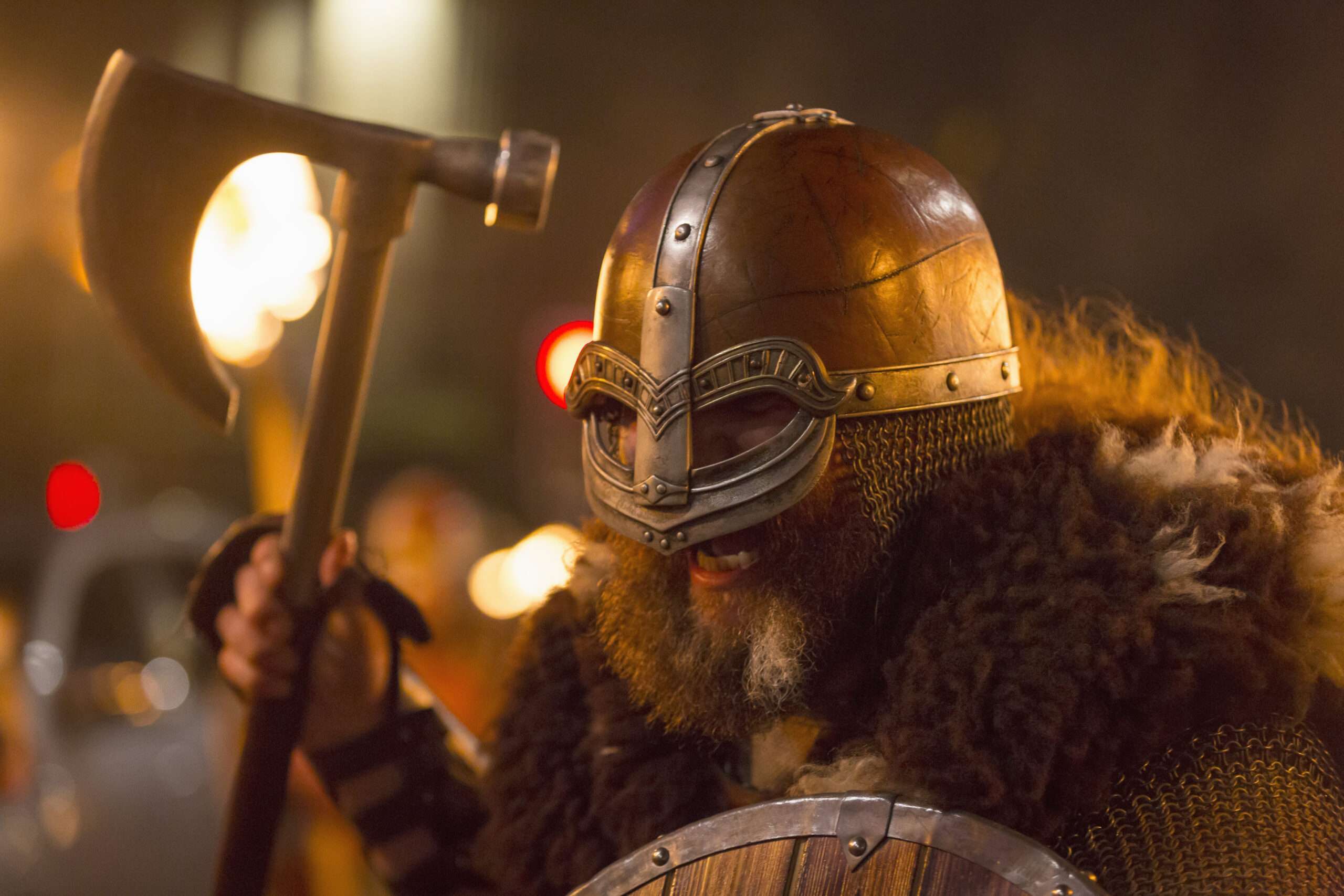
On the day of an Up Helly Aa festival, squads gather together for the torchlight procession, marching through the streets while carrying wooden posts topped with paraffin-soaked sacking. Each squad is dressed in themed costumes, and they are referred to as guizers.
The central figure in the proceedings is the Guizer Jarl, the chief guizer and leader of the Jarl Squad. This squad is made up of the Jarl’s supporters and is the lead squad for the event. Each year the Jarl takes the name of a character from the Norse Sagas and there is great secrecy surrounding both the name and the costume he will don. The procession culminates in the burning of a replica Viking long-ship. The guizers gather round the vessel to sing the traditional Galley Song before throwing their torches onto it.
The Norseman’s Home
Once it has burned, the guizers sing The Norseman’s Home before visiting local halls where each squad performs an act or skit of some sort, usually of a humorous nature, and where drinking and dancing are the order of the night. This is an extract of a recording of guizers singing The Norseman’s Home, which was recorded at the Lerwick Up Helly Aa in 1982.
The Norseman’s home in days gone by, was on the rolling sea,
And there his pennon did defy, the foe of Normandy.
Then let us ne’er forget the race, who bravely fought and died,
Who never filled a craven’s grave, but ruled the foaming tide.
The Lerwick Up Helly Aa takes place on the last Tuesday in January every year. It is a spectacular sight so if you ever get the chance to go, we’d highly recommend it. The following day is known as ‘Hop Night’, when further dances and celebrations are held. If not, don’t worry. The country versions take place between the middle of January and the end of March.
This article was written by Elsie Maclean from Tobar an Dualchais/Kist o Riches, a project dedicated to the presentation and promotion of audio recordings of Scotland’s cultural heritage. It was originally published on the Historic Environment blog in 2018. www.tobarandualchais.co.uk
Main photo: Up Helly Aa Vikings at Hogmanay. Photo: Edinburgh Hogmanay.
Support the Scottish Banner! To donate to assist with production of our publication and website visit: The Scottish Banner