
The Duke of Wellington famously said, “You can as well write the history of a ball as of a battle.” It’s a really vivid comparison; think how all the movements and talk and the interactions at a ceilidh in your local community centre are much too complex to even begin recording in any detail, yet it would probably be simpler than recording all the details of any battle. Horrible, whirlwind affairs, that, before the 20th century, often didn’t last long and which every participant experienced differently. Yet there’s one thing about dances and balls; you can usually pin down exactly where they happened. That’s not always possible even with well-known passages of arms.
There are two battles associated with Falkirk. The earlier took place on 22 July, 1298, some ten months after William Wallace’s Scots defeated the English at Stirling Bridge. Proud Edward’s army left nothing to chance this time, and may have outnumbered the Scots by five to one or even more. It was a brutal defeat for the Scots, but it didn’t dim the battle for independence. Afterwards, instead of going toe-to-toe with massively superior English forces, the Scots began guerilla, hit-and-run operations, and followed this tactic for until the great victory of Bannockburn, against another Proud Edward, in 1314. By which time, of course, there was Bruce, but no Wallace.
A significant, game-changing battle
A significant, game-changing battle, then. Yet we’re not really sure where it took place. These days, the consensus is that it was likely fought between what is now Falkirk’s Callander Park and Polmont, around the banks of the Westquarter Burn. Other theories placed it high on the moors southwest of Falkirk, perhaps some miles away.
We’re on slightly surer ground when it comes to the second Battle of Falkirk. This took place at the latter end of the 1745 Jacobite Rising, after Charles Edward Stewart’s army had marched south to Derby and marched back again. The battle took place on January 17th (my birthday, as it happens) 1746 in cold, wet weather. It’s agreed that the site of the battle was just south of the town on what was known as Falkirk Muir. Then it was wild, heathery moorland, but is now fields and woodland. It’s sometimes referred to as the Battle of Falkirk Muir.
Actually, the exact location of the battle isn’t universally agreed, nor are historians of one mind even on which way the armies faced. What seems certain is that the housing developments just south-west of Falkirk High Station are built on part of the site. In fact, the remains of some of the casualties were discovered when the railway through Falkirk High was being built in the 1800s. However, go further south-west and there are names and memorials, legends and stories, that take us right back to 1746. The battle was the largest in scale of the ’45 Rising, with perhaps over 20,000 troops involved, and was a Jacobite victory that covered their retreat back to the Highlands. Of course, the Hanoverians would win the decisive encounter at Culloden that April.
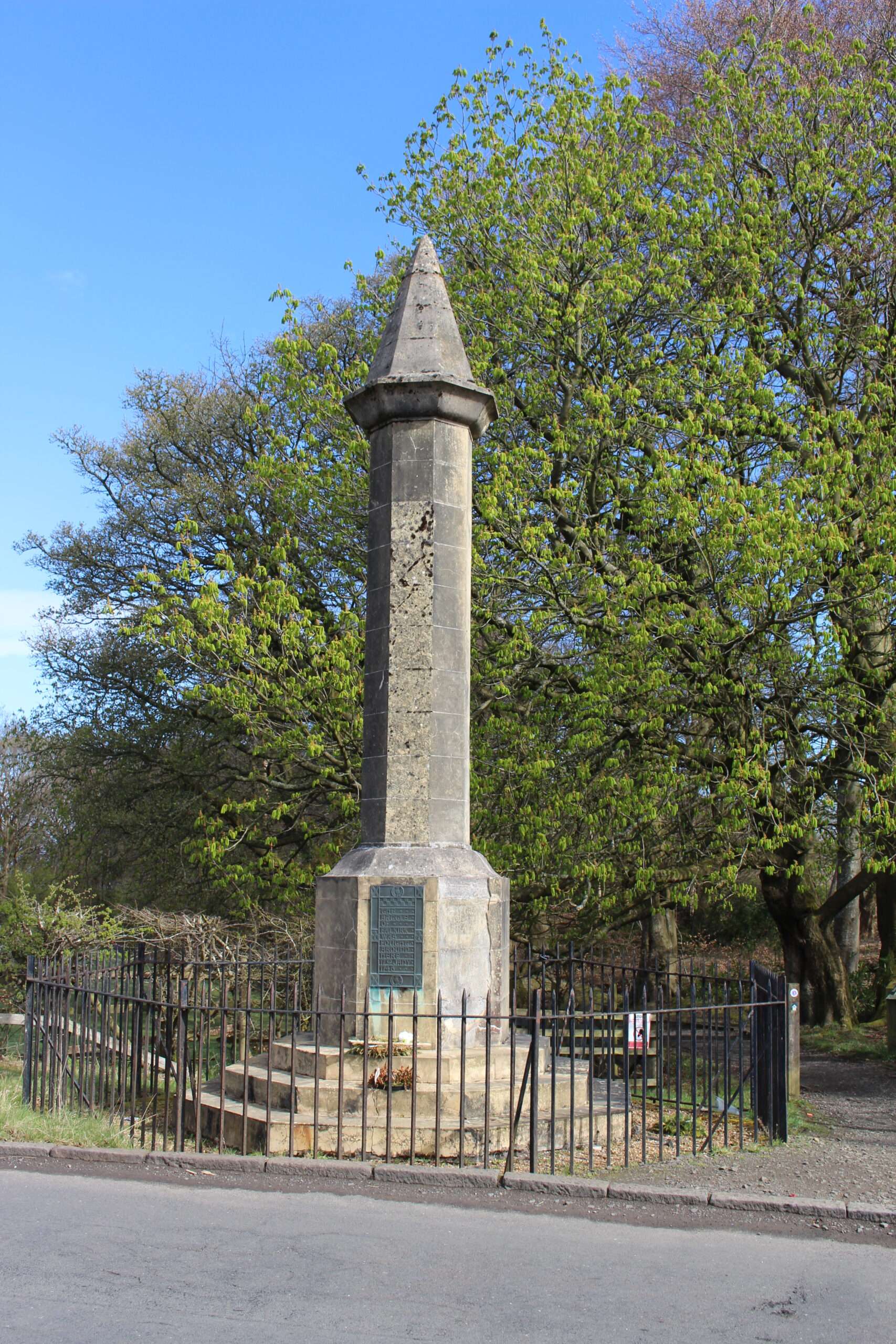
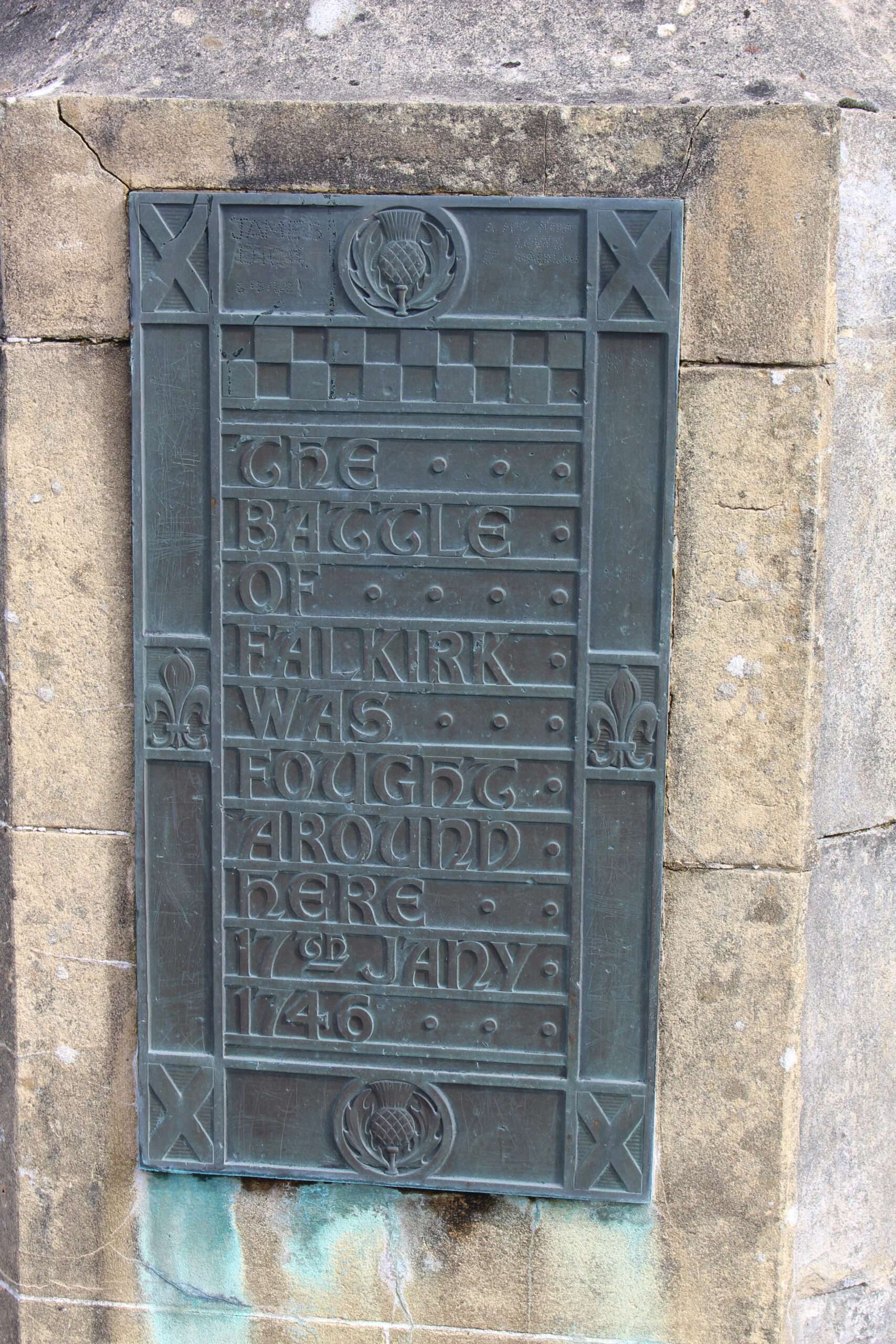
These days Callendar Estates have laid out a network of paths through the fields and woods around the battle site. One of these walking routes is specifically termed the Battle of Falkirk Trail and in around 45 minutes will take you round some of the surviving remembrances of the battle. The most obvious reminder of the battle is the memorial that stands by an unclassified road that climbs steeply south from Falkirk. A tall, hexagonal column with a rounded pyramidal top, a plate on the monument reads simply, in a Celtic script, ‘The Battle of Falkirk was fought around here 17th Jany 1746.’ The monument actually only dates from 1927. It was unveiled by the then Duke of Atholl after a fundraising campaign in the local area.
No simplistic Scotland v England encounter
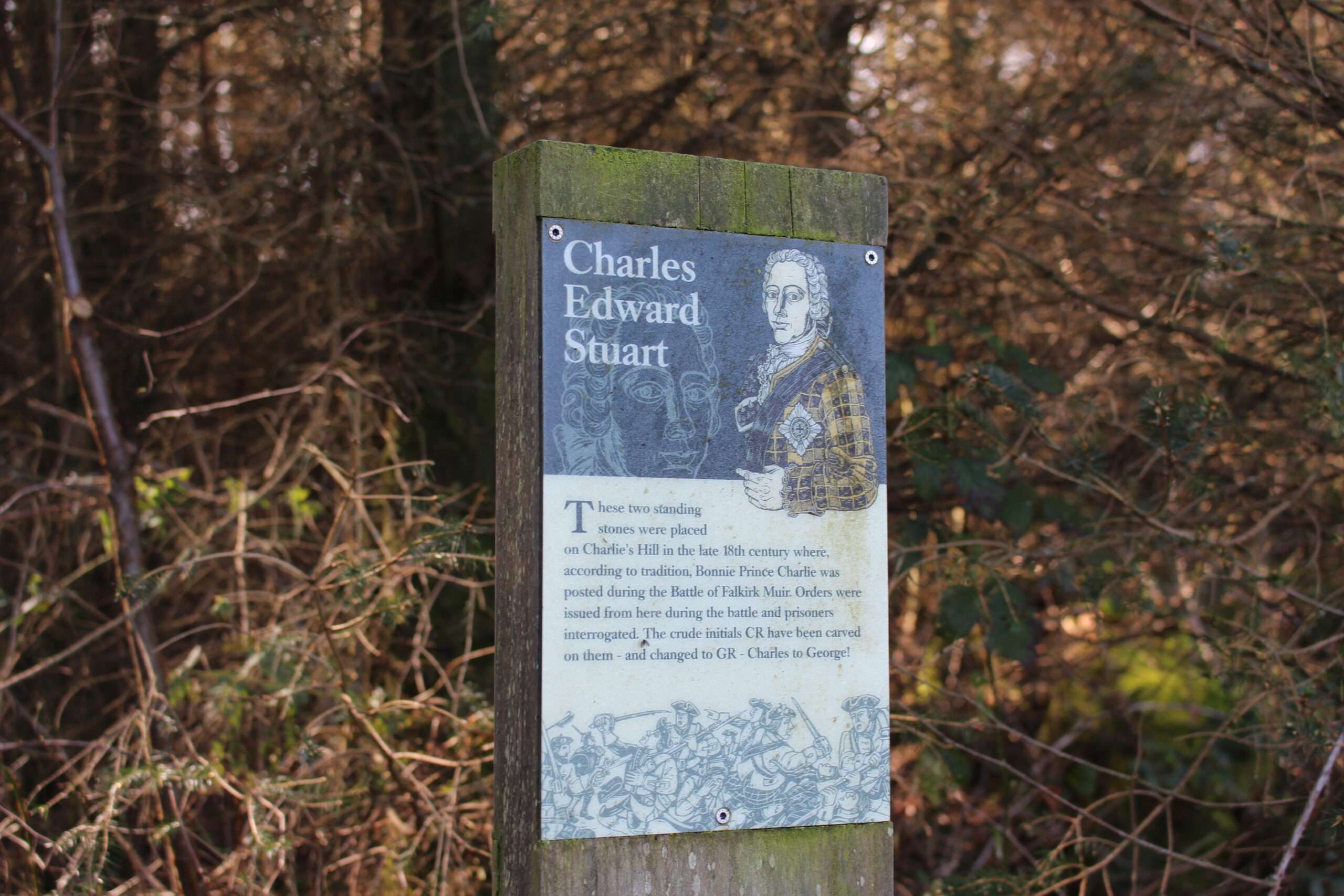
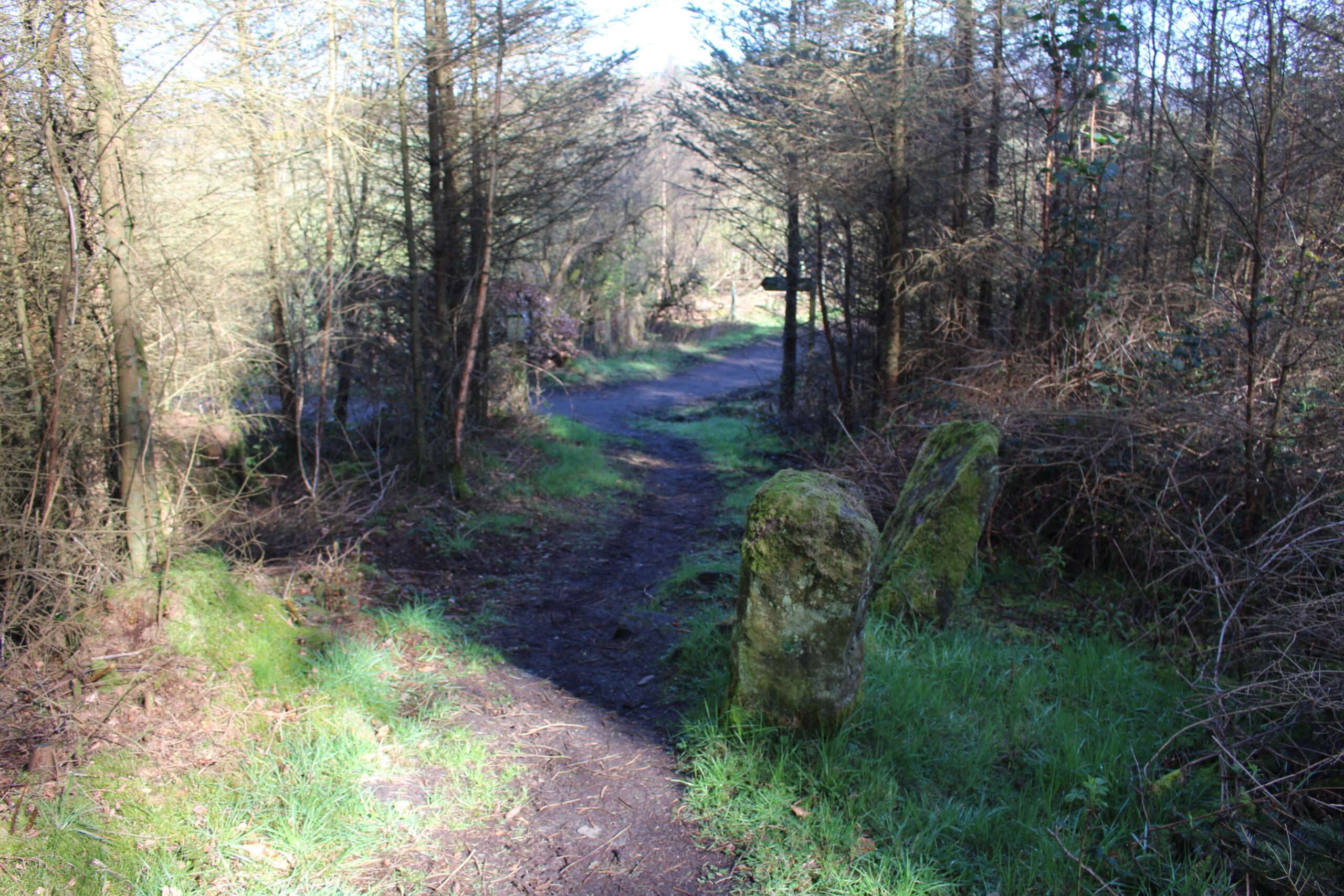
In woodland to the south-west of the monument – Canada Wood, it’s called – there are two more pieces of stone that recall the battle. These are ‘Charlie’s Stones’ and are said to mark the position from which the Jacobite leaders Charles Edward Stuart viewed the course of the battle. This might be true but the stones date from some time after the battle. The hill on whose slopes they stand is sometimes known as Charlie’s Hill. One stone was informally inscribed with ‘CR’ (‘Carolus Rex’) but the ‘C’ has since been altered to look like a ‘G’. For the Hanoverian King George, of course.
Nearby is the Canada Wood Café (I recommend going early and enjoying a cooked breakfast). Its position makes it a good place to start a walk around the network of paths which are supplied with interpretative panels to help you picture the events of 1746. There is plenty of parking there. Non-motorists are probably best to approach the area from Falkirk High Station.
After the battle, as the government troops scattered, the Jacobites entered the town and occupied it for a time. Many of them entered by the street known as Cow Wynd which, albeit much changed, survives today. Most of the dead were buried in mass graves which historically, at any battlefield, can prove very difficult to locate. Deep in a housing estate that now stands on the battle site, at the end of a street called Dumyat Drive, is a small, wooded area that is still called English Graves. It may or may not, of course, be a genuine burial site.
Some of the more prominent figures who perished in the battle were granted marked resting places. Sir Robert Munro of Foulis, for example, is buried in the town’s Old Parish Kirkyard. He was chief of the Clan Munro, but was an officer fighting on the Government side, a reminder that this was no simplistic Scotland v England encounter. There are other casualties of the battle in the Kirkyard as well as the remains of Sir John de Graeme, who was killed fighting alongside Wallace at the first Battle of Falkirk in 1298!
So that’s the 1746 Battle of Falkirk as it can still be traced on the ground. For those who aren’t yet historied out, the town’s Callander Park has a memorial cairn to the 1298 battle. It’s a very recent addition to the town’s history, only being unveiled in 2007.
By: David McVey
Main photo: 1746 Battle of Falkirk Monument.
Do you enjoy our content?
Content on the Scottish Banner website remains free for users. Stories and events listed for the international Scottish community continue to be an important resource for many across the world. As advertising revenue remains a challenge, our readers can donate to help us produce unique Scottish content for global Scots. Every contribution counts and thank you for considering your support.
Support the Scottish Banner! To donate to assist with production of our publication and website visit: The Scottish Banner