
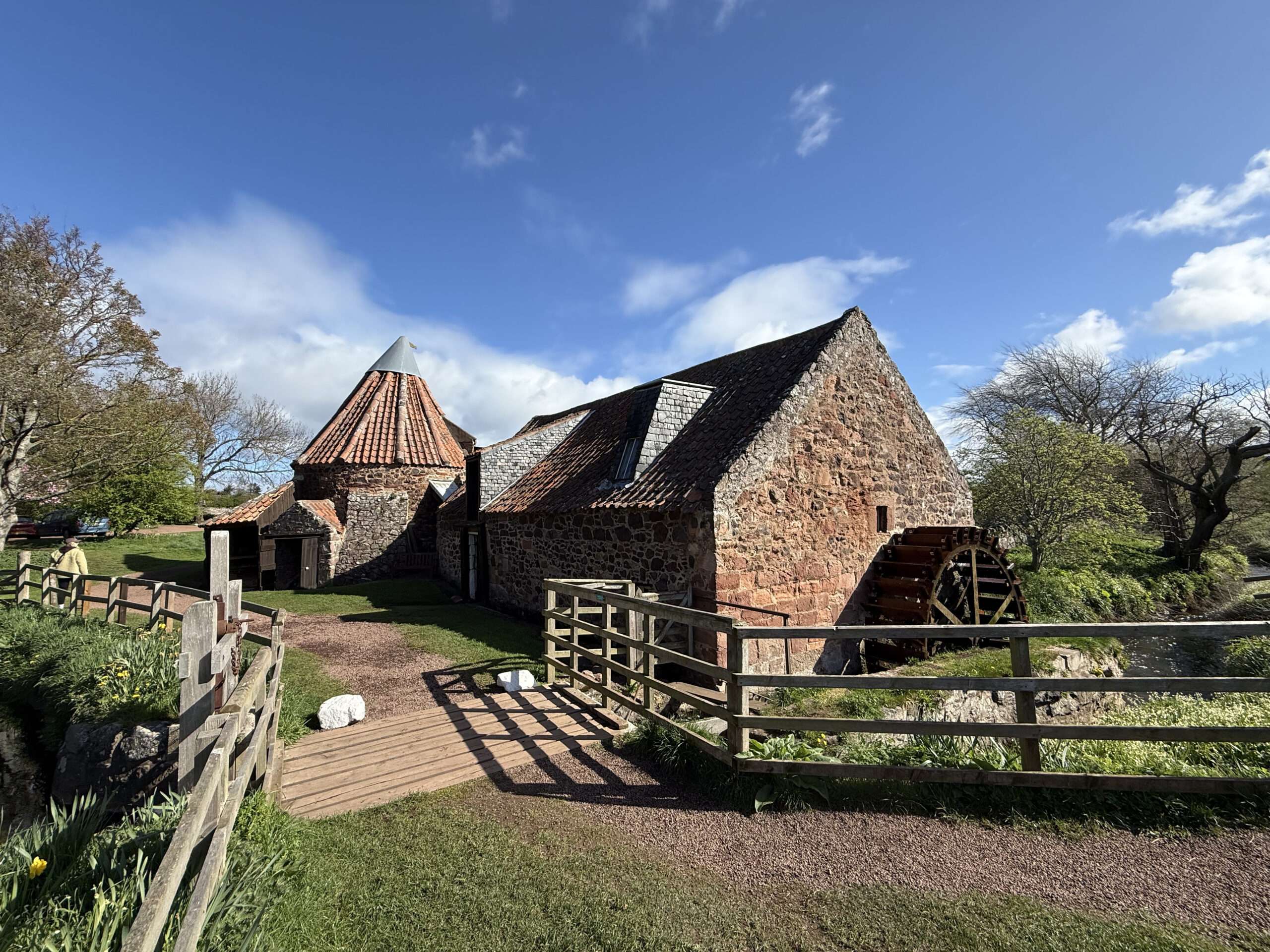
The millstones of Preston Mill are grinding again and providing milling demonstrations for the first time in 30 years following a series of conservation works undertaken by the National Trust for Scotland at the site in East Lothian. The current mill structure was built in the 18th century but the earliest surviving record of mill repairs taking place at the site in East Linton dates to 1598. There are indications that a mill might have existed on this site in the 13th century, meaning that oatmeal and other grains may have been milled in this very location for 800 years.
Preston Mill is renowned for its unique lean, which was caused by subsidence of the kiln building that is now supported by external stone buttresses. Made of local volcanic stone, the mill came into the care of the Trust in 1950 and was operated commercially until 1959. The current River Tyne-powered waterwheel was installed in 1909, and following a series of repairs to the waterwheel and sluice, as well as important conservation work to the pit wheel and upright shaft foot bearing; realignment of the millwork; new foot bearings to grindstone-spindles; coating the wooden teeth in the great spurgear; and dressing the French Burr millstones, visitors can now see the mill back in action on tours for the first time in over 30 years.
The catalyst for this work was a generous donor whose initial support made it possible for the project to progress, and it would not have happened without their support. Donor generosity has previously supported Preston Mill when other recent repairs were partially funded by fans of Outlander. Preston Mill featured in the first season of the hit TV series when it was transformed into the mill on the Fraser estate of Lallybroch, which lead character Jamie Fraser repairs while visiting his family home.
Scotland’s industrial and social heritage
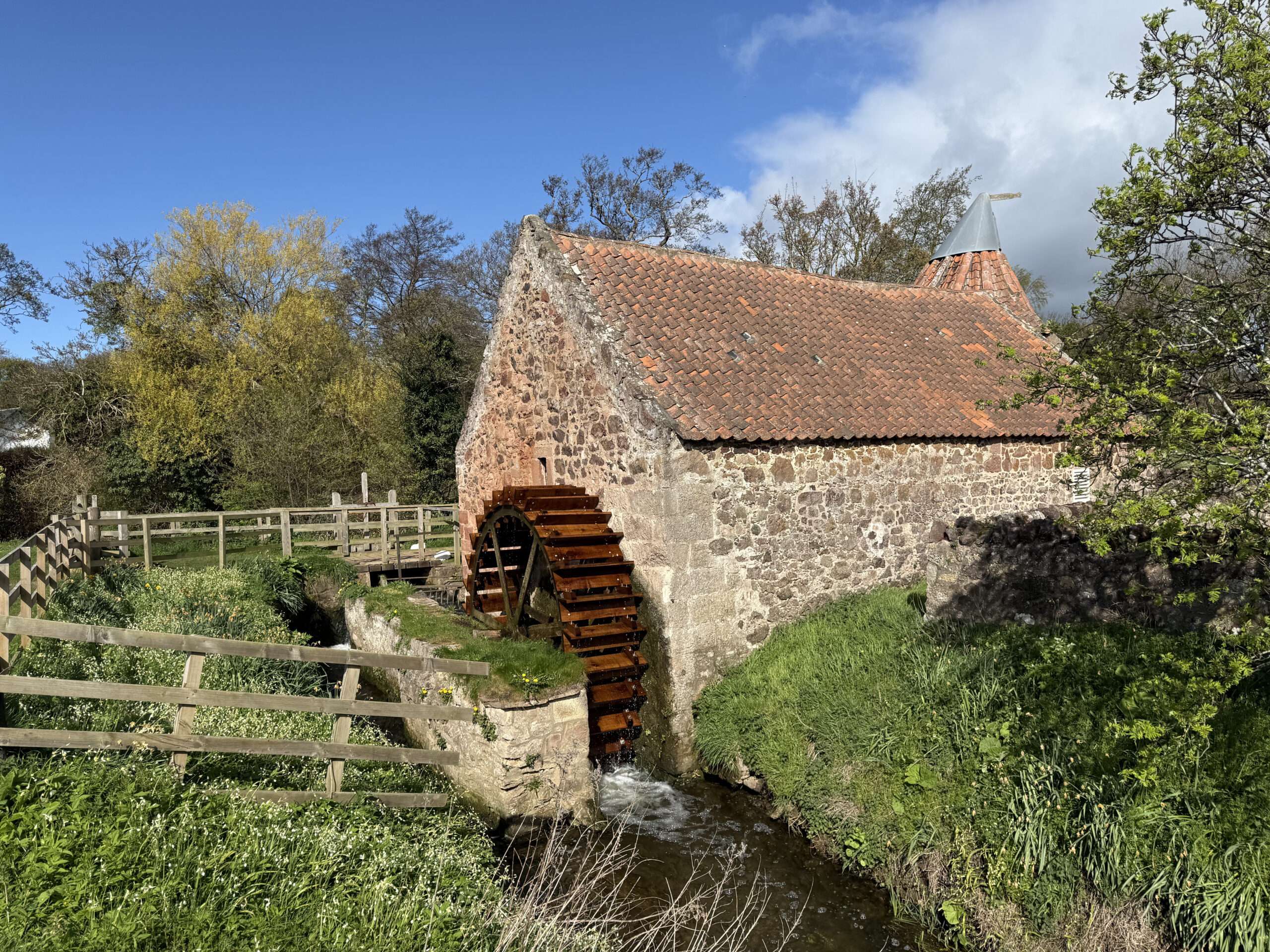
Fraser MacDonald, the National Trust for Scotland’s Visitor Services Supervisor at Preston Mill & Phantassie Doocot, said: “Much of the machinery in our mill has been continuously operational and visitors have been able to see our waterwheel turning and many of our drive belts and gears working, but our French Burr millstones have not been in a state to actually grind grain for quite some time. Last year was the 75th anniversary of Preston Mill coming into the care of the Trust and it coincided with a lot of necessary maintenance. Fortunately, we were also able to take this opportunity to address our millstones as well as our other ongoing conservation efforts. The French Burr the millstones are made from is a type of freshwater quartz that is highly prized for milling. Our stones had been separated since the 1990s and were worn completely flat, but the dressing restoration has allowed them to be put back together for milling once again. We also discovered when putting our grindstones together that there was a maker’s plate on the reverse of the stone that had been unseen for about 40 years. The plate was from J. Smith & Son, an Edinburgh millstone maker, which had not been previously noted in our records. It is exciting to still be learning new things about our mill and its machinery.”
This work at Preston Mill also complements similar work undertaken recently at Barry Mill in Angus, where Dorothea Restorations also supported in a project to get the mill grinding again. These projects confirm the Trust’s ongoing commitment to caring for Scotland’s industrial and social heritage, and its support of specialist craft skills across and deploying these experts across multiple locations.
Stuart Maxwell, Regional Director of Edinburgh and East at the National Trust for Scotland, said: “The Trust’s purpose is to care for and share Scotland’s heritage, which includes our industrial history. We know that mills like this one were at the hearts of their communities and at Preston Mill, we tell the story of rural life in East Lothian in the 18th, 19th, and early 20th centuries. Keeping aging machinery like this running takes a lot of time and effort but the revival of milling at Preston Mill is a powerful example of how donor generosity, public funding, and member support come together to protect Scotland’s heritage. With continued investment, these places can keep telling their stories for centuries to come. We hope that visitors will enjoy seeing real milling demonstrations again for the first time in decades and continue to support our vital conservation work.”
Until 31 October, the Preston Mill is open Thursday to Monday for guided tours. Tickets can be booked in advance on the Trust’s website. The shop and exhibition are open Thursday to Monday from 10:00 am – 4:30 pm, see: www.nts.org.uk/visit/places/preston-mill
Images courtesy of The National Trust for Scotland.
Do you enjoy our content?
Content on the Scottish Banner website remains free for users. Stories and events listed for the international Scottish community continue to be an important resource for many across the world. As advertising revenue remains a challenge, our readers can donate to help us produce unique Scottish content for global Scots. Every contribution counts and thank you for considering your support.
Support the Scottish Banner! To donate to assist with production of our publication and website visit: The Scottish Banner