
January 2026 (Vol. 49, Number 07)
Scotland’s unique New Year celebrations
-

One of the many places to visit in Scotland in 2026, the Isle of Iona. Photo: VisitScotland/Kenny Lam.
Welcome to 2026 and I hope the year ahead is filled with happiness, health and meaning. Though many attending Hogmanay celebrations may wake up a bit late, and possibly a tad worse for wear, on January 1st in one part of Scotland there is however no time for that.
The New Year’s Day Ba’ in Orkney is a centuries-old street football tradition played in Kirkwall, pitting two local teams—the Uppies and the Doonies—against each other in a fierce, rule-free contest.
A battleground for the Ba’
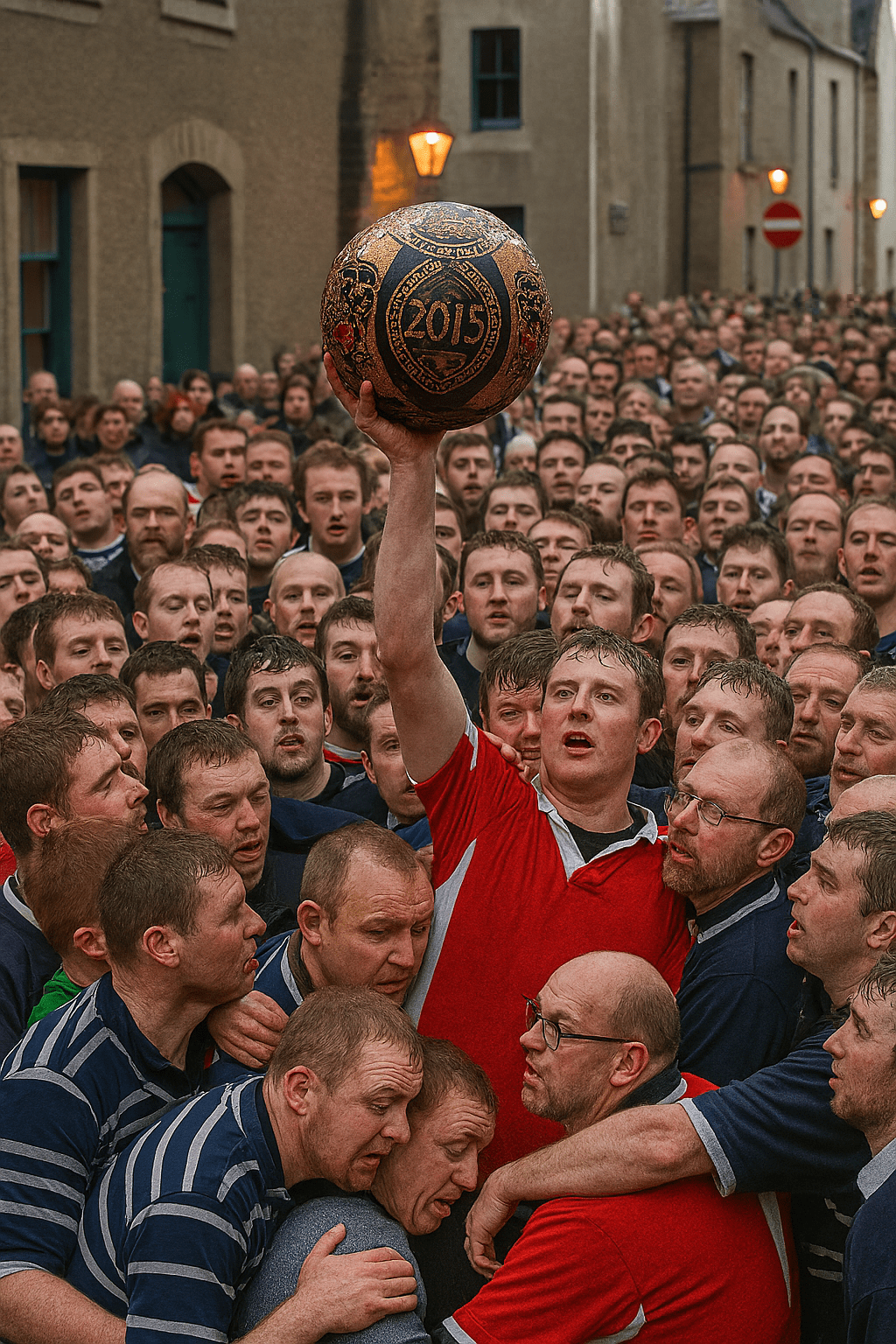
Every 1st of January, the narrow streets of Kirkwall transform into a battleground for the Ba’ game, a custom believed to date back to the Norse era. The match, which also takes place on Christmas Day, begins under the steeple of the stunning St Magnus Cathedral, where a handcrafted leather ball is thrown into a dense crowd of players. From there, chaos ensues: the Uppies aim to force the ball to Mounthoolie Lane at the town’s upper end, while the Doonies strive to reach Kirkwall Bay at the harbour. Victory is achieved when the ball touches the designated goal, often after many hours of pushing, grappling, and strategic smuggling through the throng.
The Ba’ is divided into two fixtures: the Boys’ Ba’ in the morning and the Men’s Ba’ in the afternoon, ensuring the tradition is passed down through generations. There are no time limits, no fixed team sizes, and virtually no rules, apart from the shared understanding of the goals. Men often wear the same shirt each year so fellow teammates can identify each other in the scrum.
High drama
Shops and homes along the route are barricaded in advance, as the surging scrum can spill into doorways and windows. Long periods of the scrum making little progress are interspersed with bursts of high drama, excitement, and thunderous stampedes when a player manages to make a break with the Ba’.
Beyond its physical intensity, the Ba’ embodies Orcadian culture. Players join sides based on family allegiance, birthplace, or tradition, reinforcing Kirkwall’s social fabric. Though there have been numerous injuries during this unique event, for locals the Ba’ is more than a game—it is a living link to Orkney’s unique Viking past, a celebration of resilience, rivalry, and belonging that continues to captivate islanders and visitors alike.
In this issue
As New Year is upon us there are many reasons to make 2026 your year to visit Scotland. In this issue we list a variety of new experiences, some great events and even how you can find a bit of Scotland on your screens no matter where you are. We also have a great overview how you can hear Scotland this year with the year in piping and drumming from The National Piping Centre.
Tom Weir was a beloved Scottish climber, writer, and broadcaster. Known for the Weir’s Way television series where he championed Scotland’s landscapes. Long time readers to the Scottish Banner may recall his older sister actress, broadcaster and author Mollie Weir was also a long-time contributor to these pages. Tom Weir was a son of Glasgow, but he inspired generations with his environmental passion, storytelling, and deep love for the hills and heritage of his homeland.
Scottish folklore is rich in stories and superstition. As Scotland plunges into the heart of winter this month we learn about Scotland’s goddess of winter Cailleach. The Cailleach is considered the divine hag of Celtic mythology. She made Scotland’s mountains and islands, brings about winter every year and many Highland stories tell of encounters with the Cailleach in the guise of an old woman.
Old Hogmanay
For some in Scotland however New Year traditions did not take place on January 1st. Old Scots Hogmanay is on January 11 which marks Scotland’s New Year under the Julian calendar,preserved in rural communities long after the Gregorian switch in 1600. It reflects deep-rooted traditions of fire, kinship, and renewal. Before calendar reform, Scots celebrated New Year on January 11. Even after Britain adopted the Gregorian calendar in 1752, many Highland and island communities clung to the old date, calling it “Old Hogmanay.” This was especially true in places like Shetland and the Outer Hebrides, where Norse influence and local custom ran strong.
If visiting Scotland this month you could enjoy two different Hogmanay’s and head to Burghead, Moray for when the Burning of the Clavie takes place. The townspeople of Burghead light a 100kg barrel of tar which is then carried around the town. Tradition dictates that members of the ‘Clavie Crew’ must be natives of the town.
If like me you will not be in a scrum with hundreds tearing down Kirkwall’s historic streets on New Year’s Day, I do hope you are still able to start the year off on the right foot.
Wishing all our readers, advertisers, followers and friends a wonderful year ahead-may it be a good one for all of us.
Do you have you any comments from the content in this month’s edition? Share your story with us by email, post, social media or at: www.scottishbanner.com/contact-us
#ScottishBanner, #TheBanner #NewsForGlobalScots
The Scottish Banner is more reliant than ever on our readers helping us to provide you with our unique content by buying a copy of our publication, regardless if by print or digital subscription or at a retail outlet.
We appreciate your support and hope you enjoy this edition.
Support the Scottish Banner! To donate to assist with production of our publication and website visit: The Scottish Banner