
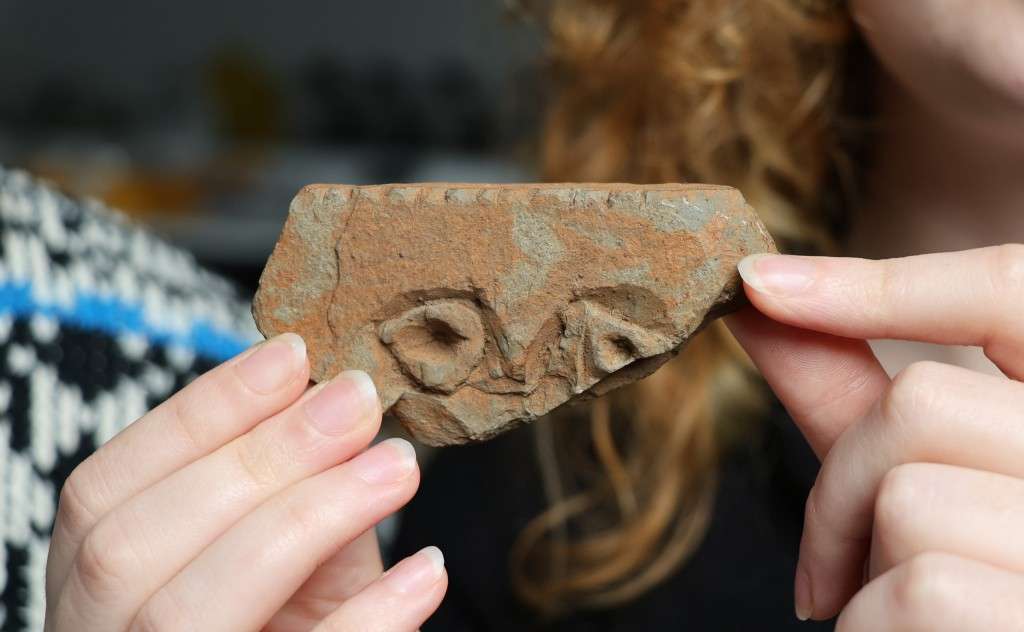
An archaeology student from the University of Aberdeen came face-to-face with Scotland’s past when she unearthed an incredibly rare, carved depiction of what may be a human face. Jodie Allan was a volunteer on a dig at East Lomond in Fife, led by Professor Gordon Noble and Joe Fitzpatrick of the Falkland Stewardship Trust, when she spotted what she initially thought was a piece of slag while sieving soil excavated from an early medieval building identified at the major hillfort.
But on closer inspection it turned out to be an incredibly rare schematic carving which experts say could be the face of a Pict.
Pictish kingdom
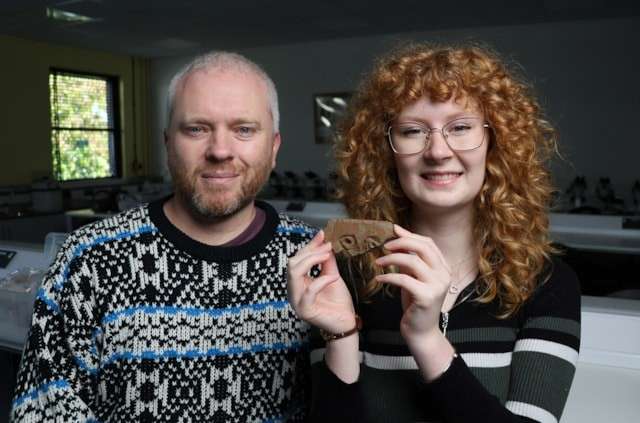
Professor Noble, from the University of Aberdeen, has been co-leading excavation work with the Trust at the site near the Falkland Estate for the last four years. The hillfort and surrounding settlement are located in what is thought to have been the southernmost part of the Pictish kingdom, which ruled a large part of what became Scotland. This major hillfort and settlement has been the focus of a joint university and community project run by the Falkland Stewardship Trust and the University of Aberdeen from 2022 onwards, building on earlier Heritage Lottery funded excavations.
Digs at the site bring together community volunteers, students and University experts for excavation work. Previous work has unearthed Roman imports such as Oxfordshire Ware pottery and E ware from northern France – a continental style of pottery used to hold exotic foodstuffs or dyes – usually found at high status sites.
Jodie said: “I had no idea I was holding anything significant. But I took a closer look because of its size and because the colour – a sort of oxidised coppery green – caught my eye. I showed it to Professor Noble who took one look at the stone and his reaction told me it was something special – with what appears to be a carved face on it.”
Incredibly rare
Professor Noble said the find adds to the growing body of evidence that East Lomond was an important Pictish settlement and added: “This is an early schematic carving with two eyes, a nose and what appears to be a hairline at the top. We need to get this fully analysed but it appears to be a carving of a face, and resembles some of the human faces you see in early medieval manuscripts. It is incredibly rare to have a representation of a human face in this time period. We’ll have to look at all the parallels, but if it really is a human face it’s nice to think it could be a rudimentary portrait of a local Picts who lived at East Lomond. The building we found appears to be from the final phase of activity in the annexe settlement which would place it in the 5th-7th century phases. The discovery could offer new insights into how Picts understood themselves and represented their own identities through crafting and stone carving. The face suggests that Pictish people here were making more expedient carvings, perhaps something for family members living at the site rather than public display like the more famous Pictish symbol stones. East Lomond is turning out to be such an amazing site. In addition to the face we found a complete mattock head, an iron tool from the floor of a building right next to the building with the carving, and from other parts of the site fragments of weaponry and other rare objects are beginning to illuminate the development of this settlement from the late Roman Iron Age through to around the 7th century AD.”
The archaeologists will now work to make sense of the face through radiocarbon dating of the floor layers and settlement deposits associated with the building and examination of other art historical parallels to understand more about the character and context of the small carved stone object.
Support the Scottish Banner! To donate to assist with production of our publication and website visit: The Scottish Banner