
East Linton is an East Lothian village with a certain old-world appeal; picturesque cottages and town houses with distinctive orange-red pantiles, quiet corners, narrow wynds and open green spaces. It must be a great place to live; just off the A1, good local bus services and a new railway station which opened in 2023. It even has a small bookshop! But what really makes it stand out is a sense of history, both within the village and in its immediate surroundings.
I suspect that many people have visited East Linton without quite knowing it, for its visitor attractions tend to be very much on the periphery (unless, like me, you view bookshops as visitor attractions in themselves). There is one relatively recent tourist draw, though, that runs right through the village. The John Muir Way (JMW) is an increasingly popular long-distance walking trail that runs right across the waist of Scotland, from Helensburgh in the west to Dunbar in the east.
Dunbar is the usual starting-point as it was the birthplace and childhood home of the man it commemorates, the John Muir who emigrated to America and became a nature writer and early pioneer of conservation. If you’re walking east-to-west (towards the sunset), East Linton is the first refuelling stop after Dunbar. Just about the only thing the humdrum commuter village near Glasgow where I live has in common with East Linton is that the JMW goes through both!
Preston Mill
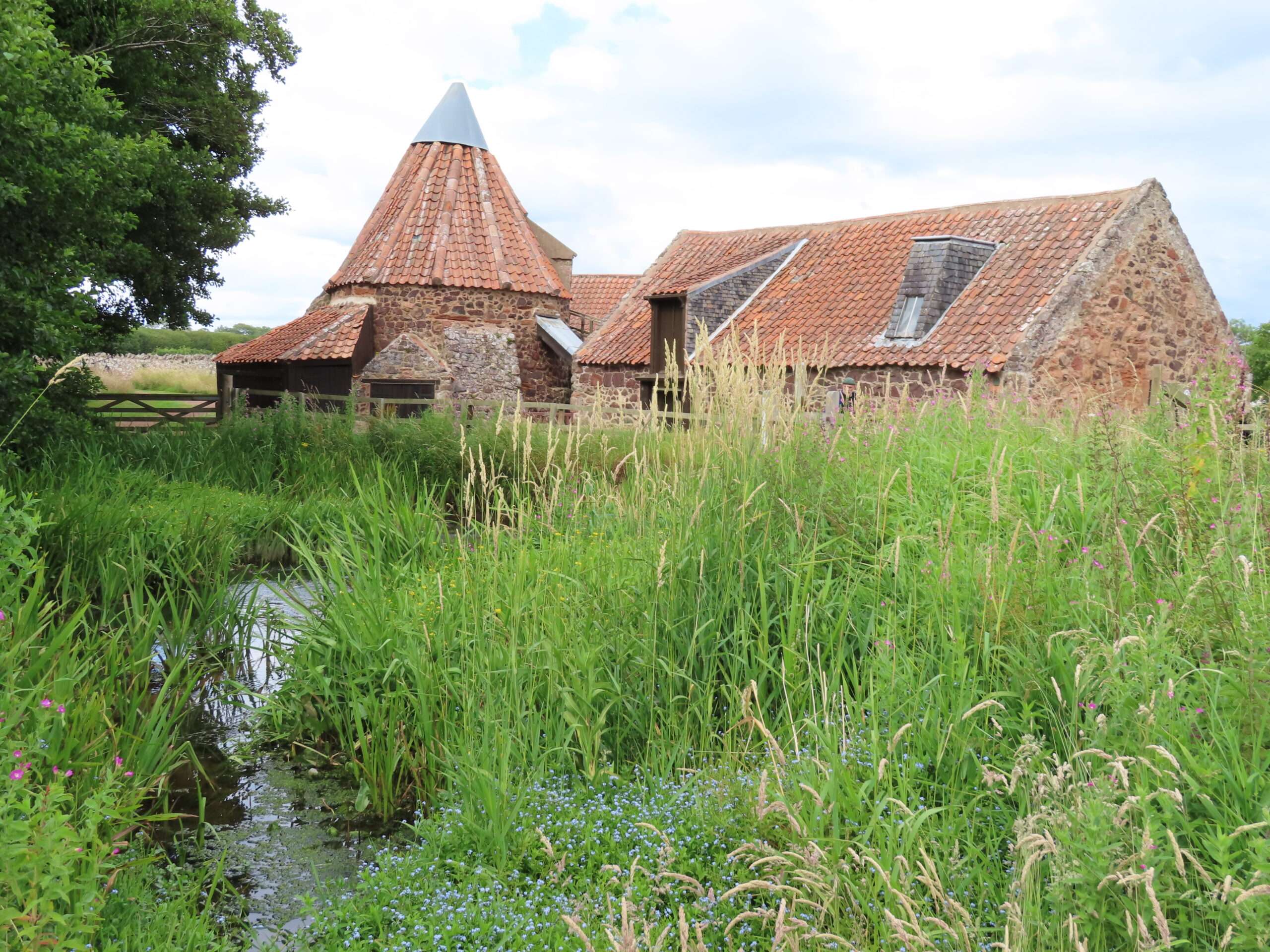
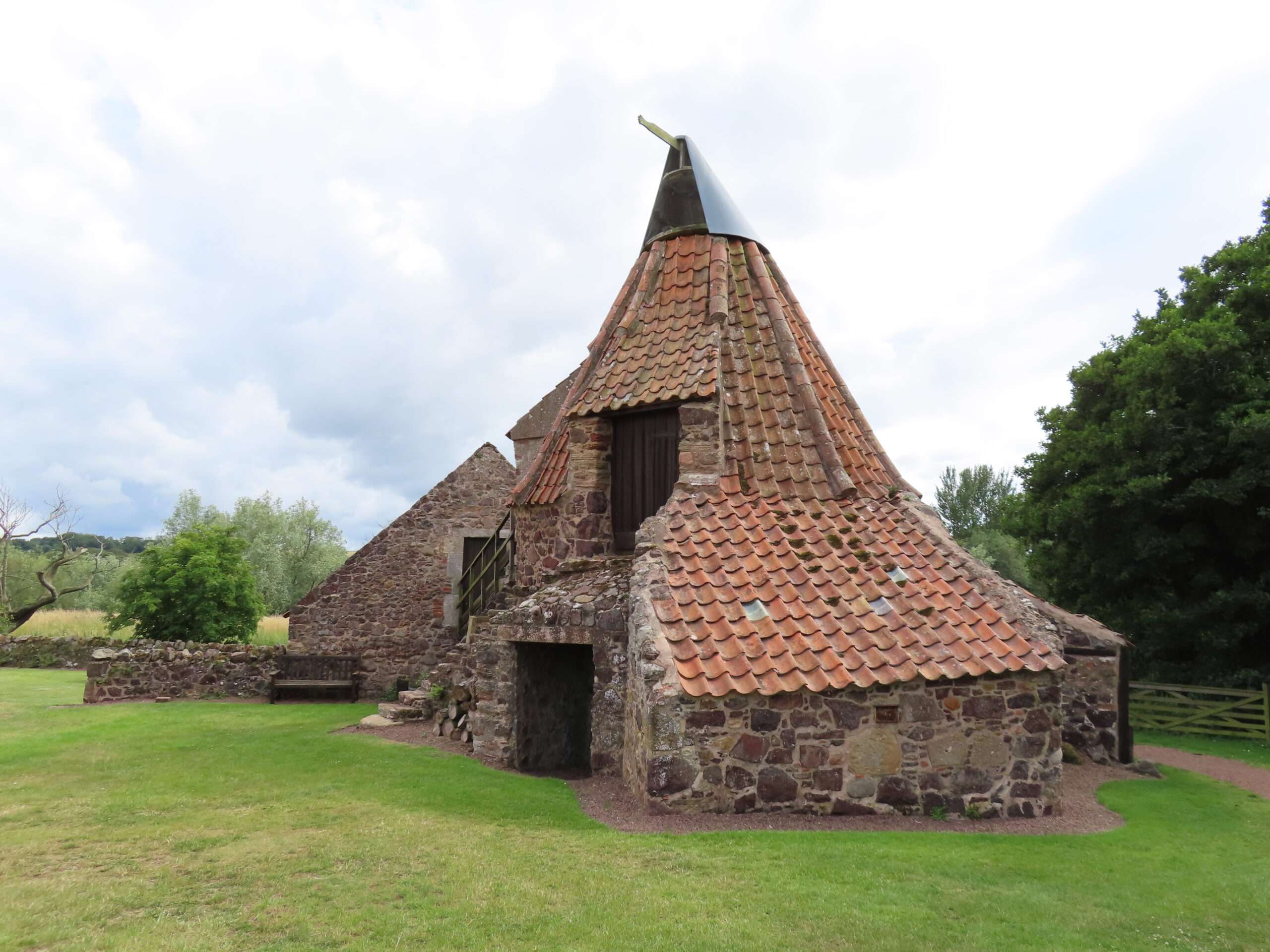
Perhaps the best-known local feature is Preston Mill. It sits by the River Tyne (a different, smaller river than the English one that runs through Newcastle) just north-east of the village and is run by the National Trust for Scotland (NTS); the JMW, following the Tyne, runs right by.
There’s been a mill on the site since the 1500s but the current buildings date from the 1700s. The mill operated commercially until 1959, but the buildings were restored to working order when the Trust took over in the 1960s. The buildings often feature on Scottish calendars, perhaps because of the eye-catching conical structure in the distinctive East Lothian pantiles. This is actually the kiln, where the grain – usually oats – was dried before milling. Visitors from Kent will spot the resemblance to their famous Oast Houses (unique agricultural buildings), which were, after all, designed for a similar purpose, drying hops. You can also see the mill pond, the wheel which powers the mill and there’s an informative display in the visitor centre.
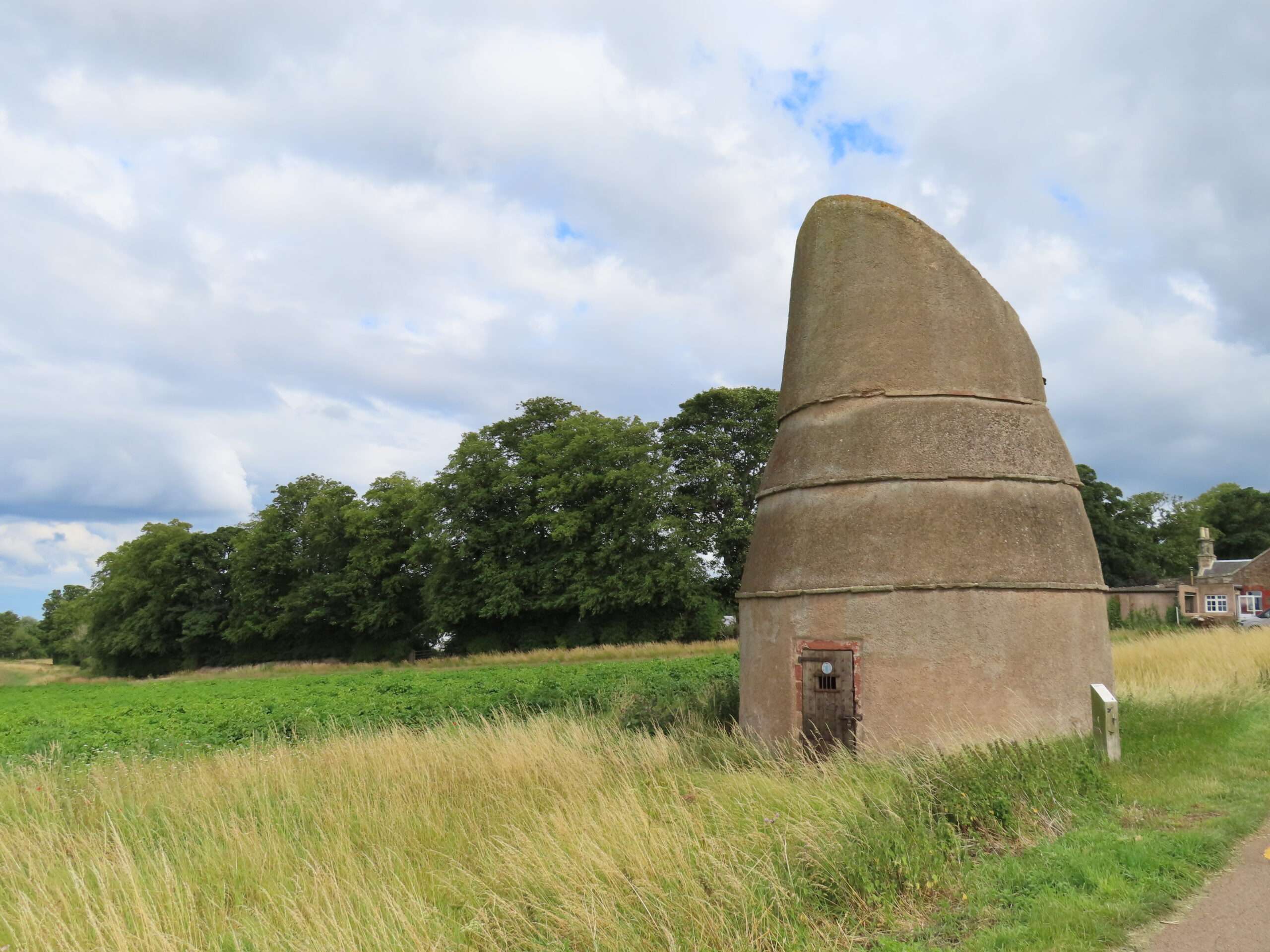
It’s an amazingly green, peaceful and scenic location for what is, after all, an industrial site. Various paths (including the JMW) offer pleasant, easy walking nearby but the most popular runs around 500m to Phantassie Doocot, an astonishing 16th century survival that is also preserved by the NTS. Shaped like a gigantic beehive, this dovecot is thought to have housed around 500 pigeons which were used as a cheap and convenient source of meat. The dovecot is not managed for this now, but apparently local pigeons do nest there, happy that they won’t end up as dinner; not for humans, anyway.
The remarkable and exotic name is supposed to be derived from the Gaelic fàn taise which means, unremarkably and very much not exotic, ‘damp slope’! The legendary Scottish engineer John Rennie was born at nearby Phantassie Farm so presumably was raised partly on pigeon-meat from the doocot.
You won’t be in East Linton long before you notice the frequent express trains hammering past on the East Coast Main Line. The railway arrived in the village in 1846 and enabled East Linton to become a centre of agricultural trade with an impressive hexagonal building being provided as a venue for auctions. The Mart, as it became known, continued in this role until the 1960s when the original East Linton Station closed. However, in recent years it has been repurposed as a community venue with shops, places to eat and event spaces. A Sunday market is also held there. The new East Linton Station is nearby and brings central Edinburgh within around twenty minutes of the village.
History doesn’t stop
The history doesn’t stop. Just upstream from the village, on the banks of the Tyne is Hailes Castle. Based around a 13th century tower with later additions, the castle is associated with the Hepburn family, but has been in ruins since the 17th century. It’s cared for by Historic Environment Scotland (HES) and is normally open to the public However, HES has been conducting a programme of safety surveys on its properties. At the time of my visit, it was Hailes’ turn and it was closed, so if you want to visit, check HES’s website in advance.
A couple of miles south of East Linton is Traprain Law, a northern outlier of the Lammermuir Hills, which reaches 221m/725ft. That isn’t high, even by the standards of the Lammermuirs, but it’s a short, sharp climb on steep paths, and the views to the Forth over East Lothian are astonishing. A really active walker could walk from East Linton to the summit of Traprain Law by way of Hailes Castle using footpaths and quiet roads. Even if you just start from the car park at the foot of the hill, stick to the path; the slopes on the south (crags) and east (quarrying) should be avoided. However, Traprain Law isn’t just about walking and the outdoors. Here’s where The History Village moves into prehistory.
Traprain Law has a number of archaeological features and may have been an occupied site from the Bronze Age until Roman times. The later dwellers seem to have come to some arrangement with the Romans, co-existing and trading with them. In 2019 the Traprain Hoard, a cache of Roman silver, was found there. You can see it at the National Museum of Scotland in Edinburgh.
If you have travelled between Edinburgh and London by train you have probably sped through East Linton at 100mph. Or you may have driven past on the A1, in neither case giving it a second thought. It’s worth slowing down, though, and taking time to explore in and around ‘The History Village’.
Text and photos by David McVey.
Support the Scottish Banner! To donate to assist with production of our publication and website visit: The Scottish Banner